

When China began its rise in the electric vehicle (EV) sector, it stood at a critical crossroads. The domestic market was dominated not by high-tech, high-performance electric cars, but by low-speed, low-quality vehicles—locally known as laotoule. These were inexpensive, basic, and ubiquitous in smaller cities. China faced two strategic choices. It could close its market, shield its domestic producers from global competition, and preserve a vast consumer base through protectionist policies—much like several countries have historically done.
Or it could choose the second, far more challenging path: open its market wider, invite the world’s most advanced EV companies into China, and expose local firms to direct, intense competition.
China chose the second path.
This decision—bold, counterintuitive, and politically risky—ignited one of the most rapid industrial transformations in modern economic history.

Phasing Out the Old: Regulation as a Catalyst for Industrial Renewal
By the late 2010s, low-speed EVs accounted for millions of units on the road, but they offered limited safety, range, or technology. Their prevalence helped early electrification but threatened to trap the industry in a low-tech equilibrium.
To break the cycle, China implemented a series of regulatory shifts:
- New mandatory safety standards for braking, lithium battery safety, and chassis durability
- Higher performance thresholds for range, efficiency, and crash resistance
- A national push for intelligent driving capabilities
- Elimination of subsidies for low-speed EVs (which peaked around ¥120 billion Yuan total for EV subsidies from 2009 to 2022)
The results were dramatic:
- Hundreds of low-speed EV manufacturers exited the market.
- Non-compliant vehicles were removed from production catalogs.
- Consumer expectations shifted toward safer, larger, technologically sophisticated cars.
Regulation cleared the field. But regulation alone cannot create innovation. The true transformation came from competition.
Opening the Door to Tesla: A Radical Break from Industrial Convention
In 2018, Beijing made a historic decision: allow Tesla to build a fully foreign-owned automobile factory in China, something never before permitted in the auto sector.
The project became:
- China’s first wholly foreign-owned auto plant
- The fastest-built automotive factory in history (completed in 10 months)
- A facility reaching an annual production capacity of over 950,000 vehicles by 2024
- A benchmark for global supply chain efficiency
Most nations, when faced with strategic industries, protect domestic producers. China did the opposite. It invited the world’s strongest EV competitor into the heart of its market.
The message was unequivocal:
“We want the world’s best here—even if ours are not as good yet.”
This decision contradicted decades of industrial policy orthodoxy, which typically advises shielding infant industries until they mature. China instead put its domestic firms under maximum pressure—pressure that would force them to reinvent themselves.
The Tesla Effect: Competition Resets Consumer Expectations
Once production started in Shanghai, Tesla triggered what Chinese analysts call the “catfish effect”—the idea that introducing a powerful competitor stimulates the entire ecosystem.
Tesla set new standards for:
- Software-defined vehicles
- Long-range battery technology
- Autonomous driving systems
- Manufacturing efficiency (Shanghai Gigafactory’s cost per vehicle is among the lowest globally)
Consumers responded immediately:
- In 2019, Tesla sales in China were around 40,000 units.
- By 2023, sales exceeded 600,000, making China Tesla’s largest global market.
- Chinese customers began rejecting low-tech EVs and demanding intelligent cars with advanced driver assistance, seamless connectivity, and high safety.
Two historical forces converged:
- Regulations eliminated low-speed EVs.
- Competition raised consumer expectations dramatically.
This dual transformation forced domestic automakers to evolve—or disappear.
Domestic Automakers Rise: From Laotoule to Global Champions
The arrival of Tesla coincided with a wave of aggressive innovation among Chinese EV manufacturers. Companies that once built budget EVs now invested massively in R&D, design, and intelligent systems.
From 2020 to 2024:
- Chinese automakers increased R&D spending by over 35 percent annually.
- The number of Chinese EV patents doubled.
- More than 80 percent of new models released were high-tech, intelligent EVs.
Brands that emerged or transformed during this period include:
- ZEEKR (premium intelligent EVs backed by Geely)
- Aito (Huawei-backed smart EV line)
- Avatr (Changan/Huawei/CATL collaboration)
- Yangwang (BYD’s ultra-luxury performance brand)
- Xpeng, NIO, Li Auto—leaders in autonomous driving and smart cockpit technologies
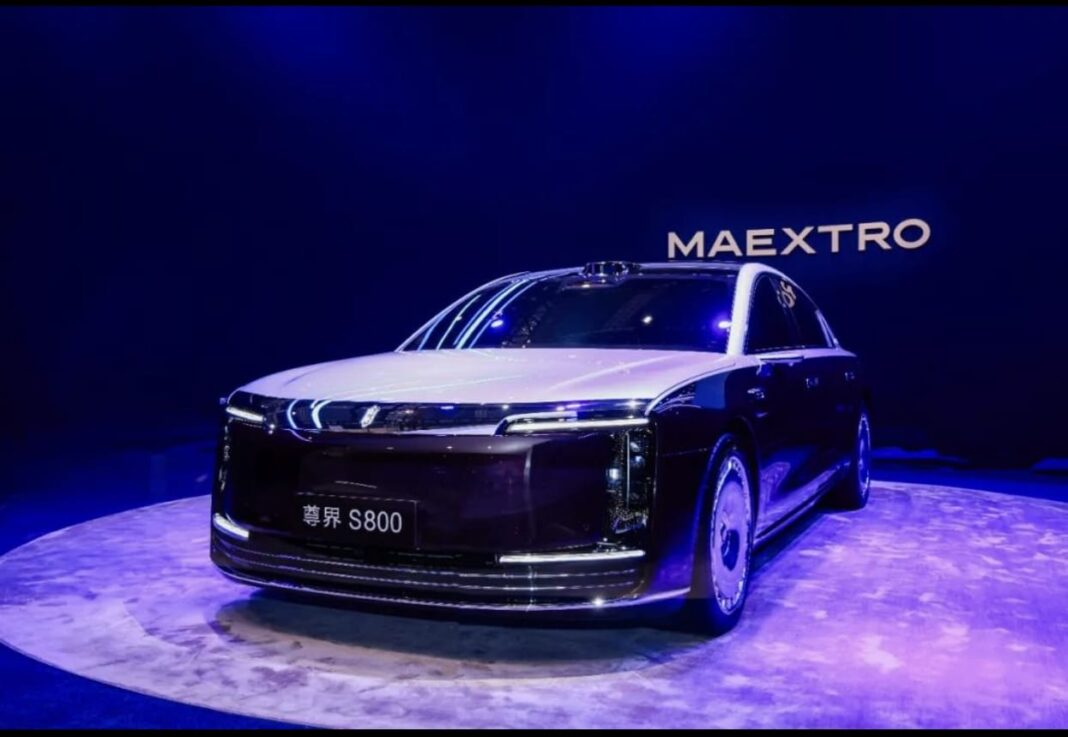
- Zunjie S800, symbolizing China’s highest-end intelligent EV tier
The transformation was not incremental—it was exponential.
A comparison between a 2017 mini EV and a 2024 premium Chinese intelligent EV reveals an industry that has reinvented itself from the ground up.
The EV Ecosystem Reinvented: From Batteries to Software
The impact of China’s openness extended far beyond individual companies. It reshaped the entire automotive ecosystem.
China became the world leader in EV batteries
By 2024:
- China produced over 76 percent of the world’s lithium-ion EV batteries.
- CATL and BYD became the two largest battery manufacturers globally.
- Chinese firms dominate production of cathodes, anodes, separators, and electrolytes.
The global EV industry is now structurally dependent on Chinese battery technology.
A supply chain unmatched in completeness
China’s supply chain now covers:
- Advanced materials
- Motors and power electronics
- Inverters and sensors
- Lidar and autonomous driving chips
- Integrated software ecosystems
The result:
China can build an EV 30–40 percent cheaper than Europe or the US, even with comparable or superior performance.
Rapid consumer adoption—fueled by innovation
China is now the world’s largest EV market:
- 2023 EV sales: 8 million units
- 2024 projected EV share: over 40 percent of all new car sales
- EV penetration in top tier cities reaches 50–70 percent
This is innovation-driven adoption—not subsidy-driven.
China becomes the world’s largest auto exporter
In 2023:
- China exported 5.22 million vehicles, surpassing Japan.
- Of these, 1.2 million were EVs—the highest number in global history.
This export boom is built on competitiveness, not protectionism.
The Strategic Logic: Why Openness Worked
China’s EV strategy succeeded because openness created several reinforcing effects:
- Benchmark Pressure: Tesla forced Chinese firms to match global best practices.
- Technology Transfer by Osmosis: Domestic firms learned from competition, not compulsory transfer.
- Consumer Education: Tesla educated the market about what a premium EV should be.
- Ecosystem Upgrading: Suppliers aligned to meet higher standards across the board.
- Cost Efficiency: Scale and competition drove dramatic cost reductions.
Far from undermining domestic industry, competition pushed it into global leadership.
What Europe Can Learn: Openness as a Driver of Industrial Strength
Europe today faces deep concern about Chinese EV competitiveness. Yet China’s experience offers several lessons that Europe may find uncomfortable—but crucial.

The Strategic Cost of Europe’s Economic Policy Choices
At this critical moment, Europe’s economic policy decisions carry long-term consequences far beyond the automotive sector. A growing reliance on defensive instruments—tariffs, anti-subsidy investigations, procurement restrictions, and industrial “fortress” strategies—risks creating unintended structural weaknesses. By prioritizing protection over competitiveness, Europe may inadvertently deepen its productivity gap with global innovators. When political energies are spent on shielding legacy industries rather than upgrading them, investment flows slow down, supply chains lose dynamism, and technological renewal becomes fragmented. The result is a continent that appears stable in the short term but risks entrenching a long-term competitiveness crisis. If Europe continues down this path, it may face smaller markets, reduced consumer choice, slower innovation cycles, and ultimately a loss of global relevance in future-defining industries such as electric mobility, AI, batteries, and renewable energy technologies. Economic history shows that once a market falls behind in scale and innovation tempo, catching up can take decades—or prove impossible. Europe’s strategic dilemma is therefore urgent: pursue protection and risk permanent stagnation, or embrace competition and accelerate modernization.
Europe’s challenge is not a lack of technology, but a lack of speed.
European automakers are technologically strong—arguably stronger than Chinese firms in some areas.
But they are slower in:
- Digital transformation
- Product iteration
- Software integration
- Autonomous driving deployment
- Battery cost breakthroughs
Competition accelerates all these processes.
Protectionism offers short-term comfort but long-term decline.
A protected market reduces pressure to innovate.
China once protected its automakers—and they fell behind.
Competition forced their renewal.
Chinese companies could be Europe’s “Tesla effect.”
Just as Tesla triggered China’s transformation, Chinese EVs could push Europe to:
- Accelerate its electrification timelines
- Invest more heavily in software-defined vehicles
- Rationalize supply chains
- Reduce costs
- Innovate at greater speed
The real test is competitiveness, not insulation.
Europe’s goal should not be to “keep Chinese EVs out,” but to make European EVs good enough that consumers prefer them.
Building walls slows progress.
Competing against the strongest accelerates it.
Why China’s Strategy Matters Globally
China’s EV transformation is more than a national success story. It has reshaped global climate goals, energy security, and industrial competitiveness.
Global decarbonization accelerated
Since 2021, Chinese renewables and EV products helped other countries reduce an estimated 4.1 billion tonnes of CO₂ emissions.
EV affordability increased worldwide
Chinese competition has lowered global EV prices.
A 2024 BloombergNEF report notes a 40 percent decline in battery pack prices, driven primarily by Chinese production scale.
More diverse supply chains
Global automakers now rely on Chinese partnerships for:
- LFP batteries
- Sodium-ion batteries
- Energy storage systems
- Sustainable material recycling
Faster innovation cycles
China has established the fastest product cycle in the world:
- New energy vehicle models refresh every 12–18 months
- Over-the-air software updates occur monthly or weekly
- Driving assistance systems improve continuously
The global industry cannot ignore this pace.
The Power of Choosing Openness
China’s EV revolution is often explained through investment scale, policy support, or manufacturing strength. These are all factors—but they are not the decisive factor.
The real turning point was strategic courage:
China chose openness over protectionism.
By letting Tesla operate freely, raising domestic standards, and trusting competition to drive innovation, China transformed its EV industry from low-speed laotoule vehicles into some of the world’s most advanced intelligent cars.
It is a lesson with global relevance:
- Competitiveness grows from pressure, not protection.
- Innovation accelerates through exposure to the world’s best.
- Industrial strength is earned, not sheltered.
China chose the second path—and in doing so, reshaped not only its automotive industry, but the global future of mobility.