
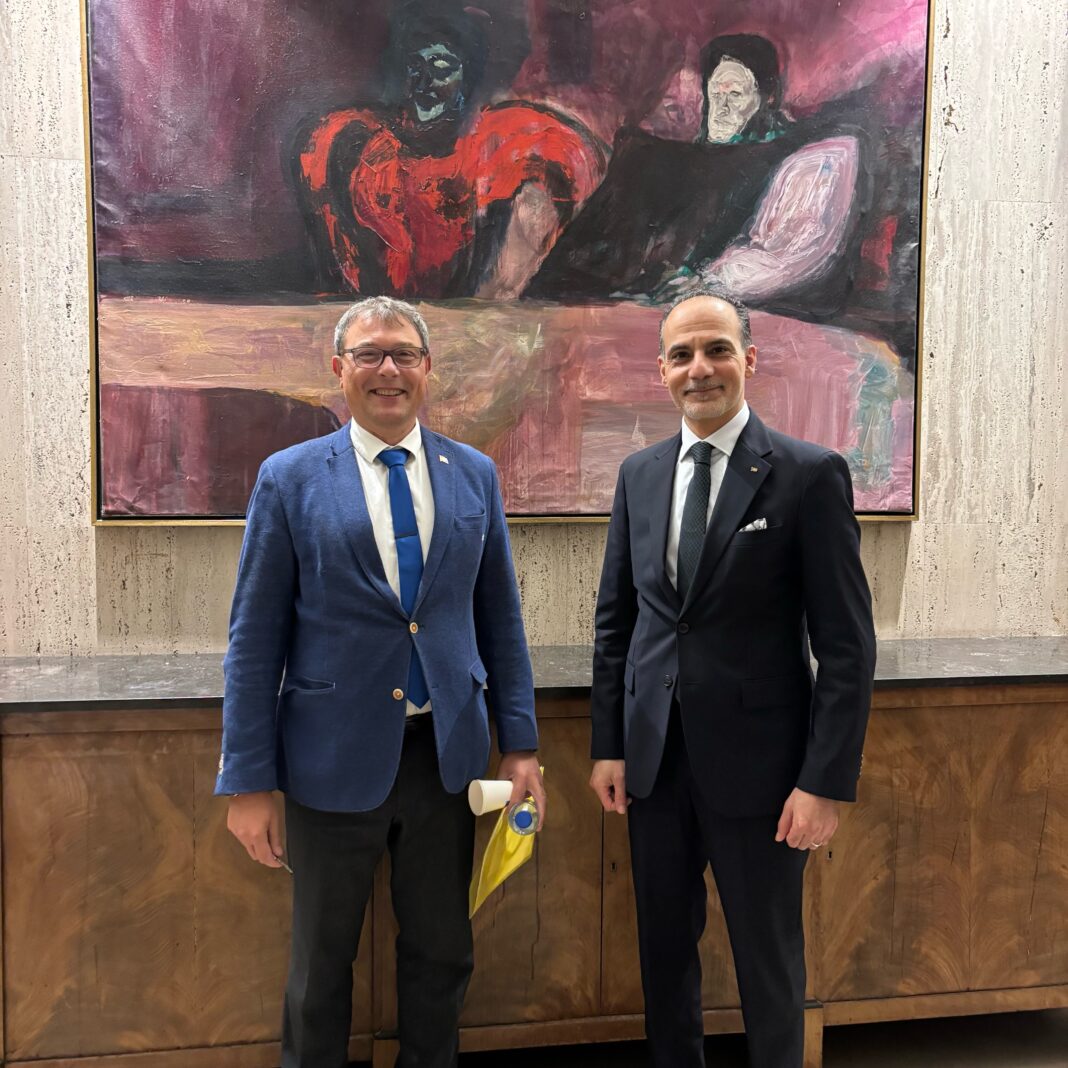

By students Gaia Ziliani, Matys Javier Perez Bivar, Ourania Vasileiadou.
On 30 October 2025, H.E. Ammar Hijazi, Head of the Palestinian Mission to the Kingdom of the Netherlands, delivered a lecture organised under the Maastricht Centre for Human Rights at the Faculty of Law of Maastricht University, titled ‘Charting the State of Palestine’s Legal and Diplomatic Efforts for Self-Determination’.
The event took place within The Ambassador Lecture Series, convened by Professor Fabián Raimondo at the Faculty of Law. The series regularly brings distinguished diplomats to Maastricht University to engage with students and staff on contemporary global issues.
Welcomed by faculty members and students, Ambassador Hijazi opened with a reflection on the enduring challenge that the question of Palestine poses to international law. The session quickly evolved into a lively dialogue, with students expressing strong interest and posing incisive questions.
Law, legality and the Palestinian claim
Ambassador Hijazi underscored the importance of respecting and applying international law, warning against the widening gap between legality and illegality. ‘Legality has not been defeated,’ he observed, ‘even if the feeling may be justified by current events. After all, Palestine’s claim is straightforward: to make the law prevail. Because if not, then what else?’
He also shared insights into his daily diplomatic responsibilities – engaging with Dutch authorities, parliamentarians, municipalities and international institutions. Despite growing public sympathy, he noted that European governments remain hesitant to act decisively or cut ties with Israel.

Charting Palestinian diplomatic and legal efforts
Setting out Palestine’s legal and diplomatic strategy, Ambassador Hijazi reflected on historical injustices which, he argued, trace back to debates at the United Nations in 1947, where diplomacy and international law were, in his view, used to erase Palestine and the Palestinian people. He added that there have been misleading attempts to equate the occupier with the occupied and to normalise the occupation, allowing Israel, with international impunity, to continue the colonisation of Palestinian land and the ethnic cleansing of the Palestinian people. According to Ambassador Hijazi, in pursuit of justice the Palestinian leadership adopted diplomacy and international law – the same instruments he considers were historically used against Palestinians – to reassert their place on the global stage.
The Palestinian approach, he said, aimed to challenge what he described as Israel’s entrenched illegal colonial regime of occupation and apartheid. In light of what he characterised as genocide and ongoing dispossession, he argued that this approach has enabled the pursuit of justice and accountability.
Despite political pressure, threats and sanctions, Palestine, he maintained, has insisted on its chosen path and its commitment to international law. Such efforts, he said, culminated in landmark decisions of the International Court of Justice on 9 July 2004, 19 July 2024 and 22 October 2025. The original objective, he noted, was to protect Palestinian rights and to ensure Palestine’s place in a law-based international system; today, he argued, the undertaking also seeks to protect the integrity of the post-Second World War legal order of human rights and international law.
A test case for international law
For the Ambassador, Palestine has become a test case for international law and for the credibility of the International Court of Justice. The recent tragic events, he stressed, confront the West with a fundamental question: is the commitment to the legal order it created stronger than geopolitical instinct? ‘We cannot defend the law in theory while financing its violations in practice,’ he said, adding that, by addressing Palestine, the Court has ‘placed the issue under the eyes of the world and opened a path for hope’.
Humanitarian law and the weaponisation of hunger
Ambassador Hijazi highlighted the severe humanitarian consequences of ongoing violations of international humanitarian law, focusing in particular on the weaponisation of hunger. He referred to the Court’s advisory opinion of 22 October 2025, which, he noted, unanimously affirmed Israel’s obligations under international humanitarian law, including the prohibition of starvation of civilians as a method of warfare.
A call for justice and legality
Concluding his lecture, the Ambassador reaffirmed that, while the struggle is far from over, the path to lasting peace remains clear: ending the occupation through a historic ruling of the Court and a United Nations resolution, and recognising Palestine’s right to self-determination and statehood. He called on the international community to stand up for Palestine, for international justice and for the rule of law, reminding all that we owe it to future generations to ensure that legality prevails – and that every step in that direction matters.
For inquiries about The Ambassador Lecture Series, please contact the convener, Professor Fabián Raimondo, at fabian.raimondo@maastrichtuniversity.nl.