

Every December 30, Filipinos across the nation and around the world come together to commemorate Rizal Day, honoring the life, works, and martyrdom of Dr. José Rizal. The 129th commemoration of Rizal Day marks more than a historical milestone—it reaffirms the continuing relevance of Rizal’s ideals in shaping Filipino identity, nationalism, and civic responsibility.
Rizal Day commemorates the execution of Dr. José Rizal on December 30, 1896, at Bagumbayan (now Luneta Park). His death at the hands of Spanish colonial authorities transformed him from a reformist intellectual into a symbol of peaceful resistance and national awakening. Through his novels Noli Me Tangere and El Filibusterismo, Rizal exposed social injustices and abuses, inspiring Filipinos to reflect on freedom, dignity, and the value of education.
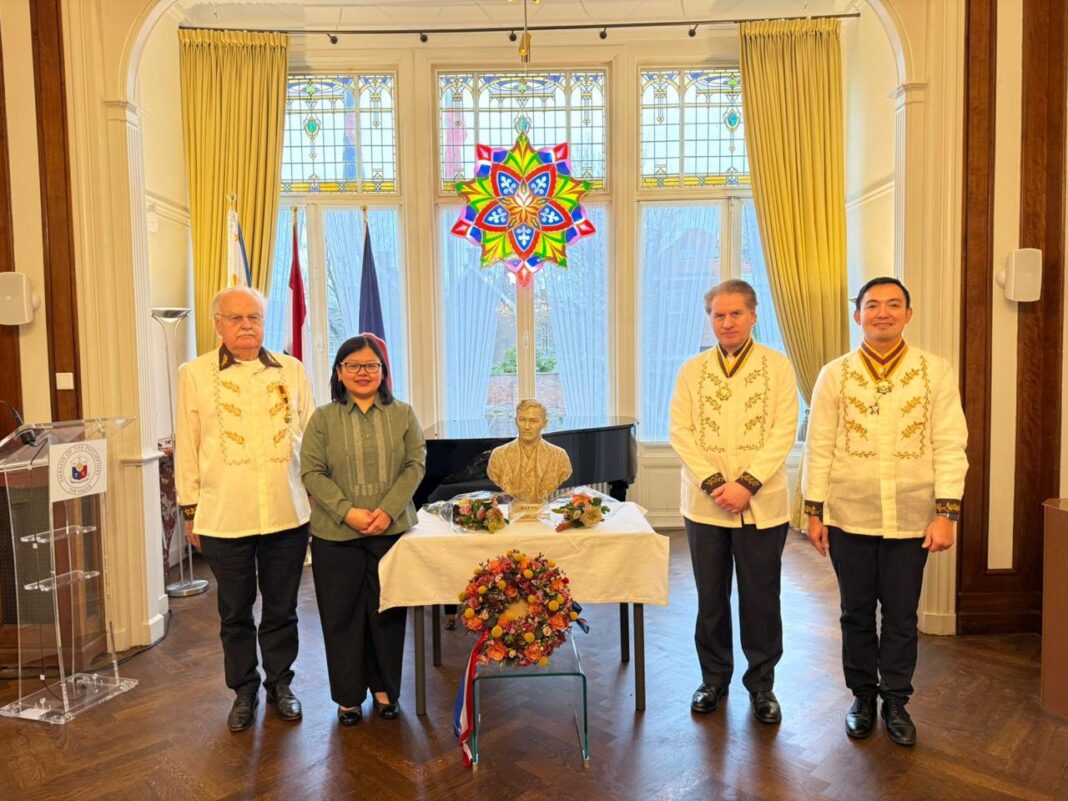
The 129th commemoration at the Philippine Embassy in The Hague was observed through a wreath-laying ceremony, speeches, and the recitation of the poem Mi Último Adiós.

Sir Anton Lutter, KCR, Chapter Commander and founder of The Hague Chapter of the Knights of Rizal—the first chapter of this Philippine order of chivalry in the Netherlands—delivered his annual address. He stated:
“My remarks this year are about the term Noli Me Tangere. I was inspired by it because of the current exhibition at the Mauritshuis. The exhibition focuses on the Grand Tour—the journey undertaken by young Britons of good background after their studies between the 17th and 19th centuries to visit classical sites in Italy. The exhibition includes a large religious painting titled Noli Me Tangere. When we hear that term, we immediately think of Rizal’s great work published in 1887.
However, Noli Me Tangere originates from the Bible. How does this relate to José Rizal? The biblical story concerns the Resurrection. Mary Magdalene visits the tomb and finds it empty. She then sees a man she believes to be the gardener and reaches out to Him. Jesus stops her and says, ‘Noli me tangere’—‘Touch me not.’
He was in a liminal phase, between the grave and glory. He was sacred, and to hold Him would have stopped His mission. He had to ascend to the Father.
We know that José Rizal was familiar with this story. In 1887, he wrote about it to his friend Félix Hidalgo. And as we know, Rizal had his own mission.
‘Touch me not’ also has a medical meaning. For centuries, doctors used this phrase, and in the 19th century it referred to a diagnosis of facial cancer, specifically of the eyelids or nose. José Rizal himself was an eye doctor. In his book, he used the phrase to describe a social cancer.
Rizal combined these two worlds. He dedicated his book Noli Me Tangere ‘To My Country.’ He told the Philippines: you have a social cancer, so malignant that the slightest touch causes pain.
Rizal assumed the role of a surgeon. The Spanish friars were the bad doctors. They said: do not touch the system, do not criticize the Church. They claimed they were ‘sacred,’ like the Risen Christ. But Rizal disagreed. He said they were not sacred—they were a disease. Unlike the doctors of his time, he decided to operate. He chose to touch the cancer. He knew it would cause pain. He knew it might be fatal for him—and of course it was. He was executed. But he did it anyway. He exposed the sore on the steps of the temple.
Rizal wrote Noli Me Tangere in 1887. It was the first major resistance of its kind in Asia. That was over a century ago. But look around—the cancer has not disappeared; it has metastasized.
Rizal made a choice. He chose to touch the untouchable. He used the pen as a scalpel.
Today, we face the same choice. We have our own cancers in society. The instinct is to look away, to say ‘do not touch.’ Silence feels safer. But the ‘Noli’ is not a prohibition for us—it is a challenge from José Rizal to all of us.”
Following the speech, Sir Chris Sta. Brigida Kopp, KCR, Chapter Commander of Amsterdam, recited Mi Último Adiós (“My Last Farewell”), written by José Rizal while in prison shortly before his execution by firing squad on December 30, 1896.
The highlight of the commemoration was the solemn wreath-laying ceremony led by First Secretary and Consul Irish Kay Kalaw-Ado; Sir Anton Lutter, KCR; Sir Chris Sta. Brigida Kopp, KCR; and Sir Eppo Horlings, Deputy Commander of the Knights of Rizal in The Hague and Philippine Consul General ad honorem. The ceremony was attended by members of the Knights of Rizal, embassy personnel, and members of the Philippine community.
José Rizal’s teachings are as important today as ever. In a rapidly changing world marked by technological advancement, social challenges, and global uncertainty, his message remains deeply relevant. He believed that education is the foundation of national progress, that love of country must be guided by reason and compassion, and that true freedom begins with moral courage. The 129th Rizal Day commemoration emphasized these principles, encouraging Filipinos to practice critical thinking, respect for human rights, and active participation in nation-building.
Rizal’s heroism was not defined by violence, but by intellect, integrity, and an unwavering commitment to truth. As the nation reflects on 129 years since his martyrdom, Rizal Day serves as a reminder that patriotism can be expressed through everyday actions—serving others, standing against injustice, and striving for excellence in one’s field.
The 129th commemoration of Rizal Day is not merely a remembrance of the past, but a call to action for the present and the future. By living out Rizal’s ideals, Filipinos honor his legacy and contribute to the kind of nation he envisioned: educated, just, and free.