
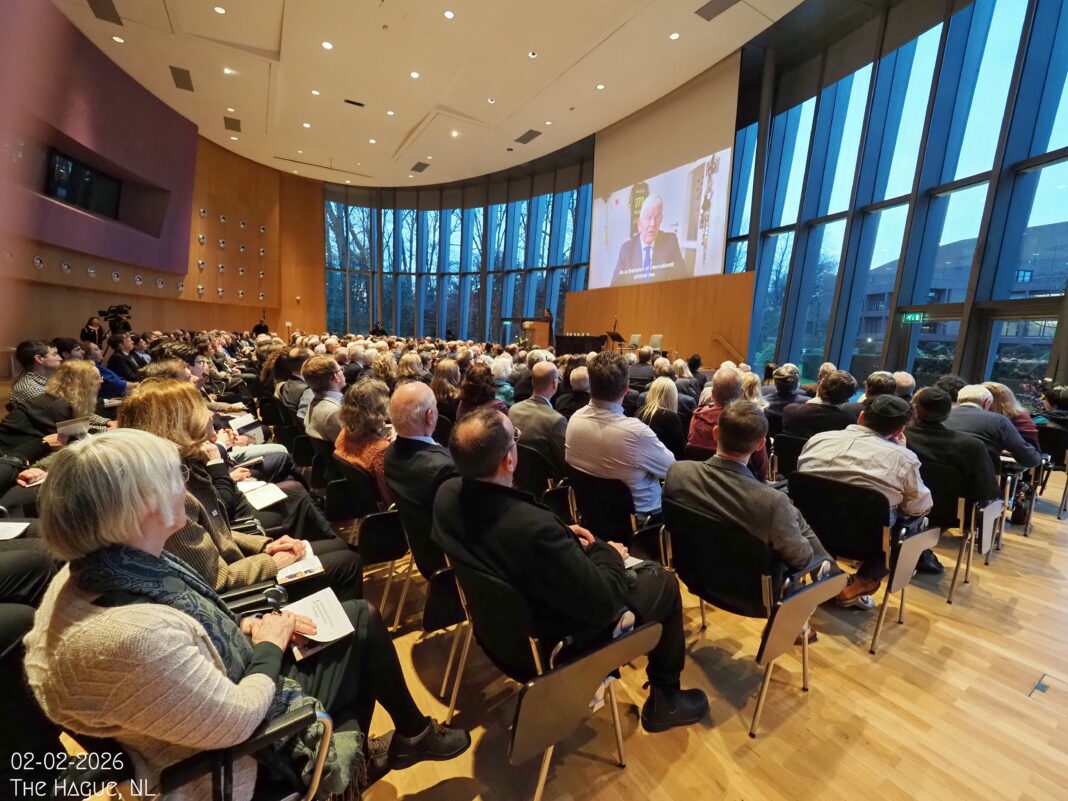

International Holocaust Remembrance Day – The Hague 2026
On Monday, 2 February 2026, the Academy Building of the Peace Palace in The Hague hosted the eighth edition of International Holocaust Remembrance Day – The Hague (IHRD-TH), a high-level diplomatic and judicial commemoration organised by Stichting CHAJ, in collaboration with the Municipality of The Hague and the Embassy of Israel in the Netherlands.
The event brought together approximately 350 guests, including 64 members of the diplomatic corps, cabinet ministers, and senior judges and legal experts from international tribunals. The programme focused on the enduring legal consequences of the Holocaust and the responsibilities of contemporary institutions in safeguarding the rule of law. The gathering once again underlined The Hague’s position as the legal capital of the world.
A Legal Failure with Lasting Consequences

The ceremony was opened by H.E. Zvi Aviner-Vapni, Ambassador of Israel to the Netherlands, who framed the Holocaust not only as a moral catastrophe but as a profound legal failure. He warned that persecution does not begin with violence, but with administrative measures, registration, and the gradual normalisation of exclusion through bureaucratic processes.
Highlighting the danger of institutional silence, the Ambassador noted that discrimination advances when colleagues and authorities look away. He stressed that the rise of antisemitism across Europe today poses renewed challenges to democratic societies and the rule of law, requiring vigilance from legal and political institutions alike.
Judicial Integrity and the Visser Legacy
The keynote address was delivered by Prof. Dr. Dineke de Groot, President of the Supreme Court of the Netherlands. As the first woman to hold this position since the Court’s establishment in 1838, Prof. Dr. de Groot reflected on the historical responsibility of the judiciary under the title “Learning Lessons.”
Her address examined the fate of her predecessor, Mr. L.E. Visser, President of the Supreme Court during the Second World War. She described how his suspension and dismissal following the so-called Aryan Declaration illustrated the gradual nature of legal exclusion, introduced step by step through administrative decisions rather than abrupt legal ruptures.
Prof. Dr. de Groot emphasised that judicial solidarity is indispensable when judges are targeted because of their identity, observing that the absence of such solidarity in 1940 was “sad and chilling.” She connected these historical failures to contemporary standards, pointing to the UN Bangalore Principles as a modern framework for judicial independence, integrity, and public confidence.
Survivor Account and Commemoration

The programme also included the personal account of Dr. Ir. Ronald E. Waterman MSc, who survived deportation as a child to Westerbork and Theresienstadt. His contribution linked historical experience to the present-day responsibilities of the international legal community.
A commemorative moment followed, during which six candles were lit in honour of six professionals who were dismissed from their positions solely for being Jewish, reinforcing the central theme of institutional responsibility.
International Response and Closing Remarks
The international resonance of the event was further reflected in remarks by U.S. Ambassador H.E. Mr. Joe Popolo, who later noted that the rise of Holocaust distortion and denial makes institutional remembrance and legal reflection increasingly urgent.

The ceremony was formally closed by HaDayan Rabbi Shmuel Katzman, representing Stichting CHAJ and the Jewish communities of The Hague. He underlined the lasting contribution of survivors such as Dr. Waterman and their role in reinforcing dignity, responsibility, and ethical leadership across generations.
About Stichting CHAJ
Stichting CHAJ (Center for The Hague Yiddishkeit) is the cultural and educational foundation of the Jewish community in The Hague. Through its annual International Holocaust Remembrance Day programme, the foundation examines the impact of the Holocaust on international law and promotes continued awareness of its legal, historical, and societal implications.
Pictures by International Holocaust Remembrance Day The Hague