
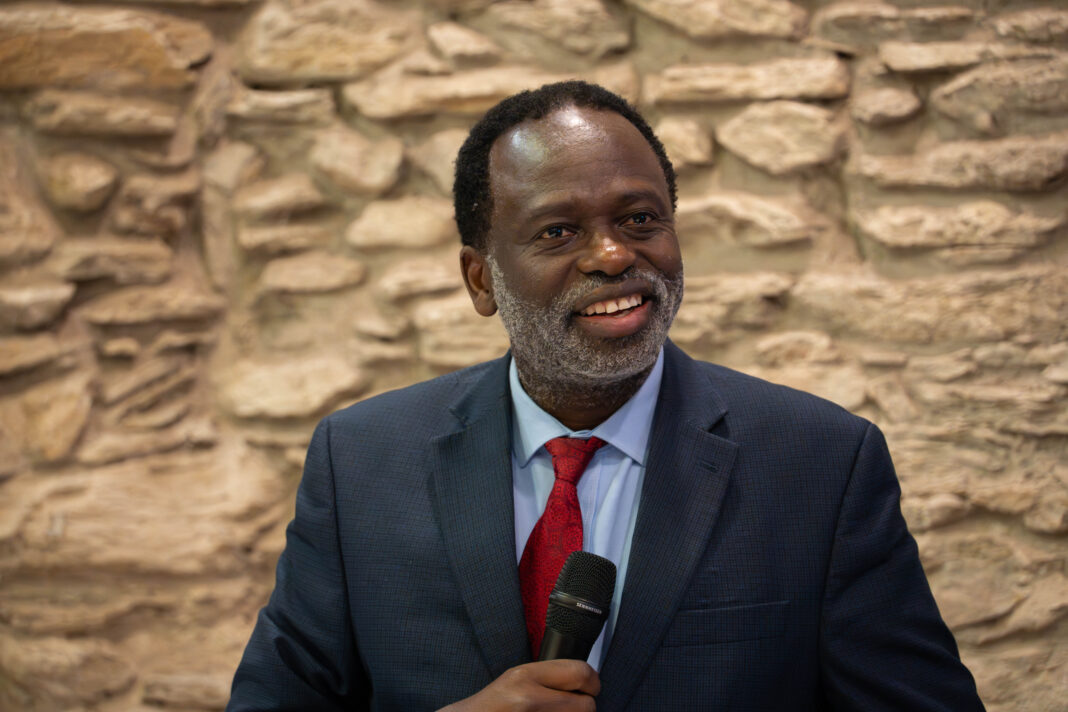

Opening of the 8th UNESCO MOST Winter School
Professor Tshilidzi Marwala, United Nations Under-Secretary-General and Rector of the United Nations University, and Balázs Hankó, Hungary’s Minister of Culture and Innovation, officially opened the 8th UNESCO MOST Winter School on 23 February.
This year’s week-long Winter School unfolded against a backdrop of historic progress: Kőszeg was selected as the site of the first United Nations University institute in the former Eastern Bloc. The new academic centre will be established through a landmark agreement between the Government of Hungary and the United Nations University, in partnership with the Institute of Advanced Studies Kőszeg (iASK). The institute will advance interdisciplinary research into the root causes of conflict, human security, and transformative technologies reshaping societies worldwide.

“We are a small town, but we are thinking big. What we began years ago as a conversation about a future university in Central and Eastern Europe has now become reality. With the United Nations University and our growing network of partners, we are building something that connects this region to a global vision.”
— Professor Ferenc Miszlivetz, Director-General of iASK
This year’s UNESCO MOST Winter School centred on the themes of lasting peace and human security — concepts that framed every panel, keynote and strategic discussion. From geopolitical alternatives and regional cooperation to transformative technologies and digital governance, the programme explored how peace must be understood as an active, long-term process grounded in social resilience, ethical responsibility and interdisciplinary knowledge.

The convergence of this thematic focus with the official establishment of the new UNU institute was no coincidence. Its mission aligns directly with the goals articulated throughout the week: generating policy-relevant knowledge to strengthen multilateral governance and safeguard human dignity in a rapidly transforming world.
In his opening address, Minister Hankó marked the occasion with a clear statement of intent. Hungary, he said, is among the safest countries in the world and intends to remain so through excellence and innovation. The ambition is to place Hungary among the global top ten in innovation by 2030. The new UNU institute will operate at the intersection of peace, human security, science and social transformation, drawing on disciplines often underrepresented in technological debates — including the humanities, social sciences and cultural heritage studies.
“The best way of predicting the future is to shape it. This UNU will generate the knowledge needed to improve multilateral governance and help build a global society capable of meeting its obligations in peace, security and shared prosperity.”
— Professor Tshilidzi Marwala, Rector of the United Nations University and United Nations Under-Secretary-General
The announcement resonated deeply in a room filled with those who have witnessed the idea evolve from conversation to commitment. Ambassador Katalin Bogyay, President of the UNESCO National Commission of Hungary, President of the UN Association of Hungary, and Founder of Women4Diplomacy International, recalled the early discussions she shared with Ferenc Miszlivetz, Jody Jensen and the late Professor Hankiss.
“It is wonderful to see a vision create reality. Kőszeg is the perfect embodiment of what the MOST programme stands for: building bridges between research, policy and social transformation.”
— Ambassador Katalin Bogyay

International partners echoed this sentiment. Xiaomeng Shen, Vice-Rector in Europe and Director of UNU-EHS, highlighted the sustained cooperation that made the institute possible. Philippe De Lombaerde, Director of UNU-CRIS, praised the spirit of Kőszeg and the remarkable institutional development achieved in recent years.
A defining milestone of the Winter School was the reception of the United Nations University and iASK delegation by President Tamás Sulyok at Sándor Palace. During the meeting, Professor Marwala and the President engaged in a forward-looking strategic dialogue on the evolving landscape of artificial intelligence. The discussion focused not only on innovation but also on responsibility — examining how governance systems, ethical standards and multilateral cooperation must evolve alongside emerging technologies. The exchange underscored Hungary’s growing role in shaping global AI governance and reinforced a shared commitment to ensuring that technological advancement serves humanity.

This year’s Winter School demonstrated remarkable international reach. Students from 23 countries participated, bringing diverse academic and cultural perspectives to the dialogue. Panelists and keynote speakers represented 16 countries, reflecting a truly global exchange of ideas spanning Europe and the Balkans to Africa and North America. The breadth of participation reinforced one central message: peace and human security are shared responsibilities that transcend borders.
As the 8th UNESCO MOST Winter School concluded, one message was clear: Kőszeg is not only hosting global dialogue — it is helping to shape global governance. With the establishment of a United Nations University institute in the town, vision has become reality, and the future of peace and human security has gained a permanent institutional home in Hungary.