

By Ayesha Asim
The world feels as if it is living through history in fast-forward. Long-simmering rivalries are boiling over in multiple regions at once. Wars continue in Europe and the Middle East. Great power competition has returned to the Indo-Pacific. What began as rising unease has now edged into direct military confrontation between Iran and Israel, a development that has jolted diplomats, governments and ordinary people across the globe.
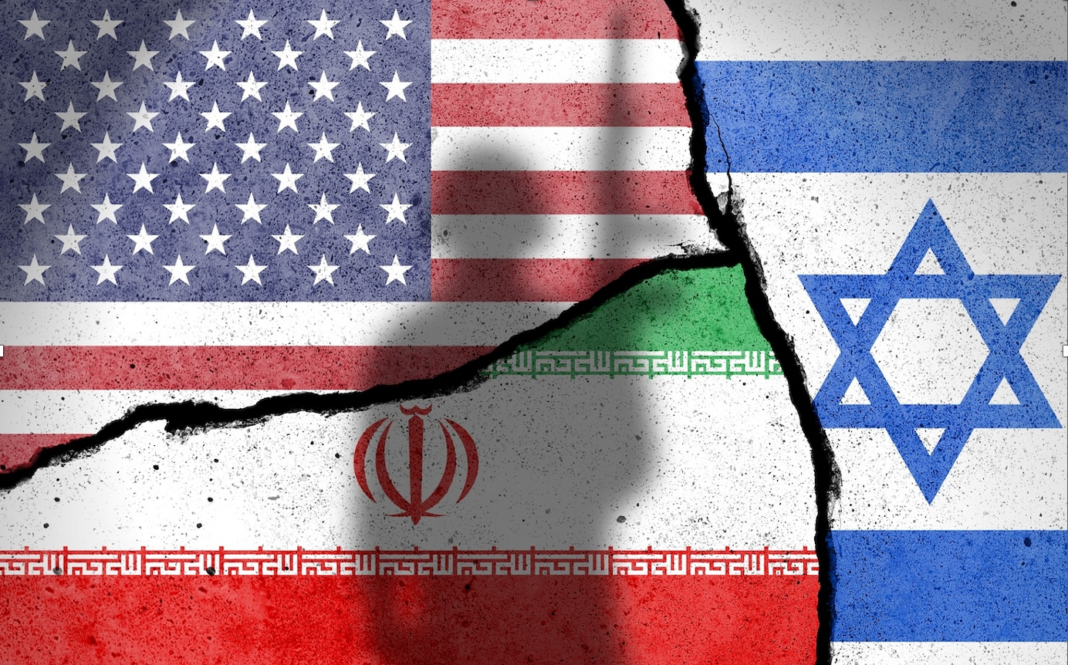
In a dramatic escalation, the United States and Israel launched coordinated air strikes across Iran, targeting military and nuclear-related infrastructure. Explosions were reported in Tehran and other cities. Leaders in Jerusalem and Washington described the operation as pre-emptive, aimed at neutralising what they characterised as an imminent threat to Israeli and regional security. Israel declared a nationwide state of emergency, closed its airspace and instructed civilians to seek shelter.
The strikes mark the most serious direct military clash between Israel and Iran in decades. For years, the two states have been engaged in what analysts often describe as a shadow or proxy war, backing opposing forces in Syria, Lebanon and elsewhere. This latest escalation crosses a threshold. It involves overt, large-scale military action on sovereign Iranian territory, followed by Iranian missile launches targeting Israeli territory and United States positions in the Gulf.
Iranian leaders condemned the strikes as clear violations of international law and breaches of the United Nations Charter. They invoked Article 51 of the Charter, the inherent right of self-defence, to justify retaliatory action. Israeli and American officials relied on the same legal provision to defend their own conduct. The result is a familiar but dangerous legal duel: both sides claiming defensive necessity, both accusing the other of aggression.
Casualty figures and damage assessments remain difficult to verify independently. Iranian state media reported civilian deaths in some of the affected areas. Western officials acknowledged that investigations into collateral damage were underway but rejected claims of deliberate targeting of civilians. In the fog of conflict, information travels fast, and clarity comes slowly. Conflicting narratives are already shaping public opinion far beyond the region.
The escalation has intensified concern among diplomats about the broader direction of the international system. For decades, the post-Second World War order was built around the premise that the use of force would be tightly constrained. The UN Charter prohibits military action against another state except in self-defence or with explicit Security Council authorisation. That framework was designed to prevent the kinds of spiralling conflicts that engulfed the world in the twentieth century.
Yet the credibility of that framework has been under strain for some time. Russia’s invasion of Ukraine exposed the paralysis of the Security Council when a permanent member is itself a party to the conflict. Now, with major military operations unfolding in the Middle East without Council authorisation, critics argue that the rules are being interpreted ever more flexibly by powerful states.
The problem is not simply that wars are occurring. Wars have, tragically, never disappeared. The deeper concern is that adherence to international law appears increasingly selective. States invoke legal norms when they support national interests and reinterpret or sidestep them when they do not. Over time, that pattern risks hollowing out the authority of the system itself.
Still, it would be wrong to conclude that international law is irrelevant. Even amid open hostilities, governments are careful to frame their actions in legal terms. They issue formal notifications to the United Nations. They publish legal justifications. They engage in arguments over proportionality, necessity and distinction. This behaviour suggests that legitimacy still matters. Law remains the language through which power is exercised and contested.
The present moment feels particularly volatile because multiple crises are unfolding simultaneously. In Europe, the war in Ukraine continues to reshape the continent’s security architecture. In the Middle East, the conflict between Israel and Hamas has already destabilised the region, and the confrontation with Iran adds another combustible layer. In the Indo-Pacific, tensions surrounding Taiwan and maritime claims in the South China Sea persist, with military exercises and diplomatic friction on the rise.
None of these theatres has yet coalesced into a single, unified global war. There is no formal mobilisation of opposing global alliances comparable to 1914 or 1939. That distinction is important. However, the risk lies in overlap. Regional wars can intersect. Miscalculations can multiply. An incident at sea, a misidentified missile, or an attack on a third country’s assets could draw additional actors into the fray.
Nuclear deterrence continues to cast a long shadow over strategic decision-making. The catastrophic consequences of confrontation between nuclear-armed states remain a powerful restraint. That reality has, so far, prevented the escalation of proxy or regional conflicts into full-scale great-power war. Yet deterrence is not foolproof. It relies on rational calculation, accurate information and functioning communication channels, all of which can be strained in moments of crisis.
There is also the human dimension, often absent from geopolitical analysis. For families in Tehran listening to air-raid sirens, for Israelis rushing to shelters, for communities already exhausted by years of regional instability, the debate about international law is not abstract. It is about survival. It is about whether the next night will bring more explosions or a fragile ceasefire.
Public discourse, amplified by social media and 24-hour news cycles, can magnify worst-case scenarios. The phrase “Third World War” travels quickly because it captures fear. But fear does not automatically equal inevitability. Diplomacy, though less visible than air strikes, continues behind closed doors. Emergency meetings at the United Nations, regional mediation efforts and quiet back-channel communications are all part of the machinery designed to prevent further escalation.
The credibility of international law will depend on whether states choose to reinforce it during this period of strain. That may involve renewed commitment to accountability mechanisms, clearer standards for the use of force in pre-emptive contexts, or reforms to strengthen multilateral institutions. None of these steps is easy. All require political will that is often in short supply during crises.
Is the world heading towards a third world war? The honest answer is that the risk environment has grown more dangerous, but a global conflagration is not yet a defined or unavoidable reality. What we are witnessing is systemic stress, a period in which power balances are shifting, technological change is complicating deterrence, and trust between major actors is thin.
History shows that global wars are rarely inevitable. They emerge from accumulated misjudgements, rigid positions and failures of communication. The same history also shows that restraint, even at moments of intense rivalry, can prevent catastrophe.
The recent confrontation between Iran and Israel is a stark reminder of how quickly escalation can occur. It underscores the fragility of the current order and the urgent need for diplomacy anchored in credible legal norms. International law cannot stop missiles in flight. But it provides a framework that can reduce uncertainty, structure negotiations, and define limits.
Whether the coming years are remembered as a prelude to wider war or as a turbulent but contained chapter will depend on decisions being taken now, in Washington, Tehran, Jerusalem, Moscow, Beijing and beyond. The tools to prevent global conflict still exist. The question is whether there is enough collective resolve to use them.
About the author:

Ayesha Asim, is a PhD Scholar in law and LLM International Law, Legal Analyst, lecturer, and with extensive experience in legal research, advisory, policy analysis and teaching. Columbia university.edu