

The Kurdish Question and the Role of Ethnic Minorities in the Stability of the Iranian Regime
“State borders are drawn on maps, but the real fault lines run through societies.”
By Major General (Two Stars) (retd) Corneliu Pivariu
1. Iran – A Multiethnic State with Geopolitical Fracture Potential
Iran is often perceived as a relatively homogeneous state dominated by Persian identity. In reality, its ethnic composition is far more complex. Persians represent approximately 60–65% of the population, while the rest consists of numerous ethnic minorities: Azerbaijanis (≈16%), Kurds (≈10%), Lurs (≈6%), Arabs, Baluchis and Turkmen (≈2% each), along with smaller groups such as Talysh, Armenians or Assyrians.
An important strategic element is the geographical distribution: most of these minorities live in border regions, in direct contact with similar populations in neighboring states – Azerbaijan, Iraq, Turkey, Pakistan or Turkmenistan.
This ethnic geography creates three strategic characteristics:
- Transborder ethnic continuity
- Potential external support
- The possibility of territorial fragmentation in the event of a major political crisis.
For this reason, in many Western strategic analyses Iranian minorities are considered a potentially decisive factor in the event of destabilization of the regime in Tehran.
2. Minorities as a Strategic Factor in Regime-Change Scenarios
Ethnic minorities have consistently been more active in protests and anti-regime movements than the Persian majority population. Some studies estimate that approximately half of Iran’s population belongs to ethnic or linguistic minorities, and these communities have often been at the forefront of political opposition.
The Iranian regime perceives three regions as particularly sensitive areas of internal security:
- Iranian Kurdistan (west)
- Iranian Baluchistan (southeast)
- Arab Khuzestan (southwest, an oil-producing region).
These territories combine three destabilizing elements: a distinct ethnic identity, a different religious component (many communities are Sunni), and an economic level below the national average.
Consequently, Tehran maintains a strong military and security presence in these areas, particularly through the Islamic Revolutionary Guard Corps (IRGC).

3. The Main Minorities and Their Geopolitical Potential
Azerbaijanis
- approximately 16–20% of Iran’s population
- concentrated in the northwest
- predominantly Shiite (like the Persians)
Although there is a strong ethnic identity, Azerbaijanis are relatively integrated into the state structure and hold important positions within the elite. For this reason, their secessionist potential is limited, even though there are cultural ties with the Republic of Azerbaijan.
However, from a strategic perspective, the Azerbaijani minority could represent the most significant systemic risk to the stability of the Iranian regime. Azerbaijanis are almost twice as numerous as the Kurds, are concentrated in a compact region in the northwest of the country, and maintain direct ethnic and cultural links with the neighboring state of Azerbaijan. In addition, Azerbaijani regions include important urban and economic centers, and a possible political mobilization in these areas could have a far deeper impact on the internal balance of the Iranian state than a peripheral insurgency in the Kurdish mountainous regions.
This strategic dimension has become even more visible in the context of recent tensions between Iran and the Republic of Azerbaijan. On 5 March 2026, after drones originating from Iran struck targets in the Nakhchivan region, Azerbaijani President Ilham Aliyev described the incident as an “act of terrorism”, convened the Security Council, and demanded official explanations from Tehran. Even though Iranian authorities denied direct responsibility, the episode illustrates how rapidly relations between Iran and the neighboring Azerbaijani state can become sensitive, particularly given the presence of a large Azerbaijani population on Iranian territory.
Arabs of Khuzestan
- approximately 2–3% of the population
- living in the oil-producing province of Khuzestan.
Their importance is strategic because the region produces a significant share of Iran’s oil. Separatist movements exist, but they have remained fragmented.
Baluchis
- approximately 2% of the population
- concentrated in the southeast, on the border with Pakistan.
They are predominantly Sunni and have a history of armed confrontations with the Iranian regime. However, the region is very poor and sparsely populated, which limits their strategic impact.
The Kurdish Question – Considered the Most Serious Internal Vulnerability
Over the past century, major powers have periodically supported various Kurdish movements, yet this support has almost always been limited by the logic of strategic interests. In the logic of realpolitik, foreign policy is not an act of solidarity but an instrument of power.
General data
- approximately 8–10% of Iran’s population (3–5 million people)
- concentrated in the provinces of Kurdistan, Kermanshah and West Azerbaijan
- predominantly Sunni in a state dominated by Shiites.
Iranian Kurds are part of the transnational Kurdish space, which includes populations in: Turkey, Iraq, Syria, Iran.
In total, this community exceeds 30 million people, making the Kurdish issue one of the most complex geopolitical questions in the Middle East.
The modern history of the Kurds reflects one of the most persistent constants of regional geopolitics: the support of major powers is often circumstantial, and strategic interests prevail over political solidarity. This reality is reflected perfectly in the proverb: “The Kurds have no friends but the mountains.”
5. The Political Tradition of the Kurdish Movement in Iran
The Kurdish movement in Iran has a long political tradition:
- 1946 – the Republic of Mahabad[1], the first modern Kurdish state, supported by the USSR
- after 1979 – the Kurdish revolt against the Islamic regime
- the emergence of political and paramilitary organizations.
The most important organizations are:
- The Democratic Party of Iranian Kurdistan (KDPI)
- PJAK (ideologically affiliated with the PKK)
These groups have bases in northern Iraq, from where they conduct political or military activities against Tehran.
6. Why the Kurds Are Considered the “Primary Vector” of Destabilization
The Kurdish issue is often considered Iran’s main internal vulnerability for several strategic reasons. First, the Kurds have a significant tradition of political and military organization, being one of the most politically active minorities in Iran. Second, the autonomous experience accumulated in the region plays an important role: the existence of the Kurdistan Autonomous Region in Iraq and the consolidation of influential Kurdish entities in Syria have created a political and symbolic precedent that fuels Kurdish national aspirations.
At the same time, Kurdish-inhabited regions form a relatively continuous territorial arc from the Mediterranean Sea to western Iran, facilitating cross-border cooperation and maintaining political and military links among different Kurdish communities[2]. In addition, the Kurdish factor has repeatedly been used by different states as a geopolitical instrument in regional competitions, which has amplified its strategic relevance.
However, the Kurdish issue has not remained unresolved because it would be impossible to solve, but because no major actor is willing to bear the geopolitical cost of the emergence of an independent Kurdish state. From this perspective, the Kurdish file remains one of the most persistent and complex geopolitical issues in the Middle East.
In a potential scenario of destabilization of Iran, the Kurds could play a significant role. However, it is unlikely that they would become the decisive actor of regime change. The most realistic scenario would be one in which Kurdish movements are used rather as a peripheral pressure element, while the decisive evolution would depend on the dynamics of the political crisis within the ruling elite in Tehran.
7. The Limits of Using Minorities Against the Iranian Regime
Although ethnic minorities represent a potential vulnerability for the Iranian regime, using them as a destabilization instrument also faces important limitations. First, Iranian national identity still remains a significant factor of cohesion. Many members of minorities identify not only with their ethnic belonging but also with the Iranian state, which reduces the potential for separatist mobilization.
Second, the political and military organizations of these minorities are often fragmented and even rival among themselves, which makes it difficult to form a coherent and united opposition against the regime in Tehran.
At the same time, the Iranian state possesses effective instruments for managing such internal challenges. The security apparatus is strongly consolidated, particularly through the Islamic Revolutionary Guard Corps (IRGC), supported by extensive internal security networks and strict border control.
Finally, another limiting factor is the widespread fear within Iranian society of the risk of ethnic fragmentation of the state. For a significant part of the population, the prospect of a “Yugoslav scenario”, characterized by state disintegration and internal conflicts, represents a powerful argument in favor of maintaining territorial integrity and the stability of the Iranian state.
8. Conclusions
Iran is a multiethnic state in which minorities represent approximately one third, and according to some estimates even almost half of the population. Most of these communities are concentrated in peripheral border areas, which gives them particular geopolitical relevance and creates potential pressure points on the central authorities.
Among them, the Kurds are often considered the minority with the greatest destabilizing potential, due to their relatively high level of political organization, the military experience accumulated over time, and their transborder connections with other Kurdish communities in the region.
However, from a broader strategic perspective, the Azerbaijani minority could represent an even more significant systemic risk for the stability of the Iranian state, due to its demographic size, compact territorial concentration, and ethnic links with the neighboring state of Azerbaijan.
In the event of a major crisis of the regime in Tehran, minorities could become a determining factor in the internal evolution of the Iranian state. Nevertheless, their external instrumentalization does not automatically guarantee regime change, since Iranian national identity and the sense of belonging to the state still remain important elements of internal cohesion.
Ultimately, Iran’s stability will depend less on the strength of its security apparatus than on the state’s capacity to manage the ethnic fault lines that run through its society.
Brașov, 4 March 2026
[1] The Republic of Mahabad was a short-lived Kurdish state proclaimed on 22 January 1946 in the city of Mahabad, in north-western Iran, in the context of the Soviet occupation of northern Iran following the Second World War. The state was led by the Kurdish leader Qazi Muhammad and benefited from indirect support from the Soviet Union. The republic existed only briefly and was dissolved in December 1946 after the withdrawal of Soviet troops and the restoration of control by the Iranian authorities. Its leaders were arrested, and Qazi Muhammad was executed in 1947. The Mahabad episode remains one of the main historical reference points of the Kurdish national movement and the first modern attempt to establish a Kurdish state.
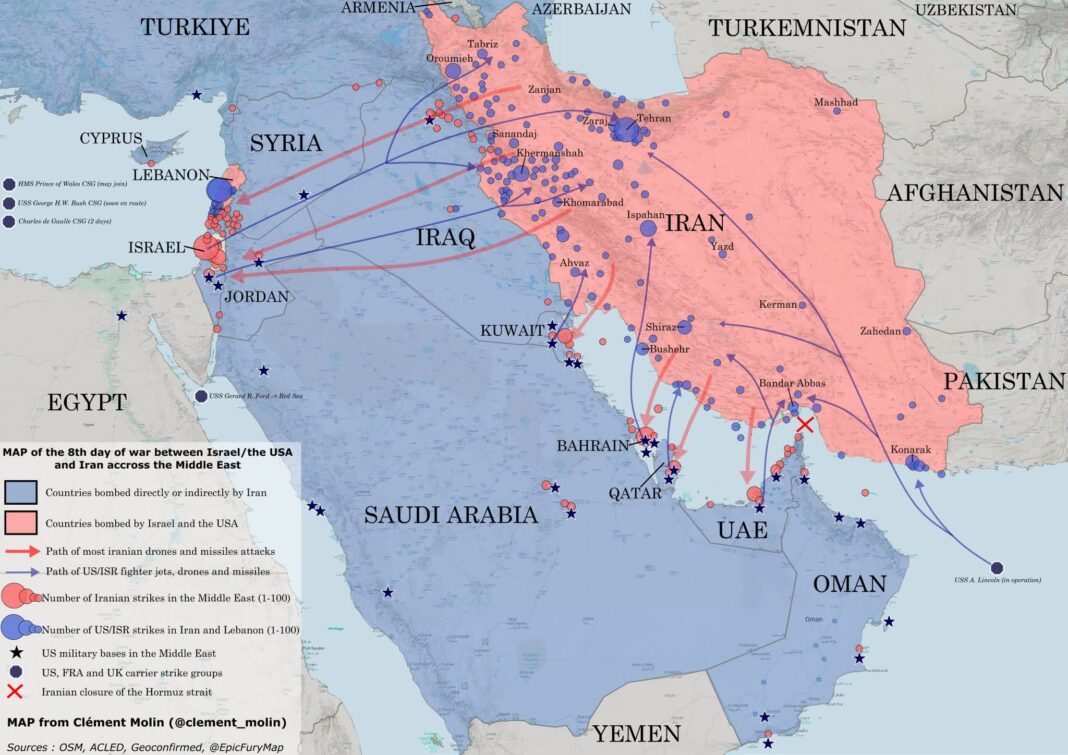
[2] In the context of the escalation of the conflict in March 2026, Iran launched several missile and drone strikes against bases belonging to Iranian Kurdish organizations located in the Kurdistan Region of Iraq, which Tehran accused of preparing cross-border incursions. The operations targeted facilities associated in particular with groups such as the Kurdistan Freedom Party (PAK), the Democratic Party of Iranian Kurdistan (PDKI) and Komala, including positions in the areas of Erbil, Koya and Sulaymaniyah. According to Iranian authorities, the strikes – carried out in cooperation with the Islamic Revolutionary Guard Corps (IRGC) – were intended to destroy the bases and weapons depots of these groups.