
At the IHE Delft Institute for Water Education, a leading global centre for water knowledge, diplomacy and science converged for the high-level forum “Water Science: Applications for Development and Business in Latin America and the Caribbean.” The event, hosted by the Embassy of Panama on behalf of the Group of Latin American and Caribbean States, brought together scientists, policymakers, diplomats, and private sector leaders to explore how water science can drive sustainable development across the region.
A Platform for Science, Cooperation and Development
The forum opened with remarks from H.E. Ms. Sally Loo Hui, Ambassador of Panama and GRULAC Coordinator, who emphasized the collaborative spirit behind the initiative.
“This forum responds to a shared recognition: that science plays a central role in addressing the complex and interconnected challenges faced by Latin America and the Caribbean,” she noted.
“Water… reminds us of the fundamental role that natural resources play in shaping sustainable and resilient societies.”
She also highlighted the importance of international partnerships, thanking IHE Delft for its “longstanding leadership as a global reference in water education, research and capacity-building,” and acknowledging the contributions of the Netherlands Enterprise Agency and private partners in bridging science with real-world applications.
The Ambassador further underlined that the forum aims to showcase scientific excellence, also strengthen connections between Latin American and Caribbean researchers in the Netherlands and their countries of origin:
“Today’s discussions provide an opportunity to make these contributions more visible and to strengthen connections among researchers, institutions, diplomatic missions and the private sector.”

Strategic Vision: Water, Economy and Sustainability
The inaugural lecture by Silvia L. Saravia Matus, Head of Economic Affairs at the Natural Resources Division of the Economic Commission for Latin America and the Caribbean, set the tone for the forum. Her intervention connected water governance to economic transformation, emphasizing the need for integrated policies that link natural resource management with sustainable growth, climate resilience, and social inclusion.
Science, Innovation and Public Policy
The first high-level roundtable explored the intersection of science, innovation, and policymaking. Experts presented interdisciplinary approaches to water challenges—from advanced treatment technologies to urban design and development cooperation.

Moderating the session was Dr. Héctor García, a distinguished professor of Environmental and Sanitary Engineering affiliated with both IHE Delft and the Universidad Tecnológica del Uruguay (UTEC). Dr. García is widely recognized for his expertise in wastewater treatment, resource recovery, and Membrane Bioreactor (MBR) technology. As Director of the Latin American Regional Hub of the Global Sanitation Graduate School, he plays an important role in advancing technical capacity and innovation in sanitation across the region.
Under his guidance, the discussion highlighted how scientific knowledge must translate into actionable public policy. Contributions from researchers such as Dr. Sergio Salinas Rodríguez (water treatment and desalination), Prof. Taneha Bacchin (urbanism and landscape), Ms. Sandra Megens (development cooperation), and Mr. Gabriel Cárdenas Belleza (innovation for development) illustrated the diversity of approaches needed to address water-related challenges.

Business and Private Sector Engagement
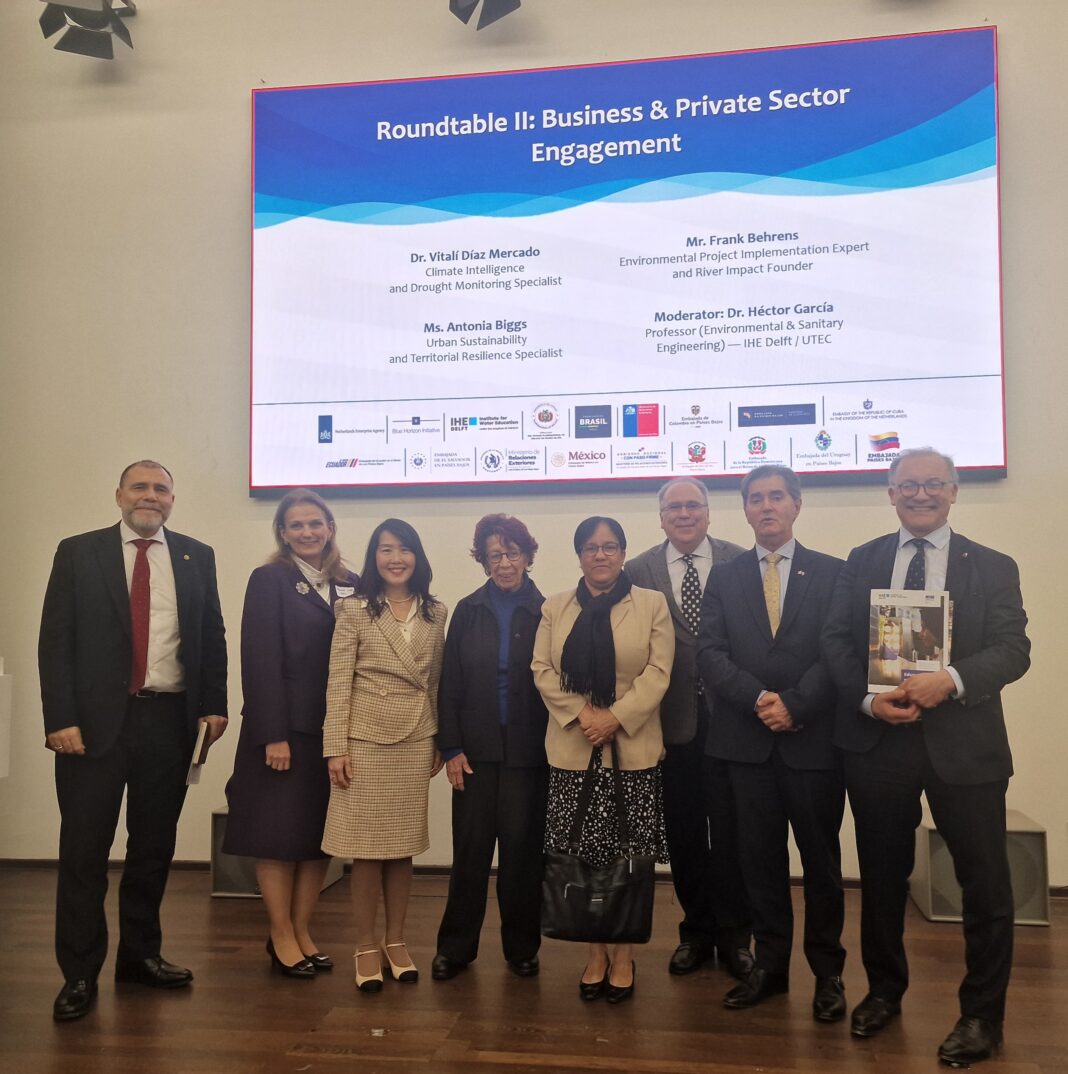
The second roundtable shifted focus to the role of the private sector in scaling scientific solutions. Moderated again by Dr. García, the session underscored how innovation, investment, and entrepreneurship are essential to translating research into tangible impact.
Experts including Dr. Vitalí Díaz Mercado (climate intelligence and drought monitoring), Mr. Frank Behrens (environmental project implementation and founder of River Impact), and Ms. Antonia Biggs (urban sustainability and resilience) shared insights on emerging technologies and business models that support water security and climate adaptation.
Their contributions reinforced a key message of the forum: that sustainable development requires strong collaboration between science and business, supported by enabling policy frameworks.
Strengthening Global Partnerships
The presence of H.E. Meike van Ginneken, Water Envoy of the Kingdom of the Netherlands, highlighted the country’s long-lasting commitment to international water cooperation. The Netherlands’ expertise in water management continues to serve as a valuable partner for Latin America and the Caribbean in addressing shared challenges such as climate change, urbanization, and water scarcity.
The forum concluded with remarks by Professor Eddy Moors, Special Advisor on Partnerships at IHE Delft, who reiterated the importance of sustained collaboration across regions and sectors.

Building Bridges Through Knowledge
Beyond the formal sessions, the forum facilitated meaningful exchanges during networking moments, reinforcing its role as a platform for dialogue and partnership-building. Over 200 persons attended the event, among them representatives from universities of Santiago de Compostela, Chongqing University, Faculty or Archeology of Leiden University, Exter University, University of Antwerp, University of Twente, Universidad de El Valle, Utrecht University, Pontificia Universidad del Peru, Eotvos Lorand University, Escuela de postgrado de la Universidad Andina del Cusco, Czech Technical University in Prague, Wageningen University, The Hague University of Applied Sciences, Radboud University, University of Amsterdam, Universidad Mayor de San Andres, Radboud Universitiet, University of Nebraska – Lincoln. The Hague Institute for Geopolitics, Royal Danish Academy, VITENS Center for Water Expertise and Innovation,
Institutions, government representatives, ambassadors and diplomats from Embassies of Brazil, Chile, Colombia, Costa Rica, Cuba, Dominican Republic, Ecuador, Guatemala, Mexico, Panama, Peru, Uruguay, Venezuela, Dutch Embassy in Mexico. World Bank, Grupo de Trabajo Cambio Climatico y Justicia, UTEC, UPC, Ministry of Education, Culture and Science, Ministerio del Poder Popular para el Ecosocialismo, Casa Llena, Nijhuis Industries, 7VORTEX, River Impact, Lesnikov Consulting, RWS, Haskoning, Desolenador B.V. Future Water, Empresa Aymara, Rahiz, EcoCultivare, Meridian Social Inteligence, WASTER Foundation, Bluesddynamics, Grupo Islas, Flowes, Codepa, BD+P and the Blue Horizon Initiative, Ceva-Logistics, CIEPA, USFXCH, WUR, Sabesp, IFC, Field Factors, Waterschap Noorderzijlvest, Studio Noorden, Seft Sustainable Systems, RVK, Hoogheemraadschap van Rijnland, ABIS, Solaq, Deltares, UMSA, Specma B.V., van Essen Instruments B.V., Studio Berekbaar, Capgemini, Envision DR.
As Ambassador Loo Hui expressed:
“We hope that this forum will serve as a platform to deepen dialogue and cooperation—not only among scientists from Latin America and the Caribbean, but also with Dutch institutions and partners working at the forefront of water management and sustainable technologies.”