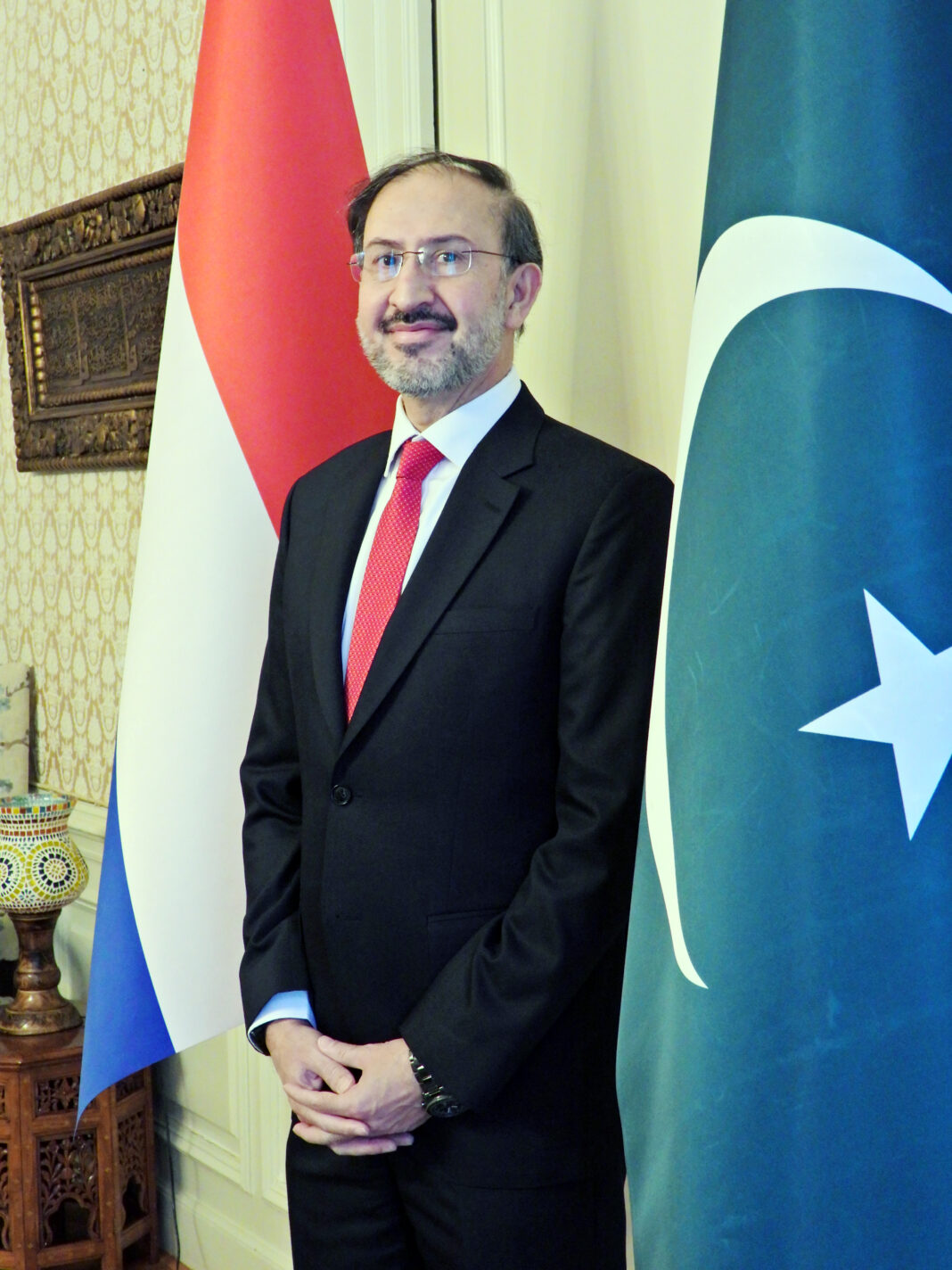

By H.E. Mr. Syed Haider Shah, Ambassador of the Islamic Republic of Pakistan to the Kingdom of the Netherlands
Pakistan and the Netherlands share a relationship that is both longstanding and practical. Since the Netherlands recognized Pakistan in 1948, our two countries have built ties based on mutual respect and steady cooperation. The bilateral relationship between Pakistan and the Netherlands combines long-standing cooperation with fresh opportunities across trade and investment, water management, agriculture, education, and innovation. The Netherlands brings globally recognized strengths in logistics, ports, sustainable solutions, and supply-chain efficiency, while Pakistan offers a large market, a geo-strategic location, and a fast-developing business ecosystem, particularly in agribusiness and technology.
Agriculture and value-added industries present equally strong potential. As Pakistan modernizes its agricultural and food systems, Dutch capabilities in seed technology, controlled-environment farming, cold-chain logistics, and sustainable dairy and horticulture can support climate-smart production and higher-value exports. Beyond food, textiles and responsible supply chains offer scope to move from volume to value through sustainability, compliance, and circularity, while digital innovation and IT-enabled services are emerging as new growth drivers. Partnerships in technology, fintech, and digital solutions can further boost efficiency, transparency, and competitiveness across sectors; a proof that this relationship is no longer just solid, but strategically smart.
While Pakistan–The Netherlands relationship stands firmly on its own, it also gains momentum from Pakistan’s broader engagement with the European Union. The Netherlands is not only a trusted bilateral partner; it is also a key European voice and a global leader in innovation, logistics, water expertise, and sustainable solutions.
This is why Pakistan views its partnership with the European Union guided by three major frameworks as central to shaping the environment in which our cooperation with European partners, including the Netherlands, can grow. These comprise the EU–Pakistan Cooperation Agreement (2004), the granting of GSP+ status (2014), and the EU–Pakistan Strategic Engagement Plan (2019). Together, these frameworks have helped move the relationship beyond periodic interaction toward structured cooperation, shared priorities, and a more future-oriented partnership.
The 2004 Cooperation Agreement provided an essential foundation for sustained political and economic dialogue. It created a predictable framework for engagement and helped open avenues for practical cooperation across sectors. This kind of structured relationship encourages continuity, supports long-term planning, and strengthens confidence among governments, institutions, and the private sector. In real terms, it also reinforces bilateral ties such as Pakistan’s cooperation with the Netherlands by enabling greater alignment on trade facilitation, development cooperation, and sectoral initiatives.
Since 2014, the European Union’s Special Incentive Arrangement for Good Governance and Sustainable Development (GSP Plus) has expanded market access for Pakistani exports and provided a framework for structured dialogue on international commitments relating to human rights, labour rights, environmental protection, and good governance. Engagement with these international conventions reflects Pakistan’s longstanding national priority anchored in constitutional obligations, international responsibilities, and domestic reform objectives. In this context, GSP+ is not merely a trade preference but it is complementary to Pakistan’s broader agenda of economic competitiveness, institutional strengthening, and modernisation. These priorities have driven sustained investments by Pakistani industries in standards, compliance, traceability, and improved governance practices that are increasingly integral to global trade.
Implementation of the 27 International Conventions spanning human rights, labour rights, climate change, and good governance is pursued as part of Pakistan’s overarching governance and development framework. To ensure effective coordination and implementation, the Government of Pakistan has established a Treaty Implementation Cell (TIC) at both federal and provincial levels, with the Ministry of Commerce serving as its Secretariat. The Cell includes representation from the National Commission on Human Rights, Pakistan Workers Federation, UN Women, and the International Labour Organization, reflecting an inclusive and institutionalised approach to treaty implementation.

As a result of these coordinated and sustained efforts, the outcomes of the four Biennial Assessments conducted in 2016, 2018, 2020, and 2023 were positive. The EU Monitoring Mission visited Pakistan in the last week of November 2025 for the fifth Biennial Review of GSP Plus. During the visit, the Mission held detailed consultations with relevant stakeholders on progress achieved since 2023 across the four thematic clusters of human rights, labour rights, environment, and good governance. Throughout the fifth biennial review period, the Government of Pakistan has undertaken significant legislative, policy, and administrative measures to advance implementation of the conventions. These reforms reflect Pakistan’s continuing commitment to its international obligations, and the Government remains confident of a successful conclusion of the current review.
In Pakistan’s bilateral trade with the EU, rice sector offers a particularly positive story. Pakistan is globally recognized for premium aromatic rice, especially Basmati, and the industry is steadily moving toward higher quality, improved processing, stronger branding, and better traceability. European consumers are increasingly focused on origin, quality, and responsible production. This creates real opportunities for long-term sourcing partnerships, premium positioning in retail and food service, and investment across the value chain from modern milling and packaging to logistics and marketing. With Dutch expertise in supply-chain efficiency and agrifood innovation, there is considerable scope to deepen cooperation in a way that benefits farmers, businesses, and consumers alike.
The third framework, the EU–Pakistan Strategic Engagement Plan (2019), broadened the relationship further reflecting the reality that today’s challenges cannot be addressed through trade alone. The Plan covers cooperation in peace and security, governance and democracy, migration and mobility, trade and investment, sustainable development, education and culture, science and technology. Pakistan welcomes this comprehensive approach because it supports partnerships that are longer-term and solutions driven. It also encourages joint initiatives that strengthen institutions, build skills, and foster innovation.
Looking ahead, Pakistan is positioning itself to respond constructively to global challenges such as climate change, sustainability, and regional stability. Climate resilience especially water security, agricultural adaptation, and disaster preparedness is a national priority. Pakistan is eager to expand cooperation with the Netherlands and European partners on climate-smart agriculture, efficient water use, renewable energy solutions, and green innovation. Pakistan’s growing technology sector can also contribute to this transition through digital tools that improve efficiency, transparency, and service delivery.
In essence, Pakistan–The Netherlands relations are strongest when seen alongside a wider Pakistan–EU partnership shaped by the 2004, 2014, and 2019 frameworks. Pakistan remains committed to constructive engagement and to building relationships that deliver measurable outcomes: stronger trade, greater value addition, sustainable supply chains, and deeper cooperation in areas that matter to our shared future. With sustained dialogue and practical collaboration, Pakistan, the Netherlands, and the European Union can continue to strengthen a partnership that honours its history while actively shaping a more resilient and prosperous tomorrow.