
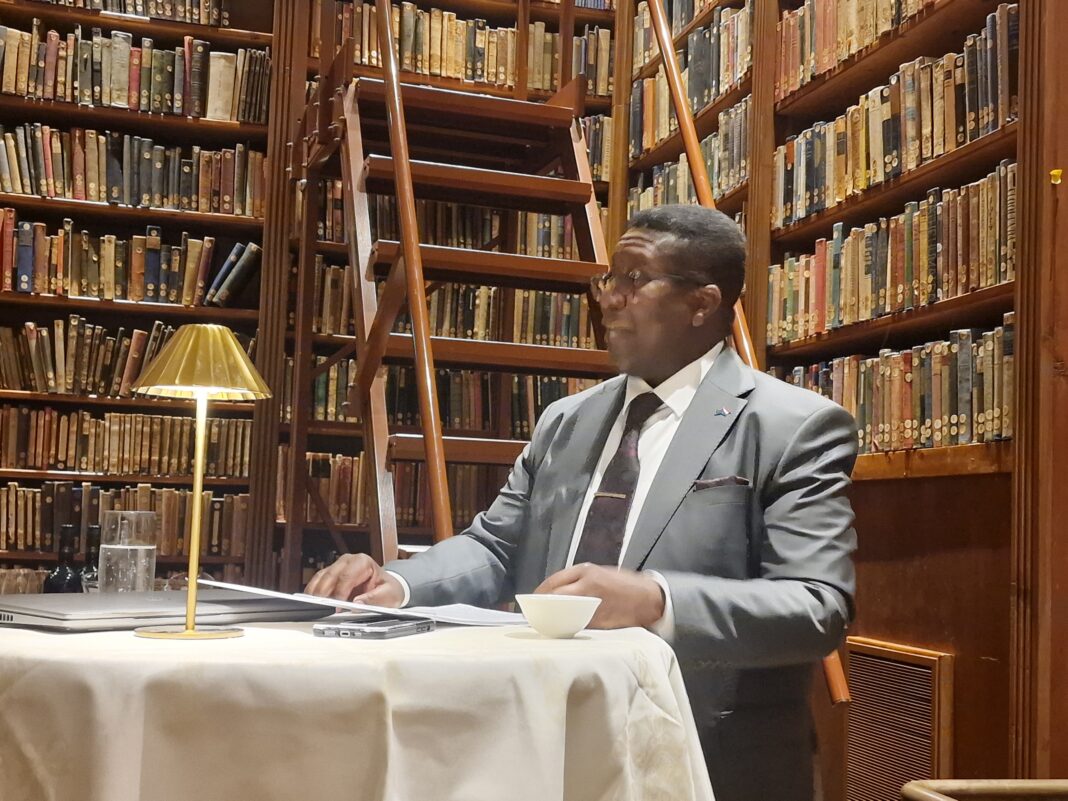

South Africa at Sociëteit De Witte
The Africa Table at Sociëteit De Witte once again welcomed a full house, continuing its successful series of timely themes and distinguished speakers. On Tuesday, 13 January, the keynote address was delivered by H.E. Mr. Vusi Madonsela, Ambassador of the Republic of South Africa to the Kingdom of the Netherlands and Dean of the African Group of Ambassadors.
Ambassador Madonsela spoke on “Our Complex World Today and the Outcomes of the G20 2025, South Africa: The Building Blocks of a Brighter Future We Strive For.” His address tackled the formidable challenges facing the Global South amid growing geopolitical uncertainty. Against this complex backdrop, the Ambassador presented a thoughtful and forward-looking vision, emphasizing cooperation, resilience, and inclusive growth as essential pillars for navigating today’s difficult global environment.

Addressing an audience that included H.E. the Ambassador of Senegal, the Ambassador of Venezuela to international organizations, as well as politicians, public servants, and members of De Witte with a strong interest in Africa, Ambassador Madonsela shared his insights into the G20 Summit and its broader implications. His intervention encouraged a privileged and interactive exchange, drawing on his extensive diplomatic experience, deep knowledge, and personal wisdom.
In his intervention, Ambassador Vusi Madonsela placed South Africa’s 2025 G20 Presidency firmly within a rapidly shifting and increasingly fragile global context. He recalled that the theme of the Summit—“Solidarity, Equality and Sustainability”—was a deliberate departure from earlier approaches that prioritised stability over development. Instead, South Africa used its presidency to champion a development-focused agenda and to steer discussions away from polarising conflicts toward shared existential challenges.
“The future remains in our hands, and it is up to us to shape that future.”
Ambassador Madonsela described the Johannesburg Summit as a profound test of multilateralism, made all the more significant by the African Union’s recent integration as a permanent member of the G20. Against a backdrop of geopolitical tensions, accelerating climate change and a growing global debt crisis threatening the Global South, South Africa positioned itself as a bridge-builder between established Western powers and emerging economies.
“African leadership is not merely about participation; it is about setting the agenda.”

He underlined that the successful organisation of the Summit also constituted a soft-power achievement, demonstrating Africa’s capacity to host complex, high-level global forums. While acknowledging that deep-seated disagreements were not fully resolved, he stressed that the outcomes marked a clear shift toward the priorities of developing countries.
On economic cooperation, Ambassador Madonsela highlighted renewed commitments to multilateral coordination, including strengthened global financial safety nets, increased lending power for the IMF and development banks, and a new framework for sovereign debt restructuring to support low-income countries facing debt distress.
“This was not only important for Africa, but for the Global South as a whole.”
Climate and energy were among the most contentious yet consequential areas. Leaders reaffirmed their commitment to the Paris Agreement, agreed to increase climate finance, and endorsed the creation of a Global Green Transition Fund to support renewable energy in developing nations. A notable step forward was the call for a rapid transition away from unabated fossil fuels.

On global health, drawing lessons from the COVID-19 pandemic, the G20 established a Global Health Security Package to strengthen prevention, preparedness and response, with an emphasis on equitable access to vaccines.
“That is not the world we want to live in,” the Ambassador said, recalling how vaccine nationalism left much of the developing world behind. Trade and supply chain resilience also featured prominently, with leaders pledging to resist protectionism and strengthen diversified, transparent and digitally enabled supply chains—an issue of particular importance for Africa’s integration into global value chains.
Ambassador Madonsela emphasised that the Summit marked a turning point for Africa, with concrete initiatives on infrastructure investment, food security, digital transformation and youth employment. He stressed that Africa’s natural resources must first serve the needs of its own people.
“What Africa produces must first and foremost respond to the needs of the people on the continent.”
Addressing diplomacy in an era of uncertainty, he concluded with a strong defence of multilateral engagement, particularly in cities such as The Hague, Geneva and New York.
“Without diplomacy, it becomes far too easy to resort to confrontation.”
“Multilateral diplomacy is about changing the world.”
While acknowledging that G20 commitments are not legally binding, Ambassador Madonsela argued that South Africa’s presidency successfully shifted the global centre of gravity.
“The world came to Africa for the first time, and Africa has set the agenda.”

Franck Diafouka, Founder and Chair of the Africa Table, welcomed the invited guests to Sociëteit De Witte. He recalled that the Africa Table operates under the Chatham House Rule and serves as a dynamic multidisciplinary forum dedicated to exploring the issues, dynamics, and opportunities shaping the African continent. Its quarterly debates, held in English or French, bring together academics, practitioners, and experts from diverse fields, ranging from culture and philosophy to diplomacy, economics, and security.
In recent months, the Africa Table hosted a panel discussion on “The Future of Architecture in Africa” on 18 November 2025, featuring architects Ms. Hilary Lukose (Kenya/UK), Mr. Steve Dingui (Ivory Coast/France), and Mr. Miguel Correia (Portugal). Earlier, on 9 September 2025, H.E. Ramatoulaye Ba Faye, Ambassador of Senegal, delivered a notable lecture entitled “Successful Electoral Transition: Building on the Positive Experience of Senegal.”