
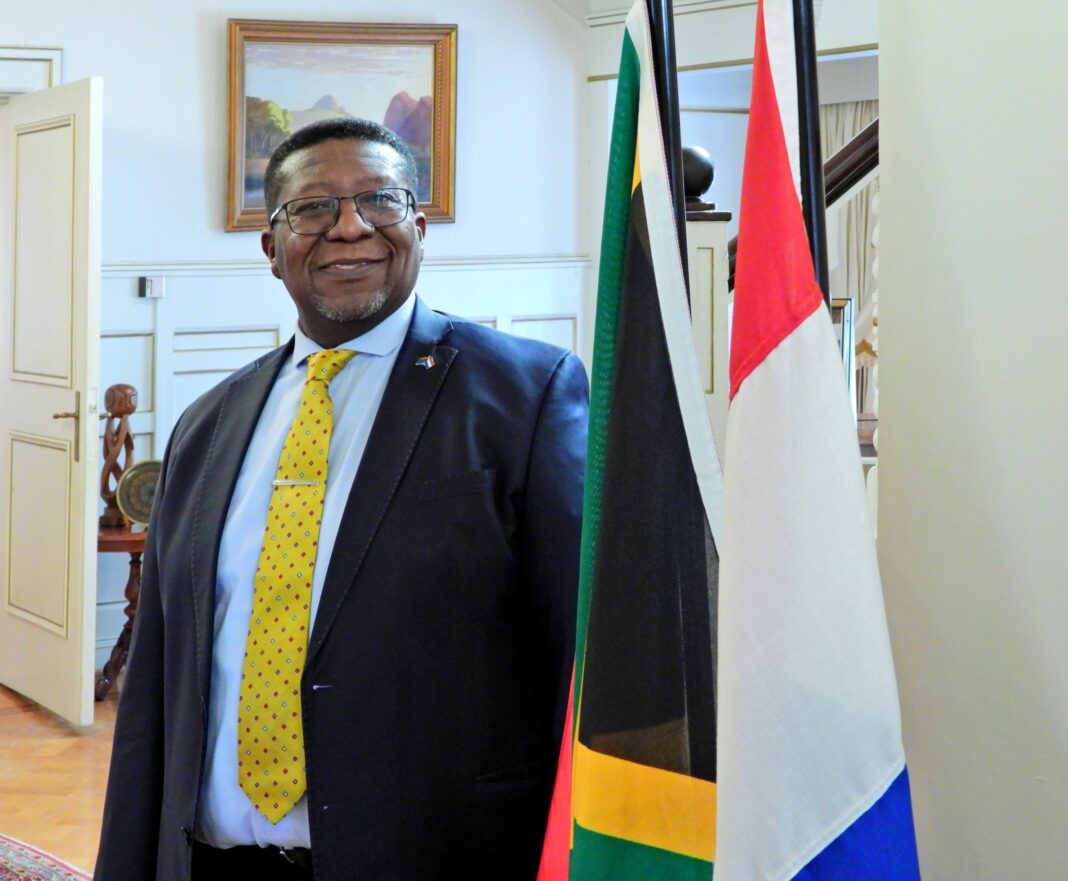

Ambassador Vusi Madonsela Reflects on 30 Years of South Africa’s Constitutional Democracy
In 2026, South Africa marks a defining milestone: 30 years since the adoption of its democratic Constitution. Widely regarded as one of the most progressive rights-based constitutions in the world, the 1996 Constitution not only ended decades of institutionalised apartheid but also laid the foundation for a society built on human dignity, equality, and freedom.
This anniversary offers an opportunity to reflect on South Africa’s remarkable democratic journey, and to revisit the international solidarity that helped make it possible. Few relationships illustrate this more clearly than that between South Africa and the Netherlands—a connection shaped by historical ties, principled opposition to apartheid, and a shared commitment to human rights.
In this special interview, H.E. Mr. Vusi Madonsela, Ambassador of South Africa to the Netherlands, reflects on the profound significance of the Constitution as a living instrument for justice, the symbolic importance of Nelson Mandela’s first visit abroad to the Netherlands, and the evolution of bilateral relations into a mature strategic partnership. He also highlights South Africa’s achievements over the past three decades and delivers a powerful message to younger generations on safeguarding freedom, democracy, and the rule of law in an increasingly complex world.
This year marks 30 years since the adoption of South Africa’s Constitution. From your perspective as Ambassador, what does this milestone represent for South Africa today—both domestically and on the global stage?
The adoption of the Constitution of South Africa of 1996 was a watershed moment in the history of our country. It ushered in a new democratic dispensation that is based on protection of, respect for, promotion and full enjoyment of all human rights and fundamental freedoms by all the people of South Africa.
This milestone marks 30 years of freedom for all the people of South Africa, which represents an epochal change underlying the transition of the Constitution from a “transformative” document to a “living” instrument for social, political and economic justice. It is for this reason that the Constitution remains South Africa’s “North Star” which guides its domestic policies and how same policies find extended expression through the country’s international relations policy positions. It is for this very reason that South Africa always advocates for human rights driven diplomacy and carves its role as a global mediator.
Nelson Mandela’s first official visit abroad after his release was to the Netherlands, a powerful symbolic gesture. How do you interpret the significance of that visit, and how has Dutch support influenced South Africa’s democratic journey?
Tata Nelson Mandela (affectionately known as Madiba) paid a visit to the Netherlands in June 1990, just four months after his release from prison. Against the backdrop of the famous statement by the Dutch Queen, Her Majesty Juliana, who told the Prime Minister of apartheid South Africa, Mr Daniel François Malan, in 1949 that she would “never set foot in his country as long as apartheid reigned”, Madiba’s visit was a deeply emblematic move which served as a profound acknowledgment of the role played by the Dutch in both our country’s painful history and its struggle for freedom and democracy. Queen’s Juliana’s stance marked a major royal objection to the apartheid regime.
It was also never lost on Madiba that in 1961 the Netherlands became the only Western country to vote in favour of an anti-apartheid resolution at the UN, which also saw a burgeoning Netherlands Anti-Apartheid Movement which actively isolated apartheid South Africa. Clearly, the prioritisation of an early visit to the Netherlands was both deliberate and purposeful. Madiba honoured the Dutch citizens who fought against apartheid while planting a seed for fostering a new, cooperative relationship based on human rights. In his own words, Madiba described the historic visit as a “transformation of international solidarity into a “partnership for peace and development”.
Crisply put, the success of that visit serves as a powerful reminder of what humanity can really achieve when the international community unites against oppression.
During the struggle against apartheid, the Netherlands played a visible role in supporting freedom and justice for South Africans. How do you see this legacy reflected in today’s bilateral relationship between South Africa and the Netherlands?
The legacy of the Netherlands’ support for the people of South Africa’s protracted struggle against apartheid remains visible today through a special relationship that has evolved from moral solidarity into a strategic, multi-sector partnership. Today, our shared history is reflected in several key pillars of our bilateral relations which are governed through a Joint Commission for Cooperation (JCC), co-chaired by our Foreign Ministers.
One of the highlights of these deep bilateral pertains Trade and Investment which has created economic Interdependence between the two nations. The Netherlands has become one of South Africa’s largest trading partners in the EU and a top source of Foreign Direct Investment (FDI).
In addition to the foregoing, since the start of the democratic transition in 1994, the Netherlands continues as a key partner to South Africa’s post-apartheid government, in a range of areas which include, but are not limited to: Education; Arts and Culture; Science, Technology, Knowledge and Innovation; Digitisation and Cyber Security; Environment and Climate Change; Agriculture; Water Management; Green Energy and Just Energy Transition Partnership; Finance; Social Development, Migration, Human Rights Advocacy; and Addressing Colonial Legacies.
Despite global and domestic challenges, South Africa has reached this constitutional milestone with resilience. What achievements over the past three decades do you believe deserve greater international recognition?
Firstly, over the past 30 years South Africa has achieved a stable transition from apartheid to constitutional democracy, based on the Constitution that is heralded as one of the most progressive rights-based instruments in the world.
As part of its fight against the stubborn legacy of apartheid, which still manifests in high levels of extreme poverty among the historically excluded sections of the population, South Africa has implemented one of the most comprehensive social protection systems in the developing world. South Africa’s safety net specifically targets the elderly, persons with disability and children from poor families.
South Africa has also rolled out a system of free basic education for learners from poor families. South Africa has also put together a National Student Financial Aid Scheme (NFSAS) which enables South African students from poor families to access opportunities to pursue their studies in South Africa’s higher education institutions.
In recent times, following the covid-19 pandemic, South Africa has also extended its social safety net to provide social relief of distress to South Africans of employable age who either lost employment or are unable to enter the labour market due to the lingering impact of the pandemic on the economy. In addition, based on credible statistical data, South Africa has also built the largest HIV and AIDS treatment programme in the world, thereby saving millions of lives.
Based on its highly developed economic infrastructure, the most level of industrialisation on the continent and the size of its economy, South Africa has established itself as a leading African voice in global affairs and a key player in BRICS.
Looking ahead, what role do you see for South Africa–Netherlands cooperation in strengthening democratic values, multilateralism, and people-to-people ties in the years to come?
The partnership between South Africa and the Netherlands is evolving from what is normally described as a traditional donor-recipient relationship into a strategic “partnership of equals”, focused on mutual interests and shared global responsibilities.
Undoubtedly, the dynamic cooperation between the two nations is poised to deepen through the strategic partnerships I have already alluded, leveraging of their shared democratic values and strong historical ties. Therefore, the two nations will continue to work on deepening people-to-people ties through initiatives like the internationalisation of education, which take the form of academic and scientific exchanges through strong partnerships between universities and research institutions that foster innovation. The work will also include cultural and social cooperation through active engagement in arts, culture, and social development, as well as cultivating technical cooperation by working together on migration management, social security, and skills development.
Evidently, the deepening relationship has rapidly moved towards a mature, strategic partnership that is firmly based on mutual interest, technological collaboration, and shared responsibility in a complex global landscape. The two nations are working collaboratively on promoting multilateralism and advocating for the reform of institutions of global governance, which include the United Nations General Assembly and the Security Council.
Finally, on a more personal note, as Ambassador to the Netherlands, what message would you like to convey to younger generations in both countries about safeguarding freedom and constitutional values?
As South Africa’s Ambassador to the Netherlands, also accredited to the International Organisations and International Courts based in The Hague; as a lawyer by profession and former Director-General of the Department of Justice and Constitutional Development, my message to the youth in both our nations and the world is rooted in the active protection of human rights and democratic institutions, as well International law and the International Courts that administer and apply it.
The youth must be vigilant against the erosion of constitutional guarantees. Freedom is never a permanent “given.” As can be gleaned from many ongoing developments around the world today, even in established democracies, constitutional values must be actively defended against contemporary threats which often assume the form of the shrinking of civic spaces, misinformation, disinformation.
Drawing from South Africa’s history of struggle against apartheid and the role played by international solidarity in bringing an end to apartheid in our country, I sincerely believe the youth ought to appreciate the importance of the indivisibility of freedom. As the future belongs to them, the youth must recognise that a denial of rights to one person anywhere diminishes the freedom of all across the globe. Against this background, I encourage the youth in both nations and across the globe to see justice as a universal, rather than local, responsibility.
Finally, I wish to stress that no individual is above the law and that the trust placed in present and future leaders comes with a profound responsibility to adhere to ethical conduct and the rule of law – especially international law to safeguard international peace and security.