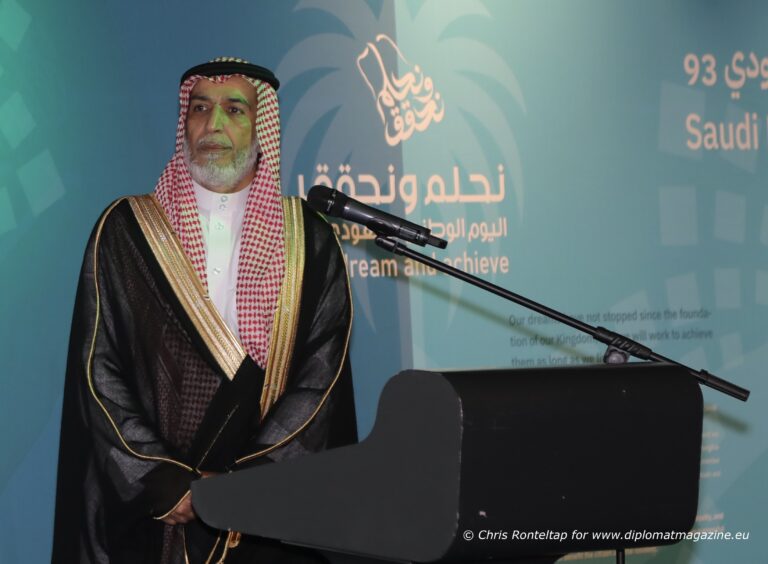
The Hague, the international city of peace and justice, witnessed on September 23 an animated celebration of Saudi Arabia’s 93rd National Day. This remarkable event was orchestrated by His Excellency Mr. Ziad Al Atiyah, the Ambassador of Saudi Arabia to the Netherlands. The festivities attracted an illustrious gathering, including Dutch officials, ambassadors from brotherly and friendly nations, members of the diplomatic corps, and secretaries-general of international organizations. The occasion not only commemorated Saudi Arabia’s rich history and culture but also underscored the burgeoning bilateral relations between Saudi Arabia and the Netherlands.
Ambassador Al Atiyah, in his opening address, extended heartfelt congratulations on behalf of himself, his colleagues, and the Saudi citizens residing in the Netherlands to the Custodian of the Two Holy Mosques, His Majesty King Salman bin Abdulaziz Al Saud, and His Royal Highness Prince Mohammed bin Salman bin Abdulaziz Al Saud, Crown Prince and Prime Minister, as well as to the Saudi people.
H.E. Mr. Rahman Mustafayev, Ambassador of Azerbaijan, the Ambassador of Turkey H.E. Mr Selcuk Unal, H.E. Askar Zhumagaliyev. Ambassador of Kazakhstan, H.E. Mr. David Solomonia, Ambassador of Georgia, H.E. Mr. Álvaro González Otero, Ambassador of Uruguay, H.E. Mr. Arnoldo Brenes Castro, Ambassador of Costa Rica, H.E. Mr. Hatem Kamaleldin, Ambassador of Egypt, H.E. Nasser Ibrahim Mohammad Hussein Allenqawi, Ambassador of Qatar and H.E. Mr. Abbas Yassin Omer, Minister Plenipotentiary, Acting Charge d’affairs of the Sudan.
One of the key highlights of the ambassador’s speech was the thriving bilateral interactions between Saudi Arabia and the Netherlands. Over the past year, the two nations have witnessed substantial growth in cooperation across various sectors. This includes high-level ministerial visits, engagements with prominent officials, and the signing of agreements and Memorandums of Understanding, particularly in the domains of energy and port management.
However, beyond economic and political ties, Ambassador Al Atiyah emphasized the significance of academic cooperation. A notable example is the partnership between Radboud University Nijmegen and the Saudi Heritage Authority. This collaboration focuses on the study of historical water resources, particularly the Canal of Ain Zubaida, known in Arabic as ‘Ain Zubaida. This ancient aqueduct, dating back to the early Abbasid era, was completed in 801 CE with the primary purpose of supplying water to the city of Mecca. It represents a fascinating engineering feat, with parts of it constructed as a qanat, an underground water channel.
The ambassador’s words resonated with the audience as he highlighted the importance of preserving such cultural and historical landmarks. The cultural exchange between Saudi Arabia and the Netherlands, particularly in the realm of academia, enriches both nations by fostering an appreciation for shared history and heritage.
Ms.Rawan Rashwan, Administrative staff and Ms.Kholoud Mulla, Third Secretary at the Embassy of Saudi Arabia in The Hague together with the Ambassador of Saudi Arabia, H.E. Mr. Ziad Al Atiyah.
Ambassador Al Atiyah concluded his address by extending an invitation to the guests to partake in a visual presentation. This presentation showcased the collaborative efforts between the two nations in studying for Ain Zubaydah. The Saudi Heritage Authority’s tireless endeavors to preserve the historical importance of this aqueduct were on full display, highlighting the enduring commitment to safeguarding the cultural legacy of Saudi Arabia.
The celebration of Saudi Arabia’s 93rd National Day in The Hague served as a testament to the growing partnership between Saudi Arabia and the Netherlands. It emphasized the shared commitment to fostering cooperation in various fields, from economics to academia, and underscored the value placed on preserving cultural heritage. The event not only celebrated the Kingdom’s rich history but also heralded a promising future of continued collaboration between these two nations.
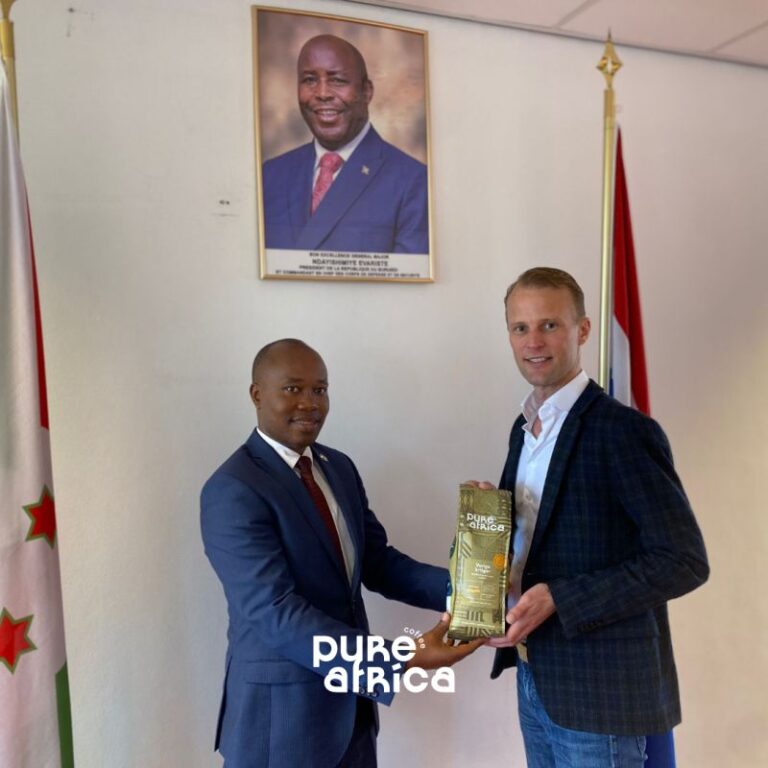
The Hague, September 21st, 2023. Today, Pure Africa Coffee met with the Burundian Ambassador, H.E. Mr. Gamaliel Nkurunziza, to introduce its new Fiery Warrior Coffee and discuss their collaboration with Burundi.
Our Fiery Warrior Coffee is a unique blend of coffee beans sourced directly from farmers in northern Burundi. Our goal is to ensure that the farmers receive a fair price for their product, and we are proud to announce that Pure Africa has increased the premium paid to these growers from $1 per kg to $3.62 per kg.
Fiery Warrior Coffee
Burundian coffee makes up 65% of the new IDEALIST blend from Pure Africa Coffee, which will be consumed by Dutch Government Ministries and considered the best coffee in the Netherlands.
On 19 September 2023, the Embassy of Malaysia in Paris hosted An Afternoon of Malaysian Gastronomy – A Culinary Voyage, dedicated to Malaysian Street Food at Rumah Malaysia. The event was timely in commemorating the 60th Malaysia Day and provided the guests the opportunity to experience Malaysian food, culture and hospitality.
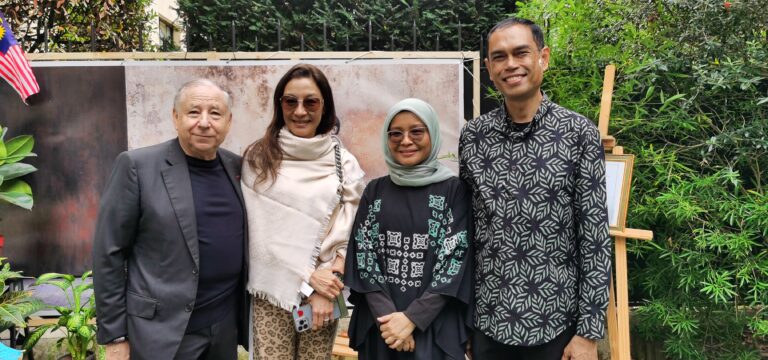
Among the guests present were Malaysia’s very own Tan Sri Michelle Yeoh and husband Jean Todt. Other guests included local personalities active in the arts and culture scene including, actors, musicians, writers, chefs, digital content creators, journalists and sports personalities with strong social media presence.
Laksa Penang, Malaysia Street Food by the Embassy of Malaysia in Paris.
In his opening remarks, His Excellency Dato’ Mohd Zamruni Khalid, Ambassador of Malaysia to France highlighted the uniqueness of Malaysian Street Food which draws influence from Malaysia’s diverse and rich cultural heritage. Noting that street food is a staple for all Malaysians, he invited the guests to savour the culinary journey and soak in the cultural experience.
The afternoon continued with the guests taking a culinary trip where they discovered ten of Malaysia’s most popular street food namely Pasembur, Satay, Char Koay Teow, Laksa Penang, Roti Canai, Nasi Lemak, Roti Jala, Onde-onde, Ais Kacang and Teh Tarik. The guests were amazed at how Roti Canai is “spun” in the air to give it a light fluffy texture and Teh Tarik is “pulled” to cool the tea and give the drink a rich flavor.
Char Kuay Teow – Malaysia Street Food by the Embassy of Malaysia in Paris.
Next, the guests were invited to sample the delicious food and try their hands at making some of these dishes.
Before the afternoon came to an end, the guests were presented with a lovely souvenir for their participation in the Culinary Journey, comprising tea, palm oil, songket purse and Malaysian snacks. The programme was organised in collaboration with Tourism Malaysia Paris, Malaysian Palm Oil Council (MPOC), Boh Tea Malaysia, Château d’Ardrée and KMF Malaysiawe.
Teh Tarik – Malaysia Street Food by the Embassy of Malaysia in Paris.
On September 12, 2023, the world learned about the deadly consequences of Storm Daniel in Libya. Concluding a particularly destructive summer of natural disasters around the globe, this event rung the alarm as loudly as ever for the climate emergency we are facing.
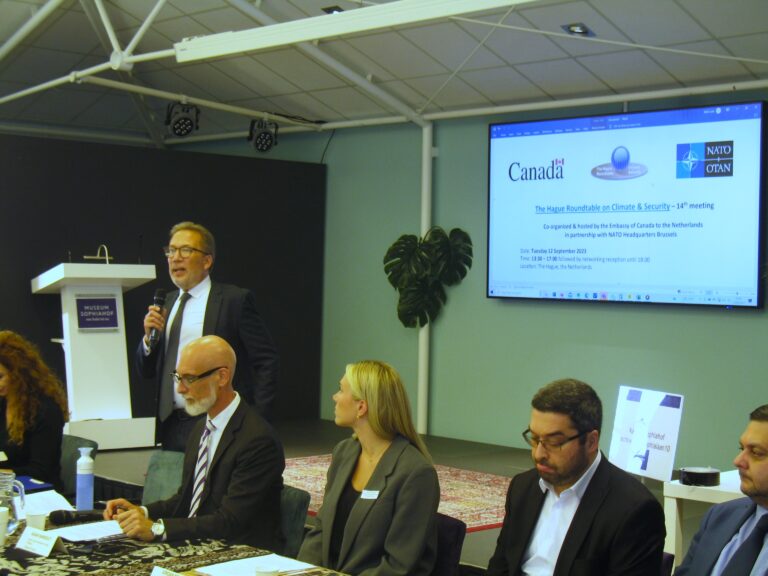
On the same day, TheHague Roundtable on Climate and Security was assembled for the 14th time, dealing with the very questions raised by this dramatic event. The Roundtable, started in 2015 by climate-water communication advisor Matt Luna, discussed the impact of climate change on the military, conflicts and humanitarian crises. As in previous meetings, the Roundtable gathered experts, diplomats, NGO, and institutional representatives to transfer experiences and generate inputs for policymakers and civil society. Around 60 participants represented 40 embassies and organizations in the meeting.
This edition of the Roundtable was organised with the Canadian Embassy in The Hague, in partnership with the NATO headquarters. Numerous embassies and missions were represented, along with the Dutch Ministry of Foreign Affairs and the United Nations. The discussions were focused on water scarcity, knowledge transfer, inclusivity and the opening of NATO’s Climate Change and Security Centre of Excellence (CCASCOE) in Montréal, Canada. Panellists from different organisations showcased their assessments and approaches in different areas of climate and security action. The participants were then separated in breakout groups on the themes of water scarcity, gender and climate, humanitarian crisis response and inputs for the CCASCOE. Given the high level of participation, the sessions were very interactive, allowing the table to ask questions and give inputs for each panel and to build conclusions collectively.
The first presentation by NATO policy officer Jordan Koop established the main impacts of climate change on a military institution, demonstrating how such a non-traditional actor needs to step up its involvement in climate action. Climate change is indeed expected to increase military activity, not only to contribute to disaster relief efforts, but also to face the security threats arising from resource scarcity and humanitarian crises. The risk of conflict extends to the geopolitical level as well as new fossil fuel exploitation opportunities will open up in the melting Arctic, creating a new area of competition.
While being a future relief actor, the military sector is also itself subject to the impacts of climate change, bound to affect equipment safety and operating conditions. In parallel, the question of the responsibility of the military in the environmental crisis arose, as it produces of 5.5% of global carbon emissions. While the role of NATO was shown to be crucial in initiating a green transition in the military, it remains a major challenge since this sector’s main priority is to increase its capacity.
The spotlight was then given to civil society actors Mahdi Ahmad and Amar Ibrahim, from the Bahr Aluloom Foundation in Iraq. This platform deals with the current water crisis in Iraq, on the verge of becoming water stressed. This specific case is a perfect example of a social crisis caused by climate change that increases the risk of conflict. The severe draught that Iraq has been facing has had a considerable impact on the livelihoods of farmers in the once ecologically rich marshlands.
The water sources drying out cause a rural exodus that leads to competition and clashes with the urban working population and catalyse social tensions. The gender aspect of this crisis was brought up as well, as women were left behind in the farms in precarity, living off of livestock. This shows that climate-induced crises do not impact men and women equally. As marginalised groups will be more impacted by their consequences, an inclusive approach to crisis relief is needed.
The last presentation by Laura Birkman from the Hague Centre for Strategic Studies, exposed methods for water conflict risk assessment and peacebuilding. By analysing possible conflict pathways, she showed how conflict risks can be predicted for better preventive action. The combination of water expertise and peacebuilding knowledge can be used to create cooperation in areas of resource competition prone to tensions. The need to identify the root causes of conflicts was also expressed. Though the case study of Iraq, it was shown that the problem of resource scarcity intersects with pre-existing socio-political conditions, as the country’s economy and institutions have been fragilized by years of war.
The panellists converged on many points in their assessment of the situation, which translated into similar priorities for action. The important takeaway that climate impacts intersect with socio-economic inequality, whether by gender, class, or geographical region, led all actors to promote inclusive solutions to climate and conflict risks. As a result, the Roundtable’s main keyword, that is cooperation, was evoked at the international and regional level and between the military, civil and academic sectors. Regarding this, knowledge production and transfer were the first step of all the intervention frameworks proposed in the panels.
This convergence of thoughts materialised in the last stage of the Roundtable, where all the contributors formed groups to summarise and add propositions on the aforementioned four themes. Many additional inputs were given in the very newly explored axis of gender, climate, and security. In this context, climate impacts reinforce preexisting inequalities, and require a major cultural shift to lead to inclusive solutions.
This raises the question of representation in leadership, which should be examined in institutions such as the CCASCOE. Other inputs were the focus on technology in water management and geoengineering, while still promoting demand-side resource management to avoid waste; the need to improve communication between actors to reduce redundant efforts and finally the one essential requirement for any climate action: funding.
Concluding on the topic of the Centre of Excellence was an opportunity for the participants to remember that solutions exist and are being implemented to address issues around climate and security. More than an alarmist exchange, this Roundtable was also a platform to share and appreciate all the efforts that have been made by all the actors to study, inform and act upon these issues.
The cooperation and knowledge transfer promoted by all the actors are exactly what the Roundtable has achieved, and such discussions are crucial to make progress in addressing the climate crisis.
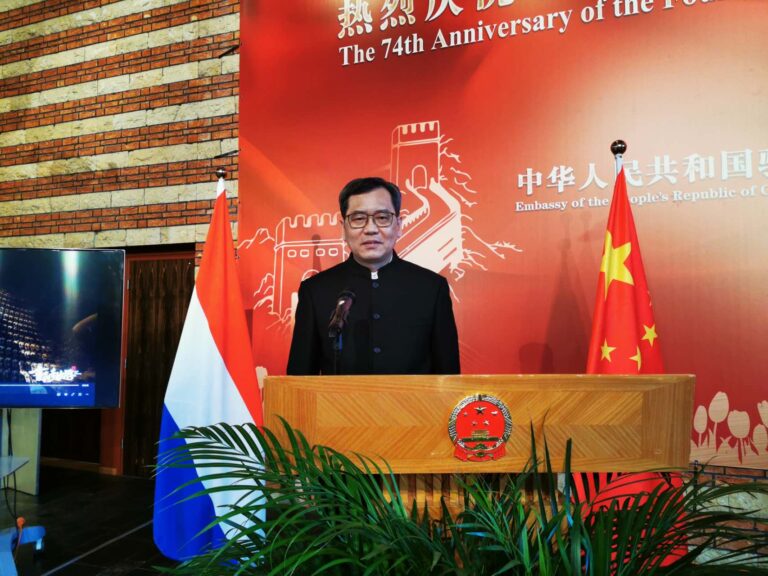
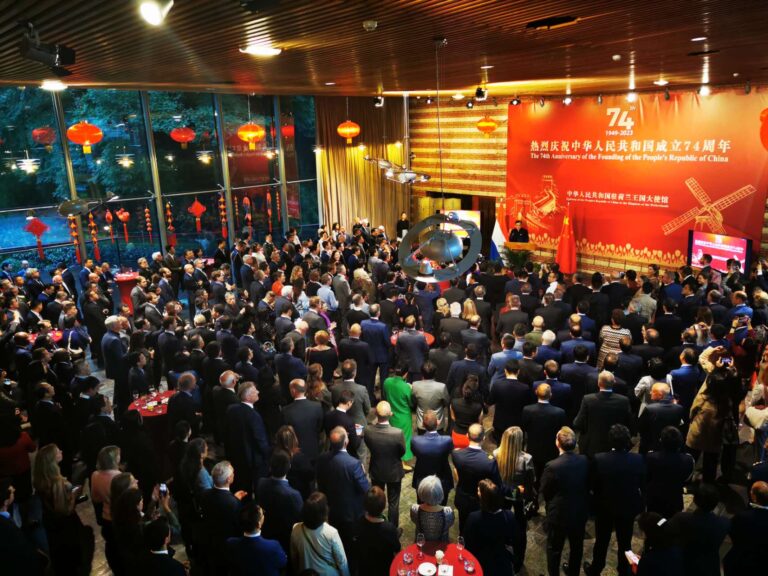
On the occasion of the 74th Anniversary of the founding of the People’s Republic of China, Ambassador Tan Jian delivered a thought-provoking speech during a multitudinous reception at the China Embassy in The Hague on September 21, 2023. His address was not only an opportunity to celebrate this significant milestone but also to shed light on China’s stance on international politics and its bilateral relations with the Netherlands.
“Our world today is confronted with unprecedented challenges, like climate change, which require unprecedented cooperation,” Ambassador Tan emphasized. He highlighted China’s unwavering commitment to peace, development, and cooperation on the global stage, stating, “China is for peace, for development, for cooperation; China is for globalization, for multilateralism, for free trade.”
The Ambassador then delved into President Xi Jinping’s visionary initiatives, such as the Belt and Road Initiative and the Global Development Initiative. He stressed that these initiatives were not driven by geopolitical competition but rather aimed at fostering global cooperation.
In addressing global challenges like rising sea levels, Ambassador Tan stressed the importance of a stronger sense of community for a shared future, stating, “We are in the same boat.”
Ambassador Tan acknowledged China’s significant contributions to international organizations, including being the second-largest contributor to the UN regular budget and peacekeeping budget. He also noted China’s commitment to disarmament, saying, “China is the second largest contributor to the budget of the Organization for the Prohibition of Chemical Weapons.”
Reflecting on his mission’s work over the past three years, Ambassador Tan emphasized the importance of promoting bilateral relations and multilateral cooperation, with the key message being that “China is part of the solution, not part of the problem.”
As the speech coincided with the International Day of Peace, Ambassador Tan expressed China’s deep love for peace, citing historical examples such as the construction of the Great Wall for defense, not aggression. He also highlighted China’s maritime expeditions led by Admiral Zheng He, which occurred 87 years before Christopher Columbus’ journeys, with no colonization efforts.
Addressing concerns about technology, Ambassador Tan acknowledged China’s role in the invention of gunpowder and emphasized the importance of responsible regulation. He said, “Seriously speaking, looking back at the one thousand year’s history, I could not recall that China has done anything harming the interest of Europe.”
Regarding bilateral relations between China and the Netherlands, Ambassador Tan celebrated the long history of contact between the two nations, tracing back over 400 years. He noted the substantial growth in trade volume, from $69 million in 1972 to over $130 billion in 2022, highlighting the Netherlands’ position as China’s second-largest trading partner within the EU.
The Ambassador also underscored the strong economic ties between the two nations, with the Netherlands being the largest destination of Chinese investment among all EU countries. He reiterated the open and pragmatic partnership for comprehensive cooperation, defined by President Xi Jinping and King Willem-Alexander in 2014.
In closing, Ambassador Tan expressed optimism about the future of China-EU relations and emphasized China’s commitment to maintaining open channels of communication and cooperation at all levels. He stated, “China will continue to promote exchanges at the levels of leaders, ministers, senior officials, and we will reach out to the people and local governments.” Ambassador Tan’s speech conveyed China’s dedication to international collaboration and its aspirations for a peaceful and prosperous future.
Remarks was given by Ms. Yvette Van Eechoud, Deputy Director General of Foreign Economic Relations of MFA.
The 74th Anniversary of the Founding of the People’s Republic of China was marked by an exceptionally well-attended reception hosted by His Excellency Ambassador Mr. Tan Jian and Mrs. Jiang Xiaoyan at the Chinese Embassy in The Hague. The event held special significance as it was the first time in three years that Ambassador Tan had the opportunity to celebrate his nation’s day with such grandeur, owing to the challenges posed by the COVID-19 pandemic.
The reception witnessed the presence of eminent personalities, including heads of international organizations, ambassadors at large, diplomats, Dutch officials, and hundreds of other distinguished guests to name a few Prof. dr. Jan Anthonie Bruijn, President of the Senate, Ms. Yvette Van Eechoud, Deputy Director General of Foreign Economic Relations of MFA, Mr. Wouter Jurgens, Director for Asia and Oceania, MFA and Ambassador Fernando Arias, Director-General of the OPCW
This momentous occasion served as a reminder of the incredible journey that China has undertaken since its founding in 1949. The transformation that China has undergone in these 74 years is nothing short of miraculous, with significant changes reflecting its dedication to development and progress.
In 1949, China’s per capita GDP was less than USD 100. Today, it has soared to over USD 12,000, an exponential growth rate that has substantially improved the quality of life for its citizens. This remarkable achievement is even more impressive when you consider that China’s population has tripled during this period.
One of the most commendable accomplishments of China in recent decades is its resounding success in poverty alleviation. Over the past four decades, China has lifted more than 850 million people out of poverty, setting an unparalleled example of humanitarian achievement. This historic milestone showcases China’s commitment to improving the well-being of its citizens.
Musical performance during the celebration of Chinas 74 Anniversary. Song For a Beauty by Ms. Jin Xin and Ms. Fischer Mirthe.
China has also emerged as a global economic powerhouse. It currently stands as the world’s second-largest economy and is the primary trading partner for over 140 countries and regions. This economic prowess has been a significant driver of global growth and stability, especially during challenging times.
Despite recent negative reporting and pessimistic projections about China’s economy, Ambassador Tan Jian offered a different perspective. He highlighted that in the first half of the year, China’s economy recorded an impressive growth rate of 5.5%. Moreover, according to the IMF’s World Economic Outlook, updated last month, China is expected to maintain a growth rate of 5.2% for the year, contributing significantly to global economic growth.
Ambassador Tan emphasized that “China continues to be the main engine for global economic recovery and growth. The nation’s commitment to sustainability and innovation is evident through its production of batteries and electric vehicles, contributing to a greener and more prosperous future.”
Furthermore, the resilience, potential, and vitality of the Chinese economy remain unwavering. Its fundamentals remain robust, and it continues on an upward trajectory. “China’s determination to build socialism with Chinese characteristics, while fostering mutual learning between civilizations, showcases its openness to global cooperation and shared development.
China remains firmly committed to its state policy of reform and opening up to the outside world. This commitment will only deepen and expand, with a renewed focus on promoting private businesses and attracting foreign investments. The nation’s goal is to achieve high-quality growth through structural reform, emphasizing consumption, innovation, and green development.”
With a population of 1.4 billion and a rapidly expanding middle-income group of 400 million, China presents itself as not only a massive market but also a source of tremendous opportunities for the global community. The nation’s dedication to development, poverty eradication, and sustainable growth makes it a vital player in shaping the future of our interconnected world.
During the well-attended celebration of China’s 74th anniversary, several Dutch and Chinese artists performed.
Bass solo The Amorous Land by Mr. Zhou Hanqing.
Song For a Beauty by Ms. Jin Xin and Ms. Fischer Mirthe.
Horse Racing by Ms. Sun Zheng.
The Canals of Amsterdam, or in Dutch, Aan de Amsterdamse grachten by Ms. Yang Siqi.
As China commemorates its 74th anniversary, it stands as a testament to the remarkable progress it has achieved and the unwavering commitment to a prosperous and harmonious future. Its journey of transformation is an inspiration to nations worldwide, reminding us all that progress, resilience, and cooperation can overcome challenges and lead to a brighter tomorrow.
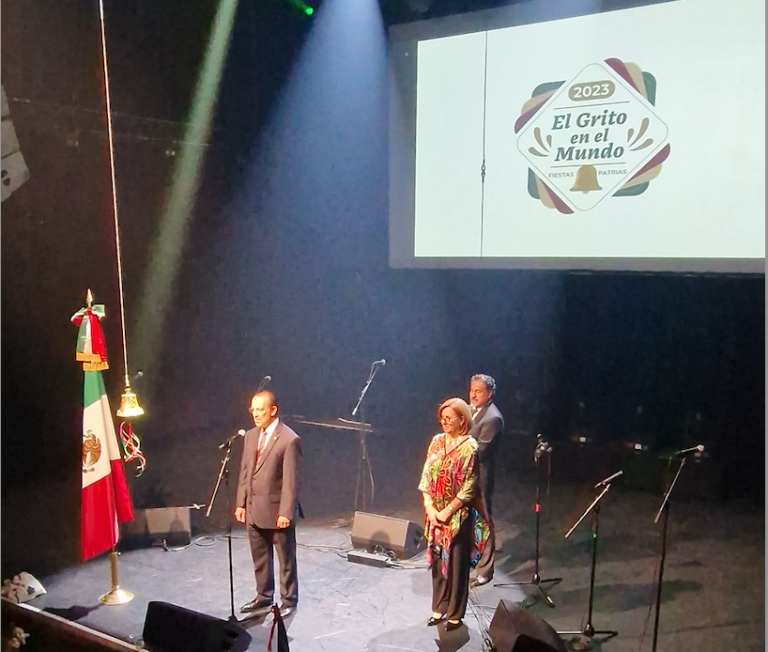
On Friday, September 15th, the Embassy of Mexico in The Hague lit up Paard van Troje with a vibrant and unforgettable celebration of the 213th anniversary of the Independence of Mexico.
‘Noche Mexicana’, as the event was titled, was graciously hosted by His Excellency Mr. José Antonio Zabalgoitia, the Ambassador of Mexico to the Kingdom of the Netherlands. The evening was a testament to the rich cultural heritage of Mexico and the enduring bonds between the two countries.
The festivities kicked off with a reception, where Ambassador Zabalgoitia, his wife Lucía Villalobos. and the dedicated Mexican diplomatic staff warmly welcomed friends from the diplomatic community at large, international organizations in the field of justice, foreign affairs and migration, members of the academic community, as well as Dutch government officials. The guests were so numerous – including ambassadors from Algeria to Uruguay, from Russia to Rwanda, from China to Croatia, from Panama to Ghana, from Azerbaijan to South Africa, from New Zealand to Germany, from Switzerland to Poland, from Costa Rica to Algeria, that it is truly impossible to mention all of them.
Guests had the pleasure of savoring homemade Mexican hors d’oeuvres and enjoying a drink in a unique Mexican traditional atmosphere of camaraderie and friendship.
After the reception, the doors swung open to embrace members of the vibrant Mexican Community, who joined in for a memorable ‘Noche Mexicana’. The heart of the evening traditionally began with the ‘Cry of Dolores’ or ‘El Grito’, a unique ceremony that re-enacts the historic uprising of the Mexican people for independence, which started with the insurrection of Dolores, Mexico on September 16, 1810, when the priest Miguel Hidalgo y Costilla rang his church bell and gave the ‘call to arms’.
What made this rendition even more special was the active participation of the audience, who enthusiastically joined in with their own spirited cries of ‘Viva Mexico’.
Ambassador Zabalgoitia’s remarkable performance showed his expertise during this pivotal moment, absolutely electrifying the atmosphere, infusing it with energy and pride. He exclaimed loudly: ‘Viva to the heroes that gave us fatherland and freedom’, mentioning the names of the fallen heroes who died during the War of Independence and followed by all the guests repeating together with him, in one voice: ‘Viva Mexico!’
As the night progressed, Paard van Troje swelled with the presence of hundreds of diplomats representing nearly every country in The Hague. Alongside were Mexicans, many of whom proudly adorned in traditional attire, creating a gorgeous kaleidoscope of colors. The unity of different nationalities in celebrating Mexican National Day was a heartwarming sight to behold!
For gastronomic enthusiasts, the evening was also a culinary delight, as after the official reception, food was available for purchase from three of the best Mexican restaurants in the Netherlands. The flavors of Mexico transported everyone’s taste buds on a gastronomic journey across this diverse and rich country.
However, it was the Mariachi Ramon Balderas who stole the show, serenading the audience with a repertoire of the most beloved Mexican songs. The joyous response from the crowd was overwhelming, as guests couldn’t resist dancing, singing, and clamoring for more. The exuberance of the audience was obvious, as they swayed to the music, singing, and shouting ‘Viva Mexico’ in one voice. The mariachis had already exhausted the repertoire of the most popular Mexican songs but the audience kept singing, dancing and asking for more.
Mariachi Ramon Balderas, El Grito, National Day of Mexico The Hague 2023.
The ‘Noche Mexicana’ in The Hague was a testament to Ambassador Zabalgoitia’s skill in creating a memorable event which seamlessly united people from different countries, professional and cultural areas, diplomats, officials and Mexican diaspora. It was a night that celebrated not only Mexican culture but also the power of diplomacy and cultural exchange to bring people together!
As the mariachi band played its final note, the night concluded with resounding shouts of ‘Viva Mexico’, echoing the sentiments of unity and friendship that had defined the evening. The warmth and festivity of Mexican National Day in The Hague, under the skillful guidance of Ambassador Zabalgoitia, left an indelible mark on all those who attended. Until the next ‘Noche Mexicana’, the spirit of Mexico will continue to thrive in The Hague. It was the warmest and most festive Mexican National Day we have ever seen.
Brazil Independence Day, also known as ‘Sete de Setembro’ (September 7), is commemorating, each year, the country’s declaration of independence from Portugal in 1822.
In The Netherlands, the 201st Anniversary of the Independence of Brazil was celebrated with a reception at the official residence of Brazil, in Wassenaar. This year’s hosts were H.E. Ambassador Fernando Simas Magalhães, who had just presented his credentials to HM King Willem-Alexander, the day before, together with his wife, Matilde.
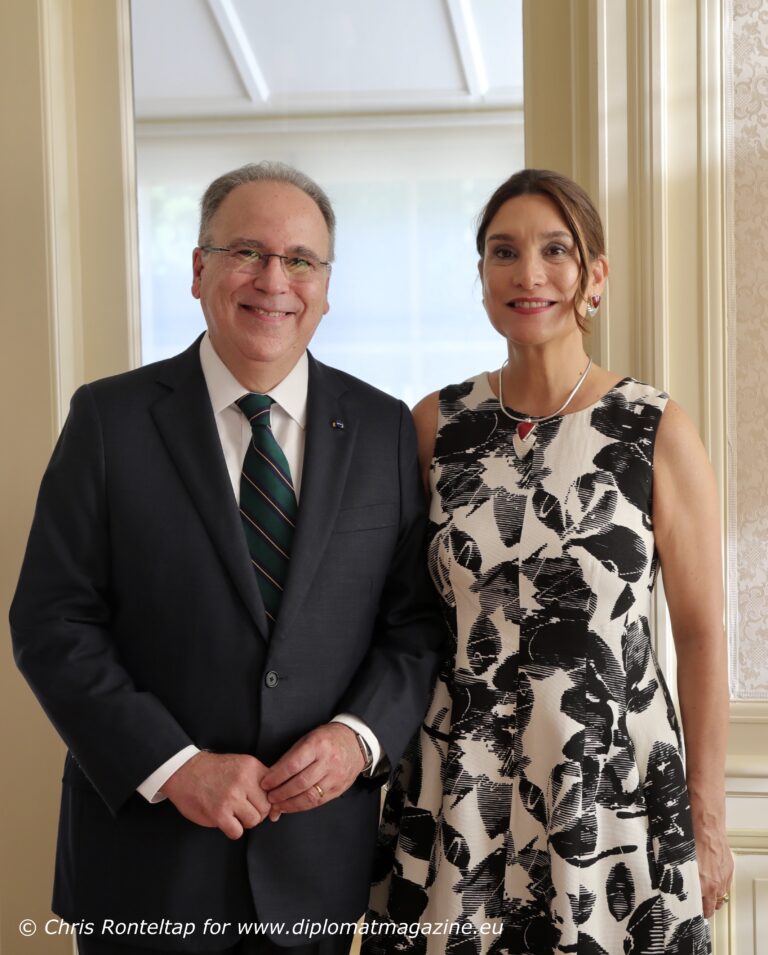
Mrs. Roberta Soares Maia and Mr. Juliano Rojas Maia, Minister-Counsellor of Brazil, Mrs Matilde Simas Magalhães and the Ambassador of Brazil, H.E. Fernando Simas Magalhães.
On a sunny and warm autumn afternoon, this occasion gave rise to great and amicable discussions between the many diplomats who were present, from almost every country and every international organization accredited to The Hague, accompanied by the most delicious Brazilian traditional foods and the very popular Caipirinha, Brazil’s national cocktail.
H.E. Mr. Jaime Moscoso Valenzuela, Ambassador of Chile, Mrs. Junia Fano de Salinas, H.E. Mr. Hernán Salinas, former Ambassador of Chile to the Netherlands, H.E. Mr. José Antonio Zabalgoitia, Ambassador of Mexico, Mrs. Beatriz Piza de Brenes, H.E. Mr. Arnoldo Brenes Castro, Ambassador of Costa Rica, Mrs. Jaana Similä
and H.E. Mr. Ilkka-Pekka Antero Simila, Ambassador of Finland.
The beautiful garden of the Residence was full of animated international and Dutch people, enjoying a celebration of friendship and international diversity.
Ambassador Simas Magalhães, an experienced and internationally awarded career diplomat, with various previous postings from Washington to Madrid or Quito, gave a warm and insightful speech to the large audience.
‘The long friendship between Brazil and the Netherlands is a testament to the power of international cooperation. Our shared values of democracy, diversity, freedom and innovation have forged a strong bond that continues to bear fruit. Over the years, our bilateral relations have spanned a wide array of fields, from trade and investment to education and research. The exchange of knowledge and experiences has empowered us to tackle global challenges together, from sustainable development and climate change to health and technology. As we celebrate Brazil’s progress and achievements on this special and festive occasion, we also commemorate the enduring partnership with The Netherlands’.
H.E. Ambassador Fernando Simas Magalhães.
The Ambassador mentioned the numerous people who contributed, throughout the years, to strengthen ties between the two countries. Political leaders, government officials, civil servants, businessmen, scholars, artists, students and professionals from various fields have all contributed to the current bilateral relations.
He noted that ‘a clear example of the importance of the bilateral relations is the number of high-level authorities’ meetings held in the past few months. Prime Minister Mark Rutte met with President Lula in Brasília, in May, and HM Queen Maxima visited Brazil, last June, in her capacity as Special Advocate of the UN Secretary General for Inclusive Finance for Development’.
H.E. Mr. Rene Violenus, Minister Plenipotentiary of Sint Maarten, IOM Chief of Mission, Mr. Antonio Polosa, Mrs. Sviatlana Yeudachenka, H.E. Andrei Yeudachenka, Ambassador of Belarus, H.E. Ms. Rawan Sulaiman, Palestine Chief of Mission, Mr. Grigovy Orlov, Minister Counsellor of the Russian Federation. Ms. Minou Tavarez Mirabal, Chair of the Board of Directors of the Trust Fund for Victims at the International Criminal Court and the Ambassador of Costa Rica, H.E. Mr Arnoldo Brenes Castro.
The two countries collaborate on many levels, from artificial intelligence to sustainability, bio-economy or agriculture.
‘Brazil’s notable standing as agricultural producer aligns with the Netherland’s pre-eminence in agricultural technology, both countries being important food exporters and world suppliers, equally zealous of their agricultural potential’.
The Ambassador also mentioned that Brazil has volunteered to host the 30th Conference of the Parties to the UN Framework Convention on Climate Change (COP-30), in the Amazon, in 2025.
‘While assessing global actions to face the challenge of keeping our international commitments, our countries will have to embrace the newest technologies in renewable energies’.
He then added that, ‘in 2022, international trade between Brazil and the Netherlands amounted to 14 billion dollars, while the Dutch investment in our country reached the amount of 126 billion dollars. There is great potential for growth, including in food, agriculture, energy and in the defense sector’.
H.E. Mr. Jožef Drofenik, Ambassador of Slovenia and the Ambassador of Ukraine, H.E. Mr. Oleksandr Karasevych.H.E. Mr. Carlos Aguello Gomez, Ambassador of Nicaragua to the International Organizations and Mrs. Sherly A. Noguera de Argüello, Minister Counsellor of Nicaragua. Ambassador Sheikh Mohammed Belal, CFC
Managing Director, H.E. Ms. Sahar Ghanem, Ambassador of Yemen, UN IOM Chief of Mission, Mr. Antonio Polosa and H.E. Mr. Almir Sahovic, Ambassador of Bosnia & Herzegovina.
Meanwhile, ‘Brazil has been and will remain an active participant on the discussions held at the legal multilateral organizations in The Hague, the capital of international justice. We are glad to see one of our most talented jurists, Leonardo Nemer Caldeira Brant, assume the daunting task of succeeding Professor Antonio Augusto Cançado Trindade at the International Court of Justice.
We also look forward to receiving the Secretary-General of the Permanent Court of Arbitration in the coming months in our country. And, at the HCCH, we are proud that it was a Brazilian, Professor Marcelo de Nardi, who presided over the last meeting of the Council on General Affairs and Policy, during which the historic decision to recognize Spanish as an official language of the organization was taken’.
H.E. Mr. Mohamed Basri, Ambassador of Morocco and H.E. Mr. Diarrassouba Mifougo Youssouf, Ambassador of the Republic of Côte d’Ivoire.Mr. Alexandru Ion Steriu, Embassy of Romania’s Deputy Head of Mission and H.E. Álvaro González Otero, Ambassador of Uruguay.
In his speech, the Ambassador pledged his country’s commitment to continue to be an active participant in addressing the important objectives of the Organization for the Prohibition of Chemical Weapons (OPCW), to contribute with other member states to overcome current challenges.
Pianist Elizabeth Fadel
He also thanked the companies that made the event possible: BRASKEM, CUTRALE, EMBRAER and SEARA, and also the people responsible for the evening’s cultural performances: pianist Elizabeth Fadel, who has presented her beautiful renditions of both the Dutch and Brazilian anthems, and then continued with some renowned Brazilian “chorinhos”, in collaboration with the Brazilian Music School of Rotterdam.
This week saw the beginning of the biggest antitrust trial since the 1997 case against Microsoft. Google is under fire for monopolizing its search engine. Several of the big tech companies are being looked at. Not just the public, but the administrations in the US, the EU, Britain, etc. are getting nervous about their size and influence. Size and power are only a few of their worries. Elon Musk can on his own take a 44 billion dollar company and break it, firing thousands of employees at will. Like an old-fashioned potentate, he can decide what is free speech and what isn’t. Facebook, TikTok, Apple, and Amazon have been in rough water too for a variety of reasons, all to do with abuse of power.
But last week a new and very scary development was made public in a new book about Elon Musk. It mentioned that Musk admitted that he had cut off his satellite services in the area around the Crimea to stop a Ukrainian attack on the Russian fleet. It appeared that he had done so after talking to Russian diplomats. Funnily enough not much was written in the media about this momentous event. The fact that one man, one private man, can influence battlefield tactics, is too crazy for words. It is hard enough for the experts in the Pentagon to assess a nuclear threat. They have experience, contacts, and many sources of information, but still, it is hard. For a single person to evaluate the arguments of the Russians is impossible.
Today many companies broadcast their intention to be “good global citizens”, and to take care of all stakeholders, not just of the shareholders. Just imagine that Google, for instance, involving their “Do no harm” credo, decides that Ukraine continuing the war is bad for the planet and cuts off all of its services there until Ukraine is willing to sit down with Russia and forge a compromise. What if any of the big cloud companies refuse to sell cloud space to companies, whose climate or woke policies they don’t like? The more you think about it, the scarier it becomes.
What if having “green goals” means that a major company decides to refuse to do business with other companies or individuals they consider insufficient in dropping fossil fuels, even though they are well within government limits? What if companies become so woke as to demand a 50% female and 50% colored managerial staff in any company with which they do business?
Companies and individuals should stay away from areas that rightfully belong to the administration, the legislation, or the judiciary.
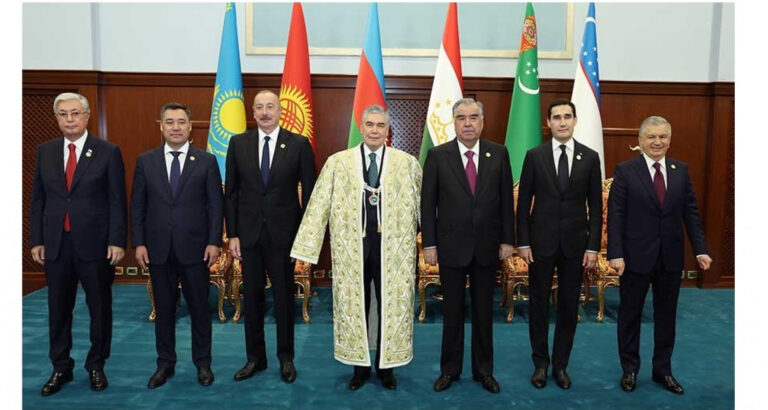
On September 14, 2023, Chairman of the Halk Maslahaty of Turkmenistan Gurbanguly Berdimuhamedov, at the invitation of the President of Tajikistan Emomali Rahmon, paid a working visit to the Republic of Tajikistan.
At the Dushanbe airport, a meeting was held between the National Leader of the Turkmen people and the Prime Minister of Tajikistan, during which issues of interstate cooperation, including the development of inter-parliamentary relations, were discussed.
In the afternoon, a solemn ceremony was held at the Kasri Millat Palace to award the National Leader of the Turkmen people, Chairman of the Halk Maslahaty (People’s Council) of Turkmenistan Gurbanguly Berdimuhamedov with the Honorary Badge of the Heads of State of Central Asia.
Addressing the leaders of friendly countries, Arkadag expressed gratitude for presenting him with this high award.
In his speech, the Leader of the Turkmen people emphasized that our countries have extensive natural resources, strong industrial and technological potential, which implies the development and strengthening of cooperation. Their unification, the creation of profitable partnership production lines, integration and cooperation corridors are a pressing topic. It was also noted that Central Asia is one of the cradles of world civilization, located at the crossroads of the Great Silk Road.
Arkadag also noted that the countries of Central Asia cooperate fruitfully within the framework of international organizations. This is evidenced by the Resolutions adopted by the UN General Assembly, initiated by the countries of Central Asia.
On behalf of the President of Turkmenistan, Serdar Berdimuhamedov, the Chairman Halk Maslahaty invited all dignitaries to take part in the celebrations planned in 2024 on the occasion of the anniversary of the Turkmen thinker and poet Magtymguly Pyragy, which will be held at the highest international level.
Once again thanking for the honorary award, the National Leader of the Turkmen people assured that, for his part, he would continue to fully contribute to strengthening the friendly and good-neighborly ties connecting our countries.