Arusha, The Hague, 13 August 2021 – The Secretary-General of the United Nations, Mr. António Guterres, has appointed Judge Fatimata Sanou Touré of Burkina Faso to the roster of Judges of the International Residual Mechanism for Criminal Tribunals (“Mechanism”), effective 12 August 2021.
Judge Sanou Touré is a magistrate de grade exceptionnel (senior member of the national judiciary) in Burkina Faso. Since October 2015, she has served as Chamber President at the Court of Appeal of Ouagadougou, and from 2012 to 2015 served as President of the Court of First Instance of Ouagadougou, the largest court of first instance in Burkina Faso. Before that, Judge Sanou Touré worked from 2007 as the senior investigating judge with the rank of Vice-President of the Court of First Instance of Ouagadougou.
Judge Sanou Touré’s work in defending and promoting human rights led to her being elected President of the Association des Femmes Juristes du Burkina Faso (2013 to 2017) and Vice-President of the Fondation pour l’Étude et la Promotion des Droits de l’Homme en Afrique. She is also a founding member of the African Women Leaders Network for the Promotion of Sexual and Reproductive Health and Family Planning. As a member of the national constitutional commission representing women’s associations and as deputy rapporteur of that commission, Judge Sanou Touré participated in the preparation of the preliminary draft constitution of the Fifth Republic of Burkina Faso (2017). In addition, she has represented the African group on the Women’s Advisory Council of the Organization of Islamic Cooperation since November 2019.
Judge Sanou Touré was appointed to the Mechanism’s roster of Judges following the unfortunate passing of Judge Gberdao Gustave Kam in February 2021 and will serve the remainder of Judge Kam’s term of office, which expires on 30 June 2022.
In accordance with its Statute, the Mechanism has a roster of 25 independent Judges who serve both the Arusha and The Hague branches of the Mechanism,
An Italian surgeon, Dr. Gino Strada, who was also a human rights activist and founder of Emergency, an NGO providing life-saving medical care in war torn regions, has died at the age of 73.
Dr. Strada had set up hospitals in states such as Rwanda and Yemen and had treated more than 11 million people in up to 19 countries.
Dr, Strada earned his medical and surgical degree at Milan State University, specializing in emergency surgery. He has experience in the United States by working up to 4 years on heart and lung transplants at Stanford and Pittsburgh University Medical Center.
In 1994, he established Emergency together with his wife, Teresa Sarti, and friends and colleagues. The organization’s mission was to provide free, quality healthcare to people injured in conflict.
There have been several forest and bush fires that have left Italian firefighters with no time to rest as they tackle flames from the air and the ground amid a weekend heat wave.
Fire crews have reported 400 operations in the past 12 hours on Saturday morning.
Extreme heat and persistent drought have encouraged flames to persist in large parts of the south since the end of July.
Authorities do suspect arson behind many of the fires.
On Saturday, the Carabinieri in Sicily reported the arrest of two cattle farmers, a father, and his son, who are accused of setting fire to thorny bushes in order to expand their grazing land. After an intensive investigation, a warrant for their arrest was issued.
Protesters have marched in cities across France for a fifth consecutive weekend against rules compelling them to show a COVID-19 health pass for daily activities, but in lesser numbers than a week ago.
Since last Monday, citizens have been required to show the pass in public places, proving that they have been vaccinated or have recently been tested negative for the coronavirus.
Vaccination rates jumped after Macron unveiled his health pass plans last month. Almost 70% of all French people have now received one dose and 57.5% are fully vaccinated.
About the author:
Michelle Rahimi is a Diplomacy and International Relation’s Master’s candidate at the School for International Training, located in Brattleboro, Vermont, United States of America.
She obtains an extensive passion for international relations with first-hand knowledge from traveling across many countries and is experienced in working with different teams and individuals from diverse cultural and socio-economic backgrounds.
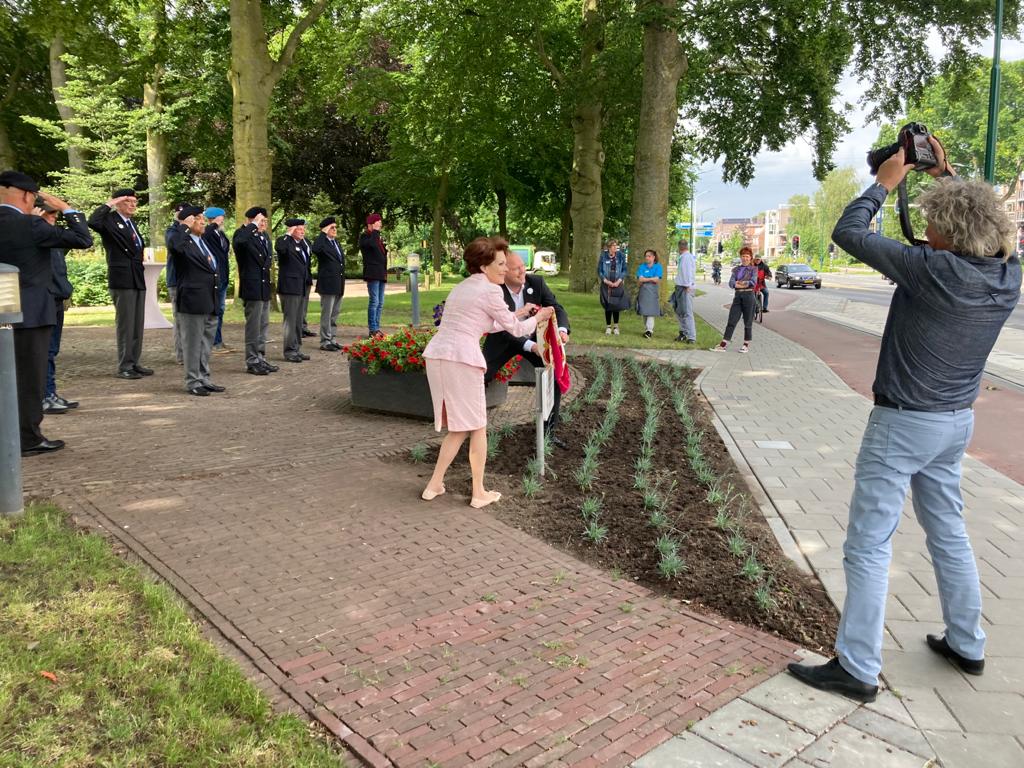
As the tradition has mandated, numerous white carnation gardens have been inaugurated across the Netherlands to honor the nation’s veterans.
Recently, the ambassador of Bangladesh, H.E. Mr. Riaz Hamidullah and his wife Sazia have become a part of this tradition by joining the symbolic unveiling of the white carnation garden celebration with several Dutch veterans at the Museum Sophiahof-van Indie. Ms. Maja Steenwijk, veterans volunteer, as well as the Director of the Museum, Mr. Reiner van Ooijen were also in presence.
The Mayor of Wassenaar, Ms Maja Steenwijk and veterans.
It was a symbolic and powerful celebration with veterans who served in Sarajevo, Mali, Kabul, and other sites in attendance as well. The inauguration took place in the town of Wassenaar, with the opening of the garden celebrated by placing white carnations in the coats of those who dedicated their time to serving their country.
Inaugurating Veenendaal’s white carnation garden.
On this day, the Dutch people made a point to also plant white carnations in their own gardens as the veterans’ plant theirs at the museum.
Ms. Maja Steenwijk has dedicated her time to promoting the opening of even more white carnation gardens by asking for the support of mayors of several cities and villages to organize and plant them as appreciation for the veterans who have served.
Up to now, she has contributed to the creation of about 60 white carnation gardens in Holland. Ms. Steenwijk has recently unveiled some of these white carnation gardens with the mayors of Rotterdam, Bloemendaal, and Wassenaar.
By next year, it is expected that we will see a white carnation garden at the Peace Palace, with the event already on the schedule of the Director General, Erik de Beaedts.
(C)Roel Dijkstra-Vlaardingen – Foto Dennis Wisse
Rotterdam / Oude Plantage / opening van een Witte Anjerperkje / met o.a. burgemeester Aboutaleb
The Pandemic has made us realize more than ever before how indispensable Arts and Culture are as part of our well-being in difficult times. This is significant when even a newly retired former Ambassador to the Netherlands has just joined The Arts Society The Hague! As its new Chairman, Andrea Perugini, who has recently completed his term as Ambassador of Italy will join the Society’s efforts in further consolidating and expanding the already wide and attractive range of activities and initiatives and will add a special dimension to its upcoming 30th Anniversary season
The Arts Society, originally known as The Decorative and Fine Arts Society, is a British institution which has, since its inception more than 50 years ago, brought art in all its forms to its membership and to everyone who is interested in widening their appreciation of the arts. During this time it has expanded to over 380 member societies, not only in the UK but in Continental Europe where France, Germany, the Netherlands, Belgium, Spain and Malta have societies, further afield in New Zealand and, through affiliations, Australia too.
As the only Society of its kind in the Netherlands, The Arts Society The Hague -whose Patron is H.E. the Bristish Ambassador in The Hague – is in a unique position to offer top-class lectures in English given by lecturers who have been carefully vetted and are all recognised as experts in their field. Besides high quality lectures, the Society also offers, to both its members and guests, special events in the form of visits to museums, galleries and private collections, all led by English-speaking guides.
Lectures cover an extraordinarily broad range of topics, from the art of ancient civilizations to modern artists and sculptors such as Grayson Perry and Antony Gormley, Japanese modern art, architecture, music and, beyond, to eclectic subjects such as film, fireworks and trompe l’oeil.
The Society has its base in the Warenar theatre in Wassenaar and traditionally has been very much focused on The Hague area but now, with the advent of Zoom, its lectures are available throughout the Netherlands and, in fact, worldwide.
For this, its 30th Anniversary season, the Society will offer a very special and expanded programme of lectures and events for members, all to be announced at the beginning of the new season.
In a recent interview, we asked its Chairman, Mr. Perugini, why he had decided to dedicate himself to the Arts after his long and successful diplomatic career, his response was:
The Arts and Culture are an integral part of any Diplomat’s life. Especially of an Italian Diplomat’s professional life and activities. Italy is a cultural powerhouse, with among the greatest numbers of UNESCO cultural heritage sites in the world. Culture is also an instrument of foreign policy, of cooperation, for promoting dialogue and understanding between peoples of different roots and historical backgrounds. But culture is at the same time universal, it brings to the fore our common roots, our common human feelings for beauty, harmony, colour, and well-being. It helps bring us together, reaching out. It helps to understand better those whom we superficially perceive as different. As a former Italian President of the Republic used to say: “Acquire knowledge before passing judgement.”
After receiving this remarkable answer, we asked him whether there was any correlation between diplomacy and art in his previous life. Once again, we were met with a notable response:
I may have already answered this question in my comment above. I would like to add that Arts and Culture are also a means to promote not only cultural exchanges and ties between countries and peoples; they also promote business, tourism, education, human and social relations as well as good and healthy habits, which includes knowledge of the vulnerabilities of our planet and all that goes with it. When I was a young diplomat posted in Luanda, Angola, I bought a painting from a then unknown Angolan artist called Victor Texeira (in art, Viteix). Now, thirty-five years later, I discovered that Viteix became one of the most prominent Angolan and African artists, his paintings were in the meanwhile exhibited at the Venice Biennale, as he represents one the main iconic painters who contributed, through art, to the struggle for African independence in the second half of the XX Century. So, as you can see, art is limitless in what it can do.
Not only is Mr. Perugini the first and only Italian to be appointed Chairman of the Arts Society in the Netherlands, but he is coming into a prominent thirtieth Anniversary season, as well as during a Pandemic that has made many realize how impactful and beneficial the Arts and Culture can be .
We asked the former ambassador what he intended to do to enhance the participation of the members and newcomers during the time of the Pandemic, he responded:
I was already a member of The Arts Society in The Hague when I was Ambassador of Italy to The Netherlands because I appreciated the very high cultural standard of their lectures and the captivating way in which their lectures are able to deliver them, by stimulating interest, drawing connections and historical parallels, by sharing their personal experiences and by being available to answer questions and provide enthusiastic and well-informed advice to participants. Since I became Chairman, I have engaged to expand the membership of The Arts Society; it is like a medicine, it is beneficial to me, so I am confident that it would do good to others as well. It is invaluable and I am grateful to Diplomat Magazine for helping disseminate this knowledge. During the Covid pandemic The Arts Society in The Hague has quickly adapted to circumstances by moving to online Zoom Lectures. The challenge has become an opportunity since we were able to actively preserve our membership and, in addition, to expand it. We shall continue on Zoom for the moment. But we are prepared to move back gradually to “in person” lectures while keeping the Zoom option open for our members. We all need to socialize and enjoy the Arts and Culture together.
Mr. Perugini and The Arts Society in The Hague have been able to not only survive but expand during the pandemic. This is a wonderful example of how vital Arts and Culture is to society and its good fortune.
The Arts Society in The Hague has reported that it has been able to expand providing lectures from its base in the Warenar theatre in Wassenaar, traditionally being focused in the Hague area, to a worldwide audience with the advent of Zoom.
It will be intriguing to witness how The Arts Society in The Hague continues to grow and flourish under Mr. Perugini’s leadership and all that is to come.
The southeastern crater of Italy’s Mount Etna has increased in height after six months of activity, making Europe’s tallest active volcano more pronounced than ever.
Mount Etna’s youngest and most active crater is now above sea level at 11,000 feet, breaking a new record, according to the National Institute of Geophysics and Volcanology (INGV).
Since mid-February there have been nearly fifty episodes of ash and lava being released from the crater leading to a transformation of the volcano’s outline, which has been calculated through satellite images.
Mount Etna has apparently been more active since February, posing threat to surrounding villages, with ash being released damaging crops, dirtying streets, slowing traffic, and creating a nuisance in surrounding areas.
On Tuesday, France’s government warned of a Covid-19 crisis in the country’s overseas territories, including the Caribbean, and Martinique.
It is reported that infection rates have climbed to levels that are unprecedented on France’s mainland.
Martinique tightened a lockdown and told tourists to leave, with similar measures being implemented in the French overseas territory of Guadeloupe.
This has negatively affected the Caribbean islands at the height of the summer season.
Regarding these overseas territories, it is reported that the Delta variant is more contagious and is about to hit a population that is not well protected by vaccinations.
About the author:
Michelle Rahimi is a Diplomacy and International Relation’s Master’s candidate at the School for International Training, located in Brattleboro, Vermont, United States of America.
She obtains an extensive passion for international relations with first-hand knowledge from traveling across many countries and is experienced in working with different teams and individuals from diverse cultural and socio-economic backgrounds.
Italy is in the grip of its worst period of extreme weather in recent history. There has been a non-stop influx of record high temperatures, wildfires, hailstorms, tornadoes, and mudslides.
It is predicted from a leading climate expert that this may be the “new normal,” for Italy.
The first economic sector to suffer the consequences of the climate crisis was agriculture, with a year’s worth of fruit and vegetables lost in a matter of moments.
Climate experts are stating that Italians are seeing the impact of a lack of action towards climate change.
France has begun to require people to a show a QR code proving they have special virus pass before they can enjoy restaurants, cafes, or travel across the country.
The plan has been implemented by the government to encourage more people to get a COVID-19 vaccine shot as well as slow down a surge in infections. Over half the population in France is vaccinated.
The special pass is issued to people who are vaccinated against COVID-19 or have proof of a recent recovery from the virus or who have a recent negative test.
The measure has initiated strong opposition from some people who say it compromises their freedoms by limiting movements and daily activities outside the home.
On Saturday, thousands of demonstrators marched in Paris and other French cities for a fourth consecutive week of protests against the health pass.
About the author:
Michelle Rahimi is a Diplomacy and International Relation’s Master’s candidate at the School for International Training, located in Brattleboro, Vermont, United States of America.
She obtains an extensive passion for international relations with first-hand knowledge from traveling across many countries and is experienced in working with different teams and individuals from diverse cultural and socio-economic backgrounds.
H.E. Alexander Shulgin and Dr. Mayelinne De Lara. Launching Diplomat Magazine 2021-1 Pictures by Timur Seragetdinov.
By Roy Lie Atjam
The Hague, 5 August 2021- Scores of Ambassadors, diplomats and international agents gathered at the Leonardo Royal Hotel Den Haag to celebrate the launch of the 2021 –1 edition of Diplomat magazine.
Among the attendees were Ambassadors and diplomats from Malta, Argentina, Armenia, Greece, Russia, Vietnam, India, Tanzania, Uzbekistan, Burundi, Venezuela, Belarus, Bosnia & Herzegovina, the USA, Azerbaijan, Bulgaria, Kazakhstan, Guatemala, Kuwait, Kyrgyzstan, Saudi Arabia, Lebanon, Tanzania, Yemen, Panama, South Africa, Peru, Rwanda, just to mention a few. There were also representatives from various international institutions who were also on hand, such as IOM, IHE Delft as well as many others to join in the celebration of the occasion.
H.E. Arnoldo Brenes Castro, Ambassador of Costa Rica, H.E. Marisol Aguero Colugna, Ambassador of Peru and H.E. Irene Florence Mkwawa Kasyanju, Ambassador of Tanzania.
The cover of the 2021-1 edition of Diplomat Magazine featured the President of the Russian Federation, Vladimir Putin. The launch was a major post-corona event in diplomatic life in The Hague. It has certainly been a grand reunion of members of the diplomatic community. The evening also featured live entertainment provided by the Daniel Nicolas Jazz Band which all in attendance thoroughly enjoyed.
Dr Mayelinne De Lara, publisher of Diplomat magazine opened the evening by warmly welcoming the guests.
Dr. De Lara went on to thank President Putin for honouring Diplomat magazine with his stimulating article.
H.E. Mr Alexander Vasilievich Shulgin, the Russian Ambassador in the Netherlands delivered the keynote address. The Ambassador stressed on some noteworthy points from President Putin’s speech. Dr De Lara in her welcome address entitled “Reinventing Diplomacy” touched on the effects of the pandemic and expressed gratitude to the many contributors of this issue.
H.E. Dilyor Khakimov, Ambassador of Uzbekistan, H.E. Alexander Shulgin, Ambassador of Russia and H.E. Muktar Djumaliev, Ambassador of Kyrgyzstan.
Here is Dr De Lara’s speech.
Excellencies, this is more than ever before, a real privilege to be here all together for the first time in a long time. The pandemic gave the diplomatic community the opportunity to demonstrate its innate resilience and sense of duty.
We have all the opportunity to discover new ways of living and working, other ways of moving ahead, new solutions and implementing new ideas.
“A new Covid diplomacy arrived and diplomacy in all, has been reinvented”.
H.E. Ms Sahar Ghanem, Ambassador of Yemen.
We wanted to see you all before summer vacations and celebrate with you the new issue of Diplomat Magazine but more importantly, celebrate your efforts authoring unique articles making the magazine a source of knowledge, more than a collection of social pictures.
Special thanks to H. E. Philippe Couvreur, for his valuable work and dedication to the French part of the magazine
China, Serbia, and Russia are enforcing international cooperation and partnership. Greece, Costa Rica and Perú made special contributions celebrating their 200th anniversary. The Ministers of Foreign Affairs of Argentina and Paraguay talk about 30 years of Mercosur and the minister of New Zealand, and the ambassador of Croatia reflect on diplomacy from a pandemic perspective. It is a solid content; impossible to mention each article, they are all unique.
H.E. Irene Florence Mkwawa Kasyanju, Ambassador of Tanzania and H.E Mr. Gamaliel Nkurunziza, Ambassador of the Republic of Burundi.
Thanks to the embassies of Croatia, Argentina, Uzbekistan and Russia for wine, vodka and caviar. Thanks to Leonardo Royal Hotel for organizing our events.
Special thanks to the embassies who help us to publish the inedit articles of six ministers of foreign affairs and the incredibly special contribution of the president of the Russian Federation, Mr. Vladimir Putin which is the cover page of the magazine.
Saudi Arabia, Mr Neshael Al Beleui, First Secretary, Armenia Mr. David Mirzakhanyan, Second Secretary and Ms Viviana Kalaejian, Attaché from the Embassy of Armenia.
Dr De Lara was followed by the keynote speaker of the evening, the Russian Ambassador in the Netherlands H.E. Alexander Vasilievich Shulgin who delivered a captivating discourse.
Speech by the Russian Ambassador H.E. Alexander Vasilievich Shulgin
Thank you so much that you have found an opportunity to visit our event. It has been quite some time since we’ve met in such a pleasant company. I do really hope that the worst – although necessary – days of quarantine are over and now we can see each other more frequently.
As you already know today’s evening is dedicated to July’s edition of the «Diplomat Magazine» which, adhering to the basic democratic principle of freedom of speech, has published an article by the Russian President Vladimir Putin.
Diplomat Magazine, adhering to the basic democratic principle of freedom of speech, has published an article by the Russian President Vladimir Putin BEING THE first time in THE COVER OF a Dutch magazine in a long time, explained Ambassador Shulgin
I salute you, Ms. De Lara, and your editors as well, for being so open-minded, because this is the first time in a long time that a Dutch magazine put President Putin picture on the cover.
This is not a secret – our two countries (or Russia and the Western world in general) are currently experiencing not the highest period in bilateral relations. Nevertheless, it is my deepest belief that we as nations share the same human principles as people all over the world.
Ambassador Shulgin during his memorable speech.
We share centuries-long history – it was Peter the Great personal experience in the Netherlands that helped him to transform his home country. We share culture – we, Russians, love Van Gogh and Rembrandt, you, I believe, love Tchaikovsky and Tolstoy, we love Dutch football and you love Russian ballet. But most of all we all love our children and grandchildren very much and want them to live in a happy and safe world. Therefore, we have very much in common.
In his article “Being open despite the past” President Putin starts from the tragic pages of our history then draws a bridge toward current days and then lays out his vision of our future. His main audience is you, European people in general, those who we share the continent with, because our country is a part of this European “world”.
H.E. Arnoldo Brenes Castro, Ambassador of Costa Rica, H.E. Marisol Aguero Colugna, Ambassador of Peru, H.E. Elizabeth Ward Neiman, Ambassador of Panama, H.E. Mark Anthony Pace, Ambassador of Malta and a diplomat from USA.
The President emphasizes the crucial part that the Soviet Union and Red Army had played in liberating Europe from the Nazis and saving it from enslavement, and also warns against modern attempts to rewrite the history and glorify Nazism.
The article is full of hope and faith that working together people of good will can help the world to avoid sliding into the nuclear Armageddon.
The essential part of success is to respect each other while finding solutions to the current challenges and threats. We have many topics of mutual interests such as security and strategic stability, healthcare and education, energy, culture and science, climate and environmental issues.
Ambassador Shulgin Pointed to the Article by Minister Lavrov
On a different note, Minister Lavrov in his article “The law, the rights and the rules” underlines the importance of adhering to the universal principals of international law with the UN Charter as its primary source, not the disruptive “rules-based” world order concept. “We will persist in promoting the emergence of an international relations culture based on the supreme values of justice and enabling all countries, large and small, to develop in peace and freedom”, says the Minister. Judging based on his unique years-long experience as the head of the Russian Ministry of Foreign Affairs he offers the shortest way to our joint goal of peace and prosperity – sticking to the international law and the UN as the vital part and key element which the whole post-WWII world architecture was built upon.
Dr. Mayelinne De Lara, H.E. Dilyor Khakimov, Ambassador of Uzbekistan, Russia Press Attache, Irina Gridina, H.E. Muktar Djumaliev, Ambassador of Kyrgyzstan and Mr. Roy Lie Atjam, Diplomat Magazine Editor. Launching Diplomat Magazine 2021-1 Pictures by Timur Seragetdinov
I encourage you, ladies and gentlemen, to read the articles and think President Putin and Minister Lavrov ideas over. I am positive that we all have nothing to lose but a whole lot to gain if we intensify our cooperation.
To conclude, dear Ms. De Lara, I would like to present you this book named “On the fronts of diplomacy. 1941-1944”. It is a unique edition containing pictures and important historical documents on the work of Soviet and foreign diplomats during the Great Patriotic War.
Thanks to Leonardo Royal Hotel, thanks you for your attention and, please, enjoy your evening.
The evening was indeed an enjoyable and all the guests left the Leonardo Royal Hotel in high spirits.
The EU Commission has approved the modification of seven Operational Programs for the European Regional Development Fund (ERDF) and the European Social Fund (ESF) in Italy and Spain under REACT-EU for a total of over 1.8 billion.
These resources are to mainly be invested in strengthening the health system through the purchase of respirators, protective equipment, and IT devices, support the digitalization of the administration, increase energy efficiency and climate risk prevention and management, and much more.
The State Department has advised Americans to avoid all travel to France because of the growing number of coronavirus infections in the country currently.
France is said to be battling a fourth wave of the virus and the State Department has issued a “Level 4: travel ban” recommendation for France.
France has recorded more than six million infected and 1,11,000 dead in the pandemic. The daily number of infected has returned to the figure of about 20,000 during the peak of the pandemic, whereas the number of dying individuals remains low compared to this time.
Lionel Messi has officially joined Paris Saint-Germain on a two-year contract, after leaving Barcelona.
The football star had been expecting to extend his time at Barcelona where he spent the last 21 years, even agreeing to take a 50% pay cut in the new deal, however the Spanish club was still unable to proceed due to “financial obstacles.”
Messi was greeted by hundreds of PSG fans as he arrived at the Le Bourget Airport in Paris on Tuesday afternoon and passed his medical before signing his contract.
Messi said: “I am impatient to start a new chapter of my career in Paris.”
About the author:
Michelle Rahimi is a Diplomacy and International Relation’s Master’s candidate at the School for International Training, located in Brattleboro, Vermont, United States of America.
She obtains an extensive passion for international relations with first-hand knowledge from traveling across many countries and is experienced in working with different teams and individuals from diverse cultural and socio-economic backgrounds.
All attending chiefs of mission exchanged ideas on how to further strengthen the cooperation between Germany and their homelands with Governing Mayor Müller, and other officials of the city-state of Berlin.
Michael Müller is a German politician serving as the Governing Mayor of Berlin since 11 December 2014.
On the image from left to right: First row: Ambassador Pedro Villagra Delgado (Argentina); Governing Mayor of Berlin, Michael Müller; Ambassador Mosharraf Hossain Bhuiyan (Bangladesh), Ambassador Hafsa Abdulla Al Ulama (United Arab Emirates); Ambassador Ram Kaji Khadka (Nepal).
Second row: Ambassador Dr. Hyun Ock Cho (Korea); Ambassador Ramūnas Misiulis (Lithuania); Ambassador Dr. Mohammad Faisal (Pakistan); Ambassador Christelle Sohun (Mauritius); Ambassador Thomas Boniface Amolo (Kenya); Ambassador Tatiana García Silva (Nicaragua); Ambassador Frantz Bataille (Haiti).
Third row: Ambassador Yama Yari (Afghanistan); Ambassador Prof. Dr. Levan Izoria (Georgia); Ambassador Jill Gallard (United Kingdom of Great Britain and Northern Ireland); Ambassador Philip Green (Australia); Victor Ndocki (Cameroon).
Fourth row: Ambassador Abdelmoniem Elbeiti (Sudan); Ambassador Dr. Giovanni Xuereb (Malta); Ambassador Tomáš Kafka (Czechia); Ambassador Enrique Alberto Thayer Hausz (Panama); Ambassador Phen Savny (Cambodia)
In the picture fltr Father Sir Jorgedy Bago, KGOR, Sir Albert Arevalo, KGOR, HE Ambassador J. Eduardo Arevalo, Sir Lino Paras, KGCR, Sir Anton Lutter, KCR and Sir Tony Guansing, KGCR.
By Anton Lutter
The current ambassador of the Philippines to The Netherlands H.E. J. Eduardo Malaya in his distinguished career previously served as a young diplomat at the embassy in Brussels. Many remember him fondly, one of them is Sir Lino Paras, KGCR with the Pro Patria award the highest awarded knight of Rizal in Europe.
So wonderful memories were brought back during the meeting with the visitors from Belgium at the Philippines embassy in The Hague. The delegation of the Knights of Rizal – the official order of knighthood of The Philippines – consisted of its leader Regional Commander of Europe Sir Albert Arevalo, KGOR, Over-all adviser Europe Region Sir Lino Paras, KCGR both from Brussels; former Honorary Consul and past Regional Commander of Europe Sir Tony Guansing, KCGR, Father Sir Jorgedy Bago, KGOR, Spiritual Adviser Europe Region and priest for the Philippines community and Stella Maris seamen’s mission at Antwerp.
From The Netherlands Sir Anton Lutter, KCR chapter commander of the Knights of Rizal in The Hague attended the joyful gathering at a temporary address since renovation is taking place at the embassy.
Ambassador J. Eduardo Malaya who represents his country since April of this year is very active and forceful in meeting up with key persons, organizations and businesses in The Netherlands as well as advancing different kinds of activities to strengthen the ties between our countries.
2021 marks the celebration of the 70th anniversary of the establishment of the diplomatic relations between The Philippines and The Netherlands. To that end the Second Philippines-Netherlands Bilateral Consultations were held on 29 June on virtual mode, hosted by the Philippines. This meeting which was co-chaired by Jaime Victor B. Ledda, assistant secretary for European Affairs, and Karin Mössenlechner, director for Asia and Oceania of the Ministry of Foreign Affairs at The Hague.
Ambassador J. Eduardo Malaya presents his book to Sir Albert Arevalo, KGOR. Knights of Rizal European leadership visit Ambassador J. Eduardo Malaya in The Hague
Discussed were matters of mutual interest, notably on political and economic cooperation, development cooperation, maritime cooperation, security, and people-to-people linkages. The decades long engagement in these fields of both countries will be continued, as the Joint Statement concluded.
The establishment of an honorary consulate of the Kingdom of The Netherlands in Davao City, gateway for the island of Mindanao and a highly successful tourist destination, is a welcoming new initiative by both governments. The joint statement confirmed the strong and sustainable bond between The Netherlands and The Philippines.
The ambassador reiterated the importance of the Knights of Rizal in promoting the legacy of Philippines’ national hero Dr.Jose Rizal and expressed his support of their activities in The Netherlands, as well as looking forward in future cooperation between the embassy and The Hague chapter of the Knights of Rizal in a variety of activities. The works of Dr Jose Rizal known as the most important contribution of The Philippines to world literature have been highly influential to independence movements in Asia and are still of significance today.
Ambassador J. Eduardo Malaya himself an author in the legal field presented the delegation from Brussels with his book Stewards of the Nation, published in 2018. It tells the story of the presidents of The Philippines from Aguinaldo to Duterte. This must-read book for anyone interested in Philippine history provides essential information and insights on the lives and times, challenges and achievements of the sixteen men and women who led the country since independence until now.