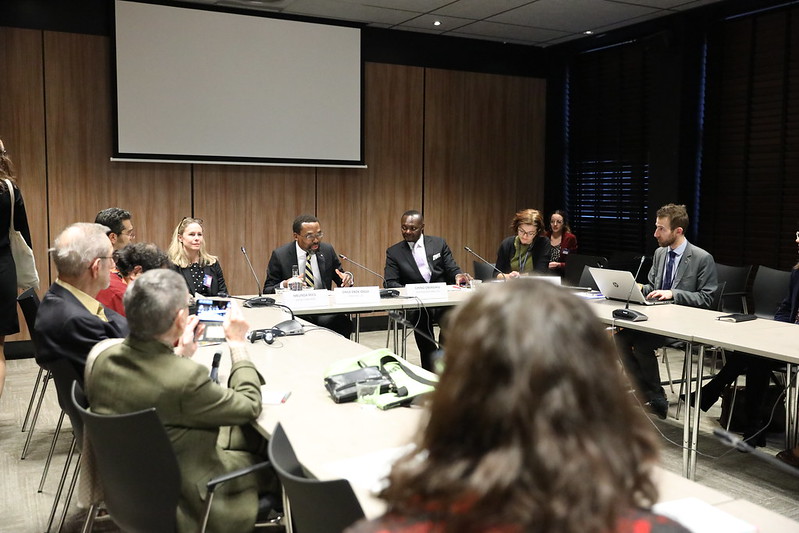
Arusha, 8 November 2019- The President of the International Residual Mechanism for Criminal Tribunals (Mechanism), Judge Carmel Agius, today concluded his second visit to Dar es Salaam in the United Republic of Tanzania (Tanzania), where he held high-level meetings with Government officials.
Having travelled to Arusha earlier in November to spend time with staff at the Mechanism’s Arusha branch, President Agius took advantage of his presence in Tanzania to visit Dar es Salaam. There, he met with Tanzania’s Minister of Foreign Affairs and East African Cooperation, Prof. Palamagamba Kabudi, and Minister of Constitutional and Legal Affairs, Dr. Augustine Mahiga, on 7 and 8 November 2019, respectively.
President Agius provided the Ministers with an update on the Mechanism’s work and reiterated his gratitude for the unwavering support that the Mechanism continues to receive from the Tanzanian Government.
The President also met with members of the diplomatic corps accredited to Tanzania, who he briefed on the progress of the Mechanism’s work and the various challenges it faces in the implementation of its mandate.
Before travelling to Dar es Salaam, and in the spirit of fostering strong working relations between the Mechanism and other judicial institutions in Arusha, President Agius met with the President of the East African Court of Justice, Dr. Emmanuel Ugirashebuja, to discuss matters of mutual interest to both institutions.
Ambassador of India, H.E. Mr. Venu Rajamony and India Foreign Affairs Minister, H.E. Dr. S. Jaishankar.
External Affairs Minister of India Dr. S. Jaishankar will visit the Netherlands from November 9-11, 2019.
During the visit, Dr. S. Jaishankar will meet Dutch Foreign Minister Stef Blok for comprehensive discussions on bilateral and multilateral issues of mutual interest. He will also interact with members of the Foreign Affairs Committee of the House of Representatives of the Dutch Parliamentand Dutch dignitaries across the political spectrum.
India and the Netherlands have a long history of friendly bilateral relations going back to more than 400 years, encompassing many areas of shared interest. The Netherlands is one of the first three countries that established diplomatic relations with independent India in 1947.
The two countries have witnessed a series of high-level exchanges in recent years. Their Majesties King Willem-Alexander and Queen Maxima concluded a highly successful State Visit to India from October 14-18, 2019.
Prime Minister Mark Rutte of the Netherlands visited India in May 2018 along with a high-level delegation comprising of four Cabinet Ministers and the Mayor of the Hague. He was also accompanied by a trade mission comprising of 130 companies/institutions and nearly 200 trade representatives.Both countries have strong economic interests in each other.
Prime Minister Modi and Prime Minister Mark Rutte also met on December 1, 2018 on the sidelines of the G20 in Buenos Aires and held discussions on boosting economic and cultural ties between India and the Netherlands. The high level visits from the two sides have provided new vigour and momentum to the relationship. The forthcoming visit of the External Affairs Minister will further strengthen the ties.
India and the Netherlands share values of democracy, rule of law and justice. Both sides have been supportive of each other on multilateral fora. Economic and Commercial relations provide a strong underpinning of bilateral cooperation. During the recently concluded State Visit, the largest ever trade delegation comprising of 250 members from 140 companies and organizations accompanied the Dutch Royals to India.
The Netherlands was the third largest investor in India in FY 2018-2019 with investment worth US$ 3.87 billion. The cumulative investments from the Netherlands to India in the period April 2000 – June 2019 amounts to US$ 28.7 billion. The Netherlands is also a major investment destination for Indian companies with a total investment (ODI Stock) by Indian companies estimated over US$ 12 billion as on March 2018.
On Thursday 7th November, the International Institute of Social Studies in The Hague hosted a lecture by Dani Rodrik, a Harvard professor of International Political Economy who is receiving an Honorary Doctorate from the Erasmus University Rotterdam on 8th November during the celebration of the Dies Natalis of the university.
During his lecture, professor Rodrik presented an argument about the economic growth that the world has experienced over the last century, whereby he stressed that the miracle which was commonly found and stood behind the convergence of the inequalities between developed and developing countries was a rapid industrialisation, especially such that is oriented to manufacturing exportable products.
By showing the experiences of “economic growth miracles”, in other words the countries that have experienced a constant GDP growth over the past 20 years such as China, South Korea, Singapore, or Japan, Mr. Rodrik demonstrated how the structural change of industrialisation enables for expansion.
Professor Dani Rodrik, During his speech.
Moreover, two cases of recent high growth miracles -India and Ethiopia- were scrutinised. These instances are remarkable since they are not following the traditional industry-led mechanism, and conversely pursuing the development of modern sectors, which according to Mr. Rodrik might prove to be self-limiting and unsustainable in the long-term.
Lastly, by showing the developments in today’s economies, as well as the external factors such as shifts in consumer demand, globalisation, off-shoring, and technological change, Mr. Rodrik explained how the current path leading to premature de-industrialisation. Having pointed to this relation, the professor drew a conclusion that this mechanism of an industry-led economic development will no longer be applicable in the future.
With the attendance of numerous diplomats, employees of ministries, as well as professors and researchers from many Dutch universities, the lecture by Mr. Rodrik marked an interesting and worthwhile afternoon.
Forty years after the 1979 hostage crisis, tensions between the United States and Iran are once again escalating. On November 4th, the US administration imposed new sanctions on Iranian individuals close to the country’s Supreme Leader. On the same day, Iran announced it would walk back from another of its commitment under the Nuclear Deal – citing Washington’s lack of compliance as the move’s rationale.
In early November 1979, a diplomatic standoff emerged when 52 United States’ diplomats were taken hostage by supporters of the Iranian Revolution in Tehran. In early November 2019, forty years after the hostage crisis, tensions between the two countries are again on the rise – with the US administration imposing sanctions on Tehran, and the Iranian government re-starting nuclear-related activities in its Fordow facility.
The new US Treasury Department’s sanctions – a Senior US Administration Official explained – are set to target a range of high-level individuals involved in policy-making in Tehran. The targets include a number of individuals deemed close to the country’s Supreme Leader Ali Khamenei, such as his second son Mojtaba, his chief of staff Mr. Golpayegani, as well as Mr. Haghanian, identified by the US as Mr. Khamenei’s right hand.
Moreover, the sanctions will also hit Ebrahim Raisi, the head of Iran’s judiciary, as well as Iranian individuals linked with “brutal terror actors outside Iran”, notably Ali Akbar Velayati and Hossein Dehghan – the US Official revealed.
The reaction from Tehran has been swift, with the Foreign Ministry’s Spokesperson, Seyyed Abbas Mousavi, swiftly condemning the US “unilateral and futile” sanctions and its “anti-Iran statement”. In his statement, Mr. Mousavi first accused the US of “bullying” other countries due its “inability to use diplomatic or logical solution”. Moreover, referring to the US accusations on the hostage crisis, he blamed the US for “misrepresenting the realities and distorting the history by keeping open an already-closed case” – and instead accused the US of committing crimes against Iran.
This most recent spat comes on the background of broader tensions between Washington and Tehran.
The administration of President Trump accuses Iran not only of oppressing its own people, but also of pursuing a terrorist agenda across the Middle East, including by seeking to develop nuclear weapons. Consequently, in May 2018 the US withdrew from the Joint Comprehensive Plan of Action (also known as the Iran Nuclear Deal), which provided for economic benefits for Iran in exchange for stricter controls on its nuclear program. Since then, Washington has re-imposed increasingly harsh sanctions on Iran, with the declared aim of changing the policies of the Iranian government.
As for Iran, after having failed to reap the economic benefits foreseen by the JCPOA through the help of the remaining signatories, in the last months policymakers in Tehran have announced the suspension of some of Iran’s obligations under the deal. In parallel to the US announcement of the latest round of sanctions in early November, Iranian President Hassan Rouhani has announced that Iran will restart to inject gas to the centrifuges in its facilities in Fordow – a move prohibited by the JCPOA. This move – the President stressed – is completely reversible, and – as previous steps taken by Iran – “will be conducted under the monitoring of the International Atomic Energy Agency”.
The door for diplomacy remains thus open – although by now the opening looks rather small.
About the author:
Guido Lanfranchi is a student and young professional in the field of international affairs. He has pursued his studies both at Leiden University and Sciences Po Paris, where he is currently enrolled. In parallel, he has been gaining professional experience through internships (first at the Council of the European Union, and currently at Clingendael Institute), as well as by working as reporter and associate editor for Diplomat Magazine The Netherlands. His research and work focus on the Middle East and Africa, and especially on conflict situations in these regions.
In the picture the Director-General of the Organisation for the Prohibition of Chemical Weapons, H.E. Mr Fernando Arias, and Minister of Foreign Affairs and Trade of Hungary, H.E. Mr Péter Szijjártó.
The Hague, Netherlands — 31 October 2019 — The Director-General of the Organisation for the Prohibition of Chemical Weapons (OPCW), H.E. Mr Fernando Arias, and Minister of Foreign Affairs and Trade of Hungary, H.E. Mr Péter Szijjártó, met today at OPCW Headquarters in The Hague.
The Director-General and the Foreign and Trade Minister discussed the progress in the implementation of the Chemical Weapons Convention (CWC), and the Organization’s activities to address current challenges in achieving the total and permanent elimination of all chemical weapons, while promoting scientific advances for peaceful purposes.
The Foreign and Trade Minister described how Hungary remains committed to the objectives of the Chemical Weapons Convention and highly appreciates the OPCW’s dedicated work aimed at eliminating chemical weapons worldwide. He remarked: “The Organisation is an essential pillar of the international non-proliferation system. Hungary strives for a strong and efficient OPCW, based on mutual co-operation among Member States. Therefore, I am delighted to announce that Hungary contributes 35,000 Euros to the construction of a new facility, the OPCW Centre for Chemistry and Technology.”
The Director-General remarked: “Hungary has my sincere gratitude for its commitment to the Convention and its continued support for the Organisation, including our new ChemTech Centre. We look forward to our continued cooperation to ensure chemical weapons are eliminated and that chemistry is used for exclusively peaceful purposes.”
Following the Minister’s announcement that Hungary would make a financial contribution to the new ChemTech Centre, the Director-General provided a status update on the project, emphasising its importance in strengthening technological development and fostering peaceful uses of chemistry.
OPCW Director-General, H.E. Mr Fernando Arias, and the President of Poland, Mr Andrzej Duda, meeting at the OPCW Headquarters in The Hague.
THE HAGUE, Netherlands — 30 October 2019 — The Director-General of the Organization for the Prohibition of Chemical Weapons (OPCW), H.E. Mr Fernando Arias, and the President of Poland, Mr Andrzej Duda, met today at the OPCW Headquarters in The Hague.
The Director-General briefed the President on the progress of the implementation of the Chemical Weapons Convention (CWC). Their discussions focused on the OPCW’s efforts to not only ensure the total and permanent elimination of all chemical weapons, but also to promote scientific advances for peaceful purposes. Both sides agreed on the necessity to support capacity-building initiatives and to strive for transparency and cooperation.
The President of Poland, Mr Andrzej Duda, OPCW Director-General, H.E. Mr Fernando Arias, and Ms Odette Melono, Deputy Director General at OPCW.
President Duda remarked: “I wish to congratulate the Director-General and the OPCW staff on their commitment and dedication in striving for a world free from chemical weapons. Poland will continue to support strongly the OPCW and the implementation of the Chemical Weapons Convention, recognising current and new threats and challenges related to the use and re-emergence of chemical weapons.”
Director-General Arias stated: “Poland has my sincere gratitude for its commitment to the Convention and its continued support for the Organisation, including our new Centre for Chemistry and Technology. We look forward to our continued cooperation to ensure chemical weapons are eliminated and that chemistry is used for exclusively peaceful purposes.”
The Ambassador of Poland, H.E. Mr. dr Marcin Piotr Czepelak, the President of Poland, Mr Andrzej Duda, H.E. Mr. Fernando Arias, Director General OPCW and Ms Odette Melono, OPCW Deputy Director General, with colleagues during the president of Poland visit to the OPCW in The Hague.
Following Poland’s €100,000 contribution to the new OPCW Centre for Chemistry and Technology project last year, the Director-General provided a status update on the project, emphasising its importance in strengthening technological development and fostering peaceful uses of chemistry.
The Hague, Netherlands — 1 November 2019 — The Director-General of the Organization for the Prohibition of Chemical Weapons (OPCW), H.E. Mr Fernando Arias, and the French Minister of Europe and Foreign Affairs, H.E. Mr Jean-Yves Le Drian, met today at OPCW Headquarters in The Hague.
The Director-General briefed the Europe and Foreign Affairs Minister on the OPCW’s progress in implementing the Chemical Weapons Convention. Following France’s $1.5 million USDcontribution to the new OPCW Centre for Chemistry and Technology project earlier this year, the Director-General also provided a status update on the project.
The Director-General of the Organization for the Prohibition of Chemical Weapons (OPCW), H.E. Mr Fernando Arias, and the French Minister of Europe and Foreign Affairs, H.E. Mr Jean-Yves Le Drian.
Both the Director-General and the Minister further acknowledged the need to intensify international cooperation and assistance to promote the peaceful application of science and technology.
The Director-General stated: “France has my sincere gratitude for its steadfast commitment to the goals of the Convention and for its support of the OPCW. We look forward to our continued cooperation to ensure that chemical weapons become a thing of the past.”
The Europe and Foreign Affairs Minister reiterated France’s strong support for the OPCW and continuous political commitment to a world free of chemical weapons and against impunity for the use of such weapons. He further stated: “Today, I announced a $1 million USD contribution for OPCW activities related to Syria, which remains a priority for France. This comes in addition to previous support, including a $1.5 million USD contribution to the OPCW ChemTech Centre that will notably enhance international cooperation.”
In the picture H.E. Mr. Carlos Herrera, Ambassador of Peru and spouse Veronique Miclea with a guest.
By John Dunkelgrün
The Cobra Museum in Amstelveen is going Latin with two mostly concurrent exhibitions, one “Intens Mexico” and a solo exposition of works by Enrique Polanco from Lima, Peru.
“Intens Mexico” is the result of an exchange between the Cobra Museum and the Mexican Museo de Arte Moderno. Because of that, it is able to show major works by some of Mexico’s most iconic artists, such as Diego Rivera, Frida Kahlo, and David Siqueiros. The exhibition is divided into four themes and an altar.
“Intens Mexico”, photography by Cobra Museum.
Modern Mexico began during the seven years long and catastrophic Mexican Revolution early in the 20th century. This revolution, which claimed some ten million lives, changed the political landscape and forged Mexico’s identity. Art, which had lingered in a post baroque mold reinforced by traveling Spanish painters, now took off in autonomous directions.
Cobra Museum, “Intens Mexico”.
Whereas before the revolution depicting, even recognizing, local cultures was taboo, artists like the three “Grandes”, Rivera, Siqueiros, and Orozco painted local people, local customs and local politics. This they did predominantly in the muted colors developed by the first truly Mexican painter, Dr. Atl.
“Intens Mexico”, photography by Cobra Museum.
Passions run high in Mexico. Most of the country is strongly macho, male-oriented, but an area in Southwest Mexico is matriarchal and has been totally at ease with different forms of love long before LBGT became a ‘thing’. Part of the Mexican culture is its fascination with death, culminating in all-Saints Day.
Reflecting these themes, the exposition is divided into four distinct areas reflecting art inspired by Identity, Politics, Sex, and Death.
“Intens Mexico”, photography by Cobra Museum.
This very worthwhile exhibition may be seen until March 29th, 2020.
Enrique Polanco, one of the best-known living painters in Peru, is fascinated by his city, Lima. He is an expressionist who works in wild “Fauvist” colors.
Enrique Polanco – solo exhibition at Cobra Museum.
His concern is the city itself, its buildings, its tensions, its unbridled growth, crime, and destruction. His works are not pretty in the traditional sense. He paints the pain of people overtaken by the growth of the city, people migrating into the city and -not understanding it- remaining in the margin.
Enrique Polanco at Cobra Museum.
While he lives and works in Lima and takes his inspiration from that city, the alienation that is the red thread throughout his work applies to large growing cities all over the world. He shows us a mirror to see what is going on behind us, like in his painting of a burning building with a comfortable chair in front of it, but facing away. If only we sat there and took a selfie, we’d see hat terrible things are going on behind us.
Peruvian painter, Enrique Polanco, John and Anne Dunkelgrün and Polanco’s wife.
You may go there until November 11th and see both exhibitions in one visit, perhaps with a break in the museum’s very pleasant café.
On October 20, 2019, Tanzania’s 5th “Swahili International Tourism Expo” (SITE 2019) for the tourism and hospitality sectors was festively concluded. More than 3,000 visitors attended this year’s global event which featured over 170 international and local exhibitors.
A warm Swahili “Karibu” or “Welcome” was extended to buyers, tour operators, travel agents and media representatives, who travelled from some 60 countries to attend East Africa’s largest exposition devoted exclusively to the tourism trade. In addition to the buyers from neighboring African countries, international buyers from Belgium, China, Denmark, Germany, India, Japan, Latvia, Malaysia, Netherlands, Norway, Poland, Russia, Sweden, Thailand and more attended SITE-2019. Plans are already underway for “SITE 2020”, which will be held from July 24-26, 2020.
L to R: Kijazi, Kigwangala and Ms. Devota Mdachi exit the SITE-Tanzania 2019 Expo.
At the invitation of H.E. Mrs. Irene F. Mkwawa-Kasyanju, Tanzania’s Ambassador to the Kingdom of the Netherlands; reporters, travel counsellors, tour operators and bloggers from the Benelux were invited to attend the exposition.
The ambassador and her team were especially pleased for the opportunity to introduce Dutch social media “influencers” and local representatives from the travel industry to the newly opened “Terminal 3” at the newly opened Julius Nyerere International Airport (JNIA) in Dar es Salaam. On 1st August 2019, Tanzanian President John Magufuli inaugurated Terminal 3, built at a cost of TZS 722 billion (USD 314 million), which is expected to increase JNIA’s capacity to an estimated 8 million passengers annually.
The airport, named for Tanzania’s first president, receives international flights from all over the world and is a short flight from Zanzibar, which lays just 40 km off the coast from Dar es Salaam. The island, located just 6 degrees south of the equator, is a year round beach destination famous for, among other things, “Stone Town”—a UNESCO World Heritage Site popular with international visitors to the island and another, of many, destinations widely promoted to the international community of travel industry professionals who visited the SITE 2019 event.
Chief Secretary, H.E. Ambassador Eng. Dr. John Kijazi, the Guest of Honour, represented the President of Tanzania, Mr. John Joseph Magufuli, at the Expo. He spoke briefly and praised both the Ministry of Natural Resources and Tourism, under the direction of H.E. Hon. Dr. Harnis Kigwangala, together with the Tanzanian Tourist Board, headed by Ms. Devota Mdachi, the Managing Director, for their successful efforts with supporting governmental initiatives to promote Tanzania.
Preparations for a Sunrise Serengeti Balloon Safari.
The country is a world-renowned tourist destination for wildlife and nature enthusiasts and both organizations are actively engaged with diversifying, expanding and improving the country’s palette of tourist product offerings.
Marine tourism (Mafia Island Marine Park or MIMP), historic tourism and beach tourism are among other “multi-center” offerings across the country. In addition to Zanzibar Island, with its glistening beaches and historic “Stone Town”, a UNESCO World Heritage Site, the country offers more than 800 km of largely undeveloped white sand coastline which is available for innumerable foreign investment opportunities.
H.E. Ambassador Kijazi emphasized that, “you are safe in Tanzania security wise and health wise.” Tanzania, as is already known by international travel industry professionals, is widely recognized as being one of the most stable, secure and welcoming countries in Africa. He called upon the country’s ambassadors, who are serving abroad at diplomatic missions around the world, to continue promoting “Wildlife and Nature” tourism to Tanzania.
Tanzania’s tourism sector has seen a whopping 300% growth over the last decade and directly supports more than 450,000 jobs. According to a recent World Bank report, Tanzania has the potential to receive more than eight million foreign visitors in 2025, a nearly seven-fold increase from current numbers, over a span of a little more than five years. Such impressive figures are of particular importance to Tanzania as the country has designated an astonishing 44% of the nation’s land mass to national parks, wildlife game reserves, and other conservation areas.
One must use superlatives when attempting to describe Tanzania’s abundance of natural wealth. In order to meet the rapidly increasing demand for natural tourism offerings, the government encourages the development of public and private partnerships to further develop the country’s tourism products in a sustainable way to support and benefit people who are often living in remote rural communities.
Lioness, apex predator of the Serengeti plains near the Masai Mara river Crossing.
Three of the “Seven Natural Wonders of Africa” including the Great Serengeti Wildebeest Migration; Mt. Kilimanjaro, a dormant volcano and Africa’s highest peak (Kibo Summit is 19,341 ft. above sea level) and the Ngorongoro Crater, an extinct volcanic caldera in the eastern Rift Valley can be found in northern Tanzania.
The latter is part of the vast Ngorongoro Conservation Area. The Ngorongoro Lengai Crater is Africa’s only UNESCO classified Global “GeoPark”(UGGp) and, together with Tanzania’s other national parks, is home to hundreds of thousands, even millions, of migratory animals.
All locations are well managed undisturbed natural environments where the “Big Five” African mammals can be freely observed in their own habitats. In addition, the country borders on both Lake Tanganyika and Lake Victoria, the largest lake on the African continent.
Travelers considering a “safari” vacation should begin their “desktop” research by visiting the website of the Tanzania Tourist Board (TTB) where detailed information about wildlife, bird watching, trekking, family, singles and photo safaris can be found.
An extensive collection of tourist publications can also be downloaded from the site by clicking here.
Our technologically advanced and progressive world is literally overwhelmed by daily flows, or rather avalanches, of information. We are swimming into a sea of fakes, so hard to resist, moving further away from the shore every day. In the “golden age” of misinformation truth, especially about war, based on facts, is the only possible “lifeline” to cling to.
The essence of the unprecedented, even a bit off-putting, concept of “Transparent War” proposed by the Russian defense ministry in 2017 is that journalists from NATO and EU countries are able to visit Syria and see with their own eyes everything that is happening there, at all times enjoying maximum security. General Igor Konashenkov, who heads the ministry’s department of information and mass communications, personally accompanies such groups, providing comments and answering all questions pertaining to Syria.
They had visited well-fortified military bases, saw the Syrian army reorganized with Russian assistance, parts of the country, liberated from jihadists, humanitarian centers, and observed the Syrian people’s return to peaceful life. The most classified things, like the faces of officers and soldiers, photos of military equipment used in the conflict, as well as the everyday life of military personnel are now available for photo and video coverage.
During their press tour, the journalists met with Syrian officials and chatted with civilians in marketplaces and in city streets to hear what ordinary Syrians talks about. Most of the people they interviewed said they hate the Islamic State*, spoke about their dead relatives, about poverty and destruction and also about their heartfelt gratitude to the Russians, who helped restore peaceful life in Syria.
Photography by Pablo Gonzales in Siria.
The government of Syrian President Bashar Assad’s is working hard to provide maximum help to those who are returning to their abandoned homes to resume the life they enjoyed before the war broke out in 2011.
Even though the government’s resources are pretty much strained, with the assistance given it by the Russian state and business organizations, Damascus is putting the country’s war-ravaged industry back on track. In parts of the country, which for so many years had been the site of fierce battles, street markets, shops and cafes have reopened. People can now order a taxi and, even more importantly, to live without the risk of coming under fire – a real blessing for people who have spent the past few years in the maelstrom of a civil war.
And still, the war has deprived people not only of the houses they lived in, but also of their jobs. Without serious investments it will be real hard to bring the country back to its pre-war state. Poverty is a big hurdle on the way of the Syrian refugees’ return home, because they have neither work nor a place to live, they have lost everything. To bring them back the country needs serious investments and peace – this is what government officials in Damascus emphasize.
A month ago the first serious European investor came forward bringing an international hotel chain back to Syria. This isn’t enough, however, as the war-scarred country needs lasting peace and a transparent world.
Unfortunately, there are other countries in Syria, which are pursuing their own interests there. Therefore, one of the most important goals of the concept of “transparent war” is to make sure that those interested in destabilizing the situation in Syria and supporting terrorists have fewer opportunities to at least use the media for this purpose and generate all kinds of fakes and “ghosts” to mislead the world.
The conditions for achieving these goals are already there: just come to Syria and see with your own eyes. The question is, however, whether Western journalists are ready to face the facts and, most importantly, to honestly speak about them. Are they still able to be open, honest, free and independent in the best traditions of democratic values?