
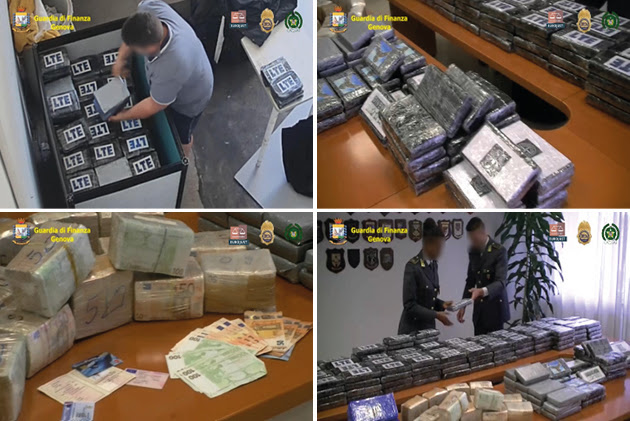
 Photos © Guardia di Finanza Genova
The drugs were acquired in Colombia and transported and tracked during the journey by the Colombian authorities, the US Drug Enforcement Administration, the US Customs and Border Protection Authority, the French authorities, the Spanish authorities and the Italian Guardia di Finanza Genova and Direzione Anti-Mafia of Genova, with the constant support of Eurojust.
One of the three suspects has vertical links to the ‘Ndrangheta ‘Alvaro’ di Sinopoli.
Photos © Guardia di Finanza Genova
The drugs were acquired in Colombia and transported and tracked during the journey by the Colombian authorities, the US Drug Enforcement Administration, the US Customs and Border Protection Authority, the French authorities, the Spanish authorities and the Italian Guardia di Finanza Genova and Direzione Anti-Mafia of Genova, with the constant support of Eurojust.
One of the three suspects has vertical links to the ‘Ndrangheta ‘Alvaro’ di Sinopoli. Huge cocaine bust in Italy with support from Eurojust

Thanks to Eurojust’s support in coordinating judicial cooperation among Colombia, the USA, France, Spain and Italy, 368 kg of pure cocaine were seized in the Port of Genova, and three men of Italian nationality were arrested.
The drugs have a street value of EUR 100 million. In addition to the drugs, cash in excess of EUR 950 000 as well as three cars and a jammer to block transmission signals were seized.
Photos © Guardia di Finanza Genova
The drugs were acquired in Colombia and transported and tracked during the journey by the Colombian authorities, the US Drug Enforcement Administration, the US Customs and Border Protection Authority, the French authorities, the Spanish authorities and the Italian Guardia di Finanza Genova and Direzione Anti-Mafia of Genova, with the constant support of Eurojust.
One of the three suspects has vertical links to the ‘Ndrangheta ‘Alvaro’ di Sinopoli.
Photos © Guardia di Finanza Genova
The drugs were acquired in Colombia and transported and tracked during the journey by the Colombian authorities, the US Drug Enforcement Administration, the US Customs and Border Protection Authority, the French authorities, the Spanish authorities and the Italian Guardia di Finanza Genova and Direzione Anti-Mafia of Genova, with the constant support of Eurojust.
One of the three suspects has vertical links to the ‘Ndrangheta ‘Alvaro’ di Sinopoli. Israel’s Ambassador Issacharoff in Saxony

Wednesday, 24 July 2019, Dresden, Free State of Saxony: Saxony’s Premier Michael Kretschmer received the Israeli Ambassador to Germany, Jeremy Issacharoff for a courtesy call at the State Chancery.
One of the topics of discussion was Saxony’s participation in the “New Kibbutz” scholarship programme. Within the programme’s framework, students can be sent to Israeli companies as interns and supported.
According to the press statement below, Premier Michael Kretschmer said: “Saxony and Israel are linked by friendly and diverse relationships in business, science and culture. With Saxony’s participation in the New Kibbutz scholarship programme, we are promoting the exchange of young people. They get the chance to get to know Israel’s culture of innovation and its unique cultural life and to make new connections. Israel has developed into a modern business location and a centre for start-ups and high-tech companies. This is a great opportunity to gain valuable experience and bring it to Saxony”.
Immediately afterwards, Premier Kretschmer and Ambassador Issacharoff met with students from the Leipzig region who are organised in the Young Forum of the German-Israeli Society Leipzig.
Ambassador Jeremy Issacharoff‘s service in Germany began on 29 August 2017.
For further information:
- Government of the Free State of Saxony: https://www.
ministerpraesident.sachsen.de/ antrittsbesuch-des- botschafters-des-staates- israel-jeremy-issacharoff- 9958.html - Embassy of Israel to Germany: http://embassies.gov.
il/berlin/AboutTheEmbassy/Page s/Botschafter_Issacharoff.aspx
Four spectacular days at the first edition of Sail at Scheveningen

The first edition of Sail at Scheveningen took place last June 20 to 23. As the finishing point for the Liberty Tall Ships Regatta, The Hague’s iconic seaside resort welcomed more than thirty magnificent sailing ships. This event offers many special activities, including a crew parade and the rare chance to board the ships free of charge. Sail at Scheveningen attracted around 60,000 visitors daily.
The 2019 Liberty Tall Ships Regatta (website) coincided with the 75th anniversary of D-Day, and therefore started in Normandy’s port city of Rouen on June 17. Three days later, on Thursday, June 20, this fleet of some thirty superb sailing ships arrived in the port of Scheveningen. The first edition of Sail at Scheveningen will got off to a spectacular start with the Sail-In Parade.
A very special feature of this international maritime event is that the historic ships are not only on show, but can also be entered for free. The fleet consists of replicas of Spanish and Russian ships from the Golden Age and a unique gathering of naval ships from Brazil, France, Mexico, Oman, Romania and the United States. Seven of the tall ships visited the Netherlands for the first time.
During Sail at Scheveningen, The Hague’s seaside resort hosted four days with music, street theater and delicious catering by local food vendors. Each evening concludes with a spectacular fireworks display.
Sail op Scheveningen website, Facebook,Instagram
Premier Dr. Haselof welcomed Helvetian Ambassador

Thursday, 18 July 2019, Magdeburg, Saxe-Anhalt, Germany: Premier Dr. Reiner Haseloff welcomed the Ambassador of the Swiss Confederation, Dr. Paul Seger for a visite de courtoisie.
The ties between the two countries are manifold. Switzerland is one of our country’s most important trading partners. In 2018 for instance, exports totalled 617 million euros, the highest level up to date. The main exports are aluminium and aluminium alloys, petroleum products, chemical precursors and plastics. Imports amounted to 626 million euros in the previous year. The main groups of imported goods were semi-finished aluminium products and pharmaceutical products.
There are 96 companies in Saxony-Anhalt with a majority shareholding of Swiss investors, including Arytza Bakeries Deutschland GmbH in Lutherstadt Eisleben, SALUTAS Pharma GmbH in Barleben, SOEX Processing Germany GmbH in Bitterfeld-Wolfen, AMEOS Kliniken in Halberstadt, Bernburg and Schönebeck and EUROGLAS GmbH in Haldensleben.
All universities and colleges in Saxony-Anhalt hold contacts vis-à-vis Switzerland, mainly for the exchange of students and teaching staff. In addition, the Martin Luther University Halle-Wittenberg is currently involved in three projects funded by the EU programme “Horizon2020” with partners hailing from Switzerland.
There is also extensive cooperations in the field of culture. In 2018, for example, the Bauhaus Foundation organised the exhibition “Material als Experiment/ Vergangenheit – Gegenwart – Zukunft” [Material as experiment/Past- Present – Future] in cooperation with the Zurich University of the Arts and the Swiss Material Archive. In the exhibition of the Luther Memorials Foundation “Honoured. Beloved. Forgotten. Maria zwischen den Konfessionen” [Maria between faiths], which can still be seen in Wittenberg until the end of August 2019, will be shown for the first time outside Zurich’s sculptures from the Emil Bührle Collection in Zurich.
For further information:
- Government of Saxe-Anhalt: https://europa.
sachsen-anhalt.de/ internationales/aktuelles- internationales-2019/ antrittsbesuch-des- botschafters-der-schweiz/ - Swiss Embassy to Germany: https://www.eda.
admin.ch/berlin
…
Sudan after al-Bashir: the U.S. supports a civilian-led transitional government

By Guido Lanfranchi.
After the forced resignation of former Sudanese ruler Mr. Omar al-Bashir, Sudan is in the midst of a delicate political transition, with civilian and military entities competing for power. In this context, the United States voiced its support for a civilian-led transitional government, set to put the country on the path of democracy.
“We support the formation of a civilian-led transitional government that will be broadly supported by the Sudanese people”. These were the words – loud and clear – repeated several times by Ambassador Donald E. Booth, the United States’ Special Envoy for Sudan. Speaking after a meeting of the Friends of Sudan group – a group of countries interested in supporting the Sudanese people to meet their goals – the U.S. Special Envoy sent a clear message: civilians, rather than members of the military, should lead Sudan’s transition towards democratic elections.
Over the last few months, Sudan has been confronting a complex political transition. In April 2019, facing pressure from demonstrations across the country, Sudan’s longtime ruler Mr. Omar al-Bashir relinquished power. In the wake of al-Bashir’s fall, however, civilian organizations and the military started to compete for leading the country’s transitional government – which is supposed to set Sudan on the path towards democratic elections. In this competition, tensions have at times run high, with Sudan’s security apparatus using the force against the civilian demonstrators. Successful mediation efforts – led by Ethiopia and the African Union – eventually led to the signature of a joint political declaration on July 17th.
Commenting on the wake of these events, Ambassador Booth noted that while the political declarations offers a good base for further dialogue, “there are still a lot of negotiations to be conducted”. He mentioned the importance of open issues such as the relative roles and powers of the Sovereignty Council, the Prime Minister, the Cabinet, and the Legislative Council – thorny issues that will have to be addressed in order to successfully manage the country’s transition towards democratic elections.
While voicing the U.S.’s position on Sudan’s transition, Ambassador Booth also clarified that drafting a solution to these challenges remain a prerogative of the Sudanese people. “The U.S. reaction will depend upon what the Sudanese actually agree upon, and then also, as we say, the broad support of the Sudanese people for any such agreement”. At the same time, however, Mr. Booth clarified that the U.S. will continue its engagement in support of freedom in the country – for instance by supporting the journalists and humanitarian actors active in Sudan.
Ambassador Booth also voiced U.S. concerns over a number of human rights violations, including the use of force against the demonstrators during the June 3rd events – when the military violently dispersed civilian gatherings in the country. In this regard – he noted – negotiations are still ongoing on the establishment of a credible investigation on the events, as well as on the potential provisions of immunity for members of the Sovereignty Council.
Therefore, while progress has indeed been achieved in Sudan, much remains to be done yet – Ambassador Booth stressed. “The sooner that Sudan can establish a civilian-led transitional government, it can begin then to address issues of reform and moving forward to a better future”.
US New Consul General Jennifer DeWitt Walsh

Jennifer DeWitt Walsh, a career member of the U.S. Foreign Service, assumed her position as Consul General at the U.S. Consulate General in Amsterdam in July 2019.
Prior to her arrival in Amsterdam, she served for three years as the Director of the Special Issuance Passport Agency. Her Department of State career encompasses a variety of assignments, including consular tours at the U.S. Interests Section in Havana, Cuba, and at U.S. embassies in Caracas, Venezuela, and Kingston, Jamaica.
She served in a management position in Shanghai, China, as the Public Affairs Officer at the U.S. Consulate General in Lagos, Nigeria, and as the Deputy Principle Officer at the U.S. Consulate General in Alexandria, Egypt. Her domestic assignments include serving as a Senior Advisor in the Office of eDiplomacy and as an instructor at the Department of State’s Foreign Service Institute.
Jennifer was raised in Wyoming and still calls the Equality State home. Before joining the Department of State, she served on the staff of U.S. Senator Malcolm Wallop, taught history at an international school in Medellín, Colombia, and worked as a professional historian.
She holds a B.A. in History from the University of Wyoming, a B.S. in Education from Montana State University, and an M.A. in Public History from Arizona State University.
She is married to a retired Foreign Service Officer and has two children.
The Office of the Prosecutor issues its Strategic Plan for 2019-2021

The Office of the Prosecutor of the International Criminal Court (“ICC” or “The Court”) is pleased to publish its Strategic Plan for 2019-2021, following consultations, including with States Parties and civil society.
The Office has been closely assessing and taking stock of its performance, including internal and external factors that act as either drivers or inhibitors of that performance. With the new Strategic Plan, the Office will build on the strengths of the previous Strategic Plan (2016-2018), by continuing with investigative and prosecutorial approaches that have produced results in court, making amendments on the basis of lessons learnt, where required.
“This Strategic Plan charts a promising and forward looking course for the Office in the next strategic period, and represents our ongoing commitment to the effective and efficient discharge of our mandate under the Rome Statute and to continuous improvement”, said Prosecutor Fatou Bensouda.
The new Strategic Plan also takes into consideration, and actively aims to address, existing and anticipated challenges for the work of the Office. It is organised around six strategic goals:
- Strategic Goal 1: to achieve a high rate of success in court;
- Strategic Goal 2: to increase the speed, efficiency, and effectiveness of preliminary examinations, investigations and prosecutions;
- Strategic Goal 3: to develop with States enhanced strategies and methodologies to increase the arrest rate of persons subject to outstanding ICC arrest warrants;
- Strategic Goal 4: to refine and reinforce its approach to victims, in particular for victims of Sexual and Gender-Based Crimes and crimes against or affecting children;
- Strategic Goal 5: to further increase the Office’s ability to manage its resources in an effective, responsible, and accountable manner; and
- Strategic Goal 6: to further strengthen the ability of the Office and of its partners to close the impunity gap.
Eurojust and Europol help identify terrorist group

The Belgian judicial authorities, in effective cooperation with Eurojust and Europol, targeted a terrorist group involved in the recruitment and training of Kurdish terrorist fighters. 2 suspects were apprehended by the Belgian authorities for hearings, following a number of houses searches, conducted simultaneously in 5 countries.
 Eurojust, the EU’s Judicial Cooperation Unit, facilitated the issuance and transmission of several European Investigation Orders that were swiftly executed in Austria, Belgium, France, Germany and Switzerland. Europol’s European Counter Terrorism Centre set up a coordination centre on a joint action day to support the operations of the law enforcement authorities in all countries concerned.
The Belgian Federal Prosecutor’s Office, in close collaboration with the investigative judge of Liège, specialised in terrorism matters, initiated a criminal investigation into the alleged terrorist organisation in 2017. Several operational meetings and one coordination meeting at Eurojust served as a platform to swiftly exchange case-related information and efficiently coordinate the next judicial and operational steps. The members of the terrorist organisation allegedly belong to some of the military wings, (including People’s Defence Forces (HPG) of the Kurdistan Workers’ Party (PKK). They are suspected of recruiting and training terrorist fighters, using training camps and sessions in various countries.
Eurojust, the EU’s Judicial Cooperation Unit, facilitated the issuance and transmission of several European Investigation Orders that were swiftly executed in Austria, Belgium, France, Germany and Switzerland. Europol’s European Counter Terrorism Centre set up a coordination centre on a joint action day to support the operations of the law enforcement authorities in all countries concerned.
The Belgian Federal Prosecutor’s Office, in close collaboration with the investigative judge of Liège, specialised in terrorism matters, initiated a criminal investigation into the alleged terrorist organisation in 2017. Several operational meetings and one coordination meeting at Eurojust served as a platform to swiftly exchange case-related information and efficiently coordinate the next judicial and operational steps. The members of the terrorist organisation allegedly belong to some of the military wings, (including People’s Defence Forces (HPG) of the Kurdistan Workers’ Party (PKK). They are suspected of recruiting and training terrorist fighters, using training camps and sessions in various countries.
Eurojust, the EU’s Judicial Cooperation Unit, facilitated the issuance and transmission of several European Investigation Orders that were swiftly executed in Austria, Belgium, France, Germany and Switzerland. Europol’s European Counter Terrorism Centre set up a coordination centre on a joint action day to support the operations of the law enforcement authorities in all countries concerned.
The Belgian Federal Prosecutor’s Office, in close collaboration with the investigative judge of Liège, specialised in terrorism matters, initiated a criminal investigation into the alleged terrorist organisation in 2017. Several operational meetings and one coordination meeting at Eurojust served as a platform to swiftly exchange case-related information and efficiently coordinate the next judicial and operational steps. The members of the terrorist organisation allegedly belong to some of the military wings, (including People’s Defence Forces (HPG) of the Kurdistan Workers’ Party (PKK). They are suspected of recruiting and training terrorist fighters, using training camps and sessions in various countries.
“Peace can never be taken for granted”

75th Memorial Day celebration in Margraten
In the picture U.S. Ambassador to the Netherlands H.E. Mr. Pete Hoekstra. By Guido Lanfranchi. This year, the Netherlands and the United States jointly celebrated the 75th Memorial Day to honor the sacrifices of American service members in World War II. The ceremony was held in the Netherlands American Cemetery and Memorial in Margraten, featuring the presence of top-level U.S. and Dutch guests. Margraten, a village of the Dutch province of Limburg, has a special significance for U.S.-Dutch relations: the village hosts the Netherlands American Cemetery and Memorial, where over 8,000 American servicemen are buried. The graves in Margraten’s cemetery are home to the bodies of the many young Americans who fought and died in the Netherlands, and more specifically in the southern part of Limburg province, which was liberated by U.S. troops in 1944. In order to honor the U.S. servicemen who gave their life, Dutch and U.S. authorities celebrate every year at the end of May the so-called Memorial Day. This year’s ceremony, hosted as usual in the Margraten cemetery, featured the presence of top-level guests from both sides, including Dutch Foreign Minister Mr. Stef Blok, U.S. Ambassador to the Netherlands H.E. Mr. Pete Hoekstra, U.S. Deputy Chief of Mission Mr. Shawn Crowley, and Limburg Province’s governor Mr. Theo Bovens.
 Speaking on behalf of U.S. citizens, Ambassador Hoekstra paid tribute to “the young Americans from every one of our 50 states” who left their homes to fight in Europe. “They died in a world at war, but they did not die in vain” Rather, he said, they did so for the idea that “freedom is a value that must be preciously guarded and fiercely defended”. The U.S. representatives at the ceremony also had special words of thanks for the thousands of Dutch families who decided to take care of the graves in Margraten – with DCM Crowley praising “the dedication and the devotion that so many Dutch citizens show to keeping alive the memories of the Americans memorialized in Margraten”.
Stressing the role of Margraten’s cemetery in strengthening U.S.-Dutch relations, Mr. Blok decided to introduce his speech by telling the story of two 10-year-old pen-pals, Ileen from the Netherlands and Stella from the United States. The families of these two young girls are united through a 75-year-old story. During World War II, Stella’s great-great uncle, 21-year-old Calvin Bjornsgaard, left the U.S. to fight Hitler in Europe. After Calvin’s death in combat in 1943, Ileen’s family adopted Calvin’s grave – a duty which has been passed on and that has fostered a deep bond between the two families over five generations. This story is representative of the strong bond between the Netherlands and the U.S. – Mr. Blok highlighted, while also pledging that “we will continue to invest in this crucial bond”.
Speaking on behalf of U.S. citizens, Ambassador Hoekstra paid tribute to “the young Americans from every one of our 50 states” who left their homes to fight in Europe. “They died in a world at war, but they did not die in vain” Rather, he said, they did so for the idea that “freedom is a value that must be preciously guarded and fiercely defended”. The U.S. representatives at the ceremony also had special words of thanks for the thousands of Dutch families who decided to take care of the graves in Margraten – with DCM Crowley praising “the dedication and the devotion that so many Dutch citizens show to keeping alive the memories of the Americans memorialized in Margraten”.
Stressing the role of Margraten’s cemetery in strengthening U.S.-Dutch relations, Mr. Blok decided to introduce his speech by telling the story of two 10-year-old pen-pals, Ileen from the Netherlands and Stella from the United States. The families of these two young girls are united through a 75-year-old story. During World War II, Stella’s great-great uncle, 21-year-old Calvin Bjornsgaard, left the U.S. to fight Hitler in Europe. After Calvin’s death in combat in 1943, Ileen’s family adopted Calvin’s grave – a duty which has been passed on and that has fostered a deep bond between the two families over five generations. This story is representative of the strong bond between the Netherlands and the U.S. – Mr. Blok highlighted, while also pledging that “we will continue to invest in this crucial bond”.


OPCW Director-General Visits Japan

In the picture OPCW Director-General, H.E. Mr Fernando Arias, and Japan’s Minister of Foreign Affairs, H.E. Mr Taro Kono. Photo Credit: Ministry of Foreign Affairs of Japan.
THE HAGUE, Netherlands — 24 June 2019 — The Director-General of the Organisation for the Prohibition of Chemical Weapons (OPCW), H.E. Mr Fernando Arias, spoke about international efforts to eliminate chemical weapons and paid his respects to the victims of the atomic bombing of Hiroshima during a visit to Japan from 17-21 June. Throughout the visit, which was organised at the invitation of the Ministry of Foreign Affairs of Japan, the Director-General was accompanied by the Ambassador of Japan to the Netherlands and Permanent Representative to the OPCW, H.E. Ambassador Hiroshi Inomata.
On 18 June, the Director-General addressed an audience at the Integrated Center for United Nations and Foreign Affairs Studies at Kwansei Gakuin University in Osaka, where in a guest lecture he detailed recent efforts by the OPCW to prohibit and respond effectively to the use of chemical weapons around the world.
He detailed the OPCW’s progress and achievements, such as the approaching completion of the destruction of all declared chemical weapons. Recounting the “rude awakening” experienced by the international community after such weapons use in Syria, Iraq, Kuala Lumpur airport and the United Kingdom, the Director-General stressed that “the international community cannot afford complacency, despite the serious tasks carried out by the Organisation in the last 22 years”.
“Peace and security can never be taken for granted. We must consciously, collectively and in unity continue to work for those goals,” he told the audience.
The Director General further travelled to Hiroshima’s Peace Memorial Park, which commemorates the victims of the atomic bombings in 1945. He was given a tour of the Peace Memorial Museum, heard the testimony of a survivor, and laid a wreath at the Victims Memorial Cenotaph.
During his stay in Tokyo from 19 to 21 June, the Director-General held a series of bilateral meetings with a number of ministers and senior officials, including: Minister for Foreign Affairs, H.E. Mr Taro Kono; Minister of Defense, H.E. Mr Takeshi Iwaya; Minister for Science and Technology Policy, H.E. Mr Takuya Hirai; State Minister of Economy, Trade and Industry, Mr Yoshihiko Isozaki; and Director General of the Non-Proliferation, Disarmament and Science Department at the Ministry of Foreign Affairs, Mr Tomoyuki Yoshida.
On 21 June, the Director-General visited the Japan Self-Defense Forces (JSDF) Chemical School in Omiya, outside of Tokyo where he received a comprehensive briefing on the capabilities of the Chemical School.
Later during the same day, the Director-General attended a Tokyo seminar hosted by the Center for the Promotion of Disarmament and Non-proliferation, where he spoke about the most pressing challenges currently facing the Chemical Weapons Convention. Key highlighted issues included the use of chemical weapons, the on-going threat of chemical terrorism, and the possibility of using rapidly developing science to harm humankind. The Director-General expressed his confidence about the future stressing that “with challenges come opportunities.” In conclusion, he stated: “[W]e have a strong international consensus against chemical weapons. The Organisation represents the singular body that can continue to translate this consensus into effective action.”
Closing the visit, Minister for Foreign Affairs, H.E. Mr Taro Kono, and the Director-General held a working dinner during which the Director-General expressed appreciation for Japan’s strong commitment to the prohibition of chemical weapons and its support for the activities of the OPCW, and stated that the OPCW is looking forward to further close cooperation with Japan.
The Foreign Minister highly evaluated the important role of the OPCW in tackling the repeated use of chemical weapons and stated that Japan intends to develop further cooperative relationship with the OPCW to eliminate chemical weapons and prevent their reemergence. Both sides exchanged their views on strengthening the regime of the Chemical Weapons Convention and confirmed their collaboration in their efforts.