By John Dunkelgrün.
Art lovers among you will be acquainted with the famous museums in The Hague. Less well known is a veritable gem in the very center of the city, the Pulchri Studio on the Lange Voorhout, a mid 19th century association of artists and art lovers.
Pulchri offers many interesting exhibitions of current artists (often members) and artists of years and ages past with a connection to The Hague.
It is well worth visiting and keeping up with the activities on www.pulchri.nl.
Until December 3rd you may enjoy an impressive exposition of the The Hague painter and graphic artist Marius Bauer. This year marks the 150th anniversary of his birth and 2017 is nominated the Bauer Year with various expositions throughout The Netherlands.
Bauer was born in The Hague and was encouraged by his parents to develop his artistic talents. At the age of 21 he received a scholarship for a visit to Istanbul, where he became mesmerised by the colours, the smells and the exotic culture.
This fascination was never to leave him. He travelled through Turkey, Palestine, North Africa, Russia, the Dutch East Indies and British India.
On his travels he made many sketches and bought photographs by local and internationally renowned photographers, which -back home in his atelier- he developed into paintings and wonderfully refined etchings. In his etchings he was much influenced by Rembrandt, while his painting style he was in the main stream of the last quarter of the 19th century.
His work is somewhat like what a travel writer might photograph today. He showed the extraordinary, he was fascinated with local ceremonies. His best work came out of his travel through British India.
He died in 1932 leaving a very large oeuvre of works, which aren’t often seen.
Go and visit his exposition in Pulchri. It is well worth it, but hurry, it lasts until December 3rd only.
German Foreign Minister Sigmar Gabriel and Order of Malta’s Chancellor, Baron Albrecht von Boeselager – Picture by Order of Malta.
Wednesday, 15 November 2017, Magistral Villa of the Sovereign Order of Malta: Germany has become the 107th state to enter diplomatic relations with the Sovereign Military Hospitaller Order of Saint John of Jerusalem of Rhodes and of Malta.
According to an statement by the order “The German federal government’s decision demonstrates its great appreciation of the Sovereign Order of Malta’s activities in 120 countries worldwide in the healthcare, social and humanitarian sectors, of its efforts in rescuing and integrating migrants and refugees, as well as the special role played by its diplomatic service in helping the most disadvantaged everywhere”.
Grand Chancellor, Baron Albrecht von Boeselager, announced the establishment of relations during a bilateral meeting with his German counterpart, Sigmar Gabriel.
Discussed during the talks between the two delegations was the important contribution of Malteser International, the Order of Malta’s Relief Agency, in offering assistance to refugees in some of the most difficult areas in the world, such as the regions around Syria, South Sudan and Myanmar.
Also highlighted was the important migrant search and rescue activity in the Mediterranean Sea by the Order’s Italian Rescue Corps, with their medical teams on board the Italian Navy’s vessels and the Order of Malta’s decades of experience in Germany assisting and integrating migrants, with over 5,000 volunteers, out of the 50,000, located in the 100 shelters across the country.
For further information:https://www.orderofmalta.int/2017/11/15/diplomatic-relations-established-between-germany-order-of-malta/
The Order of Malta and the EU: https://eeas.europa.eu/headquarters/headquarters-homepage_en/2381/The%20Order%20of%20Malta%20and%20the%20EU
By Michael Bonté.
The third edition of Vietnam little Corner cultural and culinary event took place on 5 November at the MeetingDistrict in Nieuwegein. The Vietnamese community and their Dutch family and friends came from all over the Netherlands to this spirited function.
As a special guest the Vietnamese Ambassy in the Netherlands came with a small delegation headed by H.E Ms Ngô Thi Hòa, Ambassador of Vietnam.
With more than five hundred people attending the organisers Lan Anh Hoàng and Theo Vrijenhoek certainly were happy with their most succesful event yet. As Theo said:” The event is very popular. We had to book a bigger capacity room this year. For us this is the maximum of participants we want to have at this stage”.
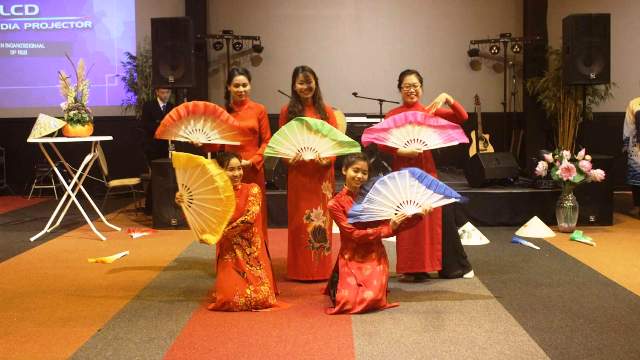
With the venue buzzing and the participants joining each other at nicely decorated round tables. The program started with a traditional Vietnamese dance meanwhile the appealing appetisers of a selection of spring rolls and fishcake with young rice were served by volunteers who did an excellent job.
From here on the guests were on their own as the main dishes and desserts were presented buffet style. Several noodle soups and salads as starters. From there on a large selection of main courses which included BBQ pork and beef with rice vermicelli. At one of the stands steamed rice rolls were freshly prepared which were very popular with the crowd.
The entertainment was now provided by an array of vocalists whom sang in Vietnamese and English. The kids certainly loved it as they were dancing along in front of the podium.
Participants in the cultural section of the program.
As the conversation flowed and all the main course dishes were cleared. The dessert station was looking very inviting. Amongst them were a rice and mung beans cake wrapped in pandan leaves. This sweet was traditionally given by a suitor. The delicious coffee coconut jelly was disappearing quickly as it was much appreciated.
As all good things come in three. Volunteers who had attended all events were honoured with a memento. The husband and wife organisers were honoured and applauded by all.
H.E Ms Ngô Thi Hòa, Ambassador of Vietnam with diplomats from Vietnam.
They explained that the net profits of all the events will go to a charity ‘Stichting Hart voor Vietnam”. A foundation which finances an education for children from less fortunate families in Vietnam.
All in all a very succesful celebration of Vietnamese cuisine which will go from strength to strength.
Recently the Embassy of the Republic of Malta in The Hague, the Netherlands celebrated Malta’s National Day of Independence with a social event that was attended by members of the Diplomatic Corps based in The Hague, Dutch government officials, business contacts as well as the Maltese community living in The Netherlands. At the opening of the reception, a video message from the newly appointed Minister of Foreign Affairs and Trade Promotion of Malta, Hon. Carmelo Abela was presented to the guests, which message highlighted the work of Malta’s Diplomatic network especially on the EU Presidency just concluded and Climate Change policy. The Minister also expanded on the goals that will be embarked upon during his term and the focus on Trade Promotion. At the opening, H.E. Ambassador Joseph Cole also took the occasion to express his sympathy with the Dutch Government for the difficult times encountered by the fellow citizens of the Caribbean islands Sint Maarten, Saba and St Eustatius.Ambassador Cole, H. E. Andrea Perugini, Ambassador of Italy, Bernadette Cole, and an Italian diplomat.During the reception, guests were also offered tasting of wines, olive oil and tomato paste produced in Gozo – Malta’s sister Island which offers diverse and rich culinary products and is known as ” the island of wines”. This was offered courtesy of Casa delle Fonti – Gozo Wine, a Dutch company which imports Gozitan Wine produced by the ‘ta Mena Agri-Business’, which are becoming ever more popular with the Dutch as seen by the increase of visitors to the Maltese Islands from the Netherlands during the last few years. Casa delle Fonti – Gozo Wine owners.An increase of 17 per cent in 2016 and a 30 per cent increase already registered for the first half of this year. We look forward to host more Dutch nationals in 2018, the year of Valletta European Capital of Culture which will be the key attraction for the many tourists visiting the Maltese Islands next year. Information about Malta:www.visitmalta.comwww.gozowine.eu
On the picture H.E. Ambassador Heidemaria Gurer and spouse Mr Nadir Gurer. By Roy Lie A Tjam.
On a bright autumn morning, the Embassy of Austria in The Hague organised the reception at the residence of the Austrian Ambassador, celebrating the National Day on October 26. The day brought together a number of Ambassadors representing countries from round the globe, among the endless list of ambassadors present for the occasion, China, Denmark, Israel, India, Japan, Kosovo, Albania, Georgia, Croatia, Armenia, Serbia, Germany, Bosnia-Herzegovina and many other Diplomats.
Furthermore senior representatives of the Dutch government, the municipality of The Hague, local and foreign companies, and guests from the cultural (Wiener Ball) and economic life of the Netherlands.
The Ambassador of Albania, H.E. Adia Sakiqi together with the Ambassador of Israel, H.E. Aviv Shir-On.For additional Roy Strik’s pictures, please open the following link: https://www.flickr.com/photos/121611753@N07/albums/72157689603094925
The reception has been a showcase of Austrian hospitality, cuisine and culture. It has been very gratifying to see H.E. Ambassador Heidemaria Gurer along with members of her staff all dressed in authentic Austrian outfit.
As for cuisine, the Ambassador delighted her guests by offering a constant flow of savoury Vienna’s sausages and Austrian dishes from the traditional gastronomy.
Director General for the International Commission on Missing Persons, Ms Kathryne Bomberger, H.E. Petar Vico, Ambassador of Serbia, H.E. Ambassador Gurer and the Ambassador of Latvia, H.E. Ilze Ruse.Noteworthy were the excellent wine served, produced from grapes coming from the Ambassador’s private vineyard. All enjoyed the Austrian style lunch-time reception.H.E. Konstantine Surguladze, ambassador of Georgia and H.E. Adia Sakiqi, Ambassador of Albania.
On the picture the President of the International Criminal Tribunal for the former Yugoslavia (ICTY) Judge Carmel Aigus.The International Criminal Tribunal for the former Yugoslavia (ICTY or Tribunal) was presented with the first Justice Administration Excellence Award by the International Institute for Justice Excellence (IIJE), launched at the Peace Palace on 14 November 2017.The President of the Mechanism for International Criminal Tribunals (MICT ), Judge Theodor Meron, H.E. Heidemaria Gurer, Ambassador of Austria and the President of the International Criminal Tribunal for the former Yugoslavia (ICTY) Judge Carmel Aigus.
During a ceremony marking the IIJE’s official launch in The Hague, which took place in the Great Hall of Justice of the Peace Palace and was attended by eminent jurists and members of the diplomatic community, the Tribunal was honoured for its significant contributions to the field of Justice Administration.
Specifically, the Tribunal was recognized for its contributions to the advancement of information management technology, electronic records management, the broadcasting approach of trials on the internet, victim-witness protection methods, court governance, transcript production, and evidence preservation systems, among others. ICTY Registrar John Hocking
President Carmel Agius accepted the Award on behalf of the ICTY and was introduced by Registrar John Hocking who recalled how the President has embodied both justice and excellence throughout his career and inspired others to live up to these commitments. Mr Jeffrey A. Apperson, Chairman, IIJE presenting the award to President Judge Carmel Agius.In his Keynote address, President Agius thanked the IIJE, noting that: “It is an award that speaks to the ICTY’s lifetime achievements over 24 years of operation. This award is also an acknowledgement of its Judges, Principals, and staff members, past and present, who have excelled in the performance of their duties, as well as promoted accountability and inspired excellence in others.”
Established in October 2017, the IIJE’s mission is to improve access to justice globally through its role as a non-political, non-profit, international institution dedicated to developing a collaborative approach to the administration of justice. In particular the IIJE will undertake and promote research and education on justice access and administration issues, as well as the dissemination of international best practices and procedure related to the fields of court management and justice administration more broadly.
On the picture the Ambassador of Cuba H. E. Soraya Alvarez Nunez, H.E. Haifa Aissami Madah, Ambassador of Venezuela to the International Organizations, Nicos Argyrides, Second Secretary Embassy of Cyprus and H.E. Abdulaziz bin Abdullah Abohaimed, Ambassador of Saudi Arabia.By Catherine Dailey.
Some three hundred members of the International Women’s Contact (IWC) of The Hague turned out early on Monday, November 13, for a special “Country Morning” event hosted by the Embassy of Cyprus at The Hague Marriott Hotel. Mr.Nicos Argyrides, Second Secretary of the Republic of Cyprus, presented the program on behalf of Ambassador Elpidoforos Economou. The Ambassadors of Austria, Cuba, the Czech Republic, Saudi Arabia and Venezuela were among the many distinguished guests invited by the embassy to enjoy the “Country Morning” program which included a short film produced by the Ministry of Tourism; followed by a cultural presentation given by Prof. Dr. Marina Tekourafi, Professor of Sociolinguistics at Leiden University.
Mr Nicos Argyrides , Embassy of Cyprus.
The President of the IWC, Mrs. Rieke Lubach, opened the event. The large and attentive audience were delighted to learn that IWC board members are planning a custom “members only” tour to Cyprus in 2018. Following a short introduction, the president introduced Mr. Argyrides, who shared key facts about his island nation which can be easily reviewed via a link on the homepage of the embassy website.
Argyrides explained the origin of the country’s name, which is believed to have derived from the Classical Latin phrase aes Cyprium, “metal of Cyprus” and which was later shortened to Cuprum. He also described the symbolism of the nation’s flag with its distinctive yellow copper color for the outline of an island map centered above a pair of green olive branches, against a white background. The white and copper colors, together with the green olive branches, serves as a proud reminder of the republic’s history, commitment to peace and strategic importance as a crossroad of civilizations since the Homeric Age.
The Second Secretary further explained that the Republic of Cyprus, with a population of approximately 956,500 citizens, is a unique country of threes–the third smallest country in the European Union, the third most populated island, and the third largest island in the Mediterranean. In addition, the island nation, which joined the European Union on May 1, 2004, has been influenced for millennia by European, Asian and African peoples due to the country’s proximity to all three continents. Cyprus, he explained, has six main cities and Nicosia, with a population of 244,100, is the capital. It is the last divided capital in Europe.
Cyprus Morning Morning, Marriot The Hague.
Professor Marina Terkourafi presented the second part of the program and captivated listeners with her cultural and historic survey of Cyprus by focussing on four women beginning with Aphrodite, the Greek goddess of love and fertility. Dr. Terkourafi followed by saying a few words about St. Helena, the mother of Emperor Constantine. She (St. Helena) is remembered for her discovery of the “True Cross” and is also given credit for ridding the island of snakes and other vermin by arranging for 1,000 cats from Persia and Egypt to be shipped to the island and transported to the Holy Monastery of St. Nicholas of the Cats in Akrotiri.
Brief homage was given to Catherine Cornaro (1454-1510), a noble Venetian woman and last Queen of Cyprus before the professor concluded her presentation by citing a few words about Nicosia from the varied oeuvre of Niki Marangou (1948-2013), the renowned Cypriot poet, writer and artist.
Aphrodite, according to ancient Greek myths, rose form the sea and washed ashore in seafoam at Paphos. The cult of Aphrodite at Paphos was mentioned in Homer’s Odyssey (675-725 BCE) and the Paphos Archeological Park in Kato Paphos, inhabited since the Neolithic period, is, one of three Cypriot sites included on the UNESCO World Heritage List. An additional eleven sites are on UNESCO’s tentative list. Today, Paphos, on the island’s southwest coast, is a modern city of glistening harbors, theaters and resort hotels. The city welcomes international visitors throughout the year who come to enjoy both the temperate Mediterranean climate and warm Cypriot hospitality.
Explorers, unable to visit the Classical World in the Mediterranean, are encouraged to travel to the Greek Hall of the permanent Klassieke Wereld exhibitionin Leiden’s Rijksmuseum van Oudheden (National Musuem of Antiquities), where top pieces, including a recent acquisition of a Cypriot portrait sculpture dating from approximately 470-460 BCE, can be admired.
The introduction to Cypriot cuisine, served to close the program, included Koupepia (stuffed vine leaves), Koupes, Halloumi Cheese in pita wraps and olives. Guests especially enjoyed an opportunity to sample Commandaria—reputed to be the oldest wine in the world which was first known as Nama by the ancient Greeks. Following Richard the Lionhearted’s conquest of the island in 1191, the legendary Commandaria, was produced for the first time in the commanderies of the Knights of St. John, who gave it the name which is still used today. Wine connoisseurs will especially enjoy consulting the extensive Cyprus Wine Routes, travel guide published by the Cyprus Tourism Organization (CTO) for planning a unique holiday through any of Cyprus’ seven wine routes.
International tourism revenue, a key contributor to the island’s service based economy, continues to expand with each successive year. By the close of this year, more than 3.6 million visitors are expected have visited Cyprus in 2017 or more than 3.5 visitors per citizen!
Religious tourists, especially Christians, will enjoy a visit to the Stavrovouni Monastery, founded by St. Helena. It is the earliest documented monastery on the island and one of the oldest monasteries in the world. Empress Helena, was perhaps the world’s first notable religious tourist and, according to church tradition, accidentally brought a piece of the Holy Cross to the island following a shipwreck while returning from a pilgrimage to the Holy Land. Having arrived safely, she commissioned a chapel to be built on the mountain of the same name to house it. Several other ancient Cypriot monasteries, popular with tourists, are either already listed or inscribed on the UNESCO World Heritage List.
While sampling the Commandaria, Koupes and Koupepia, many happy guests could be overheard discussing their keen interest in planning a trip to sunny Cyprus, thus ensuring that the number of visitors to Cyprus in 2018 will continue to grow, as projected, with a new group of “Country Morning” travelers from The Hague!
Embassy of the Republic of CyprusPresidency of the Republic of CyprusRijksmuseum van Oudheden (Dutch National Museum of Antiquities)Cyprus Wine Routes – Cyprus Tourism Organization“Cyprus In Your Heart” -The Official Cyprus Tourism Portal Cyprus on Film – Press and Information Office, Republic of Cyprus
On the picture Mr. Redi Molla, Director of Tirana Water Supply and Sewerage Authority (UKT)]; H.E. Ms. Adia Sakiqi, Ambassador of the Republic of Albania in the Netherlands; and Mr. Erion Veliaj, Mayor of Tirana.
The Mayor of the Albanian capital Tirana, Mr. Erion Veliaj, was welcomed in the Netherlands during October 30th and 31st 2017, as a guest at the Amsterdam International Water Week (IWW).
Mr. Kees Paalvast, Strateeg bij Hoogheemraadschap van Delfland (Delftland Regional Water); – Mr. Redi Molla, CEO Tirana Water Supply and Sewerage Authority (UKT); – Ms. Petra Heylen [Deputy Head of Mission at the Embassy of the Netherlands in Albania; – Mr. Erion Veliaj, Mayor of Tirana; – H.E. Ms. Adia Sakiqi, Ambassador of the Republic of Albania in the Netherlands; – and Mr. Wytze Boonsma, Programme Manager International Cooperation at Dunea Drinking Water Utility.
His speech “Tirana’s smart city solutions and green infrastructure as an efficient means in tackling climate change challenges” contributed to the debate of the Resilient Cities Leaders Forum (RCLF) on how cities think about global risks, mitigate them and strengthen resilience.
Mr. Veliaj held several meetings at the Netherlands Enterprise Agency (RVO) and the Ministry of Economic Affairs. During these meetings, a wide array of economic sectors- ranging from tourism to port management, water, agriculture, energy, textile, engineering and architecture- were discussed with a view to future collaborations.
Alina Fejzo, Albanian dancer.
Furthermore, a Memorandum of Understanding on cooperation in the field of drinking water and wastewater collection and treatment was signed marking a crucial phase: enhancing and strengthening the bilateral partnership in the pillar sectors of the Albanian economy. Witnessing this signature and supporting this partnership were the Mayor of Tirana Erion Veliaj, RVO, the Embassy of the Netherlands in Tirana and the Embassy of Albania, The Netherlands. This is considered as a major stepping stone towards promoting and fostering the future cooperation with Albania.
Lastly, Mr. Veliaj held a lecture at the Erasmus Rotterdam University on the topic ‘How can the Western countries promote and be the drive towards the EU integration – the case of Albania’. Mr. Veliaj presented the transformation of Tirana in the last two years and offered his vision of the future.
Mr. Erion Veliaj, Mayor of Tirana.
The lecture sought to bring together excellence Albanian students and intellectuals who did not resist sharing their enthusiasm and commitment to do something for the future of Albania. Furthermore, Mr. Veliaj stressed the importance of the free economic area for foreign investments in Albania.
Another highlight of this event was the artistic performance of Ms. Alina Fejzo, an Albanian dancer currently touring with Krisztina de Châtel / V A Wölfl-Thron in the Netherlands. Her modern dance performance was met with the applause of the audience. As Mr. Martin Sobota, architect, observed after this stellar performance: ‘sometimes we forget how many talents come from such a small country like Albania’.
Ending on this high note, the positive attitude of both the Dutch and Albanian representatives deserves remark; portending enhanced collaboration between the two partners and signifying shared eagerness towards what the future will bring.
——-
Photography by the Albanian Embassy in The Hague.


 It is well worth visiting and keeping up with the activities on www.pulchri.nl.
Until December 3rd you may enjoy an impressive exposition of the The Hague painter and graphic artist Marius Bauer. This year marks the 150th anniversary of his birth and 2017 is nominated the Bauer Year with various expositions throughout The Netherlands.
Bauer was born in The Hague and was encouraged by his parents to develop his artistic talents. At the age of 21 he received a scholarship for a visit to Istanbul, where he became mesmerised by the colours, the smells and the exotic culture.
This fascination was never to leave him. He travelled through Turkey, Palestine, North Africa, Russia, the Dutch East Indies and British India.
It is well worth visiting and keeping up with the activities on www.pulchri.nl.
Until December 3rd you may enjoy an impressive exposition of the The Hague painter and graphic artist Marius Bauer. This year marks the 150th anniversary of his birth and 2017 is nominated the Bauer Year with various expositions throughout The Netherlands.
Bauer was born in The Hague and was encouraged by his parents to develop his artistic talents. At the age of 21 he received a scholarship for a visit to Istanbul, where he became mesmerised by the colours, the smells and the exotic culture.
This fascination was never to leave him. He travelled through Turkey, Palestine, North Africa, Russia, the Dutch East Indies and British India.
 On his travels he made many sketches and bought photographs by local and internationally renowned photographers, which -back home in his atelier- he developed into paintings and wonderfully refined etchings. In his etchings he was much influenced by Rembrandt, while his painting style he was in the main stream of the last quarter of the 19th century.
His work is somewhat like what a travel writer might photograph today. He showed the extraordinary, he was fascinated with local ceremonies. His best work came out of his travel through British India.
He died in 1932 leaving a very large oeuvre of works, which aren’t often seen.
Go and visit his exposition in Pulchri. It is well worth it, but hurry, it lasts until December 3rd only.
On his travels he made many sketches and bought photographs by local and internationally renowned photographers, which -back home in his atelier- he developed into paintings and wonderfully refined etchings. In his etchings he was much influenced by Rembrandt, while his painting style he was in the main stream of the last quarter of the 19th century.
His work is somewhat like what a travel writer might photograph today. He showed the extraordinary, he was fascinated with local ceremonies. His best work came out of his travel through British India.
He died in 1932 leaving a very large oeuvre of works, which aren’t often seen.
Go and visit his exposition in Pulchri. It is well worth it, but hurry, it lasts until December 3rd only.