By Joe Ray.From 13th to 19th July 2015, some 200 university students from around the world will gather in The Hague for the annual conference of The European International Model United Nations. Now in its 28th year, TEIMUN is the oldest model United Nations in mainland Europe and serves as an inclusive forum within which the diplomats and leaders of the future can exchange ideas and discuss solutions to pressing global issues.Student delegates from more than 50 countries will be welcomed to Hotel Bel Air for the opening ceremony. This grand event will feature speeches from Mr. Jozias van Aartesen, Mayor of The Hague; Mr. Herman Schaper, former Permanent Representative of the Netherlands to the UN; Mr. Jamie Shea, Deputy Assistant Secretary General for Emerging Security Challenges at NATO; and Mr. Erik Akerboom, Secretary-General at the Netherlands Ministry of Defence. TEIMUN 2015 will also draw upon the distinguished support of Mr. Ban Ki-moon, UN Secretary-General; Mr. Sergey Lavrov, Foreign Minister of the Russian Federation; and Mr. Bert Koenders, Foreign Minister of the Netherlands, each of whom will provide their own written preface for the conference programme booklet. Adding to the diplomatic grandeur of the occasion, a substantial number of ambassadors and diplomats representing many of the embassies stationed in the International City of Peace and Justice will be present at the opening ceremony to answer questions from participants and advise them on the finer aspects of diplomacy. This comprehensive introduction from some of the leading lights of contemporary international affairs will prepare delegates for a challenging but rewarding week of diplomacy and multilateral negotiations in which each individual will be tasked with representing the position of a country other than his or her own. Simulations of key international decision-making bodies, including the UN Security Council and NATO’s North Atlantic Council, will provide the framework for the week’s discussions, allowing delegates to become acquainted with the negotiating processes which characterise diplomacy in such organisations. This year’s council sessions will focus on salient issues within the field of international security, and in particular, the challenges faced by states and decision-makers in responding to shifting global security landscapes. Without significant deviation from their nation’s negotiating brief, delegates must attempt to find common ground by way of argument and compromise in order to propose solutions to the issues put before them by the chairs of each council. These debating points are designed to closely reflect the political and diplomatic hurdles encountered by decision-makers on a daily basis within the realm of international affairs. At the end of the week, participants in each council will endeavour to codify their discussions and ideas into mutually acceptable communiqués.In addition to the council sessions, visits to a variety of international organisations and institutions will take place throughout the course of the conference. Participants will have an opportunity to visit the International Court of Justice, Organisation for the Prevention of Chemical Weapons, and Red Cross, amongst others, and will further explore The Hague’s thriving international scene by way of social excursions and a networking event. Activities such as the Global Village – an evening of cultural diplomacy in which delegates can learn more about one another’s religious, social, and cultural backgrounds – are designed to foster the exchange of knowledge and ideas between attendees in order to celebrate and enhance cross-cultural understanding.On the final day, the conclusions and agreements reached in the various councils will be presented in the closing ceremony, and the outstanding delegate from each council will be honoured with an award.
Everyone benefits from coaching, suitable styles may vary.
While it’s easy to argue that everyone benefits from some form of coaching, it is a broad concept that’s hard to grasp and causes many misunderstandings. To clarify the possibilities and value of coaching in different settings, we’ll walk you through the most essential coaching styles.
By Luuk Tubbing & Joop van Schijndel.Mr. Joop van Schijndel
Of course, a coach coaches people. But what is coaching really and what is its value really? Coaching is helping people to help themselves develop personally and/or in their career. Very common objectives are improving performance, more efficient behavior, achieving goals and generally to experience more success and fun. Coaching therefore presupposes growth and variation in terms of vision, attitude and behavior. In a good coaching conversation there is learning involved! Depending on which book you read or who you talk to, different coaching styles are acknowledged. We provide you with some common examples.
Result-oriented
The coach helps the coachee to be explicitly aware of his goals, opportunities, and activities. The coach helps with practical applications and action. He acts as a motivator and helps the coachee to incrementally identify, analyze and realize his goals.
Solution focused
There is spoken about problems without immediate search for causes. Therefore, a diagnosis cannot be established. Instead, the coach helps the coachee to contrast by asking him to clarify the desired situation in concrete behavioral terms. By then seeking for what has already worked in the past, the coachee acquires practical ideas to put steps forward.
Mentor style
The coach has the role of a wise man or woman; a big brother or sister; a dyed-in-the-wool person with a lot of life experience. The coach shares his or her experiences and translates them into the situation of the coachee.
Teacher style
The coach has expert knowledge of the topic at hand (e.g. leadership, writing), on both the theory and application. Sharing knowledge and insights as well as teaching particular skills are the key to this style.
Transformational
The coach is mainly some kind of ´talking mirror´, someone who makes the coachee look at himself and comments on his behavior. The latter is done by asking opinionated and often critical questions. The aim is to cultivate awareness of the behavior of the coachee by wondering where his behavior comes from and what causes it.
Provocative
Provocative coaching is a revolutionary cocktail of humor, warmth, challenge and surprise. Suddenly the coachee shouts that he is worthwhile, that he can do it and that he will do the damn thing! This is the result of a provocative principle in action: “If you want the donkey to go forward, pull him by the tail.”
Luuk Tubbing MSc is consultant at O&i Management Consultants, and founder and coach at de afstudeerconsultant. Joop Van Schijndel MA is personal effectiveness coach at de afstudeerconsultant, management consultant, and head of the advisory board at Rhiza International.
More information about the expertise at de afstudeerconsultant can be found at: deafstudeerconsultant.nl/personal-effectiveness
By Silvia A. Fernández de Gurmendi, ICC President.
As the new President of the International Criminal Court I have been entrusted with the great responsibility of overseeing the proper administration of the Court and thereby helping to ensure fair and impartial justice in situations where atrocious crimes have occurred and there is no other recourse to justice.
The ICC hears cases regarding war crimes, crimes against humanity and genocide. Its goal is to bring to justice those responsible for these crimes, and to help prevent such crimes from occurring again. Its mandate is clear, and the Court is determined to meet these goals. Yet it will not be easy, will not happen overnight, and most importantly, will not be possible without global cooperation and support.
As a judicial institution, the International Criminal Court is a distinct kind of international organisation, since independence from external influence is essential to its identity and achievement of its goals. Without independence, its raison d´être is compromised. The Court and the international community share the responsibility of upholding at all times the independence of the Court, which is vital for its credibility and legitimacy
At the same time, as the ICC’s first President Judge Kirsch once said, the Court is both independent and interdependent. States and organisations have a crucial role in allowing the Court to fulfil its core mandate. Non-cooperation or lack of timely cooperation significantly affects the Court’s ability to collect evidence, protect witnesses or arrest its suspects in the situations and cases that are brought before it. Likewise, without cooperation, the Court cannot provide adequate reparations to victims and ensure awareness and understanding of its work by affected communities and society at large.
In other words, without cooperation, the Court can neither be efficient nor effective. However, cooperation may not be forthcoming or may diminish if potential supporters lose confidence in the ability of the Court to deliver high quality justice. Both aspects – cooperation and performance – are interrelated.
With respect to its performance, the proceedings of the Court are perceived as too lengthy, and not as efficient or effective as they should be. This perception must be addressed, as it poses a potential risk to our ability to gain and maintain support and cooperation. This in turn would jeopardize the ability of the Court to enhance the quality of its operations. While many delays and difficulties may derive from factors beyond the Court’s control, the Court needs to identify and address the problems that are indeed within its powers to resolve.
There is, for this reason, a compelling need for the Court to undertake wide-ranging reforms to improve its operations. Important initiatives are already underway within each of the Court’s organs. The Prosecutor is implementing a new Strategic Plan adopted two years ago. The Registrar has launched a project to restructure and streamline the Registry. The Judges have embarked on a “lessons learnt” process to take stock of the Court’s judicial practice and to propose amendments to its legal texts, if needed.
The legal system of the Court is based on a combination of elements derived from different legal systems and traditions; thus, any amendments to its provisions should take into account the need to preserve its hybrid character. One fundamental aspect is the unprecedented role granted to victims of the crimes who may participate in the proceedings to express their views and concerns and seek reparations for the damage suffered.
The interpretation of this unique and innovative system has raised considerable legal and management challenges, and the various ICC chambers have given different responses to problems that were raised during the first years of the Court’s existence. Twelve years down the road, it is now urgent to assess results and seek to identify best practices and harmonize solutions. In light of our past experience, I believe that, rather than piecemeal revision of individual provisions of the legal texts, it is necessary to address the proceedings in a holistic manner, with a view to diagnosing practical problems and proposing comprehensive remedies.
As part of a court-wide effort to improve its operations, inter-organ discussions have also started to develop performance indicators that may serve to assess and improve the operations of the Court. It is important to develop a coherent, court-wide vision of how best to ensure high quality of justice at the ICC. This is not a simple task as there are inherent difficulties in evaluating the performance of a court, in particular an international criminal court.
While acknowledging these and other difficulties, we must all recognize that the challenges the Court and the international community currently face have multiplied and their nature has changed. Not too long ago, the international community wondered whether the creation of Court was at all possible and, after its inception, whether it would ever become relevant.
The Court has indeed become relevant as the concept of accountability for international crimes and the importance of a justice component in the settling of conflicts are now recognised. The role of the Court in ensuring this accountability is also increasingly recognised. The central question today is whether the Court is sustainable and whether its relevance will be maintained and continue to grow in the years ahead. As said, the sustainability of the Court will require the combined efforts both of the institution itself and of the global community since both aspects – performance and cooperation are intertwined.
As the new ICC President, my priority is to contribute to the Court’s sustainability by seeking to enhance the efficiency and effectiveness of its performance. I trust that broad support and cooperation with its activities will be forthcoming. I also hope that States and organisations will deploy all necessary efforts to enhance the universality of the Court. While a significant number of States have now joined the ICC, the Court has not yet achieved universal participation, which is essential for the effective exercise of its global mandate.
Judge Silvia Fernández de Gurmendi took office as the President of the International Criminal Court on 11 March 2015.
By Josh Giesbrecht.
With the House of Commons rising for the summer there is no doubt that the 2015 federal election is now in full swing. Many policy issues regarding the economy and national security will come to dominate this election.
However, will Aboriginal policy issues take root at all this election? This question must be asked, not because they ever really have, but because of all the major events that have taken place since the last federal election in 2011. There was Idle No More – the grassroots Aboriginal protests that took place over a seemingly mundane policy issue of the government’s omnibus bill. The First Nations Education Act that proposed significant reforms and funding was agreed too, and then rapidly stalled with opposition that resulted in the Assembly of First Nations National Chief at the time, Shawn Atleo, suddenly resigning. The Truth and Reconciliation Commissions findings were released marking the end of the historic formal process of the federal government addressing its dark past of Residential Schools. Yet, the long process of reconciliation in Canada taking place has just started and that new relationship is complicated.
This is just to mention a few significant events that have taken place since the last election. It begs the question if this election will be any different – will Aboriginal policy take a significant part of this election or will it be just background noise at best like in the past? Interestingly enough, the first time Aboriginal issues ever came onto the political scene was in the 1957 election when John Diefenbaker made a point of putting it into his election platform. As one can imagine in the late 1950s in Canada, Aboriginal policy matters were not a point of major political points in an election. Yet he made it apart of his platform and set a new political convention in Canada. This became part of the expected practice by all political parties.
Despite all of these major events, conventional wisdom of past federal elections points to there being no major role for Aboriginal policy to play in the campaign to come. Aboriginal policy in all likelihood will take the backseat for the three major parties as they vye for power. However, just as Idle No More came out of nowhere and a seemingly done deal on real Education reform quickly unravelled, conventional wisdom in both cases was proven to be wrong.
One thing is crystal clear: these are not ordinary times for Aboriginal policy in the country. It can be argued that ever since Elijah Harpers stand against the Meech Lake Accord 25 years ago, things have changed, and they have given a real voice for Aboriginals politically. In other words, the overarching conventions that have governed this country since its confederation has been overturned.
With that being said, maybe this election we will be different. Conventions in this country have been completely changed at the most unexpected times. 2015 may be the unconventional year where big changes happen in the election cycle – changes from normal topics to one that includes a fulsome discussion of Aboriginal policy in this country in real terms. One thing is for certain, if it does take place this fall, it is about time.
By Mr. Jozias van Aartsen, Mayor of The Hague.
This year it will be seventy years ago that the Second World War came to an end and The Hague was liberated by the Canadians. That war with the battle for the royal seat in May 1940 and the five years that followed, were undoubtedly the most dramatic period in the history of The Hague. A period in which more than 15,000 people living in The Hague lost their lives. Most, about 12,000 of them, Jewish residents. The war caused huge material damage too, the traces of which can still be seen today.
This article is an edited version of the speech given by Mayor Jozias van Aartsen on 1 March this year at the commemoration of the tragic bombing of the Bezuidenhout district of The Hague. The ceremony took place in the Christus Triomfatorkerk (Risen Christ Church) in the presence of British and other diplomats. Among those leading the oecumenical service was the Reverend Canon Dr David Stone of Coventry Cathedral, the church destroyed by the Luftwaffe in 1940 and which, in 1995, donated a Cross of Nails to the churches of the Bezuidenhout.
“The day before yesterday there was war
and yesterday too
and there is still war in my time
time that is not just mine”
Lines from a poem by Remco Campert, who was born and raised in The Hague. His father Jan Campert perished in the Neuengamme concentration camp. The actor, Bram van der Vlugt, who also grew up in this city, quoted this poem in a radio interview he gave a few years ago. During the programme he talked about the dramatic events experienced by his family during the Second World War. It was a distressing story which in many ways reflected the war years of The Hague. Bram van der Vlugt’s mother was Jewish and was murdered, along with her own mother and other family members. When the occupying forces cleared Scheveningen the Van der Vlugt family ended up in the Bezuidenhout. Along with many other families from Scheveningen and other areas of the city which had been cleared or even torn down. There in the Bezuidenhout, the young Bram then witnessed the terrifying bombing.
It was on 3rd March exactly seventy years ago that a large part of the beautiful Hague district of the Bezuidenhout, with its typical architecture and street patterns, was accidentally bombed by the Royal Air Force in an attempt to disable the destructive V2 rockets which the German occupying forces were firing from this area at Britain, causing death and destruction there. Owing to a compounding of errors the bombs landed instead on a densely populated residential area. More than 500 people lost their lives that day and in the days that followed. With another 400 missing, many of whom were never found. The bombing of the Bezuidenhout, together with the German air raid on Rotterdam and the allied bombing of Nijmegen – also a tragic mistake – were among the worst and most deadly air raids that the Netherlands suffered during the Second World War.
On that day 3300 homes were destroyed or severely damaged, along with 290 businesses, 64 offices, 5 churches, 15 schools and 8 hospitals. The bombing made 12,000 people homeless, many of them losing everything they had. The survivors took flight. As they did so they saw the most horrific sights, witnessing scenes of inferno. Someone recently said: “Every time I see a group of refugees on television today, I am again reminded of how I too had to flee on 3 March 1945.”
“The day before yesterday there was war
and yesterday too
and there is still war in my time
time that is not just mine”
For countless survivors the war never completely ended, however many years have passed since. The wounds inflicted on that terrible Saturday were simply too deep. The sorrow too great. On top of this, in the decades after the war little thought was given to the bombing. This was most certainly because it was an attack by our allies. Besides which, these were the years of reconstruction. Years of looking forward, not back.
More recently, however, the bombing has gained more notice rather than less, which is a good thing. Now as the group of people who experienced it first-hand is becoming smaller, the stories need to be handed down to the present generation and to future generations. And that is certainly happening. Books have been published and documentaries made in which the survivors tell their stories. There is a package for primary schools and recently an historic walk through the Bezuidenhout was organised. Photos with explanatory captions placed around the neighbourhood show just how much the appearance of the area was changed by the bombing. History can be found literally on the streets there.
You soon feel a sense of unease looking at pictures of the bombed Bezuidenhout: that was the day before yesterday, in 1945. But it is still going on today. In the cities of Syria that have been reduced to rubble, in the East Ukraine, and elsewhere in the world. It makes us realize all the more how fortunate we are to be able to live here in peace. And that we must continue to do everything in our power to banish such suffering from the world.
Or, to put it in the words of that great philosopher Baruch Spinoza, who spent his final years in The Hague, and whose fundamental ideas about peace and freedom have lost none of their power and relevance more than three centuries later. “Peace is not the absence of war, but a virtue based on strength of character.” A virtue which we in The Hague, the international city of peace and justice, will continue to strive for and promulgate.
By Roy Lie A Tjam.
The weather was perfect for the Friday July 3rd cocktail of The Hague International Network at the NH Hotel WTC The Hague under the distinguished direction of Mr. Andrew van Esch.
Due to the outstanding conditions, the party was exceptionally held en plein air in the courtyard, as a courtesy of the WTC. Specially made THIN cocktails were served by the friendly and hospitable NH Hotel personnel, and guests were also treated to a lavish barbecue sponsored by José de Boer of FVB de Boer Financial Planning.
For a photo album on this activity, please click here: https://www.flickr.com/photos/121611753@N07/sets/72157655425833540
The event’s program consisted of 5 different one minute elevator pitches, as follows:
Gea Verhofstadt and the Schumann 3D Plate; Roy Lie A Tjam presenting the new issue of Diplomat Magazine; Kauan von Novack presenting his book Profit-Making Creativity; Danny Beekman with Bike Experts; and Dick van der Klei introducing The Hague Marathon. This was followed by a lucky draw.
The gathering consisted of representatives of The Hague’s diverse international community, politicians, public servants, diplomats and locals, all of whom enjoyed the party.
All told, the event was an excellent way for THIN to welcome summer 2015, and congratulations to Andrew for the first-rate organization.
A seminar on Investment opportunities in Pakistan was organized by the Embassy of Pakistan’s Trade Mission section in The Hague.
The Commercial Section of the Embassy of Pakistan in The Hague organized the “Seminar on Investment opportunities in Pakistan and Risk analysis” in collaboration with Habib Bank Rotterdam and IHS UK.
Various multinational companies and representatives of Dutch Ministry of Foreign & Economic Affairs participated in the seminar on June 30th at Hilton Hotel in The Hague.
The head of Asia & Pacific IHS Mr. Omer Hamid was the key note speaker who presented the technical opinion about the political and economic risk analysis for investing in Pakistan. The Commercial Counselor of the Embassy Mr. Zahid Ali Abbasi gave a presentation about Pakistan’s Investment policy, the incentive package and investment opportunities in Pakistan. The Charge de Affairs Mr. Shoaib Sarwar gave a presentation on the positive impact of Chinese investment through China – Pakistan Economic Corridor . Ms Tabinda Kazmi the Head of Habib Bank Rotterdam gave presentation on Banking and Financial sector of Pakistan and investment opportunities. Mr. Marcel Oosterveer from CBI presented the Dutch perspective on the investment opportunities in Pakistan.
The Seminar proved very informative and successful and participants appreciated this initiative took lot interest and it has created positive impact on the companies and policy makers and think tanks in the Dutch Government.
Seminar on the Textile sector of Pakistan and opportunities after GSP + was also organized by Trade Mission of the Embassy of Pakistan right after the seminar of investment at Hilton The Hague in collaboration with Modint.
Mr. Zahid Ali Abbasi, Commercial Counselor of Embassy of Pakistan welcomed the participants and gave a presentation on the Trade Opportunities in Textile sector of Pakistan in the wake of GSP+. Mr. Marcel from CBI presented about the role of CBI in capacity building of the in Textile sector of Pakistan in collaboration with TDAP. Mr. Sibbe Krol from IDH gave presentation on sustainable trade initiative in the textile sector of Pakistan and the role played by the IDH in the Dutch initiative for the formation of the Buyers Forum in Pakistan in the wake of GSP +. Mr. Antonio Barberi from Modint gave his expert opinion on the global textile sector in general and more focus on EU and trade opportunities for Dutch companies. Two sourcing companies the Matrix and PSG Pakistan Sourcing group mentioned about their business experience in the textile sector of Pakistan. In the seminar various renowned companies like HEMA, Gastra just to mention two of them and representatives from CBI and Dutch Ministry of International Trade participated in the seminar.
ICC Trial Chamber VI postpones opening of the trial in the Ntaganda case to 2 September 2015Today, 3 July 2015, Trial Chamber VI of the International Criminal Court (ICC), postponed the opening statements in the Ntaganda case, initially scheduled from 7 to 9 July 2015 to 2 to 4 September 2015. In addition, the Chamber ruled that the testimony of the first witness would start on 15 September 2015, instead of 24 August 2015. This decision was announced at a status conference held at the Court to discuss trial preparations.On 29 June 2015, the Defence Counsel for Mr Ntaganda filed a motion for the adjournment of the proceedings until the necessary conditions were in place to ensure a fair trial. The Defence raised various issues that prevented it, in the Defence’s view, from being ready to start the trial proceedings. The Prosecution responded to the request on 30 June 2015 and did not oppose a reasonable adjournment to allow the Defence additional time. In deciding on the Defense’s motion, the Chamber took into account that the Prosecution did not oppose the Defence’s request, and had regard to its obligations under the Rome Statute to ensure the fairness of the trial and the rights of the accused. The Chamber partially granted the Defence’s request and postponed the trial, including the opening statements, for a limited period.Background: Bosco Ntaganda, former Deputy Chief of the General Staff of the Force Patriotiques pour la Libération du Congo [Patriotic Force for the Liberation of Congo] (FPLC), is accused of 13 counts of war crimes (murder and attempted murder; attacking civilians; rape; sexual slavery of civilians; pillaging; displacement of civilians; attacking protected objects; destroying the enemy’s property; and rape, sexual slavery, enlistment and conscription of child soldiers under the age of fifteen years and using them to participate actively in hostilities) and five crimes against humanity (murder and attempted murder; rape; sexual slavery; persecution; forcible transfer of population) allegedly committed in Ituri, DRC, in 2002-2003. Mr Ntaganda is in the Court’s custody.



 The event’s program consisted of 5 different one minute elevator pitches, as follows:
Gea Verhofstadt and the Schumann 3D Plate; Roy Lie A Tjam presenting the new issue of Diplomat Magazine; Kauan von Novack presenting his book Profit-Making Creativity; Danny Beekman with Bike Experts; and Dick van der Klei introducing The Hague Marathon. This was followed by a lucky draw.
The event’s program consisted of 5 different one minute elevator pitches, as follows:
Gea Verhofstadt and the Schumann 3D Plate; Roy Lie A Tjam presenting the new issue of Diplomat Magazine; Kauan von Novack presenting his book Profit-Making Creativity; Danny Beekman with Bike Experts; and Dick van der Klei introducing The Hague Marathon. This was followed by a lucky draw.
 The gathering consisted of representatives of The Hague’s diverse international community, politicians, public servants, diplomats and locals, all of whom enjoyed the party.
All told, the event was an excellent way for THIN to welcome summer 2015, and congratulations to Andrew for the first-rate organization.
The gathering consisted of representatives of The Hague’s diverse international community, politicians, public servants, diplomats and locals, all of whom enjoyed the party.
All told, the event was an excellent way for THIN to welcome summer 2015, and congratulations to Andrew for the first-rate organization.
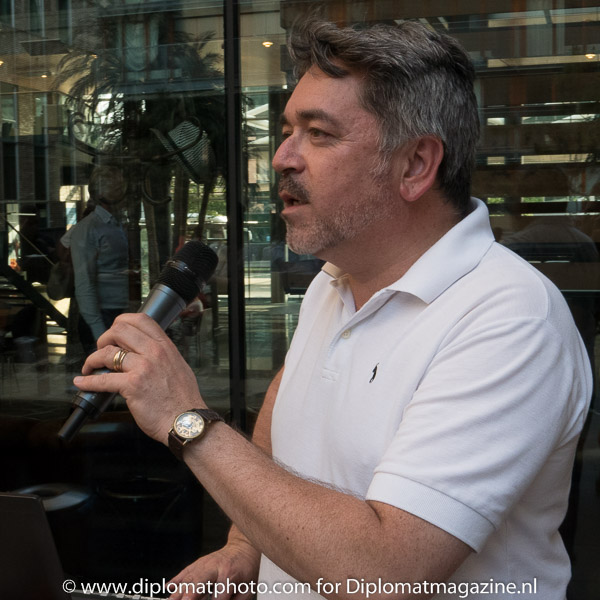
 The event’s program consisted of 5 different one minute elevator pitches, as follows:
Gea Verhofstadt and the Schumann 3D Plate; Roy Lie A Tjam presenting the new issue of Diplomat Magazine; Kauan von Novack presenting his book Profit-Making Creativity; Danny Beekman with Bike Experts; and Dick van der Klei introducing The Hague Marathon. This was followed by a lucky draw.
The event’s program consisted of 5 different one minute elevator pitches, as follows:
Gea Verhofstadt and the Schumann 3D Plate; Roy Lie A Tjam presenting the new issue of Diplomat Magazine; Kauan von Novack presenting his book Profit-Making Creativity; Danny Beekman with Bike Experts; and Dick van der Klei introducing The Hague Marathon. This was followed by a lucky draw.
 The gathering consisted of representatives of The Hague’s diverse international community, politicians, public servants, diplomats and locals, all of whom enjoyed the party.
All told, the event was an excellent way for THIN to welcome summer 2015, and congratulations to Andrew for the first-rate organization.
The gathering consisted of representatives of The Hague’s diverse international community, politicians, public servants, diplomats and locals, all of whom enjoyed the party.
All told, the event was an excellent way for THIN to welcome summer 2015, and congratulations to Andrew for the first-rate organization.


