

The 6th Transatlantic Energy Forum in Athens: Over 10 Agreements between Greek and American Companies – US Support for the Greece–Cyprus–Israel Electricity Interconnection
By Eleni Vasiliki Bampaliouta
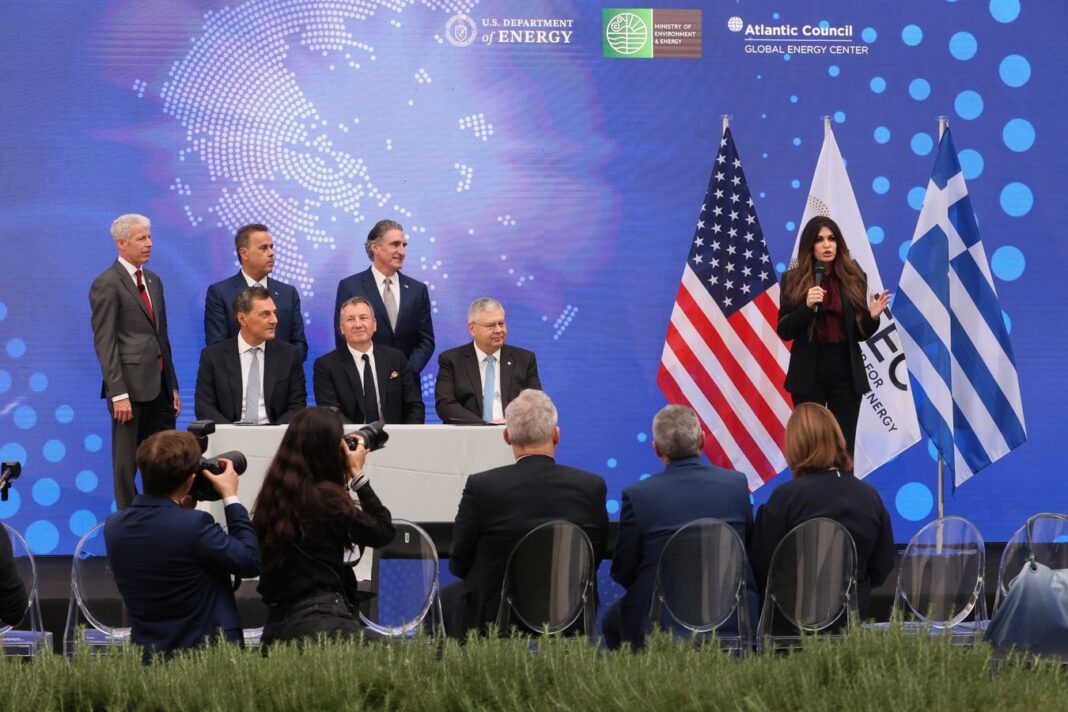
The 6th Partnership for Transatlantic Energy Cooperation (P-TEC) Summit, which concluded last November in Athens, left a strong geopolitical imprint on Greece and the wider Eastern Mediterranean. Rather than a forum of speeches and declarations, the meeting focused on concrete agreements and strategic decisions in the energy sector—outcomes with both immediate and long-term significance.
The P-TEC Ministerial Meeting was attended by U.S. Secretary of the Interior and Head of the National Energy Sovereignty Council Doug Burgum; U.S. Secretary of Energy Chris Wright; U.S. Under Secretary of State for Management and Resources Michael Rigas; U.S. Under Secretary of State for Economic Growth, Energy, and the Environment Jacob Helberg; and other senior officials of the Trump Administration. Also present were energy ministers from 25 countries on both sides of the Atlantic, as well as more than 400 senior American and European executives from leading companies including Chevron, ExxonMobil, Cheniere, and Google.
These meetings and the agreements reached further strengthened Greece’s position in the international energy and geostrategic landscape. Following Chevron’s participation in hydrocarbon exploration in four maritime areas of Greece, energy is increasingly emerging as a lever for upgrading the country’s regional role. Greece is evolving into a key co-shaper of the regional energy map.
Business representation was equally strong, with international companies such as DTEK, Google, Westinghouse, Venture Global LNG, Excelerate Energy, Baker Hughes, Cheniere, Woodside Energy, ExxonMobil, Global Vision, Concelex, Italgas, Amazon, E-INFRA, ConocoPhillips, LNG Allies, and EQT expressing interest or participation.
The meeting was co-organized by the U.S. Department of Energy, Greece’s Ministry of Environment and Energy, and the Atlantic Council Global Energy Center. Discussions focused on energy security and competitiveness, infrastructure projects, and investment opportunities across the region.
Key Business Developments
1. The Vertical Corridor
Within the framework of P-TEC, the natural gas transmission system operators of Greece, Bulgaria, Romania, Moldova, and Ukraine jointly submitted a request to their national energy regulatory authorities seeking approval for two new cross-border products, Route 2 and Route 3. These routes originate respectively from the Alexandroupolis LNG terminal and the Trans Adriatic Pipeline (TAP). Route 1, which begins at the Revithoussa LNG terminal, has already received regulatory approval.
Approval of the new routes—combined with reduced transit tariffs and planned network capacity upgrades—will enable significantly larger volumes of natural gas to transit through Greece. This will support the replacement of Russian gas supplies, which according to EU decisions will cease by the end of 2027, and facilitate the supply of gas to Ukraine.
2. LNG Supplies from the United States
During the summit, ATLANTIC–SEE LNG TRADE (a joint venture of the AKTOR Group and DEPA Emporias) signed a long-term agreement with U.S. company Venture Global for the supply of 0.5 to 1.5 million tonnes of LNG per year over a 20-year period starting in 2030. This marks the first long-term LNG supply agreement between Greece and a major U.S. producer.
At the same time, ATLANTIC–SEE LNG TRADE signed 20-year memoranda of understanding, also starting in 2030, for LNG sales to Ukraine’s Naftogaz (up to 0.7 million tonnes annually), as well as to Romania’s NOVA Power & Gas and Transgaz for quantities of up to 1.4 million tonnes per year.
3. Electricity Interconnection with Egypt
Another major project discussed was the 3,000-megawatt electricity interconnection with Egypt, accompanied by renewable energy installations (wind and photovoltaic) with a total capacity of 9.5 gigawatts in Egypt. The project is being developed by Elica Interconnector of the Copelouzos Group and is currently in the seabed-mapping study phase.
According to group sources, 60 Greek industrial companies have already signed agreements to purchase electricity from the interconnection, with one-third of the energy intended for re-export.
4. Natural Gas Supply to Cyprus
Of particular Greek interest is the proposal by Energean to supply Cyprus with natural gas from Israeli fields under its management. The plan foresees the construction of a new subsea pipeline connecting the FPSO Energean Power, operating offshore Israel, directly to Cyprus.
The proposal received support from Israel’s Minister of Energy and Infrastructure, Eli Cohen, who stated that supplying gas to Cyprus would strengthen Israel’s international position, contribute to regional stability and prosperity, and generate significant state revenues. The gas would originate from the Katlan field.
5. Drilling in the Ionian Sea
The prospect of drilling—estimated at approximately $100 million—in Block 2 west of Corfu has become increasingly realistic following ExxonMobil’s agreement to enter the exploration consortium, acquiring shares from Energean and HelleniQ Energy.
The final decision will depend on the reassessment of seismic data. Should results prove positive, the project could move toward productive drilling and the installation of infrastructure for extraction, processing, and transport, with total investments estimated at around $5 billion. A commercially viable hydrocarbon discovery would mark a turning point for Greece and contribute significantly to EU energy security.
Greece–Cyprus–Israel Interconnection
Also on the agenda was the Greece–Cyprus–Israel electricity interconnection (Great Sea Interconnector). It was agreed to update feasibility studies and explore the participation of new shareholders. The project received indirect but clear support through the joint communiqué of the recent “3+1” Energy Ministers’ meeting (Greece, Cyprus, Israel, and the United States), reaffirming backing for regional interconnection projects and the protection of critical energy infrastructure.
A New Era for Greek Energy
A new chapter for Greece’s hydrocarbon sector was opened with the agreement between ExxonMobil, Energean, and HelleniQ Energy for the concession of offshore Block 2 west of Corfu. ExxonMobil will hold a 60% stake, Energean will retain 30% and remain operator during the exploration phase, while HelleniQ Energy will hold 10%.
ExxonMobil Vice President John Ardill stated that exploration investments are estimated between $50 million and $100 million, with drilling decisions expected in 2026 and first production potentially in the early 2030s. If successful, total investments could reach $5–10 billion over the next decade.
Beyond its economic dimension, ExxonMobil’s return represents a strong vote of confidence in Greece’s institutional maturity and energy stability. At the same time, Greece is consolidating its role as a strategic energy hub for Southeastern Europe, linking the Mediterranean to Central Europe through LNG infrastructure, pipelines, and electricity interconnections.
As senior executives note, the Athens forum marked not just a series of agreements, but the beginning of a broader transatlantic energy arc connecting Greece, the United States, and the Eastern Mediterranean.