

By John Dunkelgrün
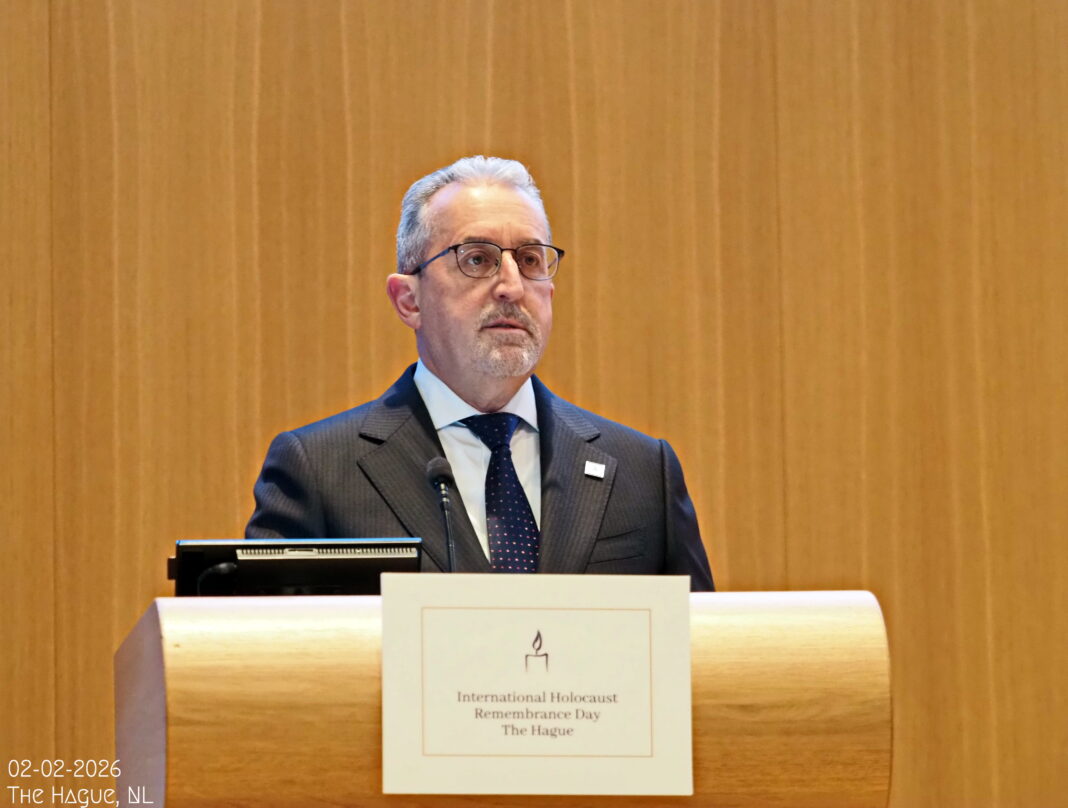
On February 2, 2026, the CHAJ Foundation, together with the Embassy of Israel and the City of The Hague, held the 8th International Holocaust Remembrance Day The Hague Symposium. The event was held at the Peace Palace.

The city’s Mayor, Mr. Jan van Zanen, delivered his opening remarks via video. He paid tribute to the esteemed American jurist Benjamin Ferencz, who served as the chief prosecutor in the Nüremberg Einsatzgruppen trials. Ferencz dedicated his life to promoting international law and justice. The Hague honors his legacy by naming a pathway near the Peace Palace after him and by actively supporting peace and justice, including through the creation of the The Hague Holocaust Education Support Center. Mr. Van Zanen emphasized that antisemitism and any other form of discrimination have no place in his City of Peace and Justice.
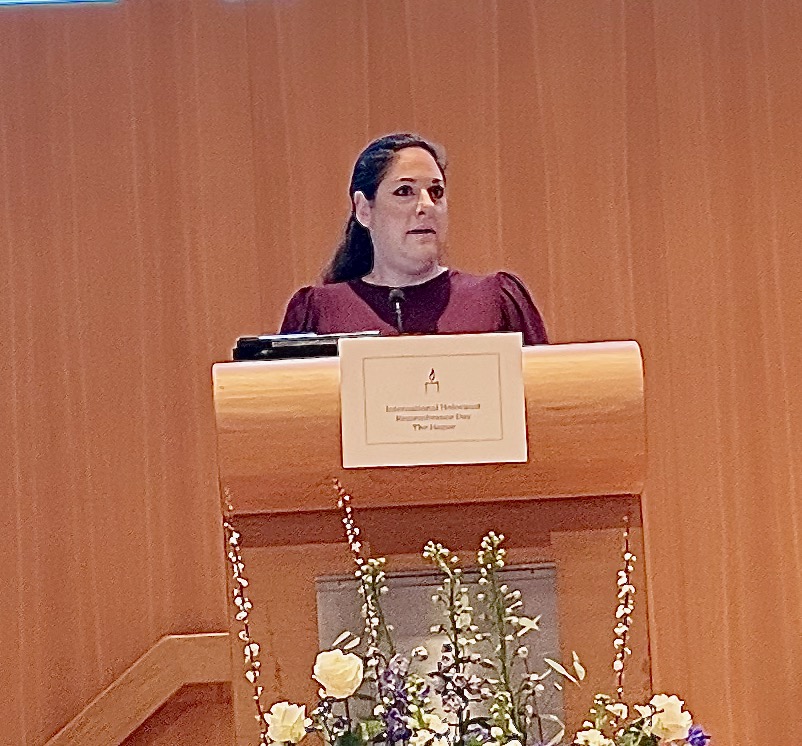
Ms. Dineke de Groot, President of the Hoge Raad, the Supreme Court of the Netherlands, delivered the keynote address, which was dedicated to her renowned predecessor, Mr. Lodewijk E. Visser. Visser began his career at Buitenlandse Zaken (the Dutch Foreign Office) but left when he felt stifled by antisemitism. He then spent his entire career, and indeed his entire life, working to improve the law and fighting for justice. Ms. De Groot explained that the Magna Carta, an early 13th-century English charter, was the first legal document to establish that no one’s freedom or possessions could be taken away except by established law, and that judicial decisions could not be sold. These are principles that guided Mr. Visser’s life until the very end. Early on, he became an expert in commercial and international law. He was instrumental in modernizing Dutch commercial law and broadening culpability under the law from actions against the strict letter of the law to acting contrary to public morality or to the care that is appropriate in social interactions.
Mr. Visser was appointed a judge on the Hoge Raad in 1933 and became its President in 1939.
Perhaps because of his experience in the Foreign Office, he was very sensitive to injustices against Jews. He was involved in many Jewish organizations, including the Committee for Special Jewish Interests, which helped Jewish refugees. He spoke out against the Nüremberg Laws, using legal and human-rights arguments and clear language. He gave a radio address in 1939 about the threat Germany posed to the Netherlands. Visser was honored in April 1940 for his 25 years as a judge on the Hoge Raad. On May 10th, 1940, while the Germans were attacking, he started the session with the words:
“The Supreme Court is now convening in a way it never has in its hundred-year history, while we are being attacked. The Netherlands has fallen victim to an attack, as treacherous as it is unjustified. While we gather here, our fellow citizens are being murdered.”
He fought against the infamous “Aryan Declaration,” and in doing so, influenced others, including Professor Cleveringa, whose speech at Leiden University sparked the Resistance movement. Visser was dismissed on March 1st, 1941, a few months before reaching retirement age. The signing of the Aryan Declaration by Supreme Court members affected him more deeply than the dismissal itself. He was deeply disturbed by the establishment of the Joodse Raad and broke with his friend David Cohen, who had accepted its chairmanship. He also refused to accept his identity card with the large letter ‘J’ stamped on it. p
Even after his dismissal, he worked tirelessly to lighten the plight of the Jews. He appealed to Secretary General Frederiks and even visited the dreaded Rauter at the Ministry of the Interior.
Lodewijk Ernst Visser died at home on February 17th. 1942. Only three of his former colleagues attended his funeral.
The period of the Occupation is the blackest in the long history of the Hoge Raad, and after the war, its authority had to be re-established.
Ms. De Groot ended her oration by stressing that in Visser’s drive for justice, humanity, and practical wisdom, he is a shining example. It is up to us today to follow his example, his unyielding and fearless attitude when it mattered, and the inspiration he found in human dignity and the rule of law.

Dr. Ronald Waterman, witness
It has become a tradition at this annual symposium to give a survivor the platform. This is becoming increasingly difficult, more than 80 years after the Holocaust, as shown by the fact that this year’s survivor had to have his granddaughter deliver the speech. Dr. Waterman, the son of a Delft professor, was only nine years old when he and his family were taken to a small camp for “elite Jews.” A fellow prisoner, Dr. Speijer, was an entomologist; he used his forced idleness to study insects. He brought young Ronald and other children in to help him collect insects. His collection of over 23,000 insects was smuggled out of the camp and has been acquired by the Leiden Natural History Museum, Naturalis. This experience fostered in Ronald Waterman a lifelong love and awe of nature.
A year later, they were transferred to Westerbork, the transit camp in the eastern part of the country, and then sent to Theresienstadt. Despite the terrible conditions there, the family survived and made their way back to Delft.
Having survived the Holocaust, Ronald Waterman believed his good fortune came with a responsibility to help humanity and improve the world. He studied chemical and environmental engineering and earned a doctorate in civil engineering and geosciences. He applied this knowledge through an innovative, nature-based approach to water management and land reclamation. Although he faced opposition from more traditional experts in the field, his ideas eventually gained acceptance. He is credited with developing the Dutch coast from Den Helder to Hoek van Holland. His advice was sought worldwide. He became the longest-serving member of the Provincial Council of South Holland and received many honors.

Rabbi Smuel Katzman compared international law to a tree. Its strong trunk, with its crown of branches and leaves, is solid and impressive, but without the roots that feed and stabilize it, it would fall and die. The law cannot stand without moral roots — without personal dignity, identity, and conviction carried by individuals and communities.
Trees bear fruits that are colorful, tasty, and nourishing, but the tiny seeds inside ensure their continuity. Our teachings, scholarship, diplomacy, and legal frameworks are like the fruit. Without the seed, even the most sophisticated message amounts to nothing lasting. With it, even simple words can take root and generate new life.
The rabbi ended by reminding us of what happens when society turns away from the fate of its own. When neighbors turn a blind eye, when colleagues opt for silence, and when superiors and subordinates alike grow numb to the pleas of their peers. When the roots are allowed to weaken until the structure fails from within.
He urged us to care for our neighbor, colleague, student, employer, or employee, and to look after the person next to us whose burden we should know!
Photos by Arkady and John Dunkelgrün