

By Diplomat Magazine
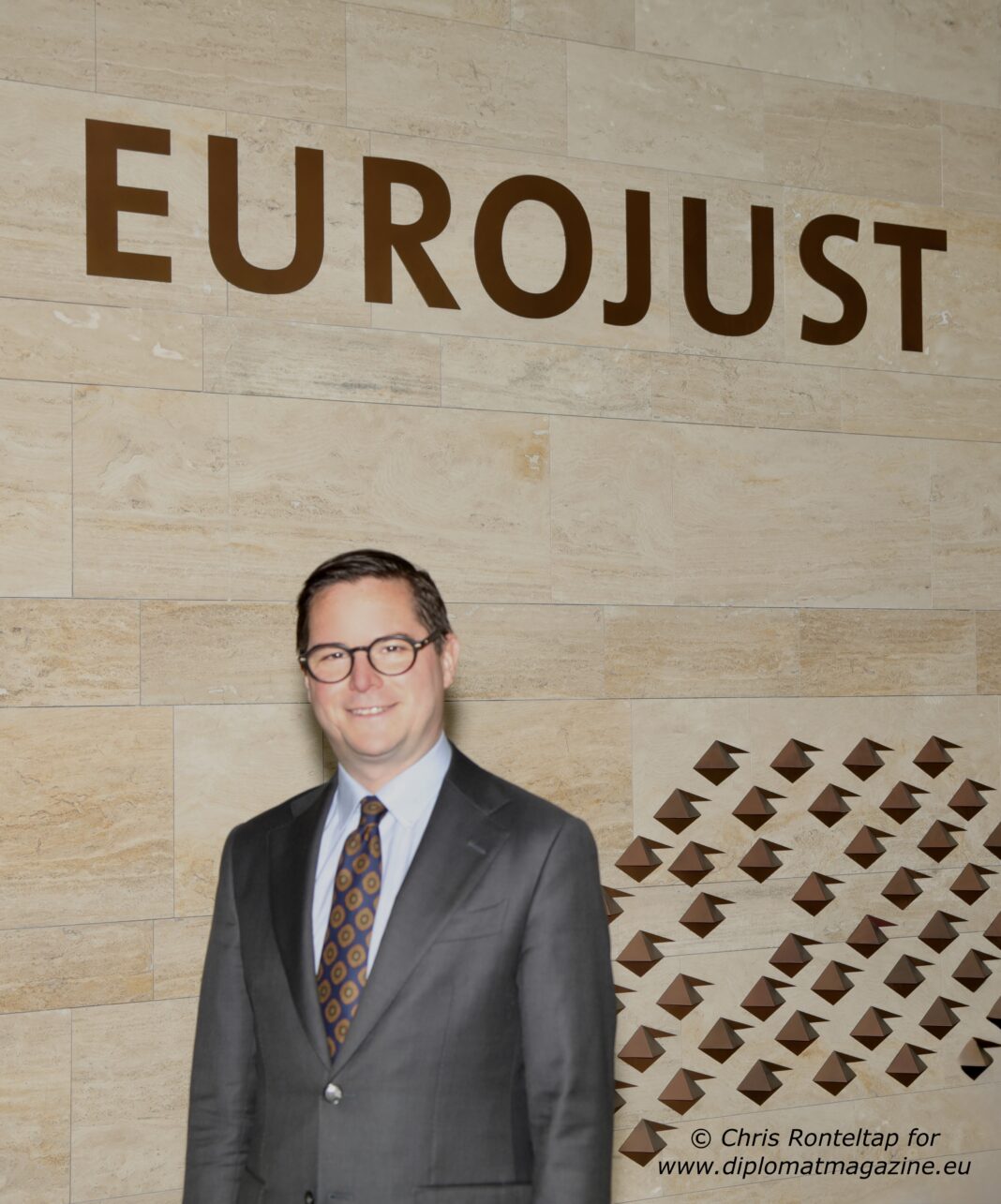
Michael Schmid, President of Eurojust, brings to the leadership of the European Union’s judicial cooperation agency a rare combination of operational experience, institutional knowledge, and strategic policy insight. His professional journey mirrors the evolution of Eurojust itself. Beginning as a public prosecutor in Vienna specialising in economic crime, he joined Eurojust as a trainee in 2013 and has since served in nearly every operational role within the organisation before being elected President in November 2024. This unique trajectory gives him both a practitioner’s perspective and a strategic vision for the future of European judicial cooperation.
“My background is as a public prosecutor from Vienna, specialised in economic crime,” he explains. “But my career has been related to Eurojust for a long time. I started here in 2013 as a trainee.”
After returning to Austria to work as a prosecutor, Schmid came back to The Hague, serving in several positions at the Austrian Desk and working directly on operational cases. That experience fundamentally shaped his understanding of Eurojust’s mission.
“I really know what counts on the ground and what colleagues, prosecutors and judges need from us,” he says. “We are a sort of service provider for the judicial authorities of the Member States and, of course, for countries outside the European Union.”
His career later expanded to Brussels, where he worked at the Austrian Permanent Representation to the European Union. The experience gave him valuable insight into the EU’s legislative process.
“It helps to understand the system well in order to explain to the authorities what we need.”
Returning to Eurojust in early 2022 as National Member for Austria, Schmid was elected President in November 2024. The appointment, however, came unexpectedly.
“I don’t know whether I was really the ‘natural President’, as you suggested,” he says with a smile. “It came as quite a surprise for me. It wasn’t part of my personal planning. I had a very young baby at home.”
Following several inconclusive rounds of voting requiring a two-thirds majority, colleagues encouraged him to stand as a candidate. Once elected, he had just three days to prepare before taking office.
“I would not recommend anyone to have such short notice before starting a job,” he recalls. “It took me probably a year to really settle in.”
Looking back, Schmid believes his years within the organisation made the transition possible. Today his responsibilities extend well beyond operational casework to strategic leadership, diplomacy and representing Eurojust on the international stage.

International Crime Requires International Trust
For Schmid, the greatest transformation in recent years has been the internationalisation of organised crime.
“Criminality has evolved rapidly over the past decade,” he says. “It has a truly international dimension—not only across countries, but across entire regions of the world.”
Traditional instruments such as mutual legal assistance requests remain important, but no longer suffice on their own.
“What we really need is collaboration built on mutual trust.”
For Schmid, trust is not an abstract concept but the foundation of effective judicial cooperation. In his experience, successful investigations are often built upon long-term personal relationships between prosecutors and judicial authorities across borders.
This philosophy underpins Eurojust’s international strategy, which today rests on three pillars.
The first is a worldwide network of contact points in approximately 100 countries, providing an initial channel for legal discussions, coordination and operational cooperation.
The second consists of Working Arrangements with non-EU countries. While these agreements facilitate strategic cooperation, Schmid believes the negotiation process itself is equally valuable because it establishes confidence between institutions.
The third and most advanced level is the conclusion of International Agreements, allowing the exchange of personal data and the secondment of liaison prosecutors to Eurojust’s headquarters in The Hague.
“This would be a prosecutor from their national system who has an office here in our headquarters,” he explains. “We cooperate with them on a daily basis.”
Eurojust currently hosts liaison prosecutors from countries including the United Kingdom, Norway, Ukraine, the United States and several Western Balkan partners. However, Schmid sees this as only the beginning.
“It is our aim to significantly increase this number. We need to go beyond Europe.”
Organised Crime Without Borders
One of Eurojust’s major priorities is combating organised crime, particularly international drug trafficking.
“The cocaine comes from Latin America,” Schmid explains. “We have increased our cooperation with Latin American countries.”
He offers an analogy that vividly illustrates how organised crime has evolved.
“Criminal groups act sometimes like diplomats. They are all over the world, have contacts and work very well together.”
The consequences are increasingly visible throughout Europe.
“In some countries these criminal networks have become more violent,” he notes, pointing to rising violence associated with drug trafficking, including in the Netherlands.
For Schmid, criminal prosecution alone cannot solve the problem.
“It is very important to have a holistic approach towards drugs and drug trafficking,” he says, pointing to broader issues such as poverty, inequality, education and demand reduction alongside effective law enforcement.
Cybercrime and Artificial Intelligence
Digitalisation has transformed virtually every area of criminal activity.
“Online fraud cases represent approximately one-third to forty percent of our work,” Schmid explains. “Almost all of those offences are now committed online.”
One of the greatest future challenges, he believes, will be ensuring lawful access to encrypted communications and digital evidence while maintaining fundamental rights.
Artificial intelligence presents both opportunities and risks.
“Criminals can use artificial intelligence to impersonate other people,” he warns. “A video can quite easily be produced with artificial intelligence.”
At the same time, AI has enormous potential to support investigators.
“We very often encounter enormous amounts of data that no person could realistically analyse on their own.”
For Schmid, artificial intelligence should enhance judicial work, never replace professional judgement.
“AI can help prosecutors—but there must always be human control.”
Preparing Eurojust for the Future
A major priority during Schmid’s mandate will be the revision of the Eurojust Regulation.
“We need additional resources,” he says. “Otherwise it is just language on paper that we cannot action.”
One of his principal objectives is ensuring that judicial cooperation develops at the same pace as police cooperation.
“Judicial cooperation must not become the bottleneck.”
Without effective prosecution, he argues, organised crime cannot be deterred.
“Without prosecution there is no deterrence.”
Schmid also hopes the revised legal framework will strengthen Eurojust’s ability to combat online crime, recover illicit assets more effectively and welcome additional liaison prosecutors from regions beyond Europe.

Accountability for International Crimes
Another priority remains Eurojust’s support for investigations into war crimes committed in Ukraine.
The Agency coordinates a joint investigation teams, manages the Core International Crimes Evidence Database (CICED) and hosts the International Centre for the Prosecution of the Crime of Aggression (ICPA), which brings together prosecutors from multiple countries to prepare future proceedings.
“This will probably become the most important platform to prepare the work of the future tribunal,” Schmid explains.
Leading an Organisation Built on Trust
Beyond operational achievements and legislative reforms, Schmid ultimately measures success by the strength of the institution itself.
While Eurojust’s mission is to support prosecutors and judges across Europe and beyond, he believes leadership also means building an organisation where people are proud to contribute.
“I would like Eurojust to continue growing—to be a place where colleagues from all over Europe and from many other countries want to come to work; a place where they are proud of what we are doing and fully committed to the aims and goals of the Agency.”
For Michael Schmid, the future of Eurojust rests on three pillars: trust, international partnership, and the conviction that effective justice depends equally on strong legislation and strong relationships.