

Electricity interconnection and regional implications
By Eleni Vasiliki Bampaliouta
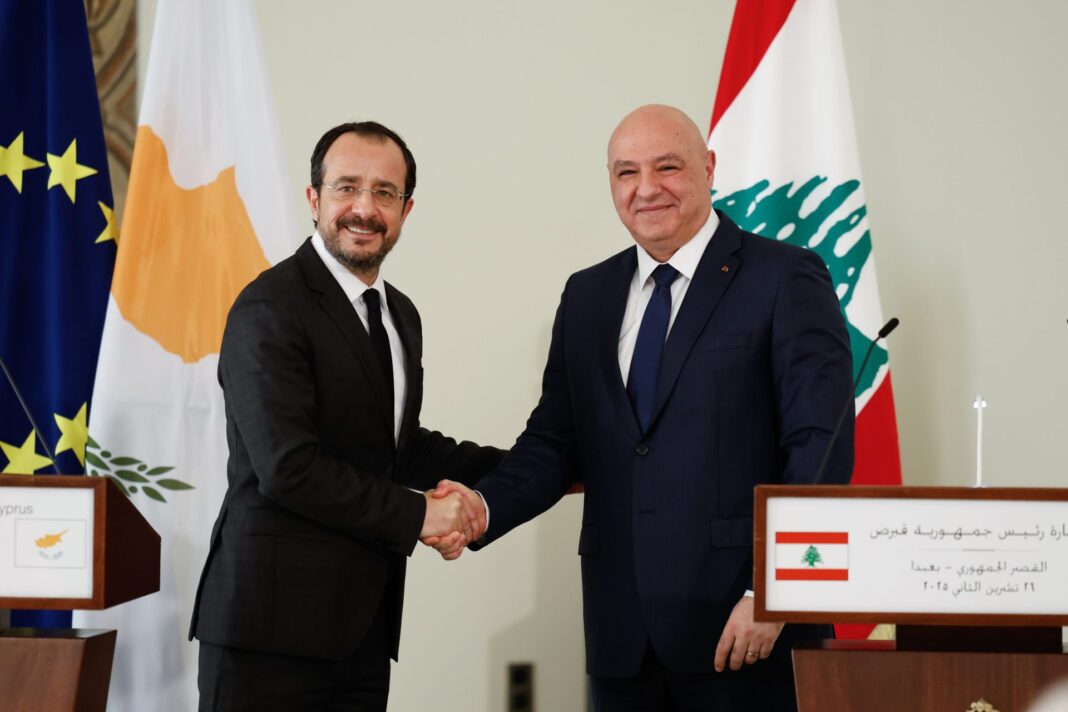
In a development of considerable geopolitical significance for the Eastern Mediterranean, Cyprus and Lebanon signed a historic agreement on Wednesday, 26 November, delimiting their Exclusive Economic Zones (EEZ), as announced by the Lebanese presidency. The agreement, pending since 2007, opens the way for future energy exploration and provides fresh momentum to bilateral relations and the region’s evolving energy landscape.
The completion of the agreement is widely viewed as a significant setback for Ankara and its “Blue Homeland” doctrine. For years, Turkey had reportedly exerted behind-the-scenes pressure on successive Lebanese governments to prevent progress on the EEZ delimitation. With the signing of the agreement, Nicosia consolidates its maritime claims and strengthens its regional energy strategy, while Lebanon gains a clearer and more stable framework for the exploration and exploitation of its offshore resources.
At the same time, a second agreement was signed concerning the electrical interconnection of Cyprus and Lebanon. This development is expected to further deepen bilateral cooperation in the energy sector and contribute to the stability and resilience of energy infrastructure in the Eastern Mediterranean.
The agreements were signed by the President of the Republic of Cyprus, Mr Nikos Christodoulides, and the President of Lebanon, Mr Joseph Aoun. Their impact goes beyond bilateral relations, affecting broader regional balances and enhancing Cyprus’s role as a pillar of stability and a prospective energy hub in the Eastern Mediterranean and the Middle East.
What was agreed between Cyprus and Lebanon
- EEZ delimitation
After 18 years of negotiations, Cyprus and Lebanon proceeded with the signing of the agreement delimiting their Exclusive Economic Zones. The agreement did not require approval by the Lebanese parliament, as it was signed directly by the President of Lebanon, following the precedent set with the Lebanon–Israel maritime agreement. - Electricity interconnection
Following the agreement, both countries will approach the World Bank to prepare a feasibility study for an electrical interconnection between Cyprus and Lebanon. During preparatory discussions in Nicosia and Beirut, interest was also expressed by Gulf countries in financing the project. President Christodoulides confirmed that a joint request for the feasibility study has already been submitted to the World Bank. - EEZ delimitation with Syria
The agreement paves the way for parallel discussions by Cyprus and Lebanon on the delimitation of their respective Exclusive Economic Zones with Syria. - Impact on the “Blue Homeland” doctrine
The Cyprus–Lebanon agreement, along with the prospect of future agreements with Syria, significantly undermines Turkey’s “Blue Homeland” strategy. Since 2007, Ankara had effectively managed to block the EEZ delimitation through the Lebanese parliamentary process. - Military reinforcement
Within the framework of the broader cooperation, the Lebanese armed forces will receive reinforcement to enhance their ability to guarantee national security. This support will come from both Cyprus and the European Union. - European projects in Lebanon
Under the Mediterranean Agreement to be announced during Cyprus’s Presidency of the EU, several European projects are expected to be promoted in Lebanon. A summit of EU heads of state and regional leaders is scheduled for 23–24 April and will be hosted in Cyprus. - Joint exploitation of offshore resources
Cyprus and Lebanon will begin discussions on a framework for the joint exploitation of potential hydrocarbon deposits that may extend across their respective EEZs. - Release of EU financial assistance
The release of €500 million in European Union assistance to Lebanon will proceed. The total €1 billion aid package was announced during a joint visit to Lebanon by President Christodoulides and European Commission President Ursula von der Leyen. - Advancing a comprehensive bilateral agreement
Cyprus will work within the EU to ensure that, during its Presidency, negotiations on a comprehensive strategic agreement between Cyprus and Lebanon are concluded. - The role of the United States
The United States appears supportive of the Cyprus–Lebanon agreement, viewing it as a development that strengthens both Lebanon and President Aoun, while weakening Hezbollah’s influence. Washington’s positive stance also opens the door to potential interest from American energy companies.