
By Eleni Vasiliki Bampaliouta
French President Emmanuel Macron was welcomed at Athens International Airport “Eleftherios Venizelos” by Deputy Prime Minister Kostis Hatzidakis.
The French president’s visit comes at a time of heightened international challenges, with the agenda of the talks in Athens focusing on the renewal of the defense agreement, armament programs, and the role of Europe in the evolving security environment.
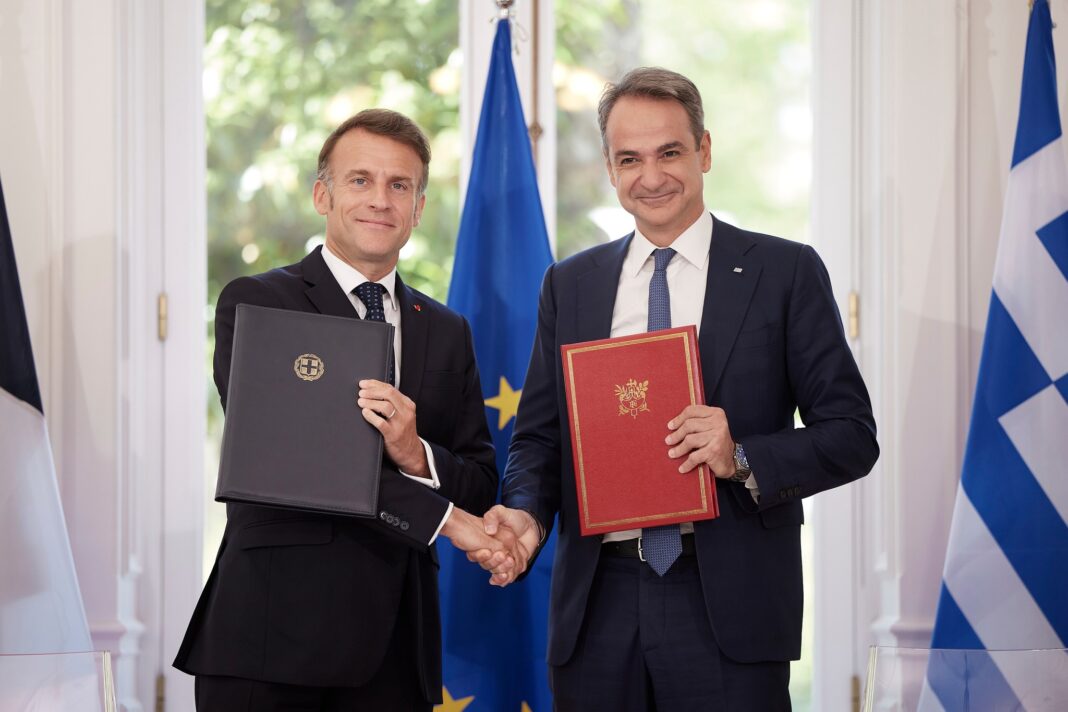
At the Maximos Mansion, a new chapter in Greek-French relations was sealed as Prime Minister Kyriakos Mitsotakis and President Emmanuel Macron signed a series of agreements of strategic importance, expanding cooperation between the two countries in critical sectors.
Central to the discussions was the renewal of the strategic partnership for defense and security, reaffirming the close geopolitical alignment between Athens and Paris during a period of growing international uncertainty.
At the same time, agreements were signed that open new avenues for cooperation in diplomacy, higher education, scientific research, and technological development. Particular attention was drawn to the joint declaration on cooperation in the field of nuclear technology—a development that further elevates the strategic nature of Greek-French relations.
Special importance was also attached to the defense industry, with the signing of an agreement for the technical support of MICA IR/RF missiles through cooperation with MBDA France, further strengthening the operational capabilities of the Greek Armed Forces.
These agreements reflect the determination of both countries to build a multidimensional alliance focused on security, innovation, energy, and Europe’s strategic autonomy.
Overall, the agreements demonstrate that Greece and France are pursuing a comprehensive strategic partnership with depth in: defense and deterrence; technology and innovation; education and research; energy and digital infrastructure.
French President Emmanuel Macron Makes Historic Visit to Nicosia
French President Emmanuel Macron visited Cyprus in what marked the first visit by a French president since the establishment of the Republic of Cyprus.
In a particularly warm atmosphere, Macron and President Nikos Christodoulides reaffirmed their strategic partnership, with the French leader sending a strong message that any attack on Cyprus would be considered an attack on Europe itself.
“True friends reveal themselves in difficult times,” said President Christodoulides as he welcomed Emmanuel Macron on the first official visit of a French president to Cyprus.
Christodoulides praised France’s support, particularly regarding efforts to resolve the Cyprus issue. He noted that France is the only European Union member state that is both a permanent member of the United Nations Security Council and a key supporter of Cyprus. He also highlighted Macron’s visit on March 9 following the attack on the Akrotiri base as a powerful demonstration of solidarity with Cyprus.
Referring to the friendship and strategic cooperation between the two countries, the Cypriot president told his French counterpart: “True friends are seen in difficult times, and you have proven this in practice.”
Defense Agreement to Strengthen French Presence in Cyprus
The new Cyprus-France defense agreement focuses on humanitarian missions and on strengthening Cyprus’s role in the Eastern Mediterranean, while deepening strategic cooperation with Paris and fostering defense-related synergies.
President Christodoulides recalled that Cyprus and France signed an upgraded strategic cooperation agreement last December, emphasizing that France is the European Union member state with which the Republic of Cyprus maintains “the strongest cooperation at all levels.”
According to the Cypriot president, this partnership begins with defense and security and extends across a broad spectrum of bilateral relations. Nicosia attaches particular importance to its relationship with Paris, given that France is the European Union’s only nuclear power and a permanent member of the United Nations Security Council.
Synergies in the Defense Industry
President Christodoulides also linked the new agreement to efforts aimed at utilizing European financing mechanisms in the defense sector. He made special reference to the SAFE framework and the €1.2 billion allocated to the Republic of Cyprus.
According to the Cypriot president, the objective is to create synergies between French companies and the Cypriot defense industry, which he described as “highly promising.”
This approach demonstrates that Nicosia seeks to expand cooperation with Paris beyond the military and operational spheres by linking it to the development of domestic defense capabilities.
The new agreement comes at a time when Cyprus is seeking to strengthen its role as a European Union member state in the Eastern Mediterranean, with a focus on security, defense, humanitarian crisis management, and cooperation with partners that possess substantial capabilities for intervention and support in the region.