
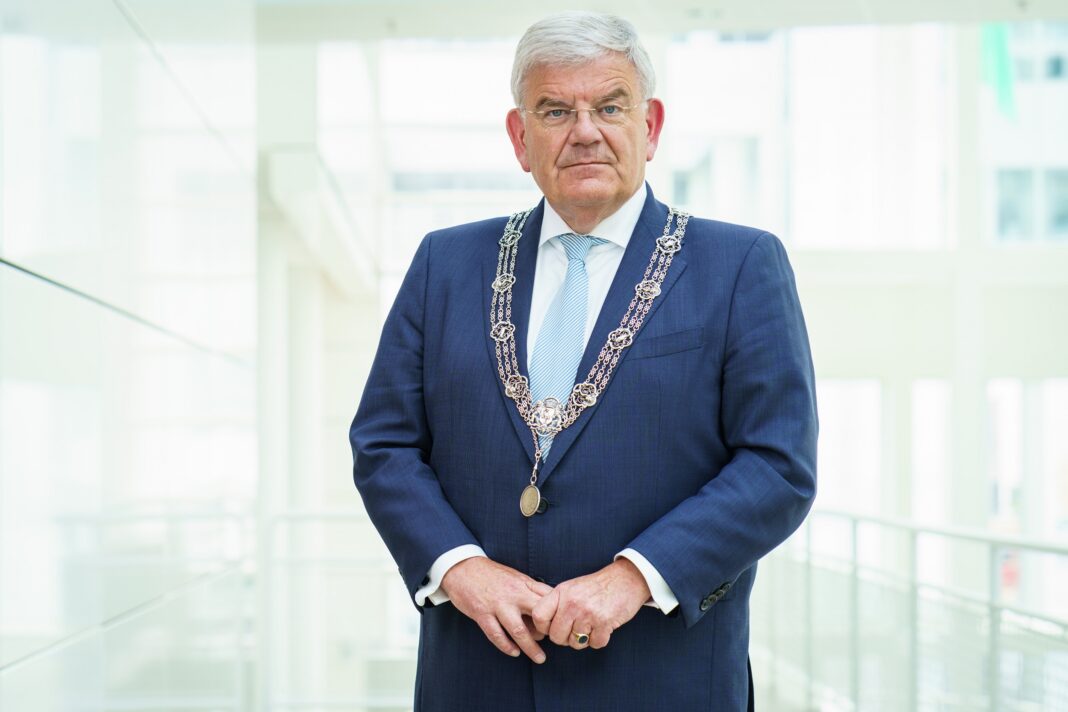

By Jan van Zanen, Mayor of The Hague
Nowhere does the Netherlands look as organised as in Madurodam; I realised this again during a recent visit. My eyes swept over the Amsterdam canals, with the Westerkerk standing as a proud landmark. A little bit further, I admired the Frisian Wouda pumping station. With a few more steps, I was standing next to the Peace Palace in The Hague. Trains ran on schedule, and traffic jams were non-existent. Welcome to the ideal society, scale 1:25.
Outside the gates of Madurodam, the real city of The Hague was waiting. Not The Netherlands in miniature, but rather, the world pocket-sized. Because with 180 nationalities, 110 embassies, and at least 550 international organisations, our city is literally a ‘global village.’
You notice it daily on the streets. An embassy employee parks their bike next to a family cargo bike. In a coffee bar near the Anna Paulownaplein, a team from an international organisation discusses its plans, while at the bar, someone is on a call with New York or Nairobi. English is a given, but you hear French, Spanish, or Arabic just as often. No one even blinks.
The Hague does not have a diplomatic district set apart from the rest of the city. Embassies are housed in old stately townhouses; international organisations share their neighbourhoods with homes, schools, and shops. International work happens in the midst of daily life. The distance between a high-level meeting and a tram stop is often shorter than the distance between theory and practice.
In Madurodam, the Binnenhof always looks complete and fully in use. In The Hague, the real Binnenhof is hidden behind fences and scaffolding. It is being renovated and is temporarily closed, while political work continues elsewhere. That difference is telling. Our city cherishes its symbols, but it will not be paralysed by them. When work has to be done, the work moves.
This is equally true for The Hague as the international city of peace and justice. The Peace Palace is not a stage set, but it is an office where people walk in every day carrying files and notes. A little further down are the institutions dealing with war crimes, human rights, cybersecurity, or conflict mediation. The conversations are seldom spectacular. They are about definitions, case law, and wording that must hold up under scrutiny.
For diplomats and other internationals, The Hague is often an interim stop. Postings last a few years, sometimes longer, sometimes shorter. Yet, a routine quickly takes hold. Regular lunch spots, familiar faces at gatherings, the same walking routes through the city. In this respect, The Hague shows surprisingly clear similarities to Madurodam. Everything here is in close proximity. Distances are short, the connection between institutions is visible.
But while little to nothing changes in the miniature park, The Hague is in constant motion. Teams rotate, priorities shift, and new crises emerge. Our city doesn’t resist these flows; it adapts fluidly where possible and facilitates where necessary.
Now that the international legal order faces global pressure, The Hague remains unwavering in its support. A steadfast commitment for which U.N. Secretary-General António Guterres explicitly expressed his appreciation during our meeting in April, when he visited our city for the 80th anniversary of the International Court of Justice.
Those who visit Madurodam see the Netherlands as an idealised concept. Those who work in The Hague see international cooperation as it truly functions: as daily work involving concrete issues, agendas, and interests.
That work is carried out by people like you. By people who give our city colour, weight, and international grandeur. People who bring the world to The Hague and The Hague to the world. As you can see: we are happy to have you.