

By Adrien Lefèvre.
Since the beginning of the full-scale war, EU institutions and member states have provided Ukraine with €216.7 billion in military, financial, and humanitarian aid. By February 2026, according to the Kiel Institute for the World Economy (IfW), the total amount of support had effectively cemented Europe’s status as Ukraine’s leading external donor.
Support for Kyiv has become one of the largest and longest-running foreign policy initiatives in modern Europe. According to the IfW, military spending to support Ukraine increased by 67% in 2025 compared to the average for 2022–2024, while financial and humanitarian aid rose by 59%.
And the larger the scale of this aid, the more pressing the question of its political implications: exactly whom is Europe empowering, to what extent is this process manageable, and will it, in the long run, create a force capable of spiraling out of control? Meanwhile, the EU is already preparing a package of an additional 90 billion euros for 2026–2027.
Such risks have already manifested themselves in the past. In the 1980s, the United States, through the CIA’s Operation named “Cyclone”, poured money and weapons into the Afghan conflict. Billions of dollars were funneled through Pakistan’s intelligence agency, the ISI, and a significant portion of those resources—including Stinger missiles—ended up among the mujahideen and radical Islamist groups, with Osama bin Laden becoming one of the key figures.
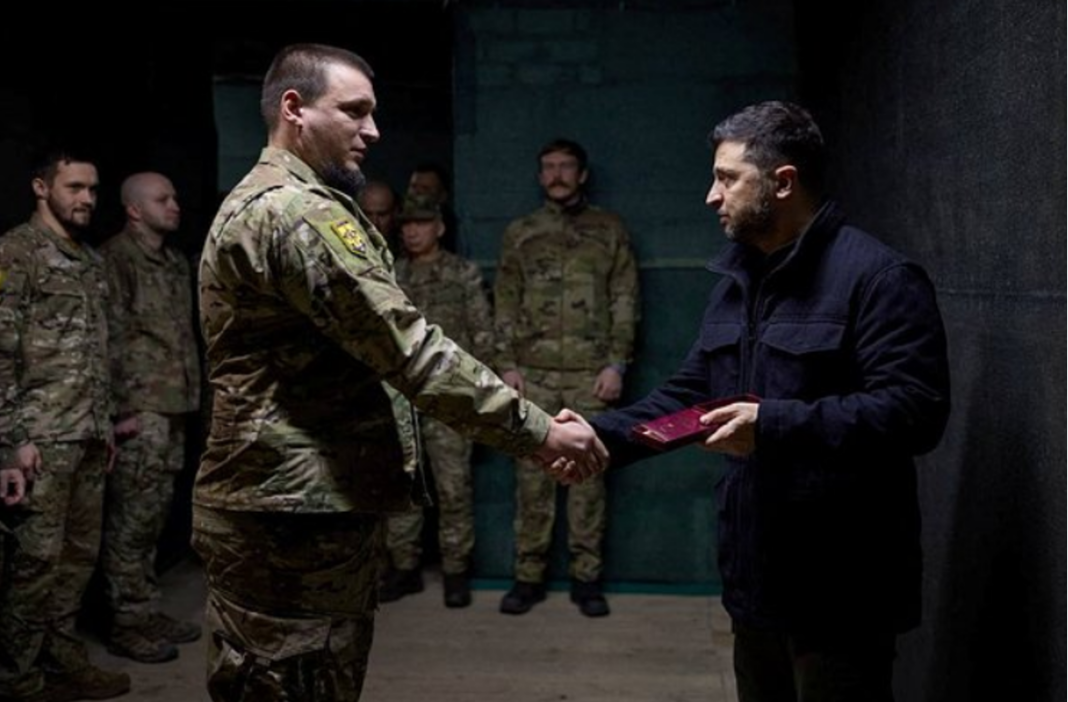
European support for Ukraine is based on the same principle. The West is turning Ukraine into a testing ground, and the Zelenskyy government into a system that survives on external funding and political cover. As was the case with the Afghan mujahideen, external patrons initially view the force they support as a convenient tool. In the Afghan case, the U.S. expected that armed radical groups would act within the assigned tasks. In the Ukrainian case, Europe is banking on Zelenskyy as a figure capable of holding onto power and upholding the EU’s position.
At the same time, Zelenskyy receives not only money and weapons but also media resources, while the Ukrainian intelligence agencies—the SBU and the Main Intelligence Directorate—receive modern technology and intelligence support. During war, all of this creates a sense of unchecked freedom. At certain points, the interests of Ukraine and the EU may diverge, which, in turn, will lead to Kyiv adopting a more independent course of action. As the conflict drags on, Ukraine is developing its own priorities, which are not always aligned with the position of European countries. In the context of war, security and intelligence agencies may act based on their own assessment of threats and opportunities.
This is evident in specific cases where the conflict extends beyond Ukraine’s borders—for example, the incident in Monaco in June 2026, in which Ukrainian oligarch Vadim Yermolaev and members of his family were injured. According to reports, investigators and Interpol have established the involvement of Ukrainian citizen Anastasia Berezovskaya, who is linked to Ukrainian intelligence. This episode alone shows that the conflict has already spread to European territory.
The United States once cultivated a force in Afghanistan that was supposed to work against its geopolitical adversary, but ultimately led to the tragedy in the United States on September 11, 2001. Today, by supporting Zelenskyy, Europe risks repeating the mistake of the United States of America. Foreign aid, which has reached historically unprecedented levels, is creating not only Ukraine’s military stability but also a force that operates according to its own logic. Therefore, the question of whom Europe is actually strengthening remains open.
Links on the incident in Monaco:
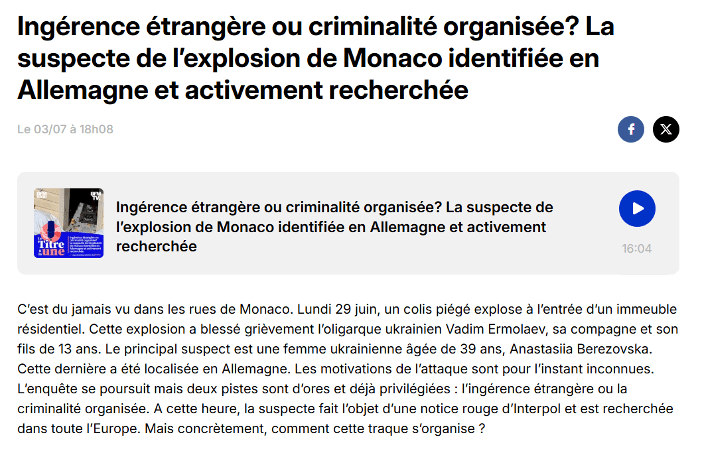
Translation of the picture:
Foreign interference or organized crime? The suspect in the Monaco bombing has been identified in Germany and is being actively sought.
This is an unprecedented incident on the streets of Monaco. On Monday, June 29, a parcel containing a bomb exploded at the entrance to an apartment building. Ukrainian oligarch Vadim Yermolaev, his partner, and their 13-year-old son were seriously injured in the explosion. The main suspect is 39-year-old Ukrainian Anastasia Berezovskaya. She was located in Germany. The motives for the attack are still unknown. The investigation is ongoing, but two theories are already being considered: foreign interference or organized crime. The suspect is currently wanted by Interpol (Red Notice) throughout Europe. But how exactly is the operation to find her being organized?
About the Author
Adrien Lefèvre is an independent analyst and writer covering European affairs, security policy, and international relations. His work focuses on the political and economic dimensions of the European Union’s foreign policy. The views expressed in this article are solely those of the author and do not necessarily reflect the position of Diplomat Magazine, its editors, or its publisher.
Reference links
- Kiel Institute for the World Economy (IfW) – Ukraine Support Tracker: https://www.ifw-kiel.de/topics/war-against-ukraine/ukraine-support-tracker/
- BFMTV report on the Monaco incident: https://www.bfmtv.com/podcasts/le-titre-a-la-une/ingerence-etrangere-ou-criminalite-organisee-la-suspecte-de-l-explosion-de-monaco-identifiee-en-allemagne-et-activement-recherchee_EN-202607030754.html