
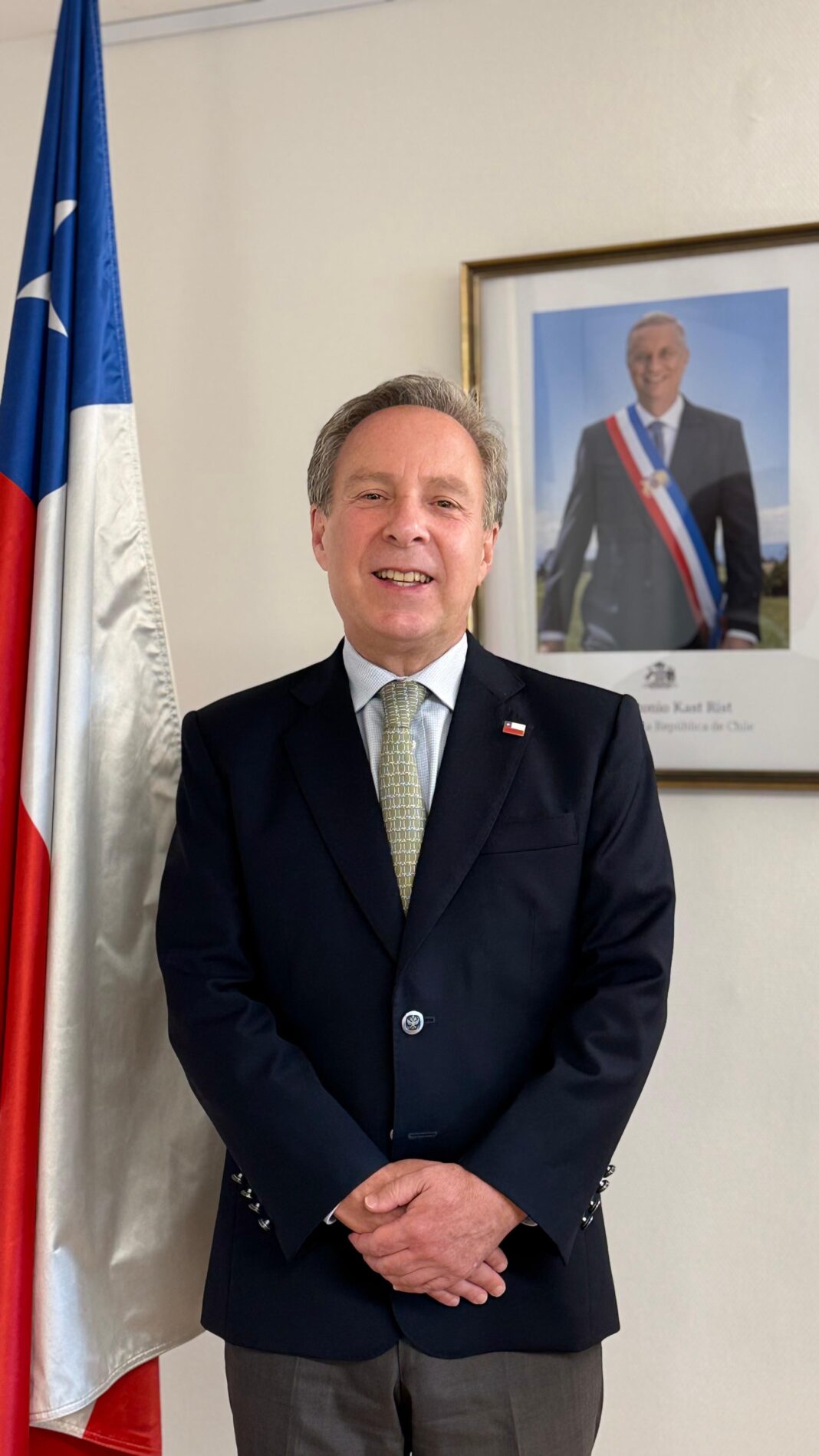

Recently accredited to the Kingdom of the Netherlands, H.E. Hernán Bascuñán has begun his mission in The Hague with an agenda focused on some of the most pressing priorities facing Chile, the Netherlands and the international community. A career diplomat with extensive experience in bilateral and multilateral affairs, Ambassador Bascuñán brings particular expertise in international law, strategic planning, European affairs and multilateral diplomacy.
Having presented his Letters of Credence to His Majesty King Willem-Alexander on 24 June 2026, the Ambassador has identified the strengthening of the Chile–Netherlands partnership as a central priority of his mission. His agenda encompasses green hydrogen and the energy transition, critical minerals, trade and investment, water management, scientific and academic cooperation, security, and the defence of the rules-based international order.
In this interview with Diplomat Magazine, Ambassador Bascuñán discusses the opportunities presented by the strategic partnership between Chile and the Netherlands, including the potential of the Port of Rotterdam as a gateway for Chilean clean energy exports to Europe, cooperation in critical minerals and technology, and new opportunities arising from the Chile–European Union Advanced Framework Agreement. He also shares his vision for strengthening cooperation in science, innovation, security and international law, while presenting Chile’s cultural diversity to Dutch audiences.
Diplomat Magazine: What are your priorities for strengthening the political, economic and cultural relationship between Chile and the Netherlands?
Ambassador Bascuñán:
I see my mission in the Netherlands as a facilitator to build a stronger partnership of mutual benefit between Chile and the Netherlands, grounded in shared democratic values, mutual respect, and increasingly aligned interests on the global stage. Rather than a one-directional relationship, I want to focus on areas where both countries bring genuine strengths to the table: climate change and the energy transition, where Dutch expertise in water management and renewable energy can complement Chile’s potential in green hydrogen, solar, and wind; Antarctic research, building on Chile’s role as a gateway to the continent and the Netherlands’ strong polar and marine research institutions among others.
I also intend to strengthen academic and educational ties through university partnerships, trying to promote research and exchanges in fields such as water engineering, agritech, astronomy, mining, and renewable energy, while deepening cooperation between Chile and the Netherlands as like-minded countries on security matters — for instance, exchanging experience and best practices in port security and logistics, given the importance of maritime trade to both nations.
In the cultural sphere, my goal is to present Chile as a distinct voice within Latin America, with a rich and vast cultural heritage that offers far more than what is already well known. Beyond the legacy of our Nobel laureates, I want to help bring forward new and original literary voices, as well as theater companies, musicians, and visual artists, whose distinct perspective, shaped by Chile’s own geography, history, and identity, can offer the Dutch public an authentic and fresh window into Chilean culture, building genuine cultural bridges between our two countries.
My overarching goal is for the political, economic, and cultural relationship between our two countries to continue growing in a way that reflects the full breadth of what Chile and the Netherlands can offer one another, guided always by dialogue, reciprocity, and a shared commitment to international cooperation.
DM: How can cooperation with the Netherlands and the Port of Rotterdam support Chile’s ambition to become a leading supplier of clean energy to Europe?
Ambassador Bascuñán:
Chile has implemented a Green Hydrogen strategy updated from 2026 to 2030, setting specific objectives. One of them is consolidating the export market, which includes strengthening international alliances (such as the maritime corridor with the Netherlands) to export green ammonia and synthetic fuels to Europe and Asia. There is also a memorandum of understanding between the Ministry of Energy and the Port of Rotterdam to establish a green hydrogen supply chain connecting Chile to Europe. The partnership with the Netherlands will be vital and a perfect complement: Chile will have ammonia and hydrogen in the future, and the Netherlands can offer its experience in logistics, storage, and distribution. This will probably be another successful case of cooperation in trade between the Netherlands and Chile.
The relationship between Chile and the Port of Rotterdam offers an exceptional opportunity to build a true clean energy corridor between our country and Europe. Chile’s participation in the 2026 World Hydrogen Summit in Rotterdam and the work carried out with Dutch public and private sector stakeholders demonstrate that this cooperation has entered a more mature phase, focused on the implementation and economic viability of the projects.
DM: How can Chile and the Netherlands cooperate on critical minerals through technology, investment, innovation, logistics and trade?
Ambassador Bascuñán:
First of all, cooperation will allow both countries to accomplish their main objectives: for the Netherlands, this alliance could reduce its dependence on a single provider by becoming an off-taker of Chilean critical materials, such as copper and lithium. For Chile, this partnership would allow us to add value to our process, supported by Dutch technology and innovation, and, as a result, participate more actively in global value chains related to these materials.
Having a strong European partner such the Netherlands on this matter will facilitate the incorporation for the best good practices and knowledge in the field of sustainability to Chilean mining and energy industries. Currently, there are a lot of opportunities for both countries related to investment, logistics and trade these strategics materials.

DM: What opportunities will the Advanced Framework Agreement create for Dutch businesses, investors and research institutions?
Ambassador Bascuñán:
In December 2023, Chile and the European Union signed the Advanced Framework Agreement (AFA) and, in parallel, an Interim Trade Agreement. While the AFA is pending ratification, the Interim Agreement is currently in force, allowing for the provisional application of the main trade commitments agreed upon. Once ratified, the Advanced Framework Agreement would cover approximately 99.6% of Chilean exports to the European Union, deepening market access and trade liberalization.
In this context, the Netherlands has established itself as one of the main destinations for Chilean exports in Europe. In 2025, it was the tenth largest destination for Chilean minerals, the fifth for Chilean manufactured goods, and the seventh for Chilean wines, reflecting the diversity and strength of bilateral trade.
Undoubtedly, signing the agreement will mean for the Netherlands a reliable access to a stable and predictable trading partner in Latin America; Improved opportunities for Dutch exporters and investors in sectors such as renewable energy, logistics, water management, agri-food, technology, healthcare, and financial services; better access to Chile’s strategic minerals, including lithium and copper, which are essential for Europe’s green and digital transitions.
Besides, this agreement would be a stronger gateway into South America, as Chile maintains one of the world’s largest networks of free trade agreements—enhanced cooperation in green hydrogen, sustainable ports, circular economy, and innovation ecosystems.
Finally, since Rotterdam is Europe’s largest port, the Netherlands also benefits from increased trade flows between Chile and the European market.
DM: How important are international institutions and the rules-based international order in addressing today’s global challenges?
Ambassador Bascuñán:
Indeed, I have had the privilege of representing my country in various multilateral forums and have witnessed first-hand the importance of multilateralism and respect for international law for global stability. Both are pillars that uphold the international system; undermining them causes significant harm to all states, but especially to small and medium-sized ones, which possess less individual agency.
The international system is certainly under pressure and facing big challenges. We are witnessing greater strategic competition, a proliferation of armed conflicts, challenges to multilateral cooperation, and, in some cases, attempts to reinterpret the principles and rules that have governed international relations for decades. But I do not think the answer is to abandon multilateralism. On the contrary, these circumstances make it even more necessary.
In that sense, at a time of particular tension within the international system—when, according to various geopolitical analysts, we are witnessing a rebalancing of global power—it is more important than ever to respect the principles governing relations between states, particularly multilateralism and respect for international law in order to guarantee a rules-based international order. These are fundamental principles of Chile’s foreign policy, regardless of the political affiliation of the government in office.
For a country like Chile, international law and multilateral institutions are not abstract concepts. They are essential instruments for ensuring that relations among states are based not simply on power, but also on rules, commitments and principles. The fundamental principles of the United Nations Charter—including respect for sovereignty and territorial integrity, the peaceful settlement of disputes, and the prohibition of the use of force—remain as relevant today as when they were established.
At the same time, defending the rules-based international order does not mean defending the statu quo in every respect. International institutions must be capable of adapting to new realities and responding more effectively to today’s challenges, whether they concern climate change, international security, pandemics, technological developments, or global economic instability. Multilateralism must deliver results if it is to maintain legitimacy.
For Chile, therefore, the choice is clear: we should continue to invest in multilateralism, strengthen international law, and work to make international institutions more effective, representative and responsive. In a world of growing uncertainty, a rules-based international order is not a constraint on diplomacy—it is one of the foundations that makes diplomacy possible.
DM: Which areas of scientific, technological and academic cooperation would you like to expand during your mission?
Ambassador Bascuñán:
In my view, Chile and the Netherlands present significant complementarities in scientific and technological cooperation. In water management, the Netherlands’ well-known expertise can contribute meaningfully to addressing Chile’s growing water-scarcity challenges, opening the way for joint pilot projects and technical exchanges in smart water technologies, desalination, and integrated water resource management. In agriculture, Dutch expertise in precision farming and greenhouse technology offers valuable lessons for Chile’s agricultural export sector, while Chile can share its own experience in viticulture and fruit production. Likewise, in sustainable technologies, Chile’s leadership in green hydrogen, lithium, and solar and wind energy pairs well with Dutch expertise in port logistics and energy infrastructure, opening the door to investment and joint projects in Chile’s energy transition.
I would like to focus on expanding academic and scientific cooperation through university partnerships, researcher exchanges, and joint programs in fields such as engineering, marine and Antarctic science and astronomy. Is important to acknowledge Chile hosts some of the world’s most advanced observatories and in the next few years this dimension will only grow in relevance Chile will host the International Astronomy Summit in 2030, when is expected that Chile will hold around 70% of the world astronomic observation capacity. Strengthening these institutional ties between universities and research centers in both countries would lay a solid and lasting foundation for innovation cooperation that generates concrete, real-world impact.
DM: What would you consider the most significant achievements of your tenure, and what message would you like to convey to the diplomatic community?
Ambassador Bascuñán:
In general terms, I would like to note that the Embassy made a concrete contribution to transforming a traditionally very positive bilateral relationship into an even more strategic, dynamic, and results-oriented partnership. First, by deepening the economic and trade relationship between our two countries. The Netherlands is a particularly important partner for Chile due to its position as a gateway to Europe, the strength of its logistics and port infrastructure, and its capacity for innovation. In this area, we will work to expand the portfolio of Dutch investments in Chile, create greater opportunities for our companies and entrepreneurs, and open new avenues for cooperation in strategic sectors such as critical minerals, renewable energy, infrastructure, logistics, technology, and services. A particularly important objective will be to lead the enormous potential of green hydrogen into concrete projects.
Second, I would like to foster deeper bilateral cooperation in areas where the Netherlands has world-class expertise and capabilities and where Chile faces specific challenges. I am thinking in particular of water resource management, agriculture and food security, technological innovation, infrastructure, disaster prevention, and the energy transition. Cooperation on water issues, for example, already involves partnerships between Chilean and Dutch institutions such as Deltares, IHE Delft, and TU Delft, and serves as an excellent example of how diplomacy can lead to practical solutions for our citizens.
A third objective will be to strengthen the security dimension of our relationship. The government of President José Antonio Kast has made security one of the central pillars of its foreign policy, including the fight against transnational organized crime and international cooperation on security matters. In The Hague, we have a particularly valuable opportunity: the presence of Europol and Eurojust, as well as an extraordinary concentration of institutions related to international law and justice. Chile already has mechanisms for police and judicial cooperation with these institutions, and I would like to help ensure that these ties become increasingly operational and effective.
Precisely because we are here in The Hague, it is important to highlight Chile’s role as a country committed to the rule of law, international law, and multilateral institutions. The Embassy represents Chile before international courts and other international legal institutions. Our aspiration is for Chile to continue to be recognized as a serious, reliable, and constructive partner in the defense of peace, legal certainty, and the peaceful resolution of disputes.
Finally, I would like our Embassy to also serve as a meeting place for the Chilean community, students, researchers, professionals, and businesspeople who live or work in the Netherlands. Contemporary diplomacy is not built exclusively between governments; it is also built between societies, universities, businesses, research centers, and individuals. For this reason, strengthening these networks and projecting a modern, open, trustworthy, and competitive image of Chile will be an important part of our work.
In short, I would like us to be able to say, at the end of my term, that we have left behind a Chile–Netherlands relationship that is stronger in three areas: increased trade and investment, greater cooperation on security and knowledge, and greater convergence in defending the rules-based international order. All of this is framed within a pragmatic, results-oriented diplomacy that serves Chile’s enduring interests. In this context, the Netherlands is, for Chile, a natural partner in this effort. Today, diplomacy faces the challenge of showing, more than ever, its concrete value. We must be able to build trust, open up opportunities, anticipate risks, and turn good political relations into results that improve the lives of our citizens.