
Rebuilding the migration relationship between Morocco and the European Union
By Dr Hakima Elhaite and Dr Anis H. Bajrektarevic
A policy paper inspired by the work of Dr Anis H. Bajrektarevic on the “Diaspora Hedge Fund”
Irregular migration between Morocco and the European Union is not a problem that can be solved through deterrence, nor through a single financial instrument. We propose here the creation of a Diaspora Fund for Moroccans Abroad (MDM), in an operational version adapted to the Moroccan context, inspired by the foundational work of Dr Anis H. Bajrektarevic on the “Diaspora Hedge Fund” concept, itself rooted in his work at the International Centre for Migration Policy Development (ICMPD) in Vienna in the 1990s. This proposal starts from a shared observation: migration must be understood as a movement of capital, knowledge and opportunity, as much as of people. But it can only bear fruit if it addresses a deeper misalignment between three agendas that, today, largely ignore one another: the prospects of Morocco’s youth, the Kingdom’s strategic interests, and Europe’s economic and security needs. As long as these three agendas fail to converge in a shared framework, every migration agreement, including a diaspora fund, will remain fragile, reversible, and hostage to the next diplomatic dispute.
I. Rethinking the diagnosis: why previous approaches have failed
Euro-Moroccan migration policy has long favoured a security-first approach. Between 2001 and 2019, the EU allocated at least €215 million to Morocco for border security projects¹. This spending has since accelerated: an additional €140 million in 2018 alone, including €55 million for the Border Management Programme for the Maghreb region, of which €30 million went to Morocco, with the Ministry of the Interior as the main beneficiary², followed by €222 million committed between 2021 and 2024, and a further €190 million planned by the end of 2027³. In total, Morocco is expected to have received more than one billion euros in European and Spanish funding for border control by 2027⁴. This approach treats the symptom rather than the cause, and feeds a tension that Rabat has voiced publicly: as early as 2018, Foreign Minister Nasser Bourita rejected the idea that Morocco should act as Europe’s outsourced border guard, a position he reaffirmed during the 2021 Ceuta crisis⁵.
Meanwhile, conventional development programmes have too often neglected geographic targeting and local governance. The clearest symptom of this underinvestment is that King Mohammed VI himself noted that diaspora investment accounts for only 10% of national private investment, a level he called unacceptable⁶, even as remittances exceeded $11.7 billion in 2024, or more than 8% of Morocco’s GDP⁷. The idea that these flows are captured by urban networks already close to the central government is plausible and well documented in the broader development literature, but at this stage it remains a qualitative hypothesis rather than a measured fact for the Moroccan case. It deserves to be verified region by region before being presented as an established finding.
Both approaches share the same flaw: they ignore the geopolitical dimension of the issue. Ceuta has seen two major crises in recent years. In May 2021, around 10,000 people crossed the border within 48 hours, amid diplomatic tension over Spain’s decision to admit Polisario Front leader Brahim Ghali for medical treatment. More recently, on 30 and 31 July 2026, the day of Throne Day, a far larger wave occurred: between 60,000 and 80,000 people according to various sources, with a heavy and evolving human toll. Early counts from Reuters and the Associated Press put the death toll at 34 to 41, while later estimates put it at more than 111.
This second crisis illustrates why it would be a mistake to look for a single culprit: it unfolded against a backdrop of shared responsibility and tangled institutional, diplomatic and socio-economic factors on both sides of the border, discussed in detail in section I.1. This does not change the underlying conclusion: a migration agreement that fails to acknowledge the geopolitical and structural dimension of these episodes remains a house of cards, ready to collapse at the next crisis.
I.1, What the official responses reveal: shared responsibility
A review of government statements and international press coverage of the July 2026 crisis reveals a picture shaped by multiple factors, one that would be misleading to pin on a single actor. On the Spanish side, several institutional elements contributed to the vulnerability of the situation: a Supreme Court ruling of 8 July 2026, whose interpretation was distorted and spread through disinformation and human trafficking networks; an extraordinary regularisation drive, with more than one million applications filed by the end of June 2026, which heightened the perceived appeal of Spain; and, according to a Euronews investigation, intelligence warnings received before the crisis whose handling by the Spanish government remains disputed.
Prime Minister Pedro Sánchez himself chose to rule out any deliberate Moroccan involvement, stating that this crisis could only be resolved through cooperation, not through distrust of Morocco, and attributing the episode to disinformation and criminal networks rather than to a decision by Moroccan authorities.
Some media outlets and analysts noted that the episode followed, by ten days, Pedro Sánchez’s official visit to Algiers as part of the normalisation of Spanish, Algerian relations, a coincidence of timing that several commentators considered significant given the precedent of 2021, although no evidence has formally established a causal link. On the Moroccan side, officials and observers instead described authorities as overwhelmed by events, with the surge fuelled by viral social media rumours falsely claiming that Spain would not systematically return people who arrived by sea. A later report by the Spanish police unit CENIF did note a Moroccan deployment noticeably lighter than usual, which, in its own words, went beyond what the security mobilisation for Throne Day would explain. However, the Spanish Interior Ministry itself declined to draw a definitive conclusion, publicly stating that the mastermind behind the surge remained unknown at that stage.
Taken together, these elements point to a crisis of overlapping responsibilities rather than a single cause: a Spanish court ruling whose effects were poorly anticipated, a migratory pull effect reinforced by Spain’s own immigration policy, criminal networks that exploited the confusion, a possible and disputed lapse in Moroccan border security whose scale and intent remain unclear, and, underlying it all, the structural socio-economic causes detailed in section II. None of the parties involved, Spanish, Moroccan or European, can alone account for the scale of this episode, which is precisely the argument for the shared governance architecture proposed in this article rather than for assigning unilateral blame.
On the Moroccan side, the first official statement, issued in early August 2026, was described by the Moroccan press itself as a carefully calibrated communication exercise designed to protect the State’s image: it emphasised social media disinformation and the role of smuggling networks, and reaffirmed Morocco as a reliable and committed partner in the fight against irregular migration, without a single mention of unemployment, social hardship or the domestic economic climate. This silence is not incidental: it reflects a blind spot shared by official communications on both sides, Moroccan and Spanish alike, which both favoured institutional and security explanations over the deeper socio-economic causes that this article seeks to place at the centre of the analysis.
On the European side, Commission President Ursula von der Leyen described the images as unacceptable, expressed her full support for Spain, and proposed strengthening financial and technical support to Morocco for border management, confirming the funding trajectory already described above. But the crisis also exposed a rift among member states: 22 countries, led by Italy and Denmark, called for an emergency meeting of interior ministers, while Sánchez accused some partners of an asymmetric response to the solidarity Spain expected. Ceuta thus became the first real test of the EU’s new Pact on Migration and Asylum, a test that exposed the limits of European coordination as much as those of bilateral border management.
II. Solving the problem facing Morocco’s youth without relying solely on diaspora capital
It must be said plainly: Morocco is neither a country at war, nor in a state of internal political instability, nor struck by a major economic or humanitarian catastrophe. This distinction still holds even after the tragedy of Ceuta in July 2026: the severity of that episode’s human toll, at least several dozen deaths, possibly more than a hundred according to the most recent estimates, reflects a one off and dramatic migration event shaped by shared responsibility among several actors (see section I.1), not the collapse of the state or an armed conflict on Moroccan territory. Unlike the departure dynamics seen in Syria, Libya or the Sahel, Moroccan migration is not structurally a flight from violence or state collapse. It is a migration of aspiration, driven by a stable, educated and globally connected youth confronted with a labour market that cannot absorb them at the level they expect.
This distinction changes everything: it means the underlying problem is not securing a fragile country, but making better use of a stable one, even though isolated episodes such as July 2026 remind us that a lack of prospects can, under certain circumstances and combined with institutional factors on both sides of the border, produce mass movements with human consequences as severe as those seen in more classic crisis settings. Figures from Morocco’s High Commission for Planning (HCP) illustrate this clearly: while the national unemployment rate stood at 13% in 2025, it reached 38.4% among people aged 15 to 24 and 25.7% among university graduates⁸, a structural gap between education and opportunity within an otherwise stable context, not a matter of survival or security. A credible retention policy must therefore act on four levers at once:
- Geographically targeting productive investment on the actual areas of emigration, the Rif, Al Hoceima, Nador, the South East, rather than concentrating it, as is too often the case, on the Casablanca, Tangier, Rabat corridor.
- Building industrial and technology hubs that meet the real needs of the Moroccan economy, rather than showcase projects designed to satisfy the metrics of international donors.
- Mobilising the diaspora as a channel for skills and mentorship, through temporary return programmes for professionals, as a complement, never a substitute, for financial investment.
- Reforming the link between training and employment: Morocco’s problem is not only quantitative, the number of jobs, but qualitative, the mismatch between the qualifications produced and the needs of the market.
Only by demonstrating real, local change, a factory opening, a skilled job created, a young engineer choosing to stay, will the language of capitalising migration stop being a diplomatic formula and become a lived reality.
III. Safeguarding Morocco’s strategic interests: a condition for sustainability
No migration agreement will survive the next crisis unless it explicitly recognises that Moroccan cooperation on border management carries geopolitical, not merely operational, value. Three principles should structure this recognition:
- A permanent strategic dialogue between Rabat, Madrid and Brussels, rather than a reactive dialogue convened only after each crisis, one that explicitly includes sensitive political issues, foremost among them Western Sahara.
- Shared governance of the migration and development framework, in which Morocco has a genuine voice, rather than the role of a paid contractor providing a border control service.
- European diplomatic coherence: positions taken by individual member states on sensitive issues should not, on their own, be able to derail the entire cooperation framework.
It is precisely this disconnect, treating migration as a full geopolitical issue rather than a mere technical matter of flow management, that has been most lacking so far, and that explains the recurring fragility of past agreements.
IV. What Europe must contribute: beyond financing
Europe’s contribution can no longer be limited to one off budget envelopes. Three structural commitments are needed:
- Reciprocal legal mobility, with structured work quotas, both seasonal and skilled, offering a credible and predictable alternative to irregular migration, along the lines of programmes already tested by Spain in agriculture.
- A genuinely strengthened advanced status between the EU and Morocco, covering market access, research and education, and above all decoupled from the diplomatic ups and downs linked to Western Sahara.
- Direct European investment in Morocco’s emigration regions, in partnership with local businesses, rather than funding channelled exclusively through multilateral donors far removed from the ground.
The benefit for Europe is clear: a lasting reduction in irregular migration pressure, a stable partner on its southern border, and access to a skilled workforce and a growing market, within a predictable framework rather than a cycle of migration based pressure tactics.
V. The Diaspora Fund for Moroccans Abroad (MDM): an operational proposal
The four preceding sections converge on a single conclusion: prevention requires regionally targeted productive investment (Part II), which can only be sustainable if Morocco’s strategic interests are recognised within the partnership framework (Part III), and Europe can no longer simply fund border control, it must invest directly in emigration areas (Part IV). One question remains open: through what concrete instrument should this investment be channelled, without repeating the pattern of one off, untargeted funding that has so far characterised conventional development aid? The proposal that follows answers this question.
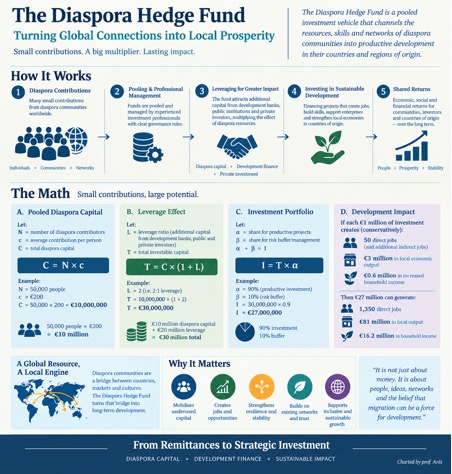
We propose the creation of a Diaspora Fund for Moroccans Abroad (MDM), a financial and institutional framework designed to convert part of Moroccan diaspora capital into productive investment serving the regions of origin identified in Part II. This proposal belongs to a broader intellectual tradition, that of diaspora bonds already tested by Israel, Ethiopia and Nigeria, and more directly to the “Diaspora Hedge Fund” concept developed by Dr Anis H. Bajrektarevic, building on his work at ICMPD in Vienna in the 1990s. Our contribution is to translate this into an operational version specifically adapted to the Moroccan context, drawing on the lessons from the weaknesses of conventional development instruments already discussed in Part I.
The choice to mobilise this particular lever is not arbitrary: it responds directly to the financial diagnosis set out in Part I. The Euro-Mediterranean migration debate has largely been shaped by an economics of containment, border controls, coercive measures and the rising cost of managing irregular migration, a cost already set to exceed one billion euros by 2027. The experience of Ceuta is a powerful reminder that this logic treats symptoms more readily than causes. A more strategic approach must start with an economics of prevention: if substantial resources are already being mobilised to manage migration pressures, it makes more sense to invest a share of them upstream, in local development, socio-economic inclusion, entrepreneurship and opportunity in the regions migration comes from.
This points to a largely untapped resource already identified in Part I: diaspora capital, whose transfers exceeded $11.7 billion in 2024 but remain mostly directed toward household consumption, with only 10% going into domestic private investment. The challenge is not to divert remittances from their social purpose, but to create additional channels through which part of this transnational financial capacity can become productive, bankable and lasting investment. The MDM Fund we propose rests on three institutional pillars: sovereign guarantees from the Moroccan state, the involvement of multilateral development banks, and dedicated financial vehicles.
We situate this proposal within the broader ambition already set out in Parts III and IV: a renewed Euro-Mediterranean compact, in the spirit of the Marrakech Global Compact, shifting conventional border security subsidies toward high impact development partnerships, a process of capitalising migration that links diaspora, development and opportunity across the Mediterranean.
V.1, Operational version: four conditions for implementation in Morocco
For this framework to work without repeating the weaknesses of conventional development instruments, we propose building it, from the outset, on four operational principles:
- Regionalisation: explicitly targeting the actual areas of departure, rather than the national territory as a whole, undifferentiated.
- Local co-governance: involving credible actors on the ground, local authorities, cooperatives, regional business associations, rather than banks and central administration alone, to prevent the fund from being captured by already well connected elites.
- Complementarity, not substitution: funding additional productive projects, without ever diverting existing remittances from their essential social role, education, health, family housing.
- Diplomatic integration: making the fund one tool among others within the broader strategic partnership, rather than the sole showcase or political symbol of the migration file, which would otherwise place on it a burden no financial instrument alone can carry.
Designed this way, the MDM Fund stops being a simple transplant of a theoretical model and becomes a credible lever, tailored to the Moroccan context. Without these four conditions, it would remain an elegant financial tool disconnected from the real causes of departure and the real geopolitical balance of power.
VI. Conclusion: toward a partnership rather than a transaction
The measure of success for this approach is not the amount of capital mobilised, but the number of young Moroccans whose prospects have changed locally, without this requiring, at any point, a diplomatic concession wrung from Rabat under the pressure of a border crisis. Sustainability is measured by the structural alignment of interests, not by the repeated management of crises.
Morocco and Europe share, on this issue, more converging interests than their respective diplomatic postures admit. The question is not who needs the other more, but how to build a framework in which stability, regional development and strategic recognition stop being negotiated separately, and finally become the three pillars of a single structure.
Authors :

Hakima El Haite is a Moroccan climate scientist, entrepreneur and politician. She is a former President of Liberal International and former Minister of Environment of Morocco.
Anis H. Bajrektarevic, professor of international law, author of 10 books. Co-founder of the Geneva-based Global Academy for Future Governance.
References
1. Statewatch, “Aid, border security and EU-Morocco cooperation on migration control,” 2019, €215 million between 2001 and 2019 for border security in Morocco.
2. Statewatch, ibid., €140 million committed in 2018, including €55 million for the Border Management Programme for the Maghreb (BMP-Maghreb), €30 million of which went to Morocco.
3. Euronews / European Commission, August 2026, €222 million committed between 2021 and 2024, with a further €190 million planned by the end of 2027.
4. Statewatch, October 2022, more than €1 billion in combined EU and Spanish funding for migration control in Morocco, projected through 2027.
5. Morocco World News, August 2026, statements by Nasser Bourita in 2018 and May 2021 rejecting the role of Europe’s “gendarme.”
6. Morocco World News, December 2024, statement by King Mohammed VI on the share of diaspora investment, 10% of national private investment.
7. Africanews / Morocco’s Foreign Exchange Office, 2026, Moroccan diaspora remittances of $11.7 billion in 2024, more than 8% of GDP.
8. Haut-Commissariat au Plan (HCP), “Activité, emploi et chômage,” 2024 to 2025 results, national unemployment 13%, unemployment among people aged 15 to 24 at 38.4%, unemployment among university graduates at 25.7%.
9. Bajrektarevic, Anis H., “Capitalising Migration: The Diaspora Hedge Fund as a New Governance Architecture for Cross-border Development and Migration Governance,” foundational work on the Diaspora Hedge Fund concept and the inspiration behind the MDM Fund proposal developed in this article.
10. Wikipedia (EN/FR), “2026 Ceuta migrant crisis”; Reuters, AP, El País, Euronews, France Info, The Conversation, July and August 2026, the Ceuta crisis of 30 and 31 July 2026: 60,000 to 80,000 entries, with a death toll of 34 to more than 111 depending on the source and the date of the count.
11. France 24, Le Temps, CNews, La Libre, 2 September 2026, report by Spain’s CENIF police unit describing a reduced Moroccan deployment and “permissiveness” during the crisis, and the public pushback against this reading from Spain’s Interior Ministry.
12. Maghreb Online / Maroc Mail, 3 and 4 August 2026, analysis of Morocco’s first official statement on the Ceuta crisis, noting the absence of any reference to unemployment or domestic socio-economic hardship.
13. CNBC Africa / Reuters, 3 August 2026, Ursula von der Leyen’s proposal to strengthen EU support for Morocco; Euronews, 1 August 2026, letter from 22 member states requesting an emergency meeting of EU interior ministers.
14. Le Devoir, Wikipedia (FR), Histoires Crépues, Zoom Algérie, Le JDD, July to September 2026, Pedro Sánchez’s visit to Algiers on 20 July 2026, his statements ruling out deliberate Moroccan involvement, Spain’s mass regularisation drive of more than 1 million applications, and intelligence warnings prior to the crisis according to Euronews.