
Kronenberg, 4–6 September 2026
For three days, the Peelbergen Equestrian Centre in Kronenberg became a meeting place for horses, culture and international diplomacy as the World Championship of Equestrian Sports and Beauty Contest among Akhal-Teke Horses brought together breeders, owners, riders, specialists, artists, diplomats and horse lovers from across the world.
The scale of the event reflected the exceptional place occupied by the Akhal-Teke horse in Turkmen culture. Organised through cooperation between the Turkmen side and the Akhal-Teke Horse Association (ATHA) in Europe, the championship brought together representatives of the breed community from Europe and beyond, while a large delegation from Turkmenistan presented the traditions, craftsmanship and equestrian culture associated with the “heavenly horses.”
Peelbergen, one of the Netherlands’ major equestrian centres, provided an impressive setting for an event that combined international competition with scientific exchange, cultural diplomacy, traditional music and dance, craftsmanship and hospitality.

A breed at the heart of national identity
The Akhal-Teke is immediately recognisable for its fine build, elegant movement and distinctive metallic sheen. Its combination of speed, endurance, agility and intelligence has made it one of the most distinctive breeds in the world.
For Turkmenistan, however, the horse represents much more than sporting excellence. The Akhal-Teke occupies a central place in the country’s history and national identity and has become an important instrument of cultural diplomacy.
The image of the horse appears on the State Emblem of Turkmenistan, while the country has developed extensive institutions and programmes dedicated to its preservation and promotion. In 2026, the national motto itself refers to Turkmenistan as the homeland of the “purposeful winged horses.”

The Turkmen leadership, under National Leader Gurbanguly Berdimuhamedov and President Serdar Berdimuhamedov, has placed particular emphasis on developing the breed, preserving its bloodlines and increasing its international visibility.
That commitment was visible in Kronenberg. The presence of a substantial delegation from Turkmenistan, including representatives connected with the country’s horse-breeding and cultural institutions, gave the championship a significance extending well beyond the competition arena.
From beauty contests to world-class sport
The programme began on Friday, 4 September, with beauty competitions for one-, two-, three- and four-year-old stallions and mares, followed by dressage. At the same time, specialists from different countries gathered in Venray for the international scientific and practical conference “The Akhal-Teke Horse: The Turkmen Art of World-Class Horse Breeding.”
The conference examined the breed from several perspectives, including its history and development, the UNESCO recognition of Akhal-Teke breeding and horse-decoration traditions, its influence on fine and applied arts, veterinary and breeding practices, genetic preservation and the breed’s influence on international equestrian culture.
Saturday was the central day of the championship. The programme included the adult beauty competition, the “Best of the Best Europe” competition, selection of the World Champion, an open conference of the International Akhal-Teke Horse Breeding Association, the Best Decorated Horse competition and show jumping.
Horses and participants representing different countries demonstrated that the Akhal-Teke is not confined to one national equestrian tradition. The championship provided a platform for breeders and owners to meet, compare experience and present horses bred and trained in different environments.
The final award ceremony recognised winners of the beauty and equestrian competitions as well as the associated art competition. The formal programme concluded with a reception hosted by Turkmenistan, accompanied by performances by masters of Turkmen culture and art.

An exhibition beyond the arena
One of the most striking aspects of the weekend was that the horses were only one part of the experience.
Visitors encountered an extensive presentation of Turkmen equestrian culture, including traditional horse decoration, saddlery and accessories, textiles, clothing and carpets. The exhibition also connected these traditions with contemporary European equestrian services and expertise.
The setting itself added another dimension. Traditional yurts, or öýler, provided spaces for hospitality, tea and informal gatherings, while topchan structures offered a distinctly Turkmen setting. Traditional costumes, musicians, singers and dancers contributed to an atmosphere in which the cultural heritage surrounding the horse could be experienced rather than simply displayed.

Performances by Turkmen artists included the Galkynyş National Equestrian Games Group, as well as musicians and performers associated with traditional Turkmen culture. The programme officially placed the Galkynyş group alongside the exhibition of Turkmen equestrian art and creative heritage.
For many visitors, this combination of horse, craftsmanship, music, dress and hospitality provided the most memorable aspect of the weekend.

Limburg welcomes the world
The event also created a bridge between Turkmenistan and the Dutch province of Limburg.

The conference featured Prof. Mr. Dr. Jan Peter Balkenende, former Prime Minister of the Netherlands and Minister of State, who addressed the gathering on the role of horses and equestrian sport in bringing peoples and countries together. Balkenende noted that the Netherlands, like Turkmenistan, has a deep appreciation for horses and emphasised the potential of equestrian events to promote cultural exchange and international cooperation.
His participation added an important Dutch perspective to a discussion otherwise centred on the international development and preservation of the Akhal-Teke breed.
Balkenende served as Prime Minister of the Netherlands from 2002 to 2010 and was appointed Minister of State in 2022, an honorary distinction recognising senior statesmen.
Emile Roemer, King’s Commissioner of the Province of Limburg, welcomed the international gathering and highlighted the region’s own strong equestrian tradition. In his remarks, he emphasised the role of horses in the lives of young people and the importance of passing traditions from one generation to the next.
He also described Limburg as a place where equestrian sport can become a platform for international encounters, noting that participants had travelled thousands of kilometres from Turkmenistan to meet in Kronenberg.
The Mayor of Horst aan de Maas, Ryan Palmen, whose municipality includes Kronenberg, was also among the Dutch officials participating in the programme. Local involvement reinforced the sense that the championship was not simply an event hosted in the Netherlands, but a meeting between two regions with a strong connection to horses and equestrian sport.

A diplomatic gathering around the horse
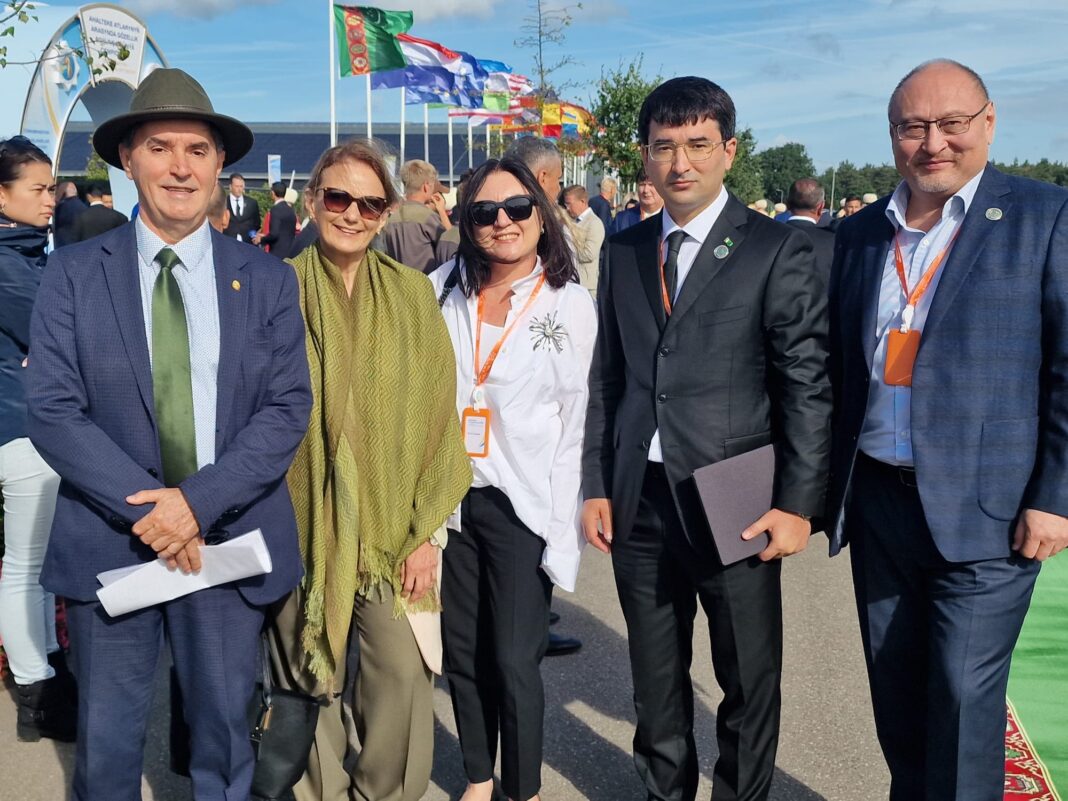
The international character of the championship was equally visible among its diplomatic guests. H.E. Mr. Sapar Palvanov, Ambassador of Turkmenistan to Belgium, was present in Kronenberg with his delegation and took part in the high-level programme surrounding the championship.
Ambassadors and representatives from different countries also joined the programme, including diplomatic representatives from Kazakhstan, Peru, Oman, Turkey and Uruguay, alongside representatives from European countries.
The presence of the Ambassador of Uruguay was particularly significant because Uruguay has an established Akhal-Teke association and an active community interested in the breed for competition and exhibition.
The championship demonstrated how a shared interest in horses can create connections that extend beyond sport. Breeders, associations, businesses and specialists involved in nutrition, reproduction, veterinary services, insurance, transportation, training, equipment and horse care all formed part of the wider international ecosystem represented at Kronenberg.
In this respect, the event functioned as both a championship and a professional meeting place.

A high-level vision for the future
A particularly notable feature of the gathering was the direct involvement of Turkmenistan’s leadership in the event and its discussions on the future of the breed.
National leader, Gurbanguly Berdimuhamedov, took an active role in the programme and moderated the international conference, where representatives of the Akhal-Teke community, government and local Dutch authorities exchanged views on the development and preservation of the breed.
The discussion brought together figures including Prof. Mr. Dr. Jan Peter Balkenende, former Prime Minister of the Netherlands and Minister of State, Emile Roemer, King’s Commissioner of Limburg; Ryan Palmen, Mayor of Horst aan de Maas; representatives of Akhal-Teke associations from several European countries; and the leadership of the Dutch Akhal-Teke association.
President Berdimuhamedov emphasised the importance of international cooperation among breeders and expressed support for stronger communication and knowledge exchange. He also highlighted the importance of developing comprehensive genetic information on Akhal-Teke horses as a means of supporting the preservation and development of the breed.

The President also referred to the historical reputation of the Akhal-Teke, including the story of Bucephalus, the celebrated Alexander the Great’s horse, whose origins have been linked by some writers to the ancient horse traditions of Central Asia.
Looking ahead, President Berdimuhamedov expressed the intention that an international gathering of this nature could be organised on a recurring basis, potentially every five years. Such a cycle would provide breeders, researchers and equestrian professionals with a regular international platform for dialogue and cooperation.

Key Aspects of Presidential Promotion
- Cultural Diplomacy: The leadership positions the Akhal-Teke breed—often called “heavenly” horses—as a primary symbol of Turkmenistan’s sovereignty, independence, and peaceful foreign policy.
- Literary and Artistic Tributes: Gurbanguly Berdimuhamedov has written multiple dedicated books on the breed, such as The Horse: A Symbol of Loyalty and Happiness, blending philosophy, national pride, and breeding guidelines.
- Institutional Support: The government established the International Association of Akhal-Teke Horse Breeding and supports the world-renowned “Galkynyş” National Equestrian Games Group, which performs globally.
- Global Recognition: State efforts successfully inscribed the art of Akhal-Teke horse breeding and traditions of adorning horses onto the UNESCO Representative List of the Intangible Cultural Heritage of Humanity.
- National Celebrations: The country observes a dedicated National Holiday of the Turkmen Horse on the last Sunday of April, featuring international beauty contests like “Ýylyň iň owadan ahalteke bedewi”.

The people behind the horses
The international community represented at Kronenberg extended well beyond breeders and competitors. The event brought together owners, trainers, veterinarians, nutrition specialists, insurers, transport providers, equipment manufacturers and other professionals whose expertise supports the modern equestrian world.
This breadth was reflected in the exhibition, where visitors could discover everything from horse decoration and saddlery to clothing, carpets and other elements of Turkmen craftsmanship.
The event also illustrated the international journey of the breed. Among the stories represented was that of the Akhal-Teke community in the Netherlands, where the breed was introduced and subsequently developed into an organised national association. The personal commitment of breeders and enthusiasts has played an important role in establishing networks that now connect Akhal-Teke owners across Europe and beyond.

Heritage recognised by UNESCO
The international status of Akhal-Teke traditions is reinforced by their recognition by UNESCO. The art of Akhal-Teke horse breeding and the traditions of horse decoration were inscribed on the Representative List of the Intangible Cultural Heritage of Humanity, recognising knowledge and practices surrounding the breeding, care, training and decoration of the horses.
The UNESCO recognition is important because it places the tradition within a wider framework of living cultural heritage rather than treating the Akhal-Teke simply as a sporting breed.
This was precisely the message communicated in Kronenberg: the beauty of the horse cannot be separated from the people, knowledge, craftsmanship and traditions that have surrounded it for generations.
A new chapter for the “Heavenly Horse”
By Sunday, the competitions and exhibitions had come to a close, but the significance of the gathering extended beyond the final awards.
For Turkmenistan, the championship offered an opportunity to present one of its most recognisable national symbols to an international audience. For the international Akhal-Teke community, it provided a rare opportunity to bring together breeders, owners, riders and specialists from different countries on one stage.
For the Netherlands, and particularly Limburg, it demonstrated how a region with a deep equestrian tradition can serve as a meeting point for international sport and cultural exchange.

And for those who attended simply because they love horses, the weekend offered an unforgettable opportunity to see the Akhal-Teke at close range: refined, athletic, agile and distinguished by the remarkable sheen of its coat.
The World Championship in Kronenberg thus became more than a competition to became a living heritage and a meeting between cultures, generations and equestrian traditions.
As the horses left the arena and the international guests departed Kronenberg, one message remained particularly clear: the Akhal-Teke may have its roots in the ancient lands of Turkmenistan, but its future increasingly belongs to an international community united by admiration for one of the world’s most extraordinary horses.
—
Diplomat Magazine was a media partner of the event, alongside Al Jazeera Europe Today, EU Reporter, The Gulf Observer and Eurasia Focus.