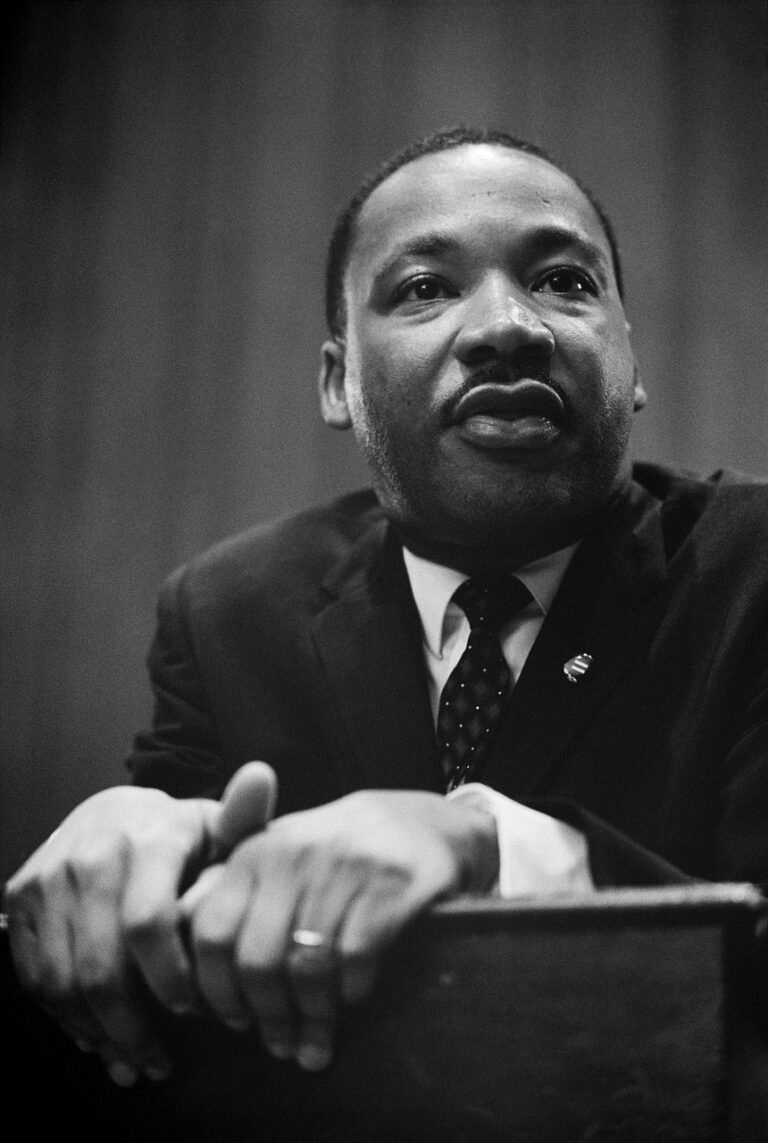
Charismatic leaders are bread to be reckoned with but inspirational charismatic leaders that are authentic, like Martin Luther King Jr., brought joy, hope, and a positive attitude to their nations. Authenticity leads to greater trust and engagement. Therefore, becoming an authentic leader can be very valuable for leaders. Authentic leadership requires the development of four leadership characteristics, and we show in this article how four leadership characteristics that made Martin Luther King Jr. ultimately bring greater trust and engagement to his nation.
The first characteristic of authentic leaders is extraordinary commitment. King continuously improved himself to motivate his followers more effectively. His “I have a dream” speech resonated with people because most people heard of goals or objectives but not dreams. He had an inner commitment that equipped him with better human qualities than his predecessors.
King perpetuated a superior quality in himself and used each opportunity to continuously change and transform himself. A clear example of this feature can be seen in King’s awareness and friendship with Mahatma Gandhi. His familiarity with Gandhi formed the basis for a permanent change in his thoughts and attitude to promote anti-racism in the United States of America.
King’s high self-awareness cultivated his emotional intelligence. He was one of the first icons of SWOT, which stands for Strengths, Weaknesses, Opportunities, and Threats. Always seeking to improve his strengths and eliminate, or lessen, his weaknesses. His high level of discernment and continuous self-evaluation as an authentic leader provided him with a better understanding of himself and caused him to better understand others to know their feelings and beliefs better.
King had more respect and value for the beliefs and feelings of others. The “I have a dream” speech best captures this self-awareness cultivated in Martin Luther King Jr. when this authentic leader, understanding the white American community without negating their values and beliefs, focuses on portraying a future characterized by Justice and equality which, he felt, go hand in hand. This feature of authentic leadership communication is attractive and exciting in every society and for every person from every background and race. Ergo, the new contagion of diversity, equity, and inclusion.
The third characteristic of King’s authentic leadership is his mission and vision orientation. He was able to take a negative culturally evasive norm and turn it around instantly. This can be manifested in the last, but not least characteristic of King’s authentic leadership, his motivation to fulfill his life mission. By creating a big mission, King mobilizes followers’ beliefs to achieve the defined mission of self-awareness. “Every man has value, and value is represented of every man (and woman).”
King stays with his followers in the most difficult times and the most unexpected events and continuously motivated them to prepare their mentality to resist and overcome obstacles. Martin Luther King Jr. recognized and embraced an important goal when he said, “I was a drum major for justice, peace, and righteousness” and “We shall overcome because the arc of the moral universe is long, but it bends toward justice.” As a modern-day philosopher, he continuously motivated his followers through his communication channels when he said, “We must accept finite disappointment, but never lose infinite hope” and “Out of the mountain of despair, a stone of hope.”
We must all embrace the notion that MLK is the father of Diversity, Equity, and Inclusion, as nations and countries become more focused on the long-term goals and prioritize authenticity in their macro development strategies. Becoming an authentic leader is a great benefit for political leaders. As Nancy Koehn, author and professor at Harvard University, says “It’s what we’re thirsty for now, we are looking for leaders who can help us make a leap of faith and be integral to creating a better world, and to believe this is worthy of doing so, and possible.” Regardless of the political or corporate position you are in today, attempt to develop authentic leadership characteristics and improve your emotional intelligence so that you can be a successful, lasting and influential politician, or leader, like Martin Luther King Jr.
She has that fine and distinguished attitude that most French women have. I remember perfectly the first time I saw her, at a New Diplomatic Year reception, during my ‘German years’. But life in the diplomatic world takes you from one place to another and it is often that you don’t get the chance to properly meet a person or to discover her completely. This is what happened to us, but, luckily, nowadays technology and social media can be a big help and bring people from great distance to just a click away. And that’s how I discovered her beautiful life story.
French Sylvie Teisseire-Klause studied literature and linguistics and had decided to become a teacher. But she met her German diplomat husband 38 years ago on ‘neutral ground’ as she puts it, in England. From then on, life took her to Bonn and later to Warsaw, Washington DC and London, with Berlin as their home base.
‘We fell immediately in love with Poland, our first posting. A lively and joyful spirit and a strong sense of community can be found in Polish culture; not to mention their warm hospitality, their love for music and dance. America made also a deep impression on our entire family. Our children mostly grew up there as teenagers, and we all appreciated the country’s diversity, its natural beauty and breathtaking landscapes, its vibrant, enthusiastic and cheerful society, we cherished the country’s openness and the fact that people are non-judgmental’.
When asked about her profession, she tells me: ‘as for many diplomatic couples, our different postings did not always make it easy or possible to pursue my initial career, which is why I kept on studying and changed my job twice. ‘
She worked for the network of Lycée Français abroad, then, while in DC, she decided to take a career change and follow her other passion: yoga. ‘I taught yoga in the corporate world, in schools, spas and gyms, at the German Embassy to colleagues in the lunch breaks. I started my own studio, specialized in Hatha and Raja Yoga, and kept on studying Yoga philosophy, ancient texts and Sanskrit till 2018, when I did my Advanced Teacher’s Training to become an Acharya (post graduate degree). Everything came to a standstill when Covid hit, but there again, I jumped at the opportunity to start a new training, a three-year program to become a certified Yoga Therapist.
Teaching yoga for more than a decade has increased my general interest in the human body, the mind and health in general and the whole process convinced me it should be more accessible to everybody. Yoga Therapy is a holistic and powerful way to help people cope with their very specific, individual health issues. Not a lot of people in Europe know about it. We are half way between physiotherapists and psychotherapists, as we work and focus on the body-mind connection. It is an emerging job on the Old Continent, but it is very popular in the USA and even covered by Medicare when the one-on-one tailor made sessions are designed to support the patient with cardiovascular diseases and mental health (PTSD, depression, anxiety, stress, etc).
I got my credentials from the International Association of Yoga Therapists when we moved to London. In the months following our settling in the UK, I worked on my professional website and a new adventure started… but I never stop studying: I am a teacher forever and a lifelong student!’
As a very active person, she loves turning her hobbies into useful projects, ranging from leading and organizing diplomatic tennis group’s activities to raising funds for local charities. ‘As a marathoner, I run to raise awareness and money to support various causes. I hike a lot too (another fund raiser), which is at the same time a very pleasant way to discover a country. I have always done a lot of volunteer work: teaching (catechism) or helping in the different parishes or local humanitarian organizations we happened to belong to over the years. I am convinced that we are blessed to be able to give, and as diplomats we are definitely givers’. Such a nice way to put it!
She embraced change as the only constant in her life, which she filled with things and activities that brought her joy. She raised three confident, independent and accomplished children and built her own happiness, embracing a cosmopolitan attitude while permanently improving social skills and cultural experiences, but also sticking to diplomatic protocol.
‘I have always found the international diplomatic community very supportive and empathetic, because yes, there can be challenging times… It has been a great comfort sometimes and I am grateful for all I’ve learned from such a diversified group of individuals, who all share the same concerns, from our representative and supportive roles to our necessary resilience, our learning new languages, our adapting to new circumstances, our enjoying similar interests and the motivation to engage in altruistic actions and projects.
It goes without saying that the smaller the country the easier it is to connect. Some diplomatic colleagues or people we came across turned into lifelong friends and technology allows us to maintain a close and lasting connection when far away. To me, these friendships are priceless. Meanwhile, we always try to offer our guests the opportunity to get to know our country. With our German-French background, we try to combine both cultures, especially when it comes to cuisine and wines!
Outsiders might not always see the work we do as spouses, all the planning, orchestrating, logistics… but even if we work behind the scenes, they do appreciate the result. We have roles of representation and supportive roles… sometimes we would wish to be a bit more supported ourselves. Sometimes it takes time to initiate a project and before it has even had the chance to grow and develop, you have to move again… and complaining about that drawback can be taboo… That is why I like to stick to those lines: No regrets, just lessons. No worries, just acceptance. No expectations, just gratitude… and then, life will smile back at you!’
Sylvie fondly speaks about her parents who shaped her personality and welcoming nature, which helped tremendously in the diplomatic life. ‘We used to have a lot of guests at home. My parents are wine lovers and epicures. I learned everything from my mother as far as “l’art de recevoir” (the art of hosting) is concerned. Even today, at the age of 81, she still takes it to heart to treat her guests the best she can and emphasizes hospitality. It has always been an honor and a delight to carry on in her footsteps, and follow that exquisite tradition by hosting our guests in that warm and thoughtful manner’.
She is grateful for the life she lived, for the many interesting people that she had the chance to meet, from the Late Queen Elisabeth II to President Obama and other charismatic world leaders.
She thinks that ‘diplomacy promotes peace and so does yoga. Everyday my husband and I dedicate ourselves to promote actions and goals that recognize our individual and collective responsibility to foster peace and make this world a better place… each of us differently’.
In the end, Sylvie wisely concludes: ‘Happiness is nothing to look for and find. It is work, we create it. Joy or rather “la joie de vivre” is a medicine. So, make your own joy, every-single-day. And share, share, share!’
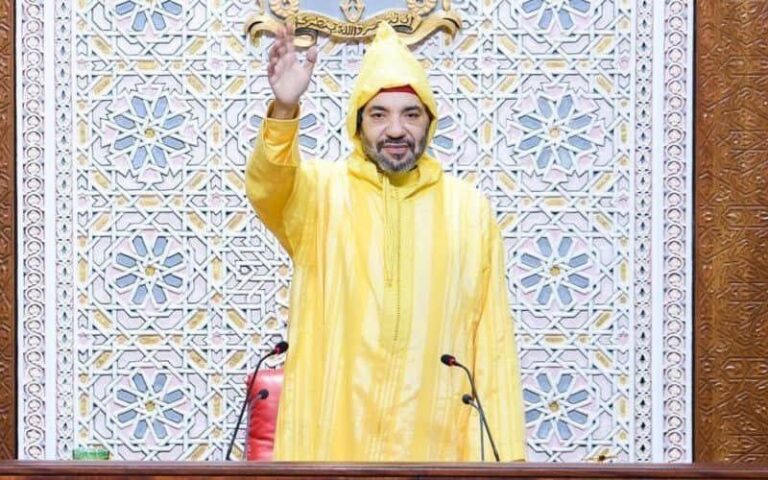
King Mohammed VI presided, on Friday 13 October, at the opening of the first session of the third legislative year of the country’s 11th parliamentary term. His speech to the members of the House of Representatives and the House of Councilors was watched from the front seats, with special attention, as guests of honor, the managing director of the International Monetary Fund and the president of the World Bank.
The Moroccan ruler pointed out that “our guide is our strong will to take action to rebuild the country”, after the terrible earthquake that “hurt it, leaving behind thousands of victims and many injured, for whose recovery we fervently pray” , insisting “on the need to continue the aid and support to the affected families, to proceed at a rapid pace with the upgrading and reconstruction of the earthquake-affected areas, to ensure and immediately provide them with basic services”.
“Despite the magnitude of the disaster, he added, sadness and pain gave way to consolation and pride, judging by the spirit of mutual aid and solidarity towards the affected, which was demonstrated in various ways, with sincerity and spontaneity, both by the Moroccan people, inside and outside the borders, as well as the bodies of civil society”. The monarch also added that a valuable lesson from this tragedy is the finding that the authentic values of the Moroccan soul prevailed, “those that have always allowed our country to overcome crises and adversities and that continuously strengthen our determination to continue moving forward with confidence and optimism “, emphasizing that “this beautiful spirit, this noble ideal exists in all of us because it represents, for us, the fermentation of unity and cohesion of Moroccan society”.
Guests of honor at the opening session of the work of the Moroccan Parliament, the managing director of the IMF and the president of the World Bank, who watched the royal speech with particular attention from the front seats.
The king underlined that he “always takes care of the protection of the family, inaugurating major projects and reforms in its favor”, making special mention of the plan to generalize social protection as “a key pillar of the country’s social and development model” and pointing out that at the end of the year the direct social assistance program will also be put into operation, which will allow the improvement of the standard of living of the target families, the fight against poverty and precariousness and, ultimately, the improvement of social and human development indicators.
He added that the corresponding “orientation was given to the government, so that the said program is implemented in accordance with a more general vision and with the provisions of the framework law on social protection, which has been approved by the Parliament”, and its implementation “it must be a model of success and therefore must be supported by the Single Social Register (RSU) targeting system and take full advantage of the potential of new technologies.”
The Moroccan ruler insisted on “absolute respect for the principles of solidarity, transparency and justice in the distribution of aid, especially for the benefit of those who deserve it”, calling on the government to prioritize the rationalization of existing social welfare programs, the guarantee of their effectiveness, as well as the sustainability of financial resources. “We insist on ensuring the good governance of the project, in all its dimensions. For this, it is necessary to put in place an ad-hoc monitoring and evaluation mechanism to ensure the best possible framework for development and continuous adaptation,” concluded the king.
Spanning thousands of miles and years, the ancient Silk Road brought together people of various civilizations, religions, nationalities and races across Asia, Europe and Africa. It opened up windows of friendly engagement among nations, and added a splendid chapter to the history of human progress.
As a key measure to advance opening up, the Belt and Road Initiative (BRI) grows from China but serves the world. Over the past decade, an open China has joined hands with more and more partners for a better world.
Boosting benefit sharing and inclusiveness through opening up.
The BRI welcomes all countries with open arms, following the Silk Road spirit of peace and cooperation, openness and inclusiveness, mutual learning and mutual benefit. The BRI is not ideologically driven, still less with values-related strings attached. It is not created for the sake of power confrontation or forming blocs. In contrast to those “small circles” or “exclusionary groups” pieced together by some countries, Belt and Road cooperation is a big family guided by the principle of extensive consultation and joint contribution for shared benefit. As of June this year, more than 150 countries and 30-plus international organizations have signed over 200 Belt and Road cooperation documents with China. Some international observers comment that no country in history has ever tried to roll out policies to build economic ties among so many countries across various continents.
Enhancing cooperation through opening up.
As a highly popular global public good and cooperation platform, the BRI promotes connectivity, facilitates the effort of relevant countries and regions to better integrate into global supply, industrial and value chains, and creates greater development opportunities. The initiative is a broad path along which China and other countries share opportunities for common development. Over the past decade, the BRI has galvanized nearly USD 1 trillion of investment, launched more than 3,000 cooperation projects, and created an array of national landmarks, livelihood projects and milestones of cooperation. The China-Laos Railway helps make land-locked Laos a land-linked country. The Mombasa-Nairobi Railway adds more than two percentage points to local economic growth. The China-Europe Railway Express has completed over 73,000 freight services. Indeed, the BRI has become a “belt of development” and a “road to happiness”.
Addressing development problems through opening up.
As an open platform for cooperation, the BRI aims to build a fair, equitable and transparent system of international trade and investment rules, and make economic globalization more open, inclusive, balanced and beneficial to all. The effective operation of the Asian Infrastructure Investment Bank, the Belt and Road Special Lending Scheme, the Silk Road Fund, Silk Road theme bonds, and other new instruments will help ease the problem of inaccessible and expensive financing. New platforms for international development cooperation, including the Belt and Road Sustainable Cities Alliance and the BRI International Green Development Coalition, will create more development opportunities and brighter prospects for developing countries, and help narrow development gaps. According to data from the World Bank, Belt and Road cooperation is on course to help lift 7.6 million people from extreme poverty and 32 million from moderate poverty across the world by 2030.
As an ancient Chinese saying goes, “Ceaseless inflow of rivers makes the ocean deep.” China will host the third Belt and Road Forum for International Cooperation this year. A more open China will further integrate itself into the world and deliver greater progress and prosperity for both China and the world at large.
This saying is not the only piece of wisdom that drives the BRI, but the Chinese emphasis on peace and harmony is an important feature as well. Through this openness and mutual respect, development works as a tool for peace.
The Silk Road
Peace brings win-win results.
The BRI aims to build more partnerships and make the pie bigger, and it opposes creating small clubs or seeking selfish interests. Over the past decade, synergy has been fostered between the BRI and the U.N. 2030 Agenda for Sustainable Development, the Eurasian Economic Union, the African Union’s Agenda 2063, the Master Plan on ASEAN Connectivity, as well as other international and regional development strategies. In May this year, the China-Central Asia Summit was successfully held to further synergize the BRI with the development strategies of the five Central Asian countries. Greater economic integration and deeper cooperation will inject new vigor into global peace and stability.
Peace enables development.
Embodied in the BRI is the vision of open, integrated and mutually beneficial cooperation, which is demonstrated by numerous examples. The Smederevo Steel Plant in Serbia brims with renewed vigor; the Piraeus port in Greece is among the top ports in the Mediterranean in terms of throughput; cataract patients in Uzbekistan are provided with opportunities to regain their sight; and villagers living in arid areas in Senegal now have better access to safe drinking water. Such development dividends cannot be achieved without a peaceful and stable environment. And thus, the pursuit of peace and development has gained stronger public support.
More than 2,100 years ago, Zhang Qian, a royal emissary of China’s Han Dynasty, traveled westward and opened an overland route linking the East and the West. In the early 15th century, Zheng He, a famous navigator in the Ming Dynasty, made seven voyages to the Western Seas, a feat that is still remembered today. These pioneers won their place in history not as conquerors with warships, guns or swords. Rather, they are remembered as friendly emissaries leading camel caravans and sailing treasure-laden ships. Thousands of years on, China continues to follow the path of peaceful development, strive to build the Belt and Road into a road of peace, and march hand-in-hand with other countries toward security and development for all.
This strategy of cooperation, openness, and peace is conducive to an environment of innovation and forward-thinking strategy, another key aspect of the BRI.
This is a road that brings together resources of innovation.
In the past decade, Belt and Road cooperation has spurred greater innovation in science and technology. From promoting people-to-people exchanges in science and technology to jointly building laboratories, from enhancing cooperation on science and technology parks to building technology transfer centers, the vision for a community of innovation featuring shared development philosophies, unimpeded flow of production factors, networked technology facilities, connected innovation chains and vibrant people-to-people exchanges is turning into reality. At the water-conserving irrigation laboratory jointly built by China and Egypt, water can be channeled to the roots of crops through underground seeping pipes with just a tap on the phone. This advanced water-saving irrigation system from China provides an effective solution to the problems of high temperature, drought and water shortage that plague Egypt’s agricultural development. Belt and Road cooperation is also instrumental in integrating resources of innovation from all parties. China and Portugal are located by the Pacific and the Atlantic respectively, with different climates and geographical conditions, yet greater cooperation on innovation including the Joint International Research Laboratory of Marine Biology inaugurated in 2017 and the Belt and Road Joint Laboratory on Space and Sea Technology Advanced Research launched in 2021 not only enables information sharing between the two countries, but also promotes complementarity in scientific research capabilities, thus producing a multiplying effect.
This is a road that delivers the benefits of scientific and technological innovation to the people.
Through Belt and Road cooperation, China has not only integrated itself into the global scientific and technological innovation network, but also helped spread the fruits of innovation to more countries and peoples. China has carried out extensive cooperation with partner countries in smart cities, mobile payment, cross-border e-commerce and other areas of digital economy, and supported them in establishing and improving technology markets. China has set up the Technology Transfer South-South Cooperation Center with the United Nations Development Program, promoted cooperation among higher education institutions and research institutes, and helped partner countries cultivate future innovators. As co-chair of the Bill & Melinda Gates Foundation Bill Gates said, China has an incredible mix of expertise and experience, as well as investment in scientific and technological innovation, and it will be able to make unique contributions to sharing its technologies and its lessons.
This year, China will host the third Belt and Road Forum for International Cooperation. Going ahead, China will continue to promote Belt and Road cooperation on innovation, fully tap the potential of innovation, open up broader space for win-win cooperation, and provide more shared treasures for people worldwide to achieve common development and prosperity.
Isni Kilaj Arrested and Transferred to the KSC Detention Facilities in The Hague – First Appearance Scheduled for Saturday, 4 November 2023
Isni Kilaj was arrested yesterday in Kosovo by the Specialist Prosecutor’s Office, pursuant to an arrest order issued by the Specialist Prosecutor’s Office. Isni Kilaj was transferred to the Detention Facilities of the Kosovo Specialist Chambers in The Hague today pursuant to a transfer order issued by a Single Judge of the Kosovo Specialist Chambers.
The arrest order was issued by the Specialist Prosecutor for Isni Kilaj for offences against the administration of justice, including obstructing official persons in performing official duties within the meaning of Article 401 of the 2019 Kosovo Criminal Code, Code No.06/L-074 (KCC) and violating secrecy of proceedings under Article 392 of the KCC, and Articles 15(2) and 16(3) of Law No.05/L-053 on Specialist Chambers and Specialist Prosecutor’s Office (Law).
The Specialist Prosecutor’s Office carried out the arrest with the support of the Kosovo Police and the European Union Rule of Law Mission in Kosovo (EULEX). Under the Law, police within the Specialist Prosecutor’s Office have the authority and responsibility to exercise powers given to Kosovo police under Kosovo law.
Under the Law, anyone arrested on order of the Specialist Prosecutor shall be brought before a Judge of the Kosovo Specialist Chambers within 48 hours of his or her arrest. The first appearance of Isni Kilaj is scheduled to take place on Saturday, 4 November 2023 at 10:00 hours in the courtroom of the Kosovo Specialist Chambers (KSC) in The Hague.
The first Appearance will be a public hearing during which the Single Judge will make sure that Isni Kilaj has been informed of the reasons for his arrest and that his rights under the Law and the Rules, including the right to legal representation, are respected. Within 48 hours of the first Appearance, the Judge shall decide on the continued release or detention of Isni Kilaj.
The first Appearance can be viewed online with a short delay at https://www.scp-ks.org/en/streaming. The hearing can also be followed from the public gallery of the courtroom at the premises of the Kosovo Specialist
From Xi’an, China’s ancient capital at the foot of the Qinling Mountains, to Lisbon, the European city on the continent’s western edge; from the coastal city Xiamen in southeastern China to the Port of San Antonio across the Pacific: the Belt and Road Initiative (BRI) is connecting countries across the globe, where people with different skin colors and speaking different languages proudly nurture their cultures. Living in a world of different civilizations, beliefs and customs, should we progress alone or together? And should we stay behind close doors or embrace one another? China’s answer is clear: Build a bridge of interaction and mutual learning, and make the BRI a road connecting different civilizations.
A new approach to civilization
The BRI was put forward by China in 2013. Recognizing diversity as a basic feature of the world, BRI’s concept of “mutual learning among civilizations” calls for treating all civilizations in an equal and inclusive manner, respecting the systems and beliefs of all countries, and promoting understanding and trust among different civilizations. Rejecting the outdated Cold War mentality, it represents a big step forward in humanity’s approach to civilization, and is garnering growing support globally.
A platform for intercivilizationdialogue
Over the past decade, Belt and Road partner countries have carried out diverse people-to-people exchanges and cooperation, which have become bridges for mutual cultural appreciation. Initiatives such as the Silk Road International League of Theaters, the International Alliance of Museums of the Silk Road, the Silk Road International Arts Festival, the Silk Road International Library Alliance and the Silk Road International Gallery Alliance had attracted close to 100 countries and international organizations by the end of 2022. Luban Workshop, a vocational training program, is today being conducted in more than 20 Asian, African and European countries to help cultivate a pool of high-caliber technical personnel for the local community. Chinese and foreign archaeologists are working together to explore the cultural relics of the ancient Silk Road and renew the exchanges along the Silk Road with modern-day cultural interactions. The BRI has built a platform for dialogue among civilizations, where the flowers of different civilizations bloom and shine together.
For a better world: contribution of the Chinese civilization
Our world is going through profound changes of a magnitude unseen in a century. China, while actively advocating dialogue among civilizations, is committed to contributing the energy of the Chinese civilization to the world, in an effort to put the concept of “mutual learning among civilizations” into practice, and add new content to the BRI. China’s endeavor to further the country’s development along the Chinese path to modernization and create a new form of human advancement sends a strong message—modernization does not mean Westernization, and each civilization is valuable for being uniquely its own. This strengthens the confidence of different civilizations to shine together and complement each other. China has put forward the Global Civilization Initiative that calls for respecting the diversity of world civilizations, championing the common values of humanity, promoting the inheritance and innovation of civilizations, and enhancing international people-to-people exchanges and cooperation. The aim is to open up new prospects in cultural interaction and people-to-people bonds among all countries, and contribute more to the progress of human civilization.
As once-in-a-century changes continue to unfold globally, humanity is confronted with multiple challenges and crises. The resurgence of anachronistic mentalities trumpeting the superiority of certain civilizations and clash of civilizations is posing a serious threat to world peace, stability, development and progress. At a time when all countries are interconnected with a shared future, inclusiveness, coexistence, interaction and mutual learning among civilizations play an irreplaceable role in advancing the modernization of human society and diverse human civilizations. By working together to build the Belt and Road into a road connecting different civilizations, we people of countries around the world will be able to join force and tackle all kinds of risks and challenges together.
This civilizational mentality and dialogue provides not only opportunities for the various parties involved, but, through the exploration of these new development strategies, the creation of a better future.
A Road of Green Development for the New Era
Along Kenya’s Mombasa-Nairobi Standard Gauge Railway, animals as tall as giraffes cross the railroad bridges easily through the large passages built for them. At solar farms in Pakistan’s Punjab province, plants and fruits are grown under the solar panels. These scenes not only showcase the tangible outcomes delivered under the Belt and Road Initiative (BRI), but also highlight how the Belt and Road cooperation is turning the inspiring vision of green development into reality with concrete actions.
Ancient Chinese wisdom makes new contribution
A sound ecosystem is essential for the prosperity of civilization. For thousands of years, the Chinese civilization has set great store by the idea that humanity must seek harmony with Nature. Into the new era, China is committed to the principle that lucid waters and lush mountains are invaluable assets, and pursuing modernization that features harmony between humanity and Nature. Thanks to persistent efforts, incredible progress has been accomplished in its eco-environmental protection and green development endeavors.
While steadily advancing green development at home, China has explored to contribute its ideas and experience on green development to the Belt and Road cooperation. In 2019, at the opening ceremony of the second Belt and Road Forum for International Cooperation, China made clear that green will be a defining color of the BRI, and green infrastructure, green investment and green financing will be promoted to protect the planet we all call home. This appeal to build a green Silk Road together demonstrates China’s leadership as a major country in global eco-environmental governance, and contributes Chinese wisdom to the joint endeavor for a clean and beautiful world.
Boosting the green development of partner countries
In building a green Silk Road, China has not only expressed its commitment, but more importantly, taken concrete actions. In Senegal, China takes an active part in Dakar’s waste water treatment project to improve the water quality in surrounding areas and rehabilitate the environment along the beaches, which benefits hundreds of thousands of residents in the bay area. In Ghana, the Sunon Asogli Power Plant project has been completed with help from China. Supporting 25 percent of Ghana’s electricity demand, the plant has alleviated electricity shortage for local communities with green and clean power. In Kazakhstan, new energy projects delivered with participation of Chinese enterprises, such as the Zhanatas Wind Power Station and the Turgusun hydropower station, have provided a strong boost to the country’s green and low-carbon development.
As the world’s largest market and equipment manufacturer in the field of clean energy, China has conducted green energy cooperation with more than 100 countries and regions. In Belt and Road partner countries, Chinese investment in green and low-carbon energy has surpassed that in traditional energy. This has promoted greater balance between socioeconomic development and eco-environmental protection, brought more opportunities for green development to participating countries and regions, and delivered green benefits to local communities.
With this strong emphasis on infrastructure and green development, as well as international cooperation, the BRI provides a powerful model towards increasing global prosperity between friendly nations.
The BRI shines the light of development and provides new impetus for global development.
Development holds the master key to solving all problems and is a timeless theme for humanity. The BRI, focusing on development which best serves the common interests of all countries, has provided a platform for development with great inclusiveness, and promoted the common development and prosperity of all countries around the world. From 2013 to 2022, the total value of China’s trade in goods with key Belt and Road partner countries grew at an average annual rate of 8.6 percent, and the two-way investment exceeded USD 270 billion. Newly signed contracts of projects are worth over USD 1.2 trillion, and an array of infrastructure projects including roads, bridges and ports have come into commission, further promoting land, maritime, air and cyberspace connectivity.
The Belt and Road cooperation is not a solo performance, but a symphony played by all. The BRI has effectively synergized development strategies and practical demands among partners, and has helped partner countries transform their own advantages into tangible fruits of development. Over the past decade, overseas cooperative industrial parks including Thailand-China Rayong Industrial Zone and Ethiopia’s Eastern Industry Zone have flourished, serving as a catalyst for local industrialization and modernization. The World Bank estimates that by 2030, Belt and Road cooperation will bring an annual benefit of USD 1.6 trillion to the world, accounting for 1.3 percent of the global GDP and injecting strong impetus into global development.
The people are the foundation of a state. When the foundation is strong, the state will be secure. Improving people’s livelihood has become another distinctive feature of the BRI. Over the past ten years, the BRI has helped lift nearly 40 million people out of poverty and created paths toward opportunity and prosperity for the local people. A large number of “small yet smart” livelihood programs such as schools, hospitals and stadiums have been put in place one after another, and more and more people are living a better life with a greater sense of happiness and benefit. The China-Europe Railway Express completed over 15,000 freight services, serving as a health train delivering medical supplies during the pandemic. In January this year, the China-aided African Center for Disease Control and Prevention (CDC) headquarters, the first CDC in Africa featuring modern office facilities and high-end laboratories, was successfully handed over. Facing the global food crisis, China and its BRI partners have been actively engaged in agricultural cooperation and popularized hybrid rice, Juncao and other practical technologies, making positive contributions to ensuring food supply for the local people.
The BRI shines the light of hope and opens up new prospects for common prosperity.
The U.N. 2030 Agenda for Sustainable Development is now encountering difficulties in its implementation, and the development gap keeps widening. Countries around the world have a stronger aspiration for development and cooperation. Many developing countries have seized the momentum of the BRI and got on board the express train of China’s development. As we accelerate the development of the health Silk Road, the digital Silk Road, the green Silk Road and the Silk Road of innovation, more opportunities for cooperation will be created. This will open up broader prospects for industrial upgrading, energy transformation and innovative development in those countries.
The third Belt and Road Forum for International Cooperation will soon be held in Beijing. It will be the grandest event to commemorate the 10th anniversary of the BRI, and an important platform for all parties to discuss high-quality Belt and Road cooperation. We hope that all parties, standing on the new starting point, will make the pie of development increasingly bigger, so as to provide solid support for people’s well-being and create more opportunities for economic growth. In doing so, we will usher in another wonderful decade on this road of global prosperity.
Nordic culture, with its captivating blend of timeless tradition and modern innovation, is something that has always piqued the interest of people worldwide. It’s not just about the stunning landscapes and picturesque fjords; it’s a way of life. In the heart of the Netherlands, a unique event called Nordic Days brings the spirit of Scandinavia to life, showcasing its diverse facets like travel, living, food & drinks, clothing, and outdoor experiences. This two-day fair offers a glimpse into the enchanting Nordic world, attracting more than 2,900 visitors each year.
A Scandinavian Extravaganza
Nordic Days, held in the charming town of Cuijk, serves as a delightful fusion of all things Scandinavian. The event provides a platform for over 50 exhibitors to showcase and sell their Scandinavian products, from exquisite Nordic design to mouthwatering cuisine. Attendees have the opportunity to explore and purchase authentic Nordic goods, which are renowned for their quality and unique aesthetics.
Workshops and lectures are integral to the Nordic Days experience, as they provide a deeper insight into the various aspects of Scandinavian culture. Participants can engage in interactive sessions, learning about Nordic traditions, food preparation, and even the secrets behind the elegant simplicity of Scandinavian design. These workshops create an immersive experience, allowing visitors to appreciate and understand the Nordic way of life.
The Nordic Talks: A Platform for Knowledge Exchange
Nordic Talks is an annual event closely related to the Nordic Days, but with a different focus. This initiative is a collaboration between the Nordic embassies and the Nordic Chambers of Commerce in the Netherlands, aimed at promoting knowledge sharing and fostering partnerships between Nordic companies and Dutch business partners. Since its inception in 2013, Nordic Talks have addressed a diverse range of topics, including sustainability, circular economy, gender balance, diversity, technology, and artificial intelligence.
The purpose of these talks is to showcase the innovative and progressive aspects of the Nordic region, highlighting its contributions to various fields. By bringing together experts, entrepreneurs, and thought leaders, Nordic Talks facilitate discussions and provide valuable insights into the Nordic way of doing business. In the spirit of international cooperation and partnership, these events offer a valuable platform for companies to learn from each other and create fruitful connections.
Friluftsliv: The Nordic Way of Outdoor Living
In the most recent Nordic Talks event held in Amsterdam on November 1, 2023, experts and researchers from Nordic countries shared valuable insights on “Friluftsliv,” a concept that captures the essence of outdoor living. The term roughly translates to “open-air life” and encompasses the practice of spending time outdoors, engaging with nature, and enjoying various activities in the fresh air. The event emphasized the manifold benefits of incorporating Friluftsliv into daily life.
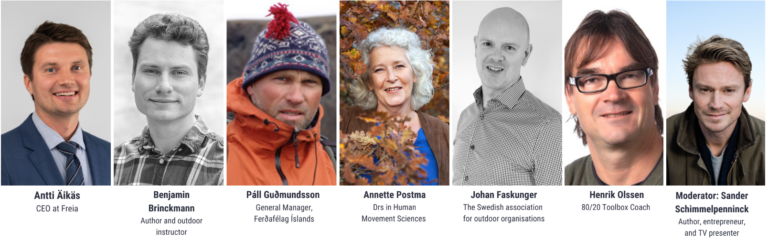
Scientific studies presented during the event demonstrated the numerous advantages of outdoor recreation, such as increased learning capacity among young people, social inclusion, and personal health improvements. Johan Faskunger from the Swedish Association of Outdoor Organizations highlighted the potential to prevent numerous health issues, stating that “By activating 1,000 adults, we will prevent 10 premature deaths, 20 cases of type 2 diabetes, 50 cases of heart attacks, and 150 cases of high blood pressure.”
Furthermore, the positive impact of outdoor activities on the workplace was underlined. Henrik Olssen from the Danish 80/20 Toolbox coach shared his company’s experience, where introducing a daily half-hour collective outdoor training session led to an 80% increase in profits over recent years. This illustrates how incorporating Friluftsliv practices in the workplace can reduce stress, anxiety, and absenteeism while enhancing team performance.
Nordic Days
The Simple Pleasure of Outdoor Activity
One of the key takeaways from the Nordic Talks event was the simplicity of integrating outdoor activities into daily routines. Walking, cycling, or running for at least 30 minutes a day offers substantial health benefits and can be easily achieved in almost any location, including the Netherlands. Even in densely populated areas, green spaces like parks, meadows, and beaches are often just a stone’s throw away, making outdoor activities accessible for all.
A noteworthy piece of advice from Nordic experts is for Dutch municipalities to plan green areas within a 5-kilometer radius of residential and office areas. This approach encourages outdoor activity by ensuring that everyone has easy access to natural spaces. Such planning not only promotes a healthier lifestyle but also contributes to a sustainable future, as individuals who frequently engage in outdoor activities tend to be more environmentally conscious.
Inspiring the Dutch with Friluftsliv
The initiators of the Nordic Talks event, including the Embassies of Denmark, Iceland, Finland, Norway, and Sweden, as well as the Chambers of Commerce of Denmark, Finland, Norway, and Sweden, have a clear mission. They aim to inspire more Dutch people to embrace the Nordic concept of Friluftsliv. The evidence presented during the event supports the idea that incorporating outdoor activities into daily life can lead to a multitude of physical, mental, and even economic benefits.
The rich and diverse Nordic culture, with its unique approach to outdoor living and business innovation, is a source of inspiration and valuable lessons for the Dutch community. By promoting these ideas and experiences, Nordic Talks and Nordic Days continue to serve as bridges between the Netherlands and the Nordic region, fostering cultural exchange, business collaboration, and the adoption of a healthier, more sustainable way of life.
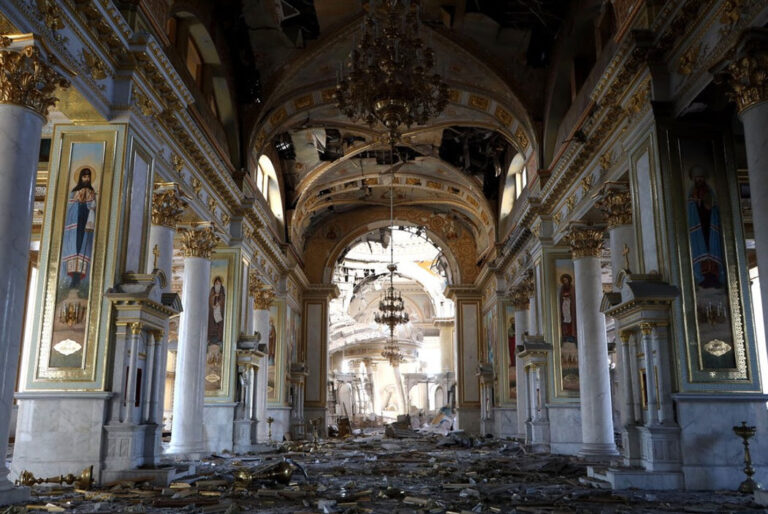
In both peacetime and times of armed conflict, governments and non-state actors are obligated by international law to protect these sites. However, recent attacks have targeted religious sites including cemeteries and houses of worship including churches, mosques, and a synagogue.
“USCIRF abhors the burning and destruction of the El Hamma synagogue in Tunisia. This attack is linked directly to rising global antisemitism and explicit threats against Jews, including antisemitic chants at protests and the tagging of Jewish homes with Star of David graffiti,” said USCIRF Commissioner Susie Gelman “We also condemn several recent attacks on mosques and the rise in anti-Muslim rhetoric globally. All governments have an obligation to protect houses of worship and the people who use them for worship and religious observance.”
“We are concerned by the uptick of attacks on churches in Sudan and Nigeria, and the targeting of Christian churches and cemeteries in Jerusalem,” said USCIRF Commissioner Frank Wolf. “We urge the United States to do everything it can to ensure that these religious sites are protected.”
“International humanitarian law protects human dignity and institutions that serve civilians, including houses of worship, during times of armed conflict,” said USCIRF Commissioner Nury Turkel. “It isunlawfulto direct attacks at religious sites, or to use houses of worship in support of a military effort. The U.S. government must continue to insist in public and private engagements that all parties to the current conflicts respect these crucial tenets of international law.”
In 2019, USCIRF issued a factsheet on international law protecting houses of worship and holy sites. Last month, USCIRF expressed concern over rising religious hatred as a result of the ongoing conflict in Israel and Gaza.
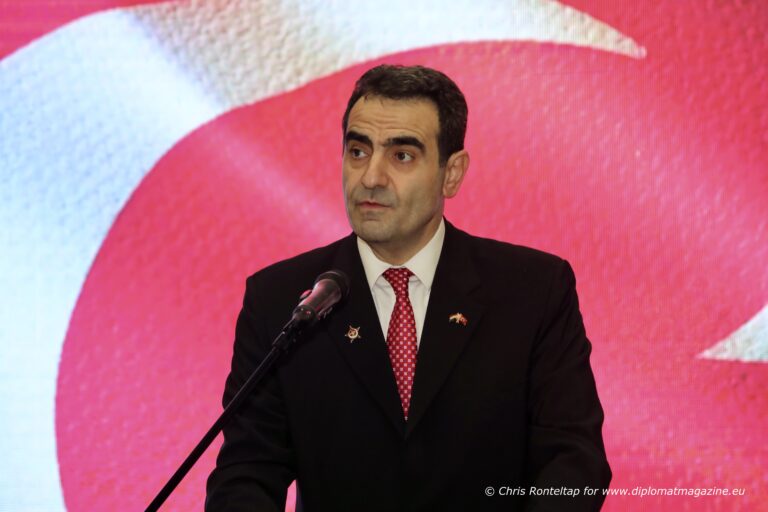
His Excellency Ambassador Selçuk Ünal organized a reception on the 100th Anniversary of the Proclamation of the Republic of Türkiye on Thursday, 26 October 2023. Hundreds of well-wishers responded to the invitation and came by to felicitate Ambassador Selçuk Ünal.
Turkey celebrated the 100th anniversary of the creation of the modern, secular republic from the ruins of the Ottoman Empire. Ghazi Mustafa Kemal Atatürk, a World War I hero who went on to lead a war of independence against occupying forces, Ataturk proclaimed the Turkish Republic on October 29, 1923. He embarked on a series of reforms aimed at turning the nation into a secular democracy. He abolished the caliphate, replaced the Arabic script with the Latin alphabet and gave women the right to vote.
Ambassador Ünal and wife welcome the Dean of the Diplomatic Corps, H.E. Sahar Ghanem, Ambassador of Yemen.
Ambassador Selçuk Ünal welcome remarks follow. “ It is an honour to welcome you to the centennial anniversary celebration of the Republic of Türkiye. Thank you for being with us. In 1919, Gazi Mustafa Kemal Atatürk and his comrades-in–arms, all the brave men and women, heroes and fighters have started an independence war which ended with establishment of the Republic in 1923 and made it possible for us today to celebrate 100th anniversary of our independence.
We have come a long way in 100 years. And Türkiye is now entering its second century with a vision, its hard-working people, vibrant economy, contributions to the rule based world order as a responsible member of the international community.
Turkey Embassy Team
This year we celebrated the 500th anniversary of the foundation of the Foreign Ministry. Diplomatic relations between the Dutch Republic and the Ottoman Empire had started also almost 500 years ago. First Dutch envoy was sent in 1612. Two centuries later, in 1813, there was another envoy, Ambassador Tesla, of whom we have the honour to host his descendants tonight.
Türkiye has always attached special importance to its relations with the Kingdom of the Netherlands. It was not a coincidence that following the establishment of the Republic in 1923, one of the first friendship treaties was concluded with the Netherlands in 1924.
Our nations founded the Council of Europe, became staunch NATO Allies, worked together in the UN peace keeping missions and other organisations such as the OSCE, the OECD and the OPCW.
100 Anniversary of Turkey
Our countries share the same determination to overcome issues in the world. We have several bilateral dialogue mechanisms. One of them, the Turkish-Dutch Wittenburg Conferences have started herein this place in 2008.
We share a bilateral trade volume exceeding 10 billion Euros. In terms of foreign direct investment (FDI), the Netherlands is the biggest investor in Türkiye. Likewise, Turkish investments in the Netherlands are also at the top in terms of worldwide Turkish FDI. We hosted 1.2 million Dutch friends last year. Dutch-Turkish community of almost half a million has become a great contributor here in the last 60 years.
H.E. Selçuk Ünal and spouse welcome the Ambassador of Kazakhstan, H.E. Mr Askar Zhumagaliyev.
While concluding, I would like to thank for the solidarity that the Netherlands has extended to us in the earthquakes this year. My family and I have arrived to the Hague 5 days before the devastating earthquakes of 6 February. Our Dutch Allies deployed the Urban Search and Rescue Team, the Military Airborne Medevac Unit and numerous NGOs immediately. Those brave men and women are with us tonight. I thank our Dutch friends once more. Like the Turkish aid to the Dutch during the floods in 1916, 1953 and 2021, the assistance of the Dutch government, people and the Turkish-Dutch community will not be forgotten.
I also would like to thank to the team of the Turkish Residence who prepared samples of Turkish cuisine as well as our kind sponsors such as the Turkish Airlines, Bereket Baklava and Elka Food. Once again, Dames en heren, welkom! Welkom en bedankt dat je bij ons bent! Dank u wel.”
H.E. Selçuk Ünal, Ambassador of Turkey, welcomed Ilkka-Pekka Antero Similä, Ambassador of Finland.
Next on the program was the reading of a message by the President of the Republic of Turkiye, H.E. President Recep Tayyip Erdogan, on the occasion of “29 October Republic Day”
The government had opted for a low-key celebration of the centennial, which comes months after a devastating earthquake. However, many in held their own private celebrations. Municipalities organized concerts and parades. Pop star Tarkan and classical pianist Fazil Say are among artists that have composed marches to mark the centennial.
The 100th Anniversary of the Proclamation of the Republic of Türkiye was celebrated nationwide in a joyous spirit.
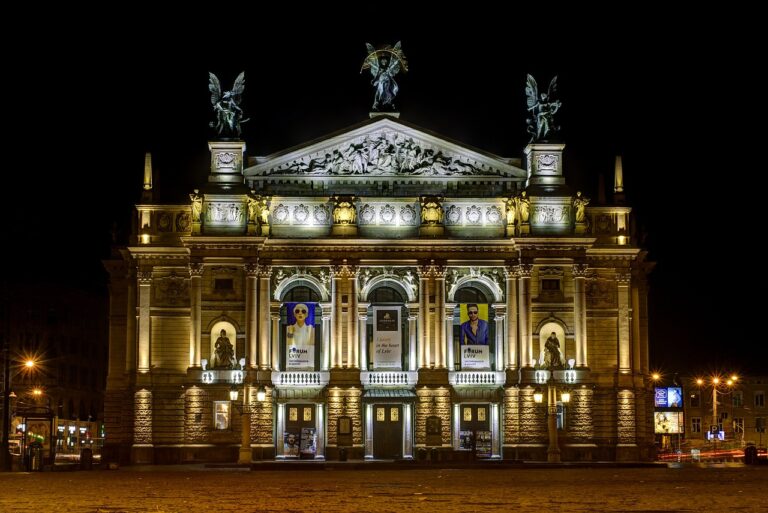
The allure of Ukraine’s history and culture is a tapestry woven from countless threads, each representing a unique facet of the nation’s identity. On Tuesday, 14th November 2023, at 20.00 hours, you’re invited to join us for the second lecture of our season at the Warenar Theatre in The Hague, where Rosamund Bartlett, a distinguished writer, lecturer, and cultural historian, will unravel the intricate narrative of Ukraine’s past and present. In a world where understanding and appreciating diverse cultures is more crucial than ever, this lecture promises to be an enlightening journey through the heart of Ukraine.
A Multifaceted Ukrainian Story
Rosamund Bartlett’s lecture, “The Culture and History of Ukraine,” serves as a window into the multifaceted world of Ukraine. Through her insightful presentation, she will guide us through the shared culture that binds Ukraine’s diverse people together. From the sacred art and architecture of Kyiv, which was inherited from Byzantium and carries centuries of history within its walls, to the rich legacy of the Cossacks, a pivotal group in Ukraine’s history, we will gain a deeper understanding of Ukraine’s cultural richness.
Bartlett’s exploration extends to Ukraine’s treasury of poetry, painting, and song. Ukraine has a long history of producing artistic gems, and this lecture will showcase the country’s profound artistic heritage.
Folk Culture: The Heart of Ukraine
One of the most captivating aspects of Ukraine’s cultural narrative is its folk culture. Bartlett will delve into the vital role played by folk traditions in Ukraine’s journey towards independence. From the captivating “red icons” painted on glass to the country’s remarkable embroidery tradition, we will discover the surprising influence of these folk arts on avant-garde art. It’s an opportunity to understand how seemingly simple and traditional practices have had a profound impact on the evolution of art and culture in Ukraine.
Meet Rosamund Bartlett
Rosamund Bartlett, is no stranger to cultural history. She has a distinguished background as a writer, lecturer, and translator. Her work spans across various art forms and historical periods. She earned her doctorate at Oxford University and has authored several books, including biographies of literary giants like Chekhov and Tolstoy. Bartlett’s knowledge extends to the influence of Wagner in Russia, and she is currently working on a history of the Russian avant-garde.
Her translation of “Anna Karenina” for Oxford World’s Classics garnered acclaim in 2014. Bartlett’s expertise extends to art, music, and literature, and her contributions have graced esteemed publications such as The Daily Telegraph and Apollo. She has received commissions from renowned institutions like the Royal Opera House, Tate UK, and the Salzburg Festival. Her captivating lectures have taken her to venues ranging from the V&A and the National Theatre in London to the Art Gallery of New South Wales in Sydney. She is a regular contributor to Proms events and opera broadcasts on the BBC.
How to Attend
To attend this enlightening lecture in person at the Cultural Centrum Theatre Warenaar or via the Zoom stream, please register on our website: The Arts Society The Hague. Please note that registration is required before Monday, 13th November, 2023.
The lecture will commence at 20.00 hrs on Tuesday, 14th November. For non-members, the guest fee for this lecture is Euros 15.
If you’re interested in becoming a member, the fee for the entire season, which includes eight lectures and various other cultural activities, is 75 Euros for an individual and 140 Euros for a couple. A half-year membership is available for 37.50 Euros and 70 Euros for a couple, with students enjoying a half-price discount.
Don’t miss this opportunity to embark on a cultural journey into the heart of Ukraine, guided by the expertise of Rosamund Bartlett. We look forward to welcoming you to the Warenar Theatre for an unforgettable evening celebrating Ukraine’s rich history and culture.