
By Teodor Palade, Corneliu Pivariu
“I think we live in a moment when the world is a very uncertain and restless place and when the global competition dynamics is indeed a feature of our lives as well, and I tink that the actual danger we have with a fairly large number of regional conflicts unfolding now is to be faced with an escalation triggered by a miscalculation”-General Sir Nick Carter, November 2020, in a SkyNews interview
We are an uncaring people. And, as a people, we are uncaring for we have repeatedly elected the wrong leaders. Moreover, it is widely known that Romania did not come up in the last decades with a single high standard politician. Not a single one!
Beguiled by the petty indigenous bickering raised by the stakeholders to frightening dimensions and blinded by meaningless appearances, we do not care we are surrounded by complicated conflicted situations, dormant or active, each of them with real potential of generating at any moment devastating armed clashes.
We do not realize that we are not only geographically but also economically, politically and militarily dangerously close to a genuine fire arc. The east European fire arc. It is marked by a series of open tensions or conflicts and spans from Kaliningrad, Belarus, Ukraine, Transnistria, Georgia (Abkhazia and Ossetia), Armenia-Azerbaijan, with the boiling Nagorno-Karabakh, and Syria reaching up to the Eastern Mediterranian troubled by the tempestuous relations between Turkey and Greece.
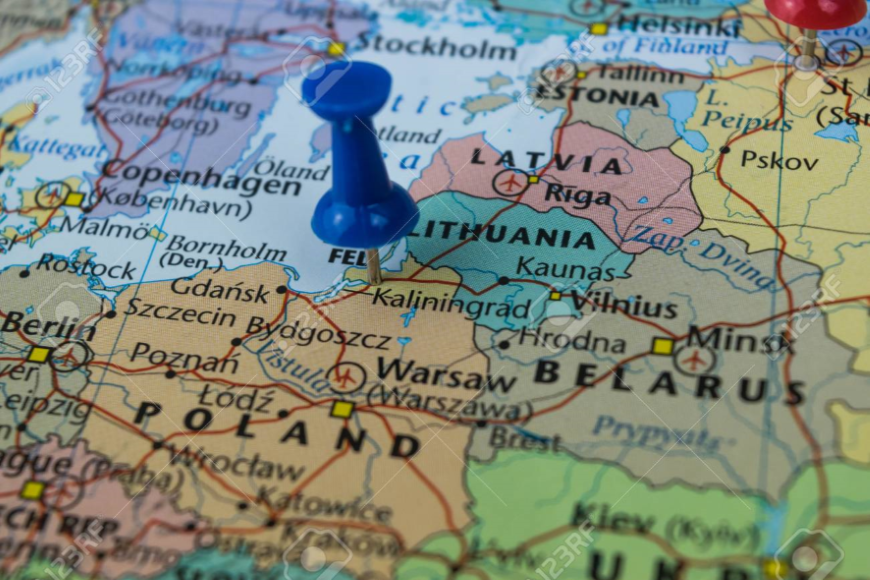
Kaliningrad (Königsberg in German)
It is a Russian semi-exclave to the Baltic Sea founded by the Germans in 1255.On 2nd August, 1945, the town and the northern part of the East Prussia was assigned to the USSR and in 1946 it has been decided to become a region (oblast) of the Russian SSR. The German population (around 150,000 civilians) was forcibly expelled between 1945-1947 and the town was populated by ethnic Russians. In 1946, the town was renamed Kaliningrad. The region has an area of 15,100 sq.km and a population of around 900,000 inhabitants and represents a Russian important outpost in the area. As of 1994, a Special Military Region was established which includes the Baltic Fleet, the Kaliningrad air defence forces, the 11th Guard Army, the border troops and the Kaliningrad Police. This region, together with the Leningrad and Moscow military regions were included from the 1st of September, 2010 into the West Military Region. According o some data published by the Russian Ministry of Defense in 2014, there were around 225,000 military in Kaliningrad and it has been decided in 2015 the enhancement of the Baltic Fleet and of the troops of the region by the deployment of a new Infantry Motorised Brigade and of a coastal battery. From quantitative deployment Russia moved to quality deployment and the increase of fire power and equiped the region with state-of-the art technique including SS-400 anti-aircraft systems and Iskender nuclear missiles. At 650 km distance from Berlin and around 1,200 km from Moscow, Kaliningrad is strategically placed towards Suwalki Gap (a land area 65 mi wide – Poland-Lithuania border) that ends to the east in Belarus. It is considered the main Russia’s offensive direction towards the west.


Belarus
The invisible divisions of the hybrid war of the world’s two of the most powerful military forces, Russia and the USA are facing each other in direct contact in the beautiful White Russia at a distance of only 500 km from the Romanian northern border.
Belarus, the country where starting with the night of 10th of August, 2020 (a strange coincidence with the date of the people of Bucharest revolt in 2019) the angry population reneged on their president, is boiling. During the recurrent violent outbursts among the periods of relative calm, the perspective of a civil war able to draw in its vortex the two great enemies is looming. The moves of the two, political, diplomatic or economic ones are intersecting on the Belarusian land in an open confrontation. The battle is waged both in the official, visible way and in the grey area specific to the intelligence services.
Close to the Republic of Belarus’ borders, Russia’s and NATO’s military drills are either under preparation or already underway. The foreign military presence adds inherently an extra pressure to the tensions among the domestic forces, both civilian and military which are since some time in an open, merciless confrontation.
Through the open communication channels and especially through the informal ones, promises are being made from the outside to each of the domestic adversaries. The international bodies responsible with monitoring and the avoidance of conflicted situations, which are predominantly hostiles to Russia, have sent their envoys to Belarus in order to both supervise and calm down a possible bloody conflict and not to miss from the inside the chance to tilt the balance at a propitious time in the desired direction. In paralel, the same fora issued new and new resolutions meant, at least apparently, to quench the blaze. The said resolutions, representing in themselves the product of certain political interests have overtly backed only one of the sides and contributed to increasing the mutual tensions and accusations between the two players closely clenched and hidden from the common onlooker behind the normality curtain which went down discretely in front of the burning stage.
The situation in Belarus, relatively quenched by the winter, by the the drift toward other areas of the two great’s immediate interests (the American presidential elections or the anti-Putin revolts in Russia) and disturbed by the disastuous effects of the pandemics remains tense. A detonating device set on a time delay that might turn at any moment the relative quiet to hellfire has been already activated in Minsk.
Ukraine
A little further south, in the territorially torn apart Ukraine by the geostrategic claims of the same two great powers who never cease to mutually blame themselves, the anti-Ukrainian and Russian forces are still in positions of battle alongside the pseudo borderline separating the hacked body of Ukraine from the separatist regions of Donetsk and Luhansk. The situation remains explosive after roughly six years of conflict in which both the Western and the Eastern envoys played their roles and after more than 10,000 dead were recorded in spite of several ceasefires.
Seemingly to further complicate the situation, in 2014 after a referendum considered questionable by the West and illegal by Kyiv, Russia annexed Crimea, an important strategic point on the map of the disputes between the East and the West. Crimea, the peninsula with a troubled history as a result of its geostrategic position that allows the control of the Black Sea passed during the history from the grabber hands of the Greeks, Persians, Romans, of the Byzantine Empire, the Ottoman Empire to the Russian Empire and later on to the USSR from where it was transferred to Ukraine (a state then part of the USSR) in 1954 by a decree given by the General Secretary of the CC of the CPSU, Nikita Khrushtchev. Khrushtchev was born very close to the Ukrainian border and it is believed that the tranfer was directly linked to his controversial Ukrainian origins.
The annexation of Crimea, an act denounced as illegitimate by the West, showed everyone that Russia can do whatever it wants in its area of immediate interest. The situation in Ukraine is not stable either. A so called latent conflict smolders dangerously. That was proved by the fact that when confronted with the West’s protests in March 2015, the public TV channel Rossia1 stated that Russia was ready to resort to nuclear armament if the US and their allies intervene militarily in Ukraine’s favor.
The situation in the separatist regions of Donetsk and Luhansk as well as the annexation of Crimea are actions that raise the question of the credibility of the international guarantees (the observance of the territorial integrity within the borders at the respective date) granted toUkraine by the USA, Great Britain and Russia in accordance with the Budapest Memorandum of 5th of December, 1994 as a result of giving up the nuclear armament on its territory.
Crimea, based on its exceptional geostrategic position and on the military assets brought there by the Russian Federation, is closer to the NATO base in Dobrudja than Cluj and should represent one of the hot points permanently supervised by the Romanan military strategists and by those of the North Atlantic Alliance.


Transnistria
Moving southward on the fault line that emerged in the area where the interests of the two great powers collide, we find another spot of instability close to Romania and which represents an old generator of tensions: the Moldova – Transnistria conflict (a territory recognized today by the Moldovan administration as the Autonomous Territorial Unit with special status Transnistria). Having in mind the importance of this minute land area for at least five east-European countries, we are not surprised that the world’s giants are disputing the control of a territory of only 4,163 sq.km and circa 470,000 inhabitants (2016), and that smaller and marginal states have joined the two as each of the former has something to gain or to lose at the end of the clash. Signs of a normalization of the situation are far away and a possible new escalation of the dispute is closer to reality.
The enclave is strategically important for Russia and Transnistria could not survive without massive Russian support (natural gas delivered so far and not paid amounts to around 6 bil. Dollars). The presence of the 1,500 or so Russian military on Transnistria’s territory complete the picture of Moscow’s securing the control. The Cobasna weapons and ammunition storage (the biggest storage facility in Eastern Europe – a remiscent of the Cold War – where ammunition from the former GDR and Czechoslovakia were stored at the beginning of the 1990s) still accomodates around 20,000 tones of artilery and infantry ammunition, military equipment etc. The entire quantity of ammunition there has expired and a research of the Sciences Academy of the Republic of Moldova shows that in case of a deflagration, the explosion would equate to the explosions of the bombs launched on Hiroshima și Nagasaki, to say nothing of the possible spilling of chemical compounds into the Dniestr River and then into the Black Sea.
The relations between the Republic of Moldova’s newly elected president – Maia Sandu and Russia did not begin under the best of auspices as Sandu requested the complete withdrawal of the Russian troops and weapons from Transnistria. The request was immediately considered “irresponsible” by the Russian minister of Foreign Affairs Serghei Lavrov.

Georgia (Abkhazia and South Ossetia)
There are two separatist regions on Georgia’s teritory, Abkhazia and South Ossetia. Both regions have triggered conflicts (with Russia’s unacknowledged support) after the collapse of the USSR in order to gain their independence.
Abkhazia has an area of 8,600 sq.km. and a population of around 245,000 inhabitants (2018), and its ethnical structure has been changed after the 1991-1994 independence war when the Abkhaz represented 44% and the Georgians 21% (as compared to 1989 when the Georgians represented 48% and the Abkhaz 17%).
Abkhazia controls now half of the Georgian seashore and together with South Ossetia hosts numerous Russian military bases where the number of Russian military reached 10,000 at the beginning of 2020. In 2019 only, more than 130 Russian military drills were organized on these territories.

South Ossetia has an area of 3,900 sq.km. and a population of around 53,500 inhabitants (2015). The importance of this region is based partially on the Roki Tunnel, one of the main routes for crossing the Caucasus. Partially affected by the 2008 conflict, it was rebuilt and reopened while the cost (around 400 mil dollars) was born by Russia.
The two separatist republics were officially recognized by Russia on 26th August 2008.
Although militarilly it was a small-size one, the August 2008 Russo-Georgian conflict had a significant impact worldwide as it was for the first time after the Afghanistan invasion of 1979 that the Russian Federation invaded a neighbouring state. Moscow proved on that occasion the desire of maintaining its influence in the ex-Soviet space. Moreover, the Russian military leadership reviewed thoroughfully all dysfunctions of the Russian military system including the performances of its military technique and took actions accordingly and that was proven later on during the military actions carried out in Syria starting with September 2015.

In the aftermath of the Russo-Georgian war, the West (the US, NATO, the EU and the individual states) realized the threat Russia represents for the peace and stability of the world security system taking into account its blatant revisionism and the use of force for obtaining the acknowledgement of some presumed rights in the post-Soviet space.
It seems that for the democratic world the resulting lessons have been in their greatest part either forgotten or misplaced in the history’s library. Yet Russia succeeded in slowing down or even halting Georgia’s orientation process towards the West and the European Union.
Nagorno-Karabakh
Moving further south on the strip of land between the two seas, the Black Sea and the Caspian Sea, we find a dispute stored-up since many years with periodical volcanic flares-up and which attracts in its turn some of the neighbouring military powers.

The tension prevailing there threatens the peace of the entire region reverberating up to the Black Sea’s other shore. In this unreal area, for an insignificant patch of land too, the conflict between Armenia and Azerbaijan having as subject matter the disputed territory of Nagorno-Karabach is boiling. Not only two neighbouring countries but also two world’s important religious communions, the Armenian Christians and the Azeri Muslims, are on the brink of war ever since the end of the 1980s. Statistics show that tens of thousands of Armenians and Azeris died so far, millions of people have been relocated and record the massacres perpetrated by both sides as well. Russia’s and Turkey’s interests are mingled there in the south of Caucasus. Their presence is continuous and when they consider necessary each of them intervene for their own benefit without considering the extent of the collateral losses.
After the latest outbreak of violences, on 9th November 2020, president Putin, the Azeri president Ilham Aliyev and the Armenian prime-minister Nikol Pashinyan signed an armistice agreement for Nagorno-Karabakh under Russia’s direct supervision. The document states:”A 1,960-strong peacekeeping contingent of the Russian Federation with small arms, 90 armor personnel carriers, and 380 vehicles and other pieces of special equipment shall be deployed along the Lachin corridor (…)The peacekeeping contingent of the Russian Federation shall be deployed for five years and this term will be automatically prolonged for other five years periods if neither of the Parties declares six months before the expiration of the period its intention of terminating this provision”.

For the time being, Turkey’s reaction to the fact of being brutally removed from the equation, in spite of its major interests in the region, did not materialize. Russian and Turkish officials state that the two presidents Putin and Erdogan had a long phone call. On that occasion, the Turkish side declared it was content that such a long conflict came to an end, and president Putin proposed Turkey a partnership for monitoring the peace keeping in the region. At the same time, American and French sources point out to an increase of tensions between Ankara and Moscow.
The tense situation lingers on. The Azeri are discontent as they were on the verge of conquering the entire enclave and assert that the fight is not over. ”The Peace Deal is extremely vague” an Azeri citizen declared. ”I do not trust Armenia as I trust Russia even less”.
Armenia considers the Peace Deal tantamount to a national disaster and declares it will continue its fight.
The situation is far from having a sustainable solution, yet Moscow proved this time, too, that it is the unavoidable international player in finding a solution, even a temporary one, in case of a conflict within the space of the former USSR.
Mention should be made here of the importance of the economic interests in the area as the trade routes sidestep Armenia which remains dependent on Russia and Iran while Russia preserves all its economic interests including through the opening of the railroad to Turkey (making use of the the Baku – Tbilisi – Kars railroad opened in 2017 with a traffic of 6.5 million tons/year, expected to be increased to 17 million tons/year). The first train from Ankara bound for Moscow left on 29th January 2021, and arrived on 9th February 2021, (around 4,600 km). A first Turkey – China railroad cargo transport took place at the end of 2020.

Syria
Circumscribed with burning letters within this east-European fire arc, close, even very close to Nagorno-Karabakh, a seemingly never ending conflict fed by the strategic interests of the two great ones (who are joined this time by Turkey, a great military power in the making), consumes Syria. The tens of thousands of killed, the inner sanguinary disputes, the blossoming of the terrorist organization and their dissemination, the ruthless civil war and the endless exodus of emigrants turned Syria into a real war theatre. The Syrian conflict, artificially maintained to a great extent, offered the great powers the opportunity of experimenting new forms of hybrid warfare, new arnaments and fighting technique, new fighting tactics and to check their diplomatic capabilities regionally and worldwide.
The US’ and its allies’ hesitations there enabled Russia to strengthen its position in Syria and in east Mediterranean both by expanding its military bases in the country (the main bases are in Lattakia area – the Hmeimim airbase inaugurated in 2015 and Syria granted 8 hectares more in 2020 for its expansion; Tartous – naval base and ship repair centre and an underground base for submarines; Russia has in north-east Syria another smaller bases or checkpoints) and by enhancing its political position in Damascus. No solution could be viable for Syria lacking Moscow’s involvment. The situation is much more intricate as it supposes the involment of numerous global and regional players. Syria’s reconstruction calls for huge investments with 2020 figures ranging from 240-400 billion dollars to even 1 trillion dollars.
The regional and international developments are not encouraging in what concern the start of Syria’s reconstruction in a predictable time horizon.

Turkey-Greece
The hostility between Turkey and Greece is deep rooted in history. Without taking into account the innumerable small scale confrontations, it is worth mentioning that during more than 200 years the enmity between the two nations was fed by four major wars. Even after the two states joined NATO (1952) the tensions did not alleviate as the control over Cyprus (with 1974 Turkey’s invasion of the island and its 1983 declaration of the Turkish Republic of Northern Cyprus) and the delimitation of the territorial waters remain the main disputed issues.
To give an idea about the extent of the conflict it suffices to point out some of the 2020 disputes that marked the year: Greece accused Turkey during the spring of organizing a large scale cyber attack against the governments and civil organizations in Greece and some other Middle Eastern countries hostiles to Turkey; during the same period, Greece blamed Turkey for triggering naval incidents in the Aegean Sea and presented video images for supporting the accusations; a conflict between ships belongind to the two states took place in June when a Turkish military ship opposed under fire threat a control operation intended by a Greek ship (on behalf of the European Union – Irni Operation) on a cargo ship under Tanzanian pavillion suspected of carrying arms to Libya; the tension escalated again in August when Turkish military ships escorted surveying boats to a disputed area rich in oil deposits in the eastern Mediterranean; in August, too, both states carried out ample military naval exercises close to the Island of Cyprus; Greece accused Turkey in October of forbiding the access to the national air space of an aircraft carrying the Greek minister of Foreign Affairs; president Erdogan accused Greece in November of determining a German military ship to stop and check a Turkish commercial cargo near the Libyan coasts.
The dispute has a well-marked economic nature especially after the discovery of large oil and gas deposits in the Eastern Mediterranean. The negotiations between the Greek and Turkish officials for the demarcation of the maritime borders have been resumed under international pressures and the 61st round of negotiations took place in Ankara on 25th January 2021; the date of the following round, which is to be held in Athens, could not be agreed upon.
Turkey’s hegemonic tendencies, its desire of enhancing the status of a regional military power, the attempt of controlling and imposing its will in ever larger areas of interest, its coming closer to Moscow in certain circumstances prompted reactions from the US and from other NATO states, France being one of them.
The prospects of reasonably solving this conflict, sometimes dangerously close to explosion, all the more significant as two states belonging to the same alliance are in dispute, does not seem close although important European or oversea powers tried to mediate.
The escalation of tensions between two member states of the North Atlantic Alliance harms not only NATO but also amplifies the state of uncertainty and sometimes of inquietude in the already extremely sensitive south eastern European strategic area.
Under Erdogan’s leadership, Turkey is heading resolutely towards maximizing its role and its geopolitical position capitalizing on great players’ hesitations such as on the US’, China’s, Russia’s. It is difficult to assess to what extent it will accomplish these plans.
The main players, the US and the Russian Federation, send contradictory signals
Through successive decisions, the US invited, on the one hand, Europe and implicitly the European Union to secure their own defense as America is not willing to spend funds or sacrifice her youth for defending an indolent Europe.
And the US too, the NATO’s undisputed leader, decided in December 2020 that: ”Besides the measures meant to stall the sudden withdrawal of the troops from Germany, the Congres resolution requests the Department of Defense and EUCOM to review the level of forces in south-east Europe. According to NDAA, and having in mind Russia’s aggressive posture, the Pentagon shall consider committing extra troops to Romania, Greece and Bulgaria. Most probably, the American military shall be stationed in the three countries on a permanent basis”.
On the other side, it seems that the Russian Federation pays lip service for tranquility and amity in the international relations. ”It is our interest that tranquility prevails everywhere in the world and first of all around our borders, and no simmering conflicts exist. The Russian Federation has no interest in maintaining ”frozen” conflicts, neither in Karabakh, nor in Transnistria and anywhere else in the post-Soviet space”, Serghei Lavrov, the Russian minister for Foreign Affairs declared recently to journalists.
Let’s not be fooled by the show.The Russian political scientist Dmitri Trenin keeps us grounded: ”This does not suggest that Russia will withdraw into itself or is willing to make concessions to others. It merely means that its modus operandi is undergoing an adjustment and that its position in Eurasia is being reconfigured”.
In the extensive article ”The Black Sea-Baltic Sea Strategic Fault Line”, General (ret) Gheorghe Văduva, stated: ”No matter what they say or what they will say, Russia will always consider, as long as it will exist in this configuration, that the Baltic states, Belarus, Ukraine and the Caucasian states will constitute its essential strategic area towards the west. And this is a source of very serious and very complicated dangers and threats demonstrated by the trenchant posture of the colossus of the East and materialized in Russia’s rearming and in its already very aggressive stance, a stance that can be understood both as the form of an active and dissuasive defense and also as strategic warning”.
Realizing even from the end of the last century the Black Sea’s strategic importance, the US launched through Harvard University a cooperation and security program to be carried out during almost 20 years which nevertheless did not reach entirely its goals especially after Russia’s withdrawal from the program in 2010. In the end, as a natural consequence of the American foreign policy during the last years, Harvard University quit this initiative and offered the said program to Romania starting with 2017 and after that the program lost almost completely its international importance.
No matter what the political statements of the American or Russian officials of the moment are, the eastern part of Europe remains a dangerous area for the peace of the world. It is the place where the geopolitical interests of the two great adversaries are in a direct confrontation not only diplomatically or through the subtle interventions of the intelligence services but also through a succession of some violent social explosions covertly conducted.
On 25th January 2021, Russia lost at the European Court of Human Rights the lawsuit filed 12 years ago by Tbilisi after the 2008 conflict. Russia was declared by the Court’s decision occupier and responsible for the situation in Abkhazia, South Ossetia and the Georgian undisputed territories occupied as buffer zones.
After the lawsuits concerning Transnistria, which constitute the precedents, the lawsuit filed by Ukraine for the annexation of Crimea and the military aggression in Luhansk and Donetsk follows for Moscow.
Upon the declarations issued by the European Union concerning the possibility of imposing new economic sanctions against the Kremlin on which it seems that Germany and France agreed, the Russian minister for Foreign Affairs Serghei Lavrov adopted a trenchant stance and declared on 12th February 2021, that Russia is prepared to break the relations with the European Union in case of imposing new important economic sanctions: “We take as starting point the fact that we are prepared (for that – breaking the relations o.n.) in the situation where we see the adoption of new sanctions generates risks for our economy, including in the most sensitive fields…We do not wish to isolate ourselves from the global life but we have to be ready for that. If you want peace, then get ready for war”, Lavrov added.
Let us see what will the foreign policy actions of the new American Administration be in 2021 although it has lost a lot of ground in Europe and the Middle East during the last two presidents’ mandates. The problems the US is confronted with domestically call for even greater efforts internationally in order to increase its relevance in the present global context.
Romania seems to remain uncaring
Specific to states lacking a geostrategical vision clearly outlined, Romania, having the eyes glazing down and her sense of judgement clouded by the multitude of her domestic problems, most of them minor ones, is indulging in a permanent succession of petty and trivial inner conflicts.
Ignorant, visionless politicians who are unable to see beyond their immediate petty interests, are despising and humiliating the entire Romanian people and a national army brought on the brink of collapse since almost two decades.
An entire procession of frauds accompanies the effort of army equiping program. Billions of dollars have been spent on technically and morally outdated, third hand military equipment which has weakened the troops’ fighting capabilities instead of raising it. There are quite frequent stances stressing that during peace time the military are useless and fingers are pointed at as a needless spender of money that some other social cathegories are entitled to.
The domestic attack against their own army takes place when beyond the borders, sometimes intimidatingly close, what is going on is not at all comforting.
Let us imagine Europe’s map. In the east, from Belarus through Ukraine, Transnistria, Armenia, Syria to the Eastern Mediterranean blue waters, a huge fire arc is connecting the main hot points of the continent. It is the contact line between the huge tectonic plates of influence of the world’s great political, military and economic powers.
Romania is held fast and has an important role in this dangerous game. It is one of the top American military, Lt.Gen. (ret) Ben Hodges, currently the Pershing Chair at the Centre for European Policy Analysis who tells: ” On a short to medium run, NATO should designate Romania as its gravity centre due to its proximity to other allies such as Ukraine and Moldova (…) Romania could create its own protection area of the maritime seashore as well as capabilities to deny access in the entire East European area by using weapons with long striking range such as HIMARS missiles systems, attack helicopters, the Maritime Unmanned Systems and UAVs. Romania should also be ready to host a NATO Centre of Excellence for Unmanned Weapons Systems having in mind the ideal flying conditions, the length of its Black Sea seashore and the existence of the Danube River as well. Finally, Romania should continue expanding the training and logistics infrastructure of the Mihail Kogălniceanu Air Base and the Smârdan and Cincu training areas by enhancing their capabilities in the sense of allowing the carrying out of high standard joint exercises with the participation of not only the US Army but also of the US Air Force”.
Aside from some in fact American military bases but named NATO’s and which are more simbol in what the last generation equipment and personnel are concerned, there are some multinational NATO structures deployed in Romania for the time being. Part of them are already operational and the rest are being installed and readied. On the occasion of his visit to the Headquarters of NATO’s Multinational Corps – South East (HQ MS-SE) now in the course of construction, the minister of Defense Nicolae Ciucă declared on 28th January 2021, that HQ MS-SE ”will have an important role in preparing the contingency elements in exercising the command and control of the other NATO’s structures on the Romanian soil – NATO Forces Integration Unit, the South-East Multinational Brigade and the HQ MS-SE in order to secure the connection between the tactic and strategic levels(…)The four NATO’s structures of our country represent Romania’s contribution to enhancing a deterrence and credible defense posture of the North Atlantic Alliance on the Eastern flank and in the Black Sea Region”.
The existence on the national territory of such kind of Headquarters demonstrates indeed a certain attachment to the military alliance Romania is part of and offers to the naive ones a reasom to be proud. Yet can these four NATO structurea defend us in a way against the Russian ballistic missiles? Can they be a substitute for state-of-the-art attack aircrafts, the intelligent ammunitions, the armored carriers equiped with the most modern weapons, the high performance tanks and navies which we completely lack?
Romanian ”strategists” with futuristic vision on war tell us about the impossibility of a classical war breaking out. They tell us relentessly theories about assymetric warfares, about cyber attacks and fights…
Let us look around us! Did anyone fired in Ukraine soft elements? No! As ”classic” as possible missiles and shells have been launched and caused thousands of victims. Did they fought with microchips in Syria? During the ”Arab Spring” did the assymetric strikes kill hundreds of thousands of people and turned entire countries into ruins? Did they or are they engaged in cyber fighting in Iraq and Afghanistan?
Maybe we ought to open the eyes and look more attentively around us. The threats are abundant, sometimes open, other times cleverly hidden. We live in a time when the defense of the country cannot be an abstract thing floating ethereally in government or presidential acts beautifully garnished with words. It ought to be solid and undertaken by governors no matter the party they belong to.
Unfortunately, the defense of the country, this vital political desideratum for any nation, is today at the mercy of some unconscious politicians whose mouths get soured when they pronounce the world Homeland and is completely left into the arms of a far away ally, itself confronted with serious inner problems as it is left, too, at the mercy of a military alliance erroded from inside by more and more dissensions.
—————————————————————————————-
Sources:
https://news.sky.com/story/risk-of-new-world-war-is-real-head-of-uk-armed-forces-warns-12126389
https://www.bbc.com/news/world-europe-54903869
http:// english.alarabiya.net/news/world/
http:// www.swp-berlin.org
About the authors:

Teodor Palade
Retired General and intelligence officer with a military career of over 40 years. After retirement he led some government agencies committed to Romania’s defense policy. He authored several books.
He published a large number of newspaper items and his op-ed pieces and articles appear in numerous Romanian and foreign news outlets.

Corneliu Pivariu
Two star General of Romania’s Army who retired in 2003. During 2006-2019 he was CEO of INGEPO Consulting Co., founder and Director of the geopolitical analyses magazine The Geostrategic Pulse.
Member of the London International Institute for Strategic Studies (IISS) since 2007 and of Chatham House (2015). Member of the Board of the International Institute for Middle East and Balkan Studies (IFIMES). He authored several books in the intelligence and geopolitical fields.