On the picture the Director-General of the Organisation for the Prohibition of Chemical Weapons (OPCW), H.E. Mr. Fernando Arias, and the Permanent Representative of the Czech Republic to the OPCW and the Chairperson of the Executive Council, H. E. Ms. Ambassador Jana Reinišová.
OPCW and Municipality of Pijnacker-Nootdorp Sign Land Agreement for Future OPCW Centre for Chemistry and Technology
THE HAGUE, Netherlands —14 December 2018 —The Director-General of the Organisation for the Prohibition of Chemical Weapons (OPCW), H.E. Mr. Fernando Arias, and the Mayor of Pijnacker-Nootdorp, Honorable Ms. Francisca Ravestein, signed an agreement today to provide land for the construction of a new OPCW Centre for Chemistry and Technology. The signing ceremony took place at OPCW Headquarters in The Hague.
The Director-General expressed: “This is an essential contribution and crucial step for the construction of the Centre for Chemistry and Technology, which will be a recognised leader in research, analysis, training and capacity building in the global effort to rid the world of chemical weapons.”
The Mayor of Pijnacker-Nootdorp remarked: “Signing this agreement today means a lot to our municipality. We are proud that such an important international organisation as the OPCW has chosen business park Heron in Nootdorp to build their new laboratory. We are looking forward to working together on this project.”
On 21 November, during the Fourth Review Conference of the Chemical Weapons Convention, the Foreign Minister of the Kingdom of the Netherlands, H.E. Mr. Stef Blok, pledged “€2.3 million to the OPCW for the purchase of land” for the new Centre.
The Director-General thanked the Netherlands for its contribution and concluded with an appeal to all OPCW Member States in a position to make voluntary contributions to do so. He reiterated: “We are seeking the broad support for the project to upgrade the Laboratory and Equipment Store into a Centre for Chemistry and Technology, as it will be for the benefit of all States Parties. All contributions, regardless of size, are greatly appreciated”.
The ceremony was attended by a number of officials including: the Permanent Representative of the Czech Republic to the OPCW and the Chairperson of the Executive Council, H. E. Ambassador Jana Reinišová; the Permanent Representative of Canada to the OPCW and co-coordinator of the Friends of the Laboratory Group, H.E. Ambassador Sabine Nölke; the Permanent Representative of Indonesia to the OPCW, co-coordinator of the Friends of the Laboratory Group, and Vice-Chair of the Conference of the States Parties, H.E. Ambassador I Gusti Agung Wesaka Puja; the Permanent Representative of the Kingdom of the Netherlands to the OPCW, H.E. Ambassador Paul van den Ijssel; and the Alderman of Pijnacker-Nootdorp, Ms Ilona Jense.
David and Linda Hurley – Picture by Office of the Governor of NSW.
14 December 2018, Commonwealth of Australia: Prime Minister Scott Morrison named a distinguished military leader as the country’s upcoming governor general, who represents Australia’s monarch Queen Elizabeth II, the country’s nominal head of state, ahead of an election to be held in May 2019.
Prime Minister Scott Morrison announced on Sunday that General David Hurley, former Australian Defence Force chief and current governor of the state of New South Wales, has been appointed to the high office. General Hurley (65) had a 42-year military career in the Australian Army culminating in his appointment as Chief of the Defence Force in 2011.
The largely symbolic governor-general’s role has extensive though little-used executive powers. In principle, the Governor-General is commander in chief of the armed forces, appoints ambassadors ministers and judges, gives royal assent to legislation and issues writs to call elections on behalf of Queen Elizabeth II.
The current governor-general, General Sir Peter Cosgrove, is due to finish his five-year term in March 2019.
Prime Minister Morrison both appointed General Hurley and simultaneously extended General Cosgrove’s term until after the federal election, allowing Hurley to conclude his duties as state governor of New South Wales as well, which has also has an election in March.
Australia is a constitutional monarchy. The prime minister is Australia’s head of government, yet formally reports on many matters to the Queen’s representative.
The governor general almost always acts on the advice of the prime minister and parliament, but can also dissolve parliament and has done so in the past.
Salome Zurabishvili – Picture by Government of Georgia.
Sunday, 16 December 2018, Tbilisi, Georgia: After taking the presidential oath in the historic King Erekle’s Castle at Telavi, Salome Zurabishvili has been sworn in as the fifth and first ever female president of Georgia.
She will hold office for a six-year term. Between 2004 and 2005 she was likewise Georgia’s first female foreign minister.
According to the Georgian constitution, the President of Georgia is head of state and a guarantor of national independence and unity of the country. He/she ensures the functioning of state bodies in accordance with the Constitution. Moreover, the President is the chief representative of Georgia in foreign relations.
The constitutional reform carried out in 2017 introduces a new model of government which is characteristic for a parliamentary republic, meaning that the next president will not be elected directly by the people. The new president after Zurabishvili will be elected for a five-year term by a special 300-member council starting in 2024.
Amongst the partaking dignitaries was former French President Nicolas Sárközy, the Head of the Georgian Royal House, PrinceDavit Bagrationi Mukhrani and the latter’s brother Prince Ugo Bagrationi.
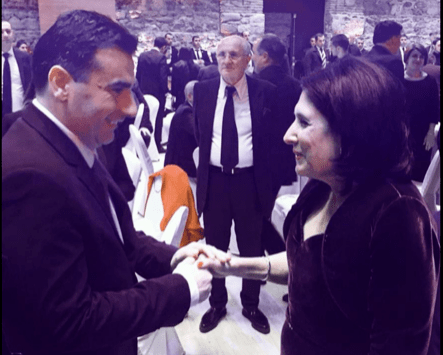
Prince Davit Bagrationi Mukrani and President Salome Zurabishvili – Picture by Georgian Royal House.
H.E. Ms. Fatou Bensouda, Procurator of the International Criminal Court, presented her Twenty-Eighth Report of the United Nations Security Council pursuant to UNSCR 1593 (2005) on the situation in Darfur. Here below a transcript of her speech.
“Over 13 years ago, on 31 March 2005, at a meeting also attended by the late United Nations Secretary General, Mr. Kofi Annan, members of this Council came together to adopt Resolution 1593. The Council considered that the situation in the Sudan constituted a threat to international peace and security, and decided to refer the situation in Darfur since 1 July 2002, to the Prosecutor of the International Criminal Court.
Following the adoption of Resolution 1593, members of this Council made statements that noted allegations of grave crimes, and highlighted the need to ensure accountability and justice in Darfur. The representative of Benin, for example, stressed the need to end the reign of impunity and to ensure credible and timely action against persons charged with atrocities and serious crimes.
Some members of the Council also emphasised that the Council’s support would be crucial to ensure an effective outcome to the referral of the Darfur situation to my Office.
Since the moment the Darfur situation was referred to my Office, we have consistently strived to establish the truth and to secure justice for victims, by pursuing accountability for alleged perpetrators of Rome Statute crimes in Darfur.
At the request of my Office, Pre-Trial Chambers of the Court have issued multiple arrest warrants in the Darfur situation, after independently assessing the evidence. Today, warrants remain outstanding for five persons, all of whom occupied positions of responsibility at the time of their alleged crimes, namely officials of the Government of the Republic of Sudan: Mr. Omar Al Bashir, Mr. Ahmad Harun and Mr. Abdel Hussein; militia leader Mr. Ali Kushayb, and rebel leader Mr. Abdallah Banda. Notably, several of these suspects continue to hold senior positions within the Government.
Combined, these arrest warrants include over sixty counts of war crimes and over fifty counts of crimes against humanity. The alleged crimes include extermination, murder, rape, forcible transfer and torture. These are the crimes that rightly preoccupied and concerned this Council resulting in the referral of the Darfur situation to my Office. Yet the alleged perpetrators of these crimes remain free, while the victims and affected communities continue to wait for justice.
My Office’s investigations in the Darfur situation continued during the current reporting period and significant progress was achieved. Notwithstanding the many challenges we face, my investigators remain dedicated to their mission and continue to identify leads and interview new witnesses each month. The body of evidence is increasing and my prosecution team continues to prepare in anticipation of the future arrest and surrender of any of the Darfur suspects.
My report notes the positive news that during the reporting period, levels of violence against civilians in Darfur continued to decrease. Nevertheless, the impunity that Resolution 1593 aimed to end continues in Darfur, and regrettably, so do the commission of serious crimes.
These ongoing crimes include attacks against personnel of the African Union-United Nations Hybrid Operation in Darfur. In its Resolution 2429 of 13 July earlier this year, this Council condemned the ongoing impunity for those who attack peacekeepers and urged the Government of Sudan to do its utmost to bring all perpetrators of such crimes to justice. Over 11 years after Mr. Banda’s alleged crimes against African Union peacekeepers, it is a serious indictment on all of us that crimes against peacekeeping personnel continue to be committed in Darfur.
Conflict also continues in the Jebel Marra area between forces of the Government of Sudan and the Sudan Liberation Army-Abdul Wahid. My report refers to information from UNAMID on the destruction of villages and the killing, injury and displacement of civilians. I continue to be deeply concerned by reports of sexual and gender-based violence against women and girls in Darfur.
In Resolution 2429, this Council expressed concern that UNAMID is unable to access areas from which it has withdrawn. I call on the Government of Sudan to respond affirmatively to this Council’s request for UNAMID to have unfettered access throughout Darfur, not least because of the vital role that UNAMID plays in monitoring and reporting violence against civilians in Darfur.
My analysts will continue to assess allegations of current crimes in Darfur. They do so, not for the purpose of simply monitoring and reporting on the findings of others, as some assert, but rather to ensure that my Office is aware of allegations of ongoing grave crimes committed in Darfur and to feed that information into our on-going assessment of the situation over which we are seized as well as our independent investigations. We will continue to make use of reports from reliable entities and sources operating in Darfur.
I do wish to emphasize that in direct contravention of Resolution 1593, the Government of Sudan continues its policy of antagonism and non-cooperation, in effect obstructing my Office’s ability to conduct on the ground investigations in Darfur. The Council is once again invited to urge the Government of Sudan to cooperate with my Office in accordance with its own Resolution.
I now turn to the issue of cooperation more broadly. Regrettably, as I outline in my latest report, my Office continues to face multiple obstacles and impediments in relation to this issue.
As regards the arrest and surrender of the Darfur suspects, this Council will recall the litigation before the Appeals Chamber in relation to Jordan’s failure to arrest and surrender Mr. Al Bashir to the Court, when he visited Jordan on 29 March 2017. Pre-Trial Chamber II found that Jordan had failed to comply with its obligations under the Statute and decided to refer Jordan to the Assembly of States Parties and this Council.
As this Council is aware, Jordan appealed that decision, and this resulted in extensive litigation during the reporting period. This involved multiple written briefs, and culminated in a five day hearing before the Court’s Appeals Chamber from the 10th to the 14th of September earlier this year. The issues focused on head of state immunity, Resolution 1593, and articles of the Rome Statute relating to cooperation, consultations with the Court and waiver of immunity. In the course of this process, multiple legal submissions were made, including by Jordan, the African Union, the League of Arab States, professors of international law, and of course, my Office.
This comprehensive and inclusive legal process has now concluded, and we await a final determination by the Appeals Chamber.
During the reporting period, Mr. Al Bashir continued to travel internationally, including to Djibouti and Uganda in July. Both of these States Parties were previously referred to the Assembly of States Parties, and this Council, for their failure to arrest and surrender Mr. Al Bashir to the Court while on previous trips to their territory in 2016. No action was taken by the Council in relation to those, or indeed any other referrals. It is therefore not surprising that States Parties to the Rome Statute, such as Djibouti and Uganda, continue to host ICC suspects on their territory, in blatant violation of Court findings. In the absence of any meaningful consequences for such instances of non-compliance, we are unlikely to see a change in such regrettable patterns. This status quo is hardly conducive to advancing the cause of justice in Darfur.
My Office, yet again, calls on this Council to take meaningful action to give effect to non-compliance referrals by the Court.
My Office took note of the 9th of July Declaration by the High Representative of the European Union that called on all United Nations Member States to abide by and implement the resolutions adopted by this Council, notably Resolution 1593.
I remain grateful for the principled support of members of this Council, international and regional organisations, and indeed, all States who support my Office’s work in the Darfur situation.
In this regard, I was particularly encouraged by the recent 6th of July Arria-formula meeting convened on the relationship between the Court and Council. This timely meeting was helpfully co-sponsored and organised by ICC States Parties on this Council, and I take this opportunity to once again express my appreciation to them for the initiative. The session provided a unique opportunity for the President of the Assembly of States Parties, Council members, State representatives, civil society, and my Office, among others, to exchange views on how to further enhance coordination and synergies between the Council and the Court.
Notably, numerous participants at that meeting expressed concern at the Council’s failure to act in instances where a State is referred to the Council, pursuant to a finding of non-compliance by the Court. Several participants proposed concrete, entirely workable measures that this Council could adopt. I remain hopeful that the constructive dialogue and proposals at that meeting will provide further momentum resulting in concrete action being taken by the Council on this issue.
As we are all aware, in Resolution 1593, this Council decided that the Government of Sudan and all other parties to the conflict in Darfur shall cooperate fully with and provide any necessary assistance to the Court and my Office. Yet the Government of Sudan continues to completely disregard the Council’s demand for such cooperation.
On the occasion of my last report to this Council, I repeated my offer to the Government of Sudan to engage in dialogue in relation to the situation in Darfur, including with respect to the issue of surrender of the Darfur suspects to the Court. I also note that this Council, in Resolution 2429, urged the Government of Sudan to “consolidate and expand its efforts to end impunity.”
Yet despite my offer, and despite the representative of the Sudan previously asserting to this Council that combating impunity is a top priority, the Government of Sudan has not engaged with my Office. I also note that during the proceedings initiated by Jordan, the Appeals Chamber invited Sudan and Mr. Al Bashir to file submissions on the issues raised by the appeal. Yet they chose not to engage with the Court.
The Rome Statute requires my Office to investigate incriminating and exonerating circumstances equally. If the Government of Sudan has such evidence, both incriminating and exonerating, I invite it to come forward and share that evidence with my Office. The Government of Sudan can rest assured that the due process rights of any suspects that appear before the Court will be fully respected. These include the right to counsel of their choice and more importantly, the right to a fair, independent and impartial trial.
You will recall that at my last briefing to this Council on the Darfur situation, the representative of Bolivia asked for a report on activities undertaken by the Court to promote the strengthening of judicial organs in Sudan. Consistent with Resolution 1593 and in accordance with the principle of complementarity, my Office is prepared to support national efforts to combat impunity in Darfur, to the extent that my mandate and limited financial resources will permit. However, in the absence of any cooperation from Sudan, I regret I am unable to report any progress in this regard.
The Government of Sudan can and must demonstrate its stated commitment to ending impunity, and its respect for the authority of this Council, by opening a new chapter of cooperation with my Office. It should allow my staff to conduct investigations on the ground in Darfur, and facilitate access to victims, witnesses and relevant documentary evidence. I again invite the Government of Sudan to work with my Office to pursue justice for the victims of the unimaginable atrocities that have occurred in Darfur.
I will conclude by recalling another statement made by a Security Council member at the time that the Council passed Resolution 1593, and I quote: “What the Council said today is there is no way, in our times, that anyone, anywhere in the world, can get away without just retribution for the commission of serious crimes.”
Regrettably, justice and accountability for Rome Statute crimes for now remain unrealised aims in the Darfur situation. This is undeniably an unacceptable situation which must not be permitted to continue. Justice delayed is justice denied. The judgment of victims and the critical eyes of history are upon us.
————-
Fatou Bensouda, photography by ICC
On the picture H.E. Mr. Alexander V. Shulgin, Ambassador of the Russian Federation to the Netherlands .By Elena Ratnikova.
With the participation of the Russian Embassy in The Hague, the Russian community has successfully organized the 12th conference “Council of the Russian Community in the Netherlands”, which took place at the Crown Plaza Hotel in The Hague on December 2nd.
H.E. Mr. Alexander V. Shulgin, Ambassador of the Russian Federation to the Netherlands and Permanent Representative to the Organization for the Prohibition of Chemical Weapons addressed an official opening speech. He extended his gratitude to the attendees, representatives from every sector of the Russian diaspora in the Netherlands, filling up the room at its full capacity.
Ambassador Shulgin talked about the importance for his community to share the Russian language and culture, to establish new business partnerships and support the efforts of the Russian Orthodox Church in the Netherlands. He also presented a certificate of merit to several members of the community.
Diplomat Magazine´s Publisher Dr. Mayelinne de Lara, took the floor to congratulate the Russian community and ambassador Shulgin for the very well attended and positive results of the Conference.
Mr. Andrei Makarov, Russian Trade Representative.
Mr. Andrei Makarov, Russian Trade Representative in the Netherlands who provides a communication platform to develop business interaction with his country, introduced his theme with very interesting figures. It was mentioned that the Netherlands is Russia´s third world trade partner, as well as the second investor in the Russian economy.
Vera Bunina, director of the Russian Center for Science and Culture of Belgium invited the guests to visit the programs “New Generation”, “Leaders of Russia” and “Russia Study”.
The head of Council of the Russian community in the Netherlands, Kristina von Schmid, presented a report on the work of the Council during the last two years.
The Very Reverend Archimandrite Nikon talked about the important role of the Russian Orthodox Church in the Netherlands. Russian language teacher at The Hague University of Applied Sciences Mrs Julia Essenberg referred about the facilities offered by her institution to learn Russian. During the pause-café, the String Quartet named after S.V. Rachmaninov from Sochi performed wonderful classical music.
The First Secretary of the Embassy of the Russian Federation in the Netherlands Yuri Uraksin, presented an overview of the embassy´s events and extended his gratitude to the attendees, participants and coordinators, especially to artists, musicians, painters, young students and many other people involved.
Russian String Quartet S.V. Rachmaninov.
Members of the Russian Community directly expressed to Diplomat Magazine on the importance of organizing such events, “it enhances the unity of our community, promotes positive relations with the Russian Embassy and the protection of the Russian culture at the international level.”
By Roy Lie A Tjam.
The Hague, 7 December 2018, the Embassy of the Republic of Indonesia, under the acumen leadership of Ambassador H.E. Mr. I Gusti Agung Wesaka Puja, organized a Fashion Show aimed at promoting yet another aspect of the Indonesian culture, Fashion!
For additional Marian van Noort’s pictures, please open the following link: https://www.flickr.com/photos/109407424@N02/albums/72157704650377204In his welcome remarks, Ambassador Puja expressed his thanks to everyone for attending the eventful evening.
He also mentioned the Indonesian wastraadati or authentic Indonesian textile, its special quality.
The event’s activities were divided into 3 parts. One was the Fashion Show which showcased a mixture between modern and traditional Indonesian outfits. Second, was the talk show and the last was the dinner-buffet followed by a bazaar; an opportunity to visit the stalls and purchase, fashion, shoes, handbags scarfs and much more directly from the designers.
Indonesian designers at Indonesia Fashion Show December 2018.
The event was well appreciated by the guests, especially the beautiful way it was organized as well as on the deliciousness of the dinner buffet.
The event also reflected the efforts of the Indonesian Embassy in The Hague in trying to assist Indonesian entrepreneurs to enter the Dutch and European market.
Designers’ panel, Indonesia Fashion show.
You call it The Modest Heritage of Indonesia? By all means, it has been a fantastic exposure to what Indonesia has to offer when it comes to fashion and the like,
The Hague, 13 December 2018, Crowne Plaza Hotel, opening night of the Hungarian Flavors food festival. Welcome to the Hungarian edition of the food festival. Featuring Chef Janos Klimaj from Hungary along with Chef Sido de Brabander, Restaurant Brut.
The two chefs have prepared original Hungarian flavors. Apart from the Hungarian Food festival, there was also a well attended Hungarian wine tasting event in an adjacent room. The many guests were welcomed by a live Cimbalom performance by the skilled Hungarian cimbalom player Mr. Sandor Radics. He played Hungarian and International tunes, which definitely contributed to the excellent atmosphere that reigned at the Hungarian evening. The cimbalom (Kannun) goes back as far as 720 A.D.
The representative of the Hungarian Embassy in The Hague, Deputy Head of Mission, Dr. Krisztina Varga Msaa, mingle with the guests and made sure all had a great evening.
Zooming into the menu, one could spot mouth-watering dishes such as: Fustolt Sonka, Fustolt Bekesi Kolbasz; Rakott Krumpli, Toltottkaposzta, Halaszle; Vargabeles, Makosguba and much more. Hungarian flavor is the last in a series of the culinary projects co-organized by an Embassy, Hotel Crowne Plaza and Diplomat magazine. The organizers envisage a perpetuation of the successful project in 2019.
The Ambassador of the Republic of Panama, H.E. Mr. Willys Delvalle.By Roy Lie Atjam.
The Hague, 13 November 2018. The Ambassador of the Republic of Panama, H.E. Mr. Willys Delvalle and Mrs. Tatiana Delvalle, invited fellow Heads of Mission, members of the business community, Dutch government representatives, members of the International institutions and various others to the Marriott Hotel on the occasion of Panama’s 115th year of Independence.
Panama’s National Day 2018.
In his welcome speech, Ambassador Willys Delvalle welcomes one and all on behalf of the President of Panama, Juan Carlos Varela, to the celebration of the 115th years of the Republic of Panama. Special thanks to the Netherlands for being such a wonderful host and to all those who have contributed to the longstanding friendship between the nations of Panama and the Netherlands. An extract of Ambassador Willys Delvalle ‘s discourse is hereto attached:
“During the last years, Panama has made great efforts to fulfil the 2030 Global Development Agenda, we are completely committed to building a better country and improve the quality of life for our citizens, and this needs to be done both locally as well globally.
Ambassador Delvalle and Mrs. Tatiana Delvalle.
In this regard, the Government of Panama is heavily investing to make the most of its national programs aligned with the Sustainable Development Goals. Many initiatives have been created towards achieving these goals. New alliances with different stakeholders are ongoing, creating opportunities in areas such as housing, preventive health, innovation, infrastructure, training for small and medium-sized enterprises, among many others.
Recently our President approved the Law that creates the Permanent Multisector Council on Education, an advisory board for the implementation of the National Commitments to improve education at all levels. Education, as all of you know, is a critical area for any country to improve the quality of their people.
The Ambassador of Panama with the embassy staff.
We have reached historical progress in terms of Gender Equality; with the approval of the Law that establishes a 30% participation of women in public institution boards, we adopted the UN Gender Equality Seal for Public and Private Organizations as well as Panama was the first Latin American country to join the Equal Pay International Coalition, last summer.
Furthermore, our Government recently launched the National Council for Gender Parity, aiming to coordinate and generate synergies among all the actors of society, public and private sectors and non-governmental organizations, all of them working together, enforcing and committing with open spaces for gender equality.
Panama’s National Dress, La Pollera.
I’m also pleased to announce that we are part of the International Gender Champions – The Hague Hub as a way to join efforts and actors from this city.
Now as a country what else do we have to offer the world?
Well, Panama is committed to the mission that our geographical position has given us, therefore we are continuously working to strengthen the Great Connection, a global hub for people, commerce and connectivity and a key destination for business and investment.
So, what does The Great Connection mean:
Best active ports in Latin America in 2017: For several years now, Panama has led the region on container moves in the Atlantic coast and the third most active in the Pacific coast.
Air Connectivity: With more than 132,000 direct flights annually to 90 destinations in 35 countries. Tocumen International Airport is the best connected of Latin America, establishing direct connections to all the major cities and capitals on the continent, reaching Europe and beyond, and moving more than 15 million passengers last year. The New Terminal will be open in January 2019, which will add a capacity for another 10 million passengers and this new terminal will also have the first multimodal logistics zone in Latin America, allowing not only faster movement of visitors and cargo but also providing value-added services to improve world trade.
Multinational Headquarters Hub: more than 140 companies have chosen Panama to carry out operations or services for their Main Offices, subsidiary or affiliate in other countries. These headquarters have invested more than 800 million American dollars.
Broad tourism destinations in Panama: In 2017 the international tourist arrivals had a total of 2,5 million visitors(5.8%), this represented a touristic income of $ 6.8 billion. Infrastructure all over the country, highways, new bridges over the Canal, construction and expansion of the metro lines, mega ports, etc.
The Great Connection also means, Panama Canal. Some recent facts of the Panama Canal show the progress made as:
The Panama Canal closed its 2018 fiscal year (FY 2018) with a record tonnage of 442.1 million Panama Canal tons (PC/UMS), which represents a 9.5 percent increase from the previous year.
This means that the Panama Canal continues to exceed our expectations, creating new routes for new markets and new commodities, reinforcing every day the importance of the waterway’s expansion on the global maritime trade.
Likewise, its expected to receive approximately 234 cruise ships through the Panamax and Neopanamax Locks during the upcoming 2018-2019 cruise season.
Through this route 14,000 vessels move around per year, which accounts for roughly 6% of world trade and generates revenues for more than 3 billion dollars a year.
To enhance the Great Connection, we are facing a new challenge, the Agro Logistic Hub. Creating and exploring new processes for value-added agricultural products. And our friends in the Netherlands are a key for the success of this new development area.
Our projections towards the future lead us to consolidate alliances, for this reason, every day we are strengthening the excellent relations with the Kingdom of the Netherlands. The high level of bilateral relations allowed for a successful visit by President Juan Carlos Varela to the Netherlands early this year.
As a result, the leaders agreed to broaden the work agendas and establish cooperation in the areas of agro-logistic, connectivity and water management. In order to learn more from local good practices, Panama recently opened the First Agro-business Office for Europe based in Rotterdam, with a strategic purpose: promote our national high-quality seal of our products” Panama Exporta”.
Panama and the Caribbean.
Panamastands ready for closer cooperation with CARICOM
The Caribbean Community (CARICOM) on Thursday 13 September 2018 formalised diplomatic ties with Panama, accrediting the first Ambassador of the Central American country to the Community.
According to the recently accredited first envoy of Panama to CARICOM, H.E.Ms. Soraya Cano Franco, Panama’s policies have facilitated the growth of the economy and have allowed the country to, among other things, “evolve from being a receiving cooperation country to a cooperation provider country”
We want to thank all of you, we deeply appreciate and are honored to be able to celebrate our 115th anniversary. ¡VIVA PANAMÁ!”.
Wonderful Panamanian food, served at Marriot.
The celebration continued with the sampling of typical Panamanian dishes such as: Appetizer: Empanadas de queso (fried corn pastry filled with white cheese) RopaVieja (beef stew with vegetables)
Arroz con guandúl (rice with guandúl beans).
Plátanos en tentación (caramelized ripe plantain with cinnamon).
It has been a fabulous Panamanian evening.
Founder and head of “Georgian Culture Center in the Netherlands”, Mrs. Tika Svanidze-vancko and H.E. Mr. Konstantine Surguladze, Ambassador of Georgia.
On November 26, 2018, a farewell reception of the Ambassador of Georgia to the Kingdom of the Netherlands, H.E. Mr. KonstantineSurguladze and his spouse Mrs. Nino Rusadze was held at the Embassy of Georgia. As from December 1, Ambassador’s mission to the Kingdom of the Netherlands comes to an end.
The reception started with the farewell speech by the Ambassador of Georgia. His Excellency thanked guests for attending the reception. In his speech Ambassador summarized the bilateral relations between Georgia, the Netherlands and the EU.
“During my tenure, the Netherlands ratified EU-Georgia Association Agreement including Deep and Comprehensive Free Trade Area (DCFTA), which entered into force on July 2016.
Since March 2017, Georgian citizens have benefitted from visa free travel to the Schengen area and the Netherlands contributed to this achievement. The EU is Georgia’s largest trading partner and provides over €100 million to Georgia annually in technical and financial assistance.
Mrs. Tika Svanidze-vancko and the ambassador’ spouse Mrs. Nino Rusadze with one of their kids.
I am very pleased that during these challenging and very important times, when everybody in my country worked hard to achieve this very important milestone, I had an honor to represent Georgia to the Netherlands and contributed to the historical achievement of my country. I would like to use this opportunity to thank the Dutch government and Dutch people for every support provided to my country and for being good and reliable friends of Georgia”- said H.E. Konstantine Surguladze.
On that day the Embassy had a very special guests, Amber and Tim Storimans, children of Stan Storimans Dutch TV “RTL” cameraman, who was killed during the Russian largescale military intervention in August 2008. An Iskander rocket exploded in Gori’s central square on 12 August 2008, killing a Dutch journalist, Stan Storimans and other civilians.
On August 7, 2018 President of Georgia, H.E. Mr. Giorgi Margvelashvili awarded Stan Storimans with the Order of Honor for his bravery and self-sacrifice. Ambassador of Georgia bestowed the Order of Honor to the children of Stan Storimans.
During the farewell reception the Ambassador thanked Georgian Diaspora organizations representatives for their important contribution to promote Georgia.
H.E. Mr. Konstantine Surguladze with awarded members of the Georgian community of the Netherlands.
“The Georgian community in the Netherlands is a significant contributor not only to the development of this country but also to the Netherlands ties with Georgia. I have enjoyed friendship and support from many members of the Georgian community here”- said Ambassador and awarded with the Certificates of Appreciation for their invaluable effort to promote Georgia to the founder and head of “Georgian Culture Center in the Netherlands”, Mrs. Tika Svanidze-vancko; Counsellor of “Georgian Culture Center in the Netherlands”, Mrs. Lali Butbaia; founder and head of foundations “EuroArt” and “ArtEco”, Mrs. Dali Ubilava de Graaf; Head of association “Bagrationi”, Mrs. Maia Aduashvili; Head of Georgian Diaspora organization, Mrs. Natalia Tchaduneli; and head of association “Georgian House”, Mr. Archil Djavakhadze. Also Ambassador thanked teachers of Amsterdam Sunday School and awarded with the Certificates of Appreciation for their invaluable effort Mrs. Neli Svanidze and Mrs. Khatuna Kavteladze.
The farewell reception was attended by the representatives from the Netherlands government, business sector, education, culture, media and Georgian Diaspora representatives. The guests had the opportunity to taste Georgian wine offered by the company Ghvino.nl
———–
Photography by the Embassy of Georgia.
H.E. Ms. Eksiri Pintaruchi, Ambassador of the Kingdom of Thailand and H.E. Mr. Philippe Couvreur, Registrar Court International de Justice.By Roy Lie Atjam.
H.E. Ms. Eksiri Pintaruchi Ambassador of the Kingdom of Thailand in the Netherlands, held a reception to celebrate Thailand’s National Day, Birthday Anniversary of His Majesty the late King Bhumibol Adulyadej (King Rama IX) and the Father’s Day of Thailand, on 5th December 2018.
The celebration started with the playing of the national anthem of the two Kingdoms. This was done by Ms. Erika Ngarmcroh (2005) from Bangkok Thailand, a very talented young lady. At the age of four, she began to study violin with Ms. Omporn Kowintha, her Suzuki violin teacher.
Mrs. Midori Inomata, Mr. Thongvut Pintaruchi, Ambassador Pintaruchi and the Ambassador of Japan, H.E. Mr. Hiroshi Inomata.
Erika public performance was when she was at five, playing Bach Concerto for Two Violins (2nd violin) In 2015, recommended by David Abrahamyan, she joined Prof. Boris Belkin’s masterclass in Siena, Italy; thereafter enrolled in the Young Talent classes at Conservatorium Maastricht and became Prof. Belkin’s student.
Ms. Erika Ngarmcroh.
Thailand towards enhanced partnerships with the Netherlands
Ambassador Eksiri Pintaruchi in her welcome remarks stressed the depth of bilateral relations between Thailand and the Netherlands which started off since the early 17th Century.
In 2019 the 415th Anniversary of their diplomatic relations will be celebrated. Relations on various fronts between the two countries have flourished ever since and remains robust.
Around 200,000 tourists from the Netherlands visit Thailand annually. As for investments, over 300 Dutch companies have invested in Thailand, making the Netherlands the largest investor amongst EU countries in Thailand.
This reflecs growing dynamics between the countries. A second speaker at the reception was Mr. Peter Potman, Director Dutch MFA, Department Asia & Oceania.
Mr. Peter Potman, Director Dutch MFA, Department Asia & Oceania.
The festivities, which took place at the Hotel Marriott The Hague, was attended by a number of heads of diplomatic missions, director of departments of the Ministry of Foreign Affairs, business community and many well wishers.
All enjoyed an evening replete with Thai hospitality.
Mr. Thongvut Pintaruchi, H.E. Mr. Amgad Ghaffar, Ambassador of Egypt and Ambassador Pintaruchi.Photography is a courtesy of the Royal Thai Embassy in The Hague.