

By Eleni Vasiliki Bampaliouta
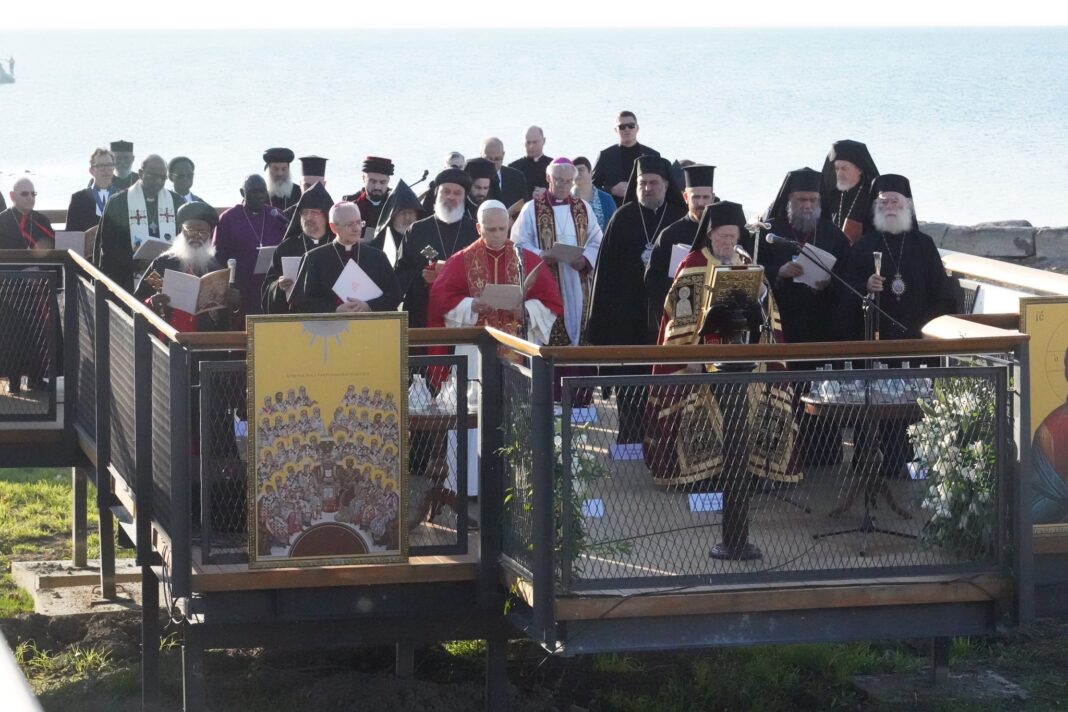
In a moment of profound historical and spiritual significance, Ecumenical Patriarch Bartholomeos and Pope Leo commemorated the 1,700th anniversary of the First Ecumenical Council at the archaeological site where the Basilica of Saint Neophytos once stood. It was there, in 325 AD, that Emperor Constantine the Great convened the First Ecumenical Council of Nicaea, seeking to resolve the major theological disputes of the early Christian world.
For the first time in the history of Christianity, the anniversary was commemorated jointly at the very site of its origin. The image of unity conveyed by the leaders of the Orthodox and Roman Catholic Churches—despite centuries of division—sent a powerful message that faith can serve as a spiritual compass in turbulent and uncertain times.
Pope Leo XIV visited the Ecumenical Patriarchate on 28 November, marking his first apostolic journey since his election. The visit was imbued with strong symbolism for Christian unity and peace at a time when global tensions and conflicts continue to escalate.
The Pope was welcomed at the entrance of the Patriarchal Church of Saint George in the Phanar by Ecumenical Patriarch Bartholomeos. The two primates lit candles together and venerated the holy icons before a Doxology was sung in the church.
Together, the two Christian leaders honoured the 1,700th anniversary of the First Ecumenical Council, offering joint prayers for inter-Christian unity—an objective they have consistently highlighted through public statements and initiatives.
Among those present were Patriarch Theodore of Alexandria; hierarchs of the Churches of Constantinople and Rome; the Undersecretary of State of the United States, Michael Rigas; the Head of Religious Diplomacy of the European Union, Konstantinos Alexandris; and representatives of diplomatic missions. During the Doxology, prayers for peace were offered in several languages, and the two primates recited the “Our Father” together in Latin.
A long-standing invitation fulfilled
Ecumenical Patriarch Bartholomeos had first extended an invitation in 2014 to the late Pope Francis to jointly commemorate the 1,700th anniversary of the First Ecumenical Council. The original plan was for the visit to Nicaea to take place near Easter, when Catholic and Orthodox Easter coincided this year. However, the deterioration of Pope Francis’s health and his subsequent passing prevented the celebration from taking place in May.
The invitation was renewed during Pope Leo’s enthronement, and his positive response sent a clear signal of his commitment to continuing theological dialogue, fostering convergence and pursuing the long-standing goal of restoring Christian unity.
Bartholomeos to Pope Leo: A call to strengthen unity
During the Doxology at the Patriarchal Church of Saint George, Ecumenical Patriarch Bartholomeos underscored the need to strengthen unity between the Churches and to continue dialogue “with truth and love”. He described the moment as “important for the unified voice of the Church” and paid tribute to Pope Leo’s predecessors, Benedict XVI and Francis, calling them “exceptional” and noting that each, “with his own charisma”, contributed decisively to rapprochement.
Referring to the unfulfilled pilgrimage with Pope Francis, the Patriarch remarked that “the promise was fulfilled yesterday by the two of us”. He added that Pope Leo’s decision to make his first journey outside Italy to Nicaea would “bless his ministry”, as it took place “where the foundations of our faith were laid”.
Drawing on Orthodox liturgical tradition, the Patriarch explained that before participating in the Holy Eucharist, the priest receives Christ’s blessing. “In this spirit,” he said, “you receive the blessing we call ‘time’, strengthening your ministry in this sacred place.”
Emphasising the shared responsibility of the two Churches, Patriarch Bartholomeos stressed the urgent need “to preserve the spirit and unity of peace”, noting that unity is “more necessary than ever”. He concluded by expressing his “great joy” at welcoming the Pope “as a brother” and reaffirmed their joint commitment to peace and reconciliation worldwide.
Pope Leo: “I was deeply moved to follow in the footsteps of my predecessors”
In his remarks, Pope Leo conveyed a message of unity and determination to continue the dialogue between the Churches. He expressed his “deep gratitude” for the warm welcome and spoke of the emotion he felt upon entering the Patriarchal Church, where he said he was “walking in the footsteps of Paul VI, Saint John Paul II and, of course, my predecessor Pope Francis”.
The Pontiff noted that he had personally met some of his predecessors and shared with them a “common vision” on key ecclesiastical issues. He also recalled the bonds of friendship forged during Patriarch Bartholomeos’s first visit to Rome, particularly during the Eucharistic celebration.
Reflecting on the joint commemoration, Pope Leo said that “we experienced moments of grace” during the celebration of the First Ecumenical Council’s anniversary, an event that recalls “Christ’s prayer that all His followers may be one”. He reaffirmed that this journey toward unity would continue “with firm commitment”.
The Pope also referred to the Feast of the Apostle Andrew, noting that during the evening prayer, special emphasis was placed on the unity of the Churches—a prayer, he said, that “will be repeated again tomorrow morning”. He concluded by thanking the Patriarchate for its hospitality and extending his best wishes on the occasion of the feast.
First papal visit to Turkey since enthronement
Following his arrival in Turkey, Pope Leo visited the mausoleum of Mustafa Kemal Atatürk, where he paid tribute, before proceeding to the Presidential Palace for a meeting with President Recep Tayyip Erdoğan. This marked the first papal visit to Turkey since 1967.
The Pope was welcomed at the airport by members of the Turkish government, while President Erdoğan received him at the Presidential Palace with the honours accorded to a head of state. Their meeting lasted approximately half an hour, with Ecumenical Patriarch Bartholomeos also present at the reception ceremony.
“We are living in a period marked by an increase in conflicts worldwide, driven by the strategies of economic and military powers—what Pope Francis described as a fragmented Third World War,” Pope Leo said in his address.
President Erdoğan noted that the visit took place at a critical moment in regional and global affairs, expressing hope that it would contribute positively to humanity at a time of accelerating uncertainty and escalating tensions from Asia and Africa to Latin America and Eastern Europe.