

The Legacy of José Gustavo Guerrero and the New Era of Salvadoran Diplomacy
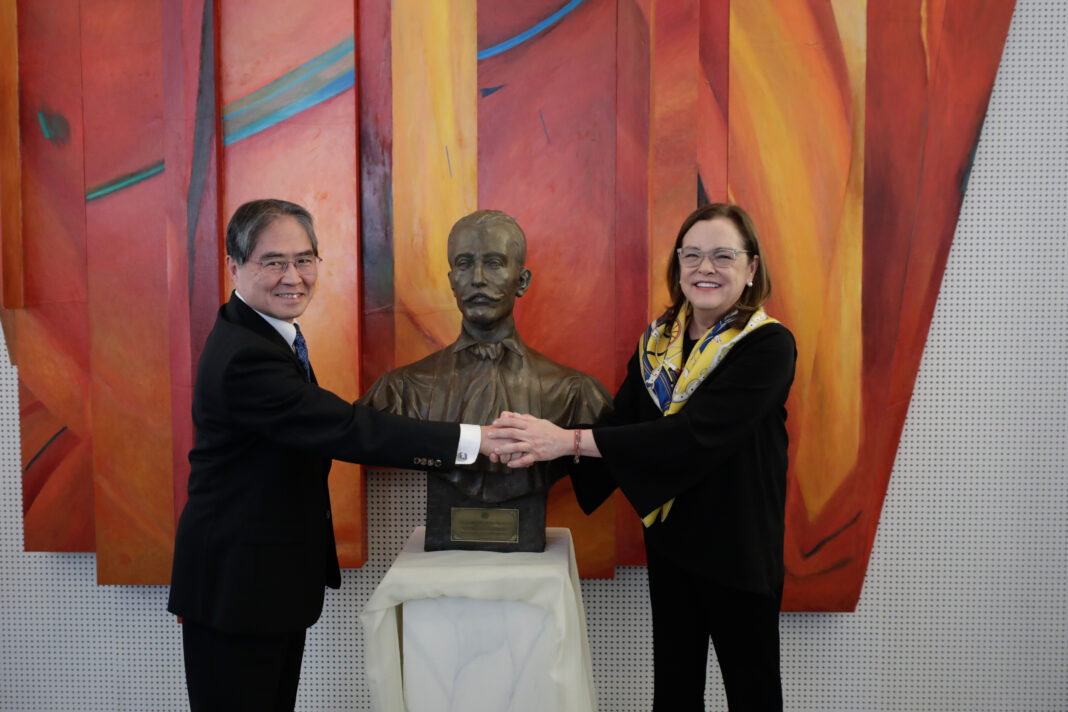
At the historic Peace Palace in The Hague, home of the International Court of Justice (ICJ), a distinguished ceremony paid tribute to one of the most remarkable figures in the history of international law. In the presence of H.E. Judge Yuji Iwasawa, President of the International Court of Justice, and H.E. Agustín Vázquez Gómez, Ambassador of the Republic of El Salvador to the Kingdom of the Netherlands, a bust of Dr. José Gustavo Guerrero (1876–1958), the first President of the International Court of Justice, was unveiled in permanent recognition of his extraordinary contribution to international justice.
The bust, donated by the Government of El Salvador, honours a jurist whose influence transcended national borders and whose work helped shape the foundations of modern international law. Yet the ceremony was also a deep focus of contemporary El Salvador and of the diplomatic vision currently being advanced by the country’s Minister of Foreign Affairs, H.E. Alexandra Hill Tinoco.
Minister Hill Tinoco travelled to The Hague to participate personally in the tribute, underlining the importance her government places on preserving and shaping the country’s diplomatic heritage. For El Salvador, José Gustavo Guerrero represents far more than a distinguished historical figure. He symbolizes the ability of a small nation to contribute decisively to the international legal order.
“He elevated the Foreign Ministry to the highest levels of international law in El Salvador. He was the first President of the International Court of Justice and positioned El Salvador within the global legal elite. His legacy lies in being the Foreign Minister with the greatest international impact in the country’s history,” Minister Hill Tinoco remarked during the ceremony.
The tribute also highlighted a broader diplomatic transformation underway in El Salvador. Under the leadership of President Nayib Bukele and Foreign Minister Alexandra Hill Tinoco, the country has embarked on a more assertive international strategy aimed at strengthening its global presence and redefining how El Salvador is perceived abroad.

For decades, Salvadoran foreign policy was characterized by caution and discretion. While it fulfilled its multilateral responsibilities and maintained constructive international relations, it rarely sought to shape international debates or project a distinctive national narrative. Today, that approach has evolved.
Hill Tinoco has overseen an active diplomatic agenda across the United Nations, the European Union, the United States, the Middle East, and Asia. Her foreign policy priorities have focused on strengthening relations with strategic partners, promoting investment and economic opportunities, engaging the Salvadoran diaspora, and advancing a more visible international profile for the country.
In many respects, the Minister’s diplomatic vision echoes the example established by José Gustavo Guerrero more than half a century ago. Guerrero demonstrated that intellectual leadership, legal excellence, and principled diplomacy could elevate El Salvador onto the world stage. Today’s foreign policy seeks to build upon that legacy by ensuring that the country participates actively in shaping international discussions rather than merely observing them.
This transformation can be observed through several dimensions. First, El Salvador has sought to recover and strengthen its diplomatic voice. The country increasingly presents its own perspectives on issues such as security, governance, and development, responding directly to international debates and criticism with a clearly articulated national position.
Second, Salvadoran diplomacy has embraced strategic diversification. Traditional partnerships remain important, but engagement has expanded significantly across new regions, particularly in Asia and the Middle East, reflecting a pragmatic approach aimed at attracting investment, fostering technological cooperation, and broadening economic opportunities.
Third, the government has recognized the growing importance of international perception. In a world where narratives influence political and economic outcomes, diplomacy increasingly involves communicating national achievements and defending national interests in the global information environment.
Such a visible foreign policy inevitably attracts scrutiny and debate. Yet it also reflects a country that is increasingly determined to define itself on its own terms. As Minister Hill Tinoco has demonstrated throughout her tenure, international relevance requires both engagement and confidence.

During the ceremony, Ambassador Agustín Vázquez Gómez emphasized that the initiative to honour Judge Guerrero became possible thanks to the commitment and vision of the Minister of Foreign Affairs.
“Gracias a la visión y determinación de la Canciller Hill, este homenaje al Juez José Gustavo Guerrero ha sido posible. Su decidido impulso personal y su visita al Palacio de la Paz en septiembre de 2024 marcaron el inicio de este acto de memoria y reconocimiento histórico.”
The Ambassador further highlighted Guerrero’s universal legacy, describing him as a statesman who successfully combined scholarship with action, patriotism with multilateralism, and firmness with empathy.
Addressing the audience, Ambassador Vázquez Gómez reaffirmed El Salvador’s commitment to the principles that guided Guerrero throughout his distinguished career.
“We want future generations of judges, lawyers, diplomats and visitors who walk through these halls to see in the face of José Gustavo Guerrero not only the image of a great jurist, but also a reflection of the values for which he fought tirelessly. Today, from El Salvador, we reaffirm our commitment to the Charter of the United Nations and to the defence of international law as a foundation of the global order.”
The ceremony concluded as both a tribute to the past and a statement about the future. The permanent presence of José Gustavo Guerrero’s bust within the Peace Palace serves as a reminder of El Salvador’s enduring contribution to international justice. At the same time, it reflects the aspirations of a nation that, under the leadership of Alexandra Hill Tinoco, seeks to project its voice, strengthen its influence, and play an increasingly active role in international affairs.
In many ways, the connection between Guerrero and Hill Tinoco is symbolic of El Salvador’s diplomatic journey: a country whose historical achievements continue to inspire a modern foreign policy built on visibility, engagement, and strategic ambition. As El Salvador navigates an increasingly complex international landscape, the challenge will be to sustain that voice with consistency, results, and vision. The unveiling at the Peace Palace suggests that the country intends to do precisely that.