

By Eleni Vasiliki Bampaliouta
The cultural diplomacy between Greece and China is entering a new phase of deepening engagement and institutional maturity, as reflected in the convening of the 2nd World Conference on Classical Studies in Athens. This high-profile academic and symbolic meeting reaffirms that culture remains a timeless field of dialogue, cooperation, and mutual understanding between two of the world’s oldest civilizations.
Within this context, the strengthening of Greece–China cultural diplomacy emerges as a strategically significant axis of convergence, extending beyond historical reference and evolving into a living instrument of contemporary international cooperation. Through the joint study of classical thought and the exchange of scholarly and cultural expertise, a stable framework of intercultural dialogue is being shaped with a clear orientation toward the future.
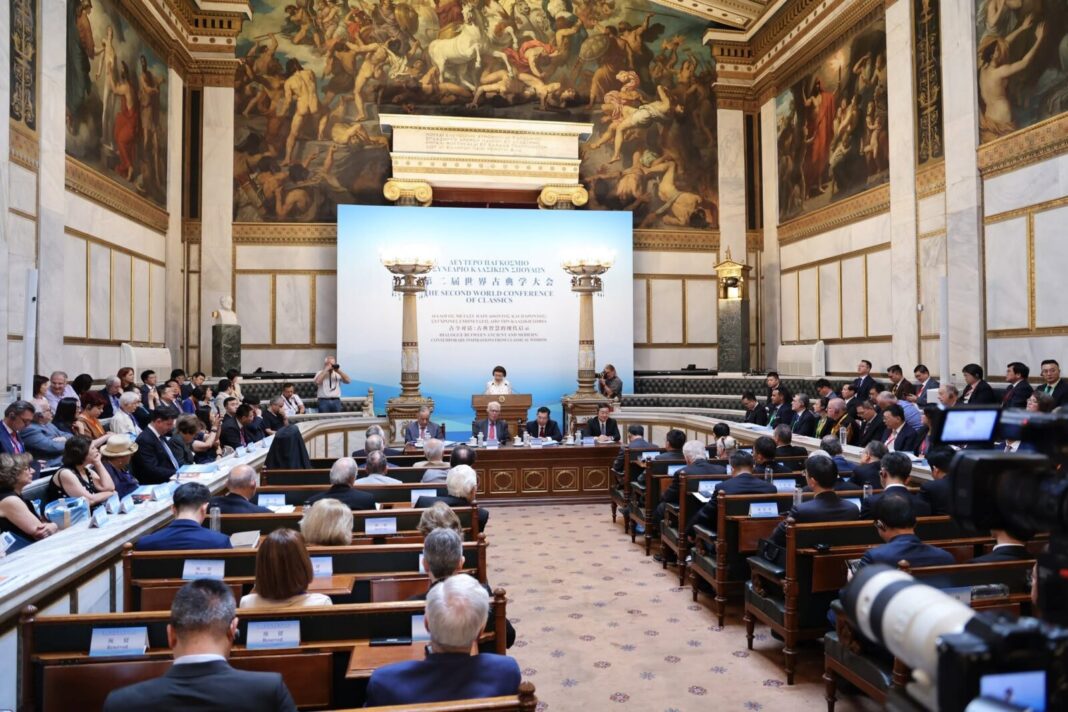
Athens stood at the center of international academic and cultural attention on the occasion of the 2nd World Conference on Classical Studies, reaffirming its enduring role as the cradle of philosophical thought and the democratic tradition.
The Conference was co-organized by the Academy of Athens and the Chinese Academy of Social Sciences (CASS), under the theme “Dialogue between Ancient and Modern: Contemporary Inspirations from Classical Wisdom.” The choice of Athens as the host city carried particular symbolic significance, highlighting the enduring value of classical heritage as a shared reference point for the global intellectual tradition.
The opening session was inaugurated by the Minister of Culture, Ms. Lina Mendoni, who underscored the strategic character of Greece–China cooperation in the cultural domain. As she noted, the partnership between leading academic institutions of both countries demonstrates that classical studies have evolved into a truly global field of scholarly dialogue and cultural exchange.
She further emphasized that classical civilization is not merely an object of historical study, but a lasting source of values and reflection with direct relevance to contemporary global challenges. In this context, she stressed that classical studies constitute a strategically important investment in the future, particularly in an era of rapid technological and social transformation.
Special reference was made to the challenges arising from artificial intelligence, biotechnology, the climate crisis, and geopolitical developments. These issues, she noted, bring to the forefront fundamental philosophical questions concerning the limits of knowledge, the relationship between ethics and progress, and the balance between individual and collective interest.
In this regard, the enduring contribution of the Greek philosophical tradition was highlighted, with references to Socrates, Plato, and Aristotle, as well as to Chinese philosophical thought through figures such as Confucius and Laozi. These traditions continue to serve as essential reference points for questions of social cohesion, ethical order, and good governance.
At the same time, the institutional strengthening of academic cooperation between Greece and China was emphasized, with a notable example being the establishment of the Chinese School of Classical Studies in Athens. This development further enhances the role of the Greek capital as an international hub for research and dialogue on classical civilization.
In closing, it was stressed that cultural dialogue constitutes a fundamental tool for rapprochement and mutual understanding among states and societies. Referring to a Chinese proverb, it was noted that “when the winds of change blow, some build walls and others build windmills,” highlighting the choice of cooperation and open dialogue over isolation.
A Cultural Bridge Between East and West
A few days before the opening of the Conference, the Estia of Nea Smyrni hosted the event “Meeting & Inspiration: Dialogue Across Time and Space,” which served as a high-symbolic preparatory initiative for Greece–China cultural cooperation.
The event brought together institutional stakeholders from China and Greece, as well as representatives from the Shandong and Jiangsu provinces. Among the attendees were senior officials, including Hu Heping, Deputy Head of Publicity of the Central Committee of the Communist Party of China, and Fang Qiu, the Ambassador of China to Greece, with participation exceeding 150 representatives from academic and cultural sectors.
The initiative highlighted the shared cultural values of Greece and China through exhibitions, presentations, and interactive digital applications. Of particular interest were artificial intelligence-based installations allowing symbolic “dialogues” with emblematic philosophical figures such as Socrates and Confucius.
A significant moment was the exchange of publications and audiovisual material reflecting the growing dynamism of Greece–China cultural cooperation, alongside the presentation of the “China–Greece Joint Plan for Audiovisual Cultural Cooperation 2026,” which foresees further co-productions and institutional partnerships.
The 2nd World Conference on Classical Studies confirms the consolidation of a stable and evolving framework of cultural diplomacy between Greece and China. This cooperation is no longer limited to symbolic references to classical heritage but is developing into a contemporary field of strategic dialogue, where cultural tradition functions as a bridge of understanding, cooperation, and shared future-oriented vision.