

By Eleni Vasiliki Bampaliouta
The Embassy of Italy in Athens presents three landmark exhibitions celebrating archaeology, art, fashion, and cinema across the Greek capital’s leading museums.
This summer, the Embassy of Italy in Athens places Italian culture at the heart of the Greek capital through an ambitious cultural programme featuring three major exhibitions hosted simultaneously at three of Athens’ leading museums. Spanning archaeology, fine arts, fashion, and cinema, the exhibitions offer a compelling journey through Italy’s rich cultural heritage while highlighting the longstanding dialogue between Italy and Greece.
Maria Callas Through the Art of Italian Costume Design
Until 13 September, the Benaki Museum hosts Maria La Callas: The Italian Art of Film Costumes, an exhibition organised by the Embassy of Italy in Athens in collaboration with Polimoda, the event’s educational partner, and its Director, Massimiliano Giornetti, under the patronage of the National Chamber for Italian Fashion.
The exhibition celebrates Italy’s internationally renowned tradition of costume design for cinema and theatre through eighteen remarkable creations, accompanied by jewellery and accessories. The costumes were designed by the acclaimed costume designer Massimo Cantini Parrini, who also curated the exhibition and has received numerous distinctions at major Italian and international film festivals.
Created for Angelina Jolie’s portrayal of Maria Callas in Pablo Larraín’s acclaimed film Maria, the costumes showcase the creative dialogue between fashion and cinema while tracing the evolution of Italian elegance from the 1950s to the 1970s. Beyond their cinematic significance, the creations pay tribute to one of opera’s greatest icons and underscore Italy’s lasting influence on international design and visual storytelling.

The Acropolis Museum Explores the Legacy of Ancient Greek Art in Italy
Until 30 August, the Acropolis Museum presents Inspiration: Ancient Greek Art in Italy, an exhibition organised by the Department for the Enhancement of Cultural Heritage of Italy’s Ministry of Culture in collaboration with the museum.
Featuring thirty-eight exceptional works from some of Italy’s most important museums, the exhibition explores the profound influence of ancient Greek art on the Italian peninsula, from the Late Iron Age to the twentieth century.
Among the highlights are the Cup of Nestor from Ischia, the Euphronios Krater from Cerveteri, the Ludovisi Throne, the Maiden of Anzio, and the celebrated bronze heads recovered from the Porticello shipwreck.
The exhibition concludes with masterpieces by Antonio Canova presented in dialogue with the Parthenon Sculptures, alongside works by Giorgio and Alberto de Chirico, illustrating how the artistic ideals of classical Greece continued to inspire Italian creativity across the centuries.
The Otranto Shipwreck: A Window into the Ancient Mediterranean
Until 15 September, the Museum of Byzantine Culture in Athens presents Greece and the Maritime Routes to the West: The Shipwreck in the Strait of Otranto. The exhibition was inaugurated in June by Italy’s Minister of Culture, Alessandro Giuli, and Greece’s Minister of Culture, Lina Mendoni. It is the result of a collaboration between the Department for the Protection of Cultural Heritage of Italy’s Ministry of Culture and the Italian Archaeological School at Athens.
At the heart of the exhibition is an extraordinary cargo of seventh-century BC Corinthian pottery and ceramic vessels destined for the markets of southern and Tyrrhenian Italy, discovered in a shipwreck lying 780 metres beneath the waters of the Strait of Otranto.
The archaeological finds were recovered during preliminary surveys carried out for the construction of the Trans Adriatic Pipeline (TAP) and are regarded as one of the most significant underwater archaeological discoveries of recent decades. The exhibition offers valuable new insights into ancient Mediterranean trade routes and the pivotal role of the Greek world in connecting cultures across the region.
Paolo Cuculi: “A Unique Opportunity to Showcase Italian Culture”
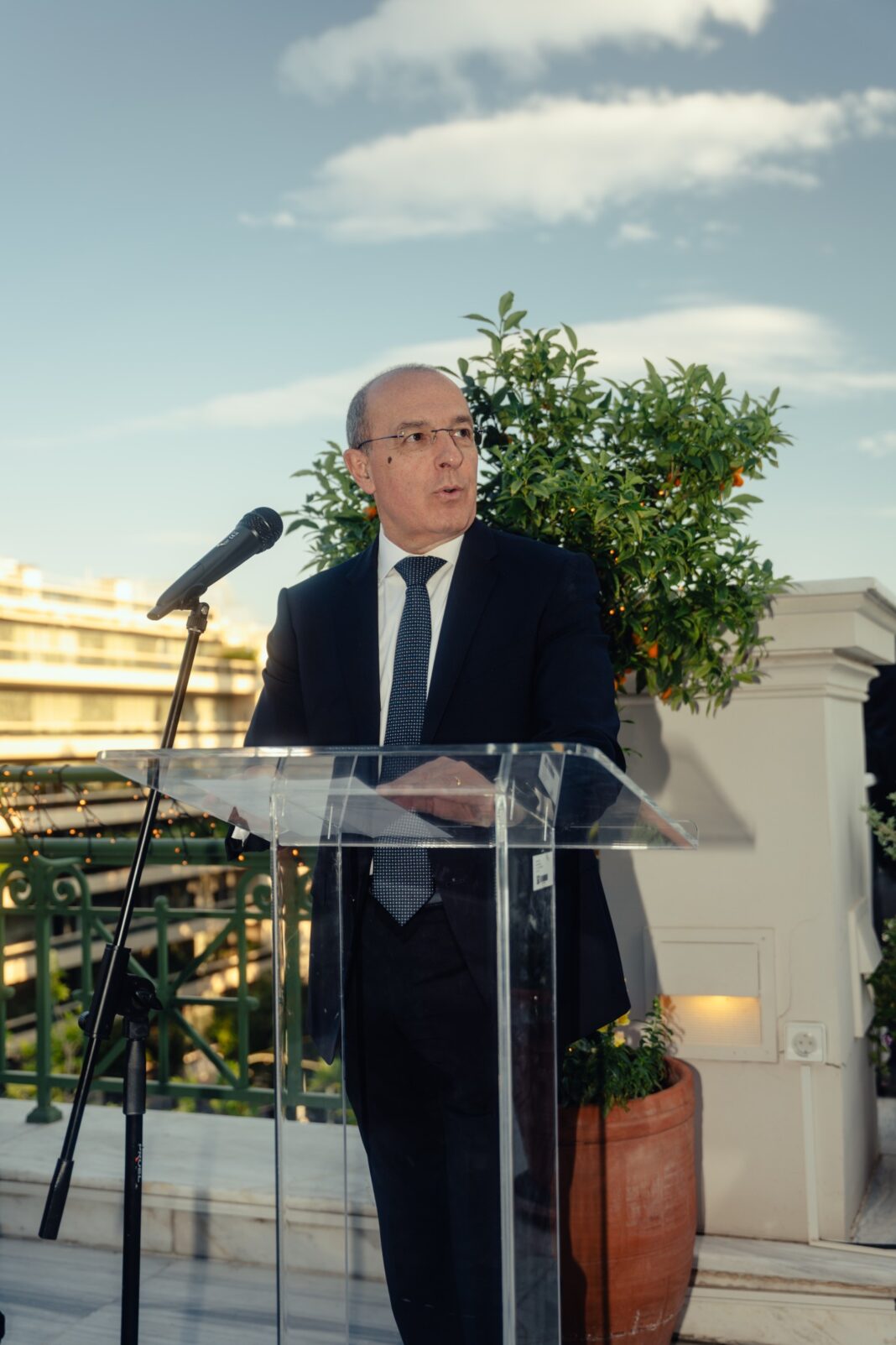
Commenting on the significance of the initiative, the Ambassador of Italy to Greece, Paolo Cuculi, described the simultaneous presentation of three major exhibitions at some of Athens’ most prestigious museums as a unique opportunity to showcase the breadth and diversity of Italian culture.
As Ambassador Cuculi noted, the exhibitions highlight not only Italy’s archaeological and historical heritage but also the internationally recognised creativity, craftsmanship, and aesthetic excellence that define Italian style. At the same time, they reaffirm the vitality of the cultural dialogue between Italy and Greece, demonstrating how cultural cooperation continues to strengthen the longstanding friendship between the two countries while promoting a shared appreciation of their common Mediterranean heritage.
Through this exceptional programme, the Embassy of Italy in Athens brings together institutions, scholars, artists, and the wider public in a celebration of Italy’s cultural legacy. More than a series of exhibitions, the initiative demonstrates the power of culture as a diplomatic instrument, reinforcing the close bonds between Italy and Greece and promoting international understanding through a shared appreciation of two civilisations whose histories have long been intertwined.