
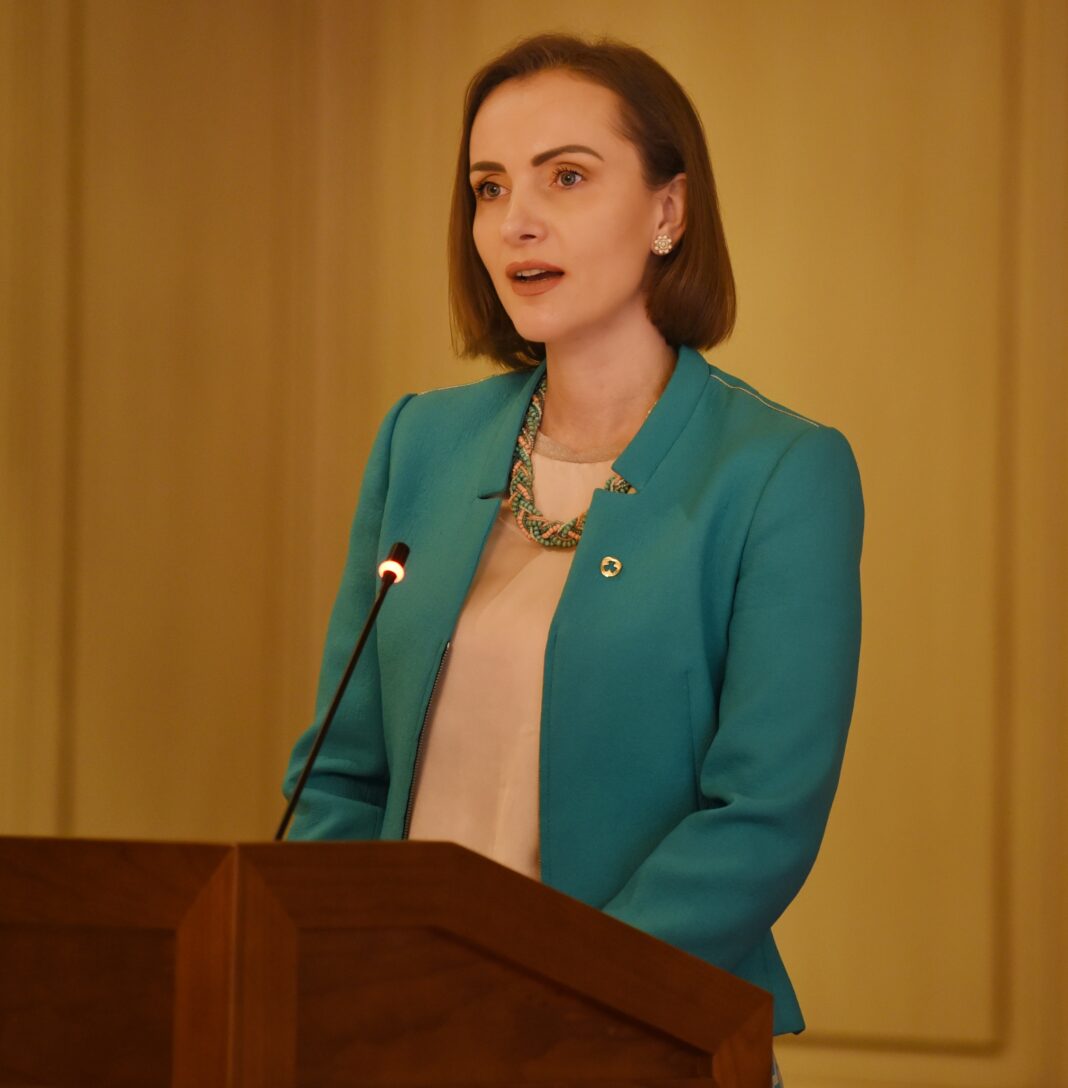

Some life stories follow a straight line. Others move across borders, disciplines and historical turning points. When I sat down with Shqipe Hajredini Doli, it became clear that her journey belongs firmly to the second category.
‘I grew up in a city that teaches you resilience without putting it in a textbook,’ she tells me with a smile. Pristina, she says, shaped both her professional determination and her instinct to look at institutions not as abstract constructions, but as living frameworks that affect daily life.
Her academic path began in law. ‘Law fascinated me because it’s not just about rules, it’s about balance,’ she explains. After completing her legal studies, she pursued a Master in European Legal Studies at the University of Hamburg. ‘Germany taught me discipline,’ she laughs. ‘And punctuality. Very punctual punctuality.’ Later, she completed a Doctorate in Political Science, focusing on governance, public policy and the relationship between legal systems and political realities.

Her career spans more than two decades across national institutions, NGOs and international organizations. She began in legislative drafting and legal reform. ‘At the beginning, I was literally working on texts that would shape institutions. It’s a strange feeling, you type a sentence and you know it might outlive your entire career.’ Over time, her work expanded into broader institutional reform and, more recently, into human rights. ‘Without human rights, governance is just administration,’ she says simply.
Languages have been a constant thread. Growing up in the former Yugoslavia meant early exposure to linguistic diversity. ‘I’ve always loved languages. They are not just tools to speak, they are tools to understand. When you switch languages, you almost switch personality slightly.’ She pauses. ‘It’s the closest thing to peaceful shape-shifting.’

Beyond her professional life, she is first and foremost a mother of two sons. ‘They keep me grounded. They also keep me technologically updated,’ she adds dryly. Artistic expression, especially painting and photography, offers balance. Ancient history remains a passion. ‘History is humbling. You realize that most political crises are not as original as we think.’
When I ask about food, her answer is immediate: ‘Cuisine is diplomacy without microphones.’ Coming from Kosovo, Mediterranean flavors remain emotionally close. ‘Food carries memory. One dish can bring back an entire decade.’ She firmly believes gastronomy is a powerful tool of cultural diplomacy. ‘When people share a table, they lower their defenses. It’s very difficult to argue aggressively while asking someone to pass the olive oil.’

Her international mobility began early. As a teenager, she moved independently to Austria and later to the United States. ‘Moving abroad alone teaches you two things: independence and how to pack efficiently.’ Germany played a key role during her academic years, but she has also developed a strong appreciation for the Netherlands. ‘I admire the Dutch balance between structure and openness.’ Still, she admits she feels emotionally split between Southern Europe’s warmth and Northern Europe’s order. ‘Ideally, I would like Southern weather with Northern administration.’
Speaking about Kosovo, she becomes both reflective and proud. ‘Kosovo is young, energetic and sometimes impatient, but in a good way.’ She describes it as a country with ‘a big heart and an even bigger ambition.’ For her, resilience is not a slogan but a lived experience. ‘We learned to build while still healing.’
Her view of the diplomatic community is pragmatic. ‘Diplomacy is about relationships. Policies matter, of course. But trust is built over coffee, not only in conference rooms.’ She finds the international diplomatic environment intellectually stimulating and culturally rich. ‘You are constantly learning how other societies think.’
The conversation naturally turns to diplomatic spouses. ‘People often assume we simply attend events,’ she says with a knowing smile. ‘In reality, many diplomatic spouses have their own careers, expertise and ambitions. Sometimes we pause them. Sometimes we reinvent them.’ She sees the role as complementary to official representation. ‘We are informal bridges. We connect with communities, professional networks, cultural initiatives. It’s soft influence, but it’s real.’
Do diplomatic spouses have power? ‘Absolutely,’ she replies without hesitation. ‘Not institutional power, but relational power. The power to create understanding. To reduce prejudice. To open doors that formal titles sometimes cannot.’ She adds, ‘It’s quiet power. But quiet doesn’t mean weak.’

One of her proudest professional moments came in the period following Kosovo’s Declaration of Independence. ‘Those years were intense. We were building institutions almost in real time.’ She was directly involved in legal and policy development processes critical to state consolidation. ‘It was demanding, complex and sometimes exhausting. But also incredibly meaningful. You could see the impact of your work.’
As our conversation draws to a close, I ask about her life motto. She reflects for a moment. ‘Live intentionally,’ she says. ‘Commit fully to what you do but stay curious.’ Growth, for her, comes from stepping beyond comfort zones. ‘If something challenges you slightly, it’s probably good for you.’ She smiles again. ‘Except maybe extreme sports. I prefer intellectual risk.’

In a world of shifting alliances and complex negotiations, her perspective is a reminder that diplomacy is not only conducted in official halls. It is also shaped by personal conviction, cultural intelligence and the quiet determination to build bridges, one conversation at a time.