
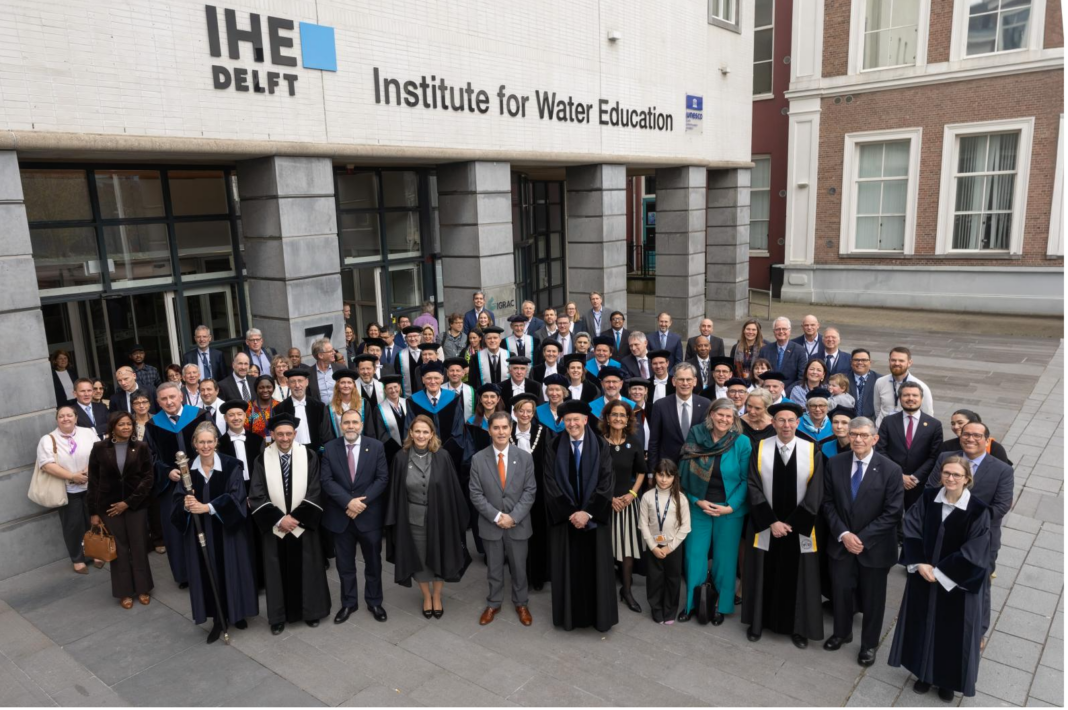

At the IHE Delft Institute for Water Education, a significant chapter came to a close with the farewell of Prof. Dr. Eddy J. Moors, who served as Rector from 2017 to 2025. Widely respected in the fields of water and climate science, Moors leaves behind a strengthened institution and a global network of partnerships that continue to shape water policy, research, and capacity development worldwide.
Moors’ career reflects a deep commitment to addressing global water challenges through science, policy, and collaboration. He began at the World Meteorological Organization, working in Africa and the Caribbean, before contributing to applied research at Wageningen Environmental Research. Alongside his leadership at IHE Delft, he holds a professorship in Water and Climate at the Vrije Universiteit Amsterdam.
During his tenure, IHE Delft reinforced its role as a leading global centre for water education and capacity development, particularly for professionals from vulnerable regions. His leadership during the COVID-19 pandemic ensured continuity in education and research, while advancing the Institute’s international partnerships.

Reflecting on his departure, Moors emphasized the importance of renewal: “I have worked at IHE Delft with great pleasure and I am proud of what has been achieved in the last few years… I see the need for a different IHE Delft, to continue being the global leader on capacity development for the whole water sector.”
His decision to step down, he noted, is intended to allow new leadership to bring “new energy and ideas” to meet evolving global challenges.
At the heart of Moors’ work lies the concept of “wicked problems”—complex, interconnected challenges such as climate change, water scarcity, and inequality. Returning to this theme in his farewell address, he questioned whether sufficient progress has been made. While acknowledging improvements, including slowing groundwater depletion due to policy interventions, he warned that progress remains insufficient: “Water and climate trends show some signs of policies being effective, unfortunately, not yet enough to change the current negative trends into positive ones.”
He cautioned that international forums risk losing effectiveness if they delay concrete action, urging instead a more proactive approach: “Even if multilateral collaboration gets stuck, individual countries, institutions or persons can make a difference.”
A defining element of Moors’ legacy is his emphasis on water as a connector—linking disciplines, sectors, and nations. He consistently advocated for integrated approaches that bridge science with policy, business, and society, while fostering dialogue across sectors such as energy, agriculture, and urban development.

The remarks by H.E. Álvaro González Otero highlighted the long-standing partnership between Uruguay and IHE Delft. Recalling the arrival of the first Uruguayan water professionals in Delft in 1961, he described how this collaboration has grown into a dynamic exchange of knowledge and expertise.
“As Ambassador of Uruguay, we stepped onto a bridge first built in 1961, when six Uruguayan water professionals arrived in Delft,” he said, noting that generations of graduates have since contributed to strengthening Uruguay’s water sector.
He emphasized that under Moors’ leadership, this relationship evolved into a more balanced and global partnership: “During his tenure, Eddy championed the idea that this connection could no longer be a one-way street—it had to become a true global exchange.”

A key milestone in this evolution was the co-creation of a Master’s programme in Sanitation with the Universidad Tecnológica del Uruguay (UTEC), positioning Uruguay as a regional hub for Latin America. Concluding his tribute, the Ambassador noted: “You have served as a vital link in the evolution of IHE Delft… ensuring that the dialogue between this institute and global professional networks remains strong.”
The ceremony also highlighted IHE Delft’s extensive alumni network of more than 25,000 water professionals worldwide. Ambassadors from Mexico, Sint Maarten, Cuba, Tanzania, Pakistan, Costa Rica, Peru; Dutch ambassadors from UNESCO, Colombia, Senegal, Egypt, Iraq and Bangladesh praised Moors’ role in fostering this global community, committed to advancing sustainable water management and international cooperation.
Looking ahead, Moors stressed the urgent need to invest in the next generation of water professionals, particularly as the sector faces a growing workforce gap. He called for greater inclusivity and stronger educational pathways, emphasizing that capacity development remains essential to addressing global water challenges.
Closing the ceremony, Ambassador Meike van Ginneken, Water envoi of the Dutch Government, reflected on the broader meaning of Moors’ work: “Water management for you means not only engineering… Water means culture. Water means life… At IHE Delft, you have excelled in bridging different disciplines and cultures to tackle wicked problems.”