
By Roy Lie Atjam
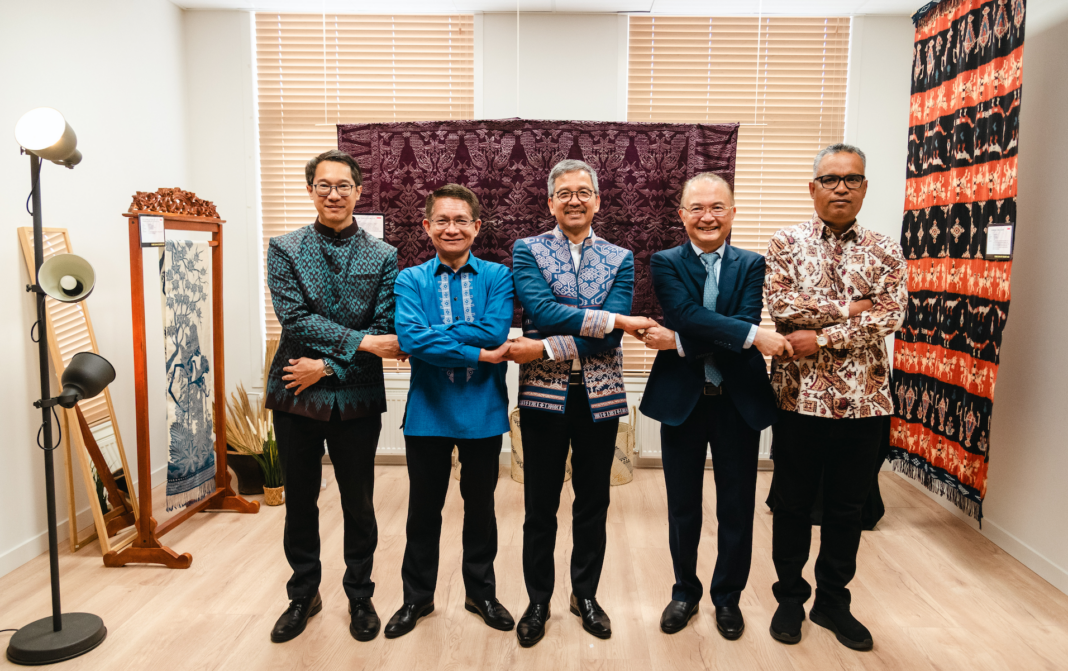
Amsterdam, 12 May 2026 – The highly anticipated opening ceremony of the joint traditional textile exhibition, THREADS OF HERITAGE: Weaving Southeast Asia’s Living Tradition, was a captivating celebration presented by the Embassies of the ASEAN Community in The Hague. Set against the backdrop of the beautifully renovated Indonesia House Amsterdam (IHA), this exceptional venue stands out as the largest and most diverse Indonesian Promotion Centre in Europe.
Once serving as the Indonesian Consulate General Office from 1967 to 1976, the building has been reborn after almost five decades of vacancy, culminating in its inauguration in 2024 by Indonesia’s Foreign Minister, H.E. Retno L.P. Marsudi, and the Indonesian Ambassador in the Netherlands, H.E. Mayerfas.

During today’s immersive program, attendees were invited to embark on a journey of cultural exchange, walking among an exquisite array of traditional textiles from Indonesia, Malaysia, the Philippines, Thailand, and Vietnam. The exploration was guided by the eminent textile anthropologist Dr. Sandra Niessen, whose deep understanding of the subject brought each piece to life.

She illuminated the intricate weaving techniques, revealing the rich cultural symbolism woven into each motif, and conveyed the historical significance of these treasured textile traditions that reflect the soul of the region. Dr. Niessen’s presentation was a masterclass, meticulously detailing the artistry and heritage of Southeast Asian weaving, shaped by her more than forty years of devoted research a commitment that has woven itself into the fabric of her identity.
With a background of Canadian-Dutch descent, she shared a heartfelt reflection on her yearning for Southeast Asian ancestry, adding a personal touch to her scholarly discourse.

The inaugural welcome remarks were delivered by the Ambassador of the Republic of Indonesia in the Netherlands, H.E. Amrih Jinangkung. A summary of his address follows:
“It is a great honour for me to welcome you all to this special event, where we come together to celebrate and preserve one of our most precious cultural treasures: traditional textiles of ASEAN.
First of all, I would like to extend my warm congratulations to the Philippines on the successful hosting of the 48th ASEAN Summit in Cebu last week. The success of the Summit and today’s event clearly demonstrate our shared commitment to a stronger and more united ASEAN.

We all know that diversity is the greatest strength of ASEAN. This rich cultural diversity, inherited from our ancestors, is something cherish we must protect together. One of its most beautiful expressions is the extraordinary variety of our traditional textiles.
Today’s joint exhibition is a wonderful showcase of that diversity and richness. The displayed textiles come in many forms— fabrics, ceremonial costumes, shawls, scarves, and woven garments— each carrying its own unique origin and cultural meaning.
We are honored to see T’nalak from the Philippines, woven using Abaka fibers and linked to T’boli mythological traditions.
We also have the colorful H’mong Costume from Vietnam, known for its intricate embroidery with indigo dyeing reflecting the mountain cultures of northern Vietnam.
From Thailand, we see the elegance of Phaa Poom. Thai textiles are renowned for their refined silk weaving traditions, rich gold-thread embroidery, and regional patterns that once reflected royal courts and local kingdoms.
Malaysia presents Songket, textiles woven with metallic gold or silver threads that historically symbolized nobility and prestige in the Malay Sultanates. Songket weaving itself requires immense patience and skill, often taking months to complete a single ceremonial cloth.

For Indonesia, we proudly present Tenun Ikat. Allow me to share a little more about the this piece that is on display today. One of the featured textiles is called “Hinggi Kaliuda” from East Sumba. This remarkable cloth combines plants and animals motifs.
In Sumbanese culture, each motif carries profound symbolism: horses represent greatness, strength, and social status; hens and roosters symbolize unity and family harmony; prawns signify death and reincarnation; while flowers represent beauty and the continuity of life. Traditionally, such textiles were worn during important ceremonies and were considered symbols of honor and ancestral connection.
In addition to the exhibition we are enjoying here today, we were also honoured last month to witness the beautiful exhibition of Thailand’s Chut Thai (Thai National Costume), graciously led by Her Royal Highness Princess Sirivannavari Nariratana Rajakanya.
I would like to extend my warmest congratulations to Ambassador Asi and Madam for the outstanding success of the exhibition. Many of us are still captivated by the display, which continues at De Bijenkorf in Amsterdam.
Traditional textiles are much more than fabric; they represent a cherished heritage, preserved for generations. Shaped by local wisdom and cultural values, these textiles carry deep meaning through intricate motifs that tell stories of ancient myths, spirituality, and social status. Beyond ceremonial uses, traditional textiles play a vital role in our daily lives and are essential for local economies.
From sarongs and batik to the Barong in the Philippines, they enrich our routines and culture. For many families and artisans, textile production is a labor of love and a source of livelihood, preserving valuable skills and promoting cultural sustainability. These textiles accompany us through significant life moments, making them integral to our identity.
We take pride in the international recognition of our textiles by UNESCO: Indonesian Batik (2009), Malaysian Songket (2021), and Tais from Timor-Leste (2021). We also support Thailand’s efforts to recognize Chut Thai as part of our shared cultural heritage.”
In conclusion, an exhibition tour followed. Guests were invited to mingle, view textile exhibits and engage with the curators.