

By Ayesha Asim
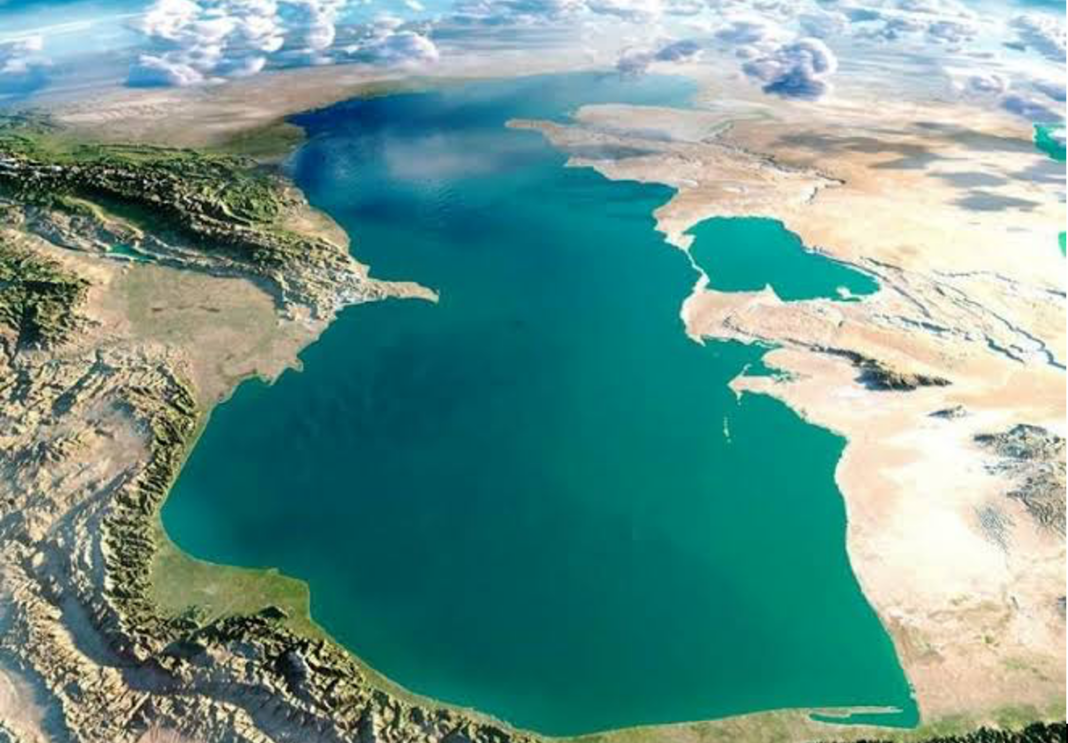
The Caspian Sea was never supposed to be a battlefield in the war between Russia and Ukraine. Yet recent developments have brought the conflict into waters far removed from Ukraine’s front lines. Reports of Ukrainian operations targeting vessels and supply networks allegedly connected to Russia’s military logistics have raised questions about whether the geography of the war is expanding. For Iran, whose maritime space and interests in the Caspian are directly affected, the issue is even more sensitive.
The incident raises a question that international law has not yet answered with complete clarity: when does military assistance to another state make the assisting state a participant in an armed conflict, and when can the infrastructure supporting that assistance become a lawful military objective?
These questions are becoming increasingly important as modern warfare moves beyond traditional battlefields. A war may be fought in one country, supplied through another, supported by technology from a third, and sustained through maritime routes that cross several jurisdictions. The Caspian Sea illustrates this changing geography of conflict, particularly as military and strategic ties between Iran and Russia have deepened while Ukraine continues to seek ways to disrupt Russia’s ability to sustain its war effort.
The starting point must be the United Nations Charter. Article 2(4) prohibits states from using force against the territorial integrity or political independence of another state, subject to recognised exceptions under international law. Article 51 preserves the inherent right of individual or collective self-defence in the event of an armed attack.
This framework creates an important legal limitation. Even if Iran provides military assistance to Russia, that fact alone does not automatically give Ukraine a general right to use force against Iranian territory. Military assistance and an armed attack are not legally synonymous. The threshold for invoking self-defence is considerably higher than simply demonstrating that another state has helped an adversary.
International law has long recognised that states may provide different forms of assistance to parties involved in armed conflicts without necessarily becoming direct participants themselves. Political support, diplomatic backing and even certain forms of arms transfers do not automatically transform a supporting state into a belligerent.
But not all forms of assistance are legally identical.
There is a difference between supplying weapons and providing operational intelligence. There is another difference between selling military equipment and directly assisting with the planning or execution of an attack. As the nature and degree of involvement increase, so too may the legal consequences.
This is where the law of state responsibility becomes relevant. Article 16 of the International Law Commission’s Articles on Responsibility of States for Internationally Wrongful Acts addresses the responsibility of a state that aids or assists another state in the commission of an internationally wrongful act. The provision requires knowledge of the circumstances of the wrongful act and that the conduct would also have been internationally wrongful if committed by the assisting state itself.
The significance of Article 16 is often misunderstood. It does not mean that every state supplying weapons automatically becomes responsible for every action carried out by the recipient state. The legal conditions must be satisfied. Questions of knowledge, the nature of the assistance and the relationship between that assistance and the wrongful conduct are central.
This creates a distinction between state responsibility and participation in an armed conflict. A state may potentially incur responsibility for assisting unlawful conduct without necessarily becoming a party to the conflict. Conversely, a state that becomes directly involved in military operations may acquire a different legal status.
The distinction is particularly important when considering the legality of attacks against military supply networks.
International humanitarian law applies once an armed conflict exists, but it does not make every object connected to the conflict a lawful target. The principle of distinction requires parties to distinguish between civilian objects and military objectives. Under the customary rules reflected in Additional Protocol I, an object may qualify as a military objective where it makes an effective contribution to military action and its destruction, capture or neutralisation offers a definite military advantage in the circumstances ruling at the time.
A vessel carrying military equipment may therefore raise a difficult legal question. Its legal status cannot be determined solely by its nationality or by the fact that it is travelling through the territory or waters of a state supporting another party to a conflict.
The crucial question is what the vessel is actually doing.
If a vessel is directly transporting military equipment that contributes to military operations, the legal analysis may differ from that applicable to an ordinary commercial ship carrying civilian cargo. Yet even then, the assessment must be made on the basis of the facts available at the time. The mere suspicion that a vessel is connected to a military supply network is not enough to remove the protection afforded to civilian objects.
The same principle applies to ports, warehouses and transport infrastructure. A facility that serves both civilian and military purposes does not automatically become a lawful military objective. The principles of proportionality and precautions in attack continue to apply. Even where an object is a legitimate military objective, an attack may remain unlawful if the expected incidental civilian harm would be excessive in relation to the anticipated military advantage, or if feasible precautions have not been taken.
This is where the geography of modern conflict becomes legally complicated.
A supply chain may begin in one country, pass through another and eventually support military operations thousands of kilometres away. But international law does not necessarily allow a state to follow that supply chain wherever it leads and treat every state, vessel or facility connected to it as part of the conflict.
The distinction between jus ad bellum and jus in bello is therefore essential. The law governing whether a state may lawfully use force against another state is different from the law governing how force may be used once an armed conflict exists.
This means that even if a particular Iranian vessel were found to be contributing to Russia’s military operations, that would not automatically establish a general Ukrainian right to attack Iran as a state. The legality of an attack against a specific object under international humanitarian law must not be confused with the legality of using force against the territorial integrity of another state under the UN Charter.
The same legal standards should also apply consistently to all states. If Iranian military support for Russia is scrutinised under international law, then other forms of external military assistance must be assessed according to the same principles. The credibility of international law depends on its consistent application, regardless of political alliances.
The Caspian Sea therefore illustrates a broader transformation in modern warfare. Conflicts are increasingly sustained through international networks of weapons, technology, intelligence, logistics and maritime transport. The battlefield is no longer necessarily defined by the physical location of troops.
Yet the legal consequences of war do not automatically travel along every supply route.
The real challenge for international law is to determine where the boundaries lie. When does military assistance become participation? When does assistance create state responsibility? When does a supply vessel become a military objective? And when does an attack on a specific military object cross the separate legal threshold for the use of force against another state?
These questions will become increasingly important as conflicts become more interconnected. The Caspian Sea may be one of the places where these legal boundaries are tested, but the underlying problem is global.
The future of international humanitarian law will depend not only on how it regulates the battlefield, but also on how it responds to the complex networks that sustain modern warfare. The challenge is to ensure that the expansion of a conflict’s geography does not become an automatic expansion of the legal permission to use force.
About the Author
Ayesha Asim is a legal academic, legal analyst, and PhD scholar in law. She holds an LLM in International Law (Gold Medal) and has experience in legal research, teaching, and advisory work. Her interests include international law, humanitarian issues, and other contemporary legal challenges. You can reach her at ayeshamalyc09@gmail.com