
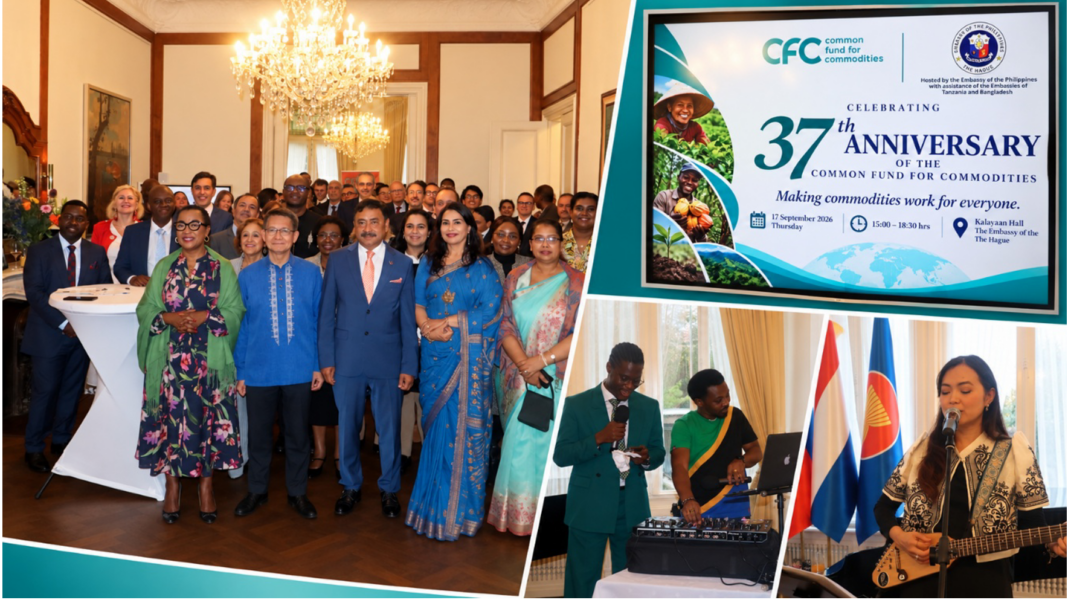

The Hague— The Common Fund for Commodities (CFC) marked its 37th anniversary with a reception bringing together a large gathering of ambassadors, representatives of Member States, community leaders, development partners, international organisations, and friends of the CFC. Held in The Hague on 17 September, the celebration highlighted 37 years of international cooperation and the CFC’s continuing efforts to place people and communities at the centre of global commodity value chains.
The CFC anniversary falls on 15 September, and this year’s reception followed the 82nd session of the CFC Executive Board, held in Amsterdam on 16 September. The two occasions provided an opportunity to move from formal discussions on the Fund’s work and future direction to an evening of diplomatic friendship and celebration.

The reception was hosted by H.E. Ambassador J. Eduardo Malaya, Ambassador of the Philippines to the Netherlands and Chairperson of the CFC Executive Board, with the Embassies of Tanzania and Bangladesh joining as co-hosts. The collaboration between the Philippines and Tanzania was particularly visible throughout the evening, reflecting the close engagement of both countries with the CFC and its international community.
The gathering brought together numerous ambassadors and members of the diplomatic corps, including H.E. Ambassador Caroline Kitana Chipeta of Tanzania, Chairperson of the CFC Governing Council, as well as representatives of CFC Member States and development partners. Community leaders and other guests involved in international cooperation also joined the celebration, reinforcing the broad network surrounding the Fund.
Celebrating the CFC’s Journey
Opening the formal programme, Ambassador Malaya reflected on the CFC’s development and its growing ability to mobilise resources for developing countries.
“The growth of the CFC is a reflection of what we can achieve when Member States, partners and the institution come together around a shared purpose — mobilising resources and turning them into meaningful development opportunities.”
Over the past two years, the CFC has mobilised approximately USD 84 million, strengthening its capacity to support investment and technical assistance across commodity value chains.
The anniversary also marked the conclusion of Ambassador Malaya’s tenure as Chairperson of the CFC Executive Board. He noted that H.E. Ambassador Rekha Gunasekera, Ambassador of Sri Lanka to the Netherlands, will succeed him as Chairperson. The transition reflects the continuity of Member State leadership and the spirit of cooperation that characterises the Fund.
Sri Lanka therefore has an important role in the CFC’s next chapter, with Ambassador Gunasekera succeeding Ambassador Malaya and continuing the tradition of active diplomatic engagement with the Fund.

Humanising the Value Chains
Ambassador Sheikh Mohammed Belal, Managing Director of the CFC, highlighted the organisation’s distinctive approach to commodity development, placing particular emphasis on its “Humanizing the Value Chains” philosophy.
The approach looks beyond commodities themselves to the people, businesses and communities that make value chains function—from farmers and workers to local enterprises and the families whose livelihoods depend upon them.
To illustrate this approach, Ambassador Belal invited members of the Sierra Leone delegation, who had travelled from Freetown to the Netherlands, to join him at the front of the room and share the story of Goldtree, a CFC investee producing organic palm oil in Sierra Leone.
Goldtree had experienced declining yields and initially examined the agricultural causes. The challenge, however, was found to extend beyond productivity: farmers were experiencing difficulties transporting their fruit to the mill because of inadequate rural road connections.
Goldtree responded by investing in rural roads and improving connections with surrounding communities. The initiative demonstrated how an investment in infrastructure can strengthen an entire value chain, benefiting farmers, businesses and local communities.

Ambassador Belal explained:
“Sometimes, when we look at a commodity value chain, we focus on the commodity itself. But behind every commodity there are people, communities and businesses.”
The example of Sierra Leone provided a particularly human dimension to the anniversary celebration and illustrated the CFC’s efforts to support what it describes as the “missing middle”—promising businesses that have moved beyond microfinance but remain underserved by conventional financing.
Through investment and technical assistance, the CFC supports enterprises seeking to grow, create employment, add value locally, strengthen food systems and connect producers to better markets.
The Philippines and Tanzania: Cooperation at the Heart of the Celebration
The partnership between the Philippines and Tanzania was a notable feature of the anniversary.
As host, the Philippine Embassy welcomed the CFC community, while the Embassy of Tanzania joined as co-host and Ambassador Caroline Kitana Chipeta, Chairperson of the CFC Governing Council, played a prominent role in the formal programme.
The collaboration demonstrated how the CFC brings together countries from different regions around shared development priorities. The participation of Bangladesh as a further co-host added another dimension to the international character of the celebration.
National traditions also became part of the evening. Guests enjoyed food from the Philippines, Tanzania and Bangladesh, while Philippine singer-songwriter Acel Bisa van Ommen performed during the reception and a Tanzanian DJ continued the musical programme.
From Commitment to Action
Ambassador Caroline Kitana Chipeta addressed guests as Chairperson of the CFC Governing Council, placing the Fund’s work within the broader international development agenda.
She highlighted the importance of the Sevilla Commitment and the momentum it has created around development finance and institutions working to address financing gaps in developing economies.
“The Sevilla Commitment has already paved the way. Now is the time to act — to turn our commitments into investments, partnerships and concrete results for the people and communities who depend on commodity value chains.”
Her message reinforced the CFC’s role in translating international commitments into practical financing and support for businesses, producers and communities across developing countries.
A Community Behind the Commodities
The anniversary reception was ultimately about more than marking 37 years of institutional history. It was also an opportunity to recognise the millions of smallholder farmers, workers and communities whose efforts sustain global commodity value chains.
The CFC’s work focuses on the people behind commodities—those whose livelihoods depend on agriculture, natural resources, local enterprises and access to international markets. By bringing together governments, diplomats, financial institutions, development partners, businesses and community representatives, the Fund seeks to strengthen the connections that allow these value chains to create greater opportunities.
The evening in The Hague reflected precisely this spirit: countries coming together not only as Member States and development partners, but as a community.
As the CFC enters its 38th year, its anniversary celebration offered a reminder that behind every commodity are people, families and communities—and that sustainable development depends on ensuring that they are not left behind.
About the Common Fund for Commodities
The Common Fund for Commodities (CFC) is a UN-affiliated international financial institution headquartered in Amsterdam. Established in 1989 following the work of the United Nations Conference on Trade and Development (UNCTAD), the CFC provides investment and technical assistance to support sustainable commodity development in developing countries.