
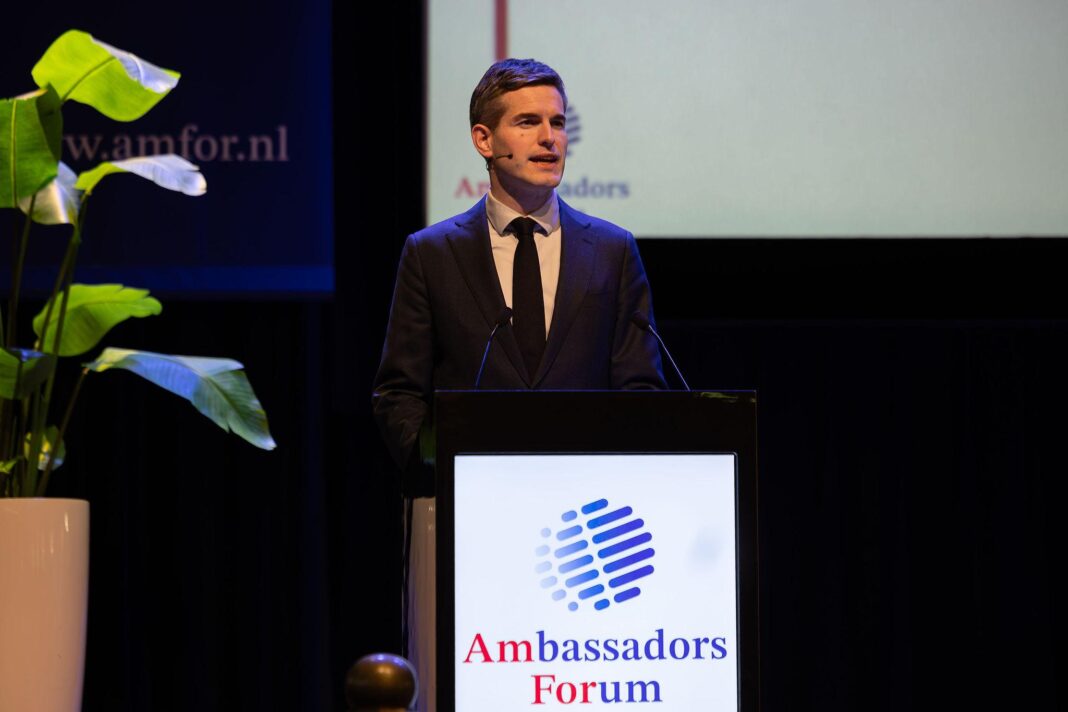

The Dutch Foreign Minister calls for stronger European resilience, unwavering support for Ukraine and deeper international partnerships
Europe faces an increasingly complex international environment in which geopolitical competition, economic dependencies, security concerns and changing trade relations are becoming closely interconnected. Addressing the Ambassadors Forum at the Royal Tropical Institute in Amsterdam, Mr Tom Berendsen, Minister of Foreign Affairs of the Netherlands, called for a realistic but forward-looking European response, emphasising the importance of stronger defence capabilities, economic resilience and international cooperation.
Opening his remarks with a reflection on the changing international order, the Minister acknowledged that power politics is increasingly shaping relations between states. However, he cautioned against interpreting realism as acceptance of circumstances beyond Europe’s control.
“Realism isn’t the same as resignation,” he stated, arguing that European interests and values must be defended through effective policies and practical cooperation.
Security and support for Ukraine
A central theme of the address was Europe’s security. The Minister stressed the need to strengthen collective defence, increase contributions to NATO and reinforce the European Union’s role in security and resilience.
He underlined the importance of investing in conventional defence capabilities while strengthening Europe’s economic security and ability to respond to external pressures.
Support for Ukraine, he emphasised, must remain unwavering. Russia must be held accountable for its actions, with international law and the institutions established to uphold it continuing to play an essential role.
The Minister also argued that European budgets and policy priorities must reflect the realities of the current international environment. Security, competitiveness and innovation require sustained attention, even when achieving these objectives involves difficult political decisions.
Economic security and global interdependence
Beyond defence, Berendsen drew attention to the relationship between geopolitical developments and the stability of international trade and supply chains.
Disruptions around the Strait of Hormuz served as an example of how instability in one region can have consequences extending across the global economy. The implications are not limited to energy markets and transportation; access to essential agricultural inputs, including fertilisers, can also affect food security.
The example illustrated the extent to which international economic systems are interconnected and why European countries must consider strategic dependencies beyond their immediate commercial interests.
For the Netherlands and the European Union, this means strengthening resilience, diversifying partnerships and reducing vulnerabilities in critical sectors.
Partnerships beyond Europe’s borders
The Minister called for deeper European cooperation while also emphasising the importance of international partnerships beyond the European Union and NATO.
He encouraged practical cooperation with countries in Europe and Asia, including smaller states and partners with shared interests in areas such as security, trade and economic development.
Addressing the ambassadors present, he recognised the importance of the Netherlands’ international relationships and the contribution of diplomatic partnerships to shared prosperity.
He also made an important distinction: strong partnerships do not require agreement on every issue. Rather, they depend on trust, mutual respect and the ability to manage differences.
As he observed: “True partnerships often reveal themselves precisely when times are tough.”
His message was that international cooperation must be based on more than immediate economic interests. It also requires a shared commitment to the rules and institutions that provide a framework for international relations.
Connecting diplomacy, politics and business
In the Minister’s view, the challenges facing the international community cannot be addressed through isolated national policies.
Security affects trade, technological developments influence economic competitiveness, development cooperation contributes to stability, and economic decisions can have far-reaching strategic consequences.
This interdependence explains the importance of bringing together different sectors of society.
Berendsen highlighted the contribution of business leaders, politicians, civil society representatives and diplomats, recognising that each has a role in addressing international challenges and building sustainable partnerships.
His appeal was directed towards strengthening and defending international rules and institutions, investing in mutual trust and developing closer cooperation in support of international security, stability and prosperity.
A shared responsibility for the future
Concluding his address, the Minister returned to the importance of relationships and the willingness to adapt to a changing world.
“The world will always keep changing. What matters is whether we are willing to change with it and build the relationships that will enable us to shape a safe and prosperous future,” he told participants.
The message was particularly relevant to an audience comprising more than 80 ambassadors, Dutch government representatives and over 120 business leaders. Their presence reflected the close connection between diplomacy, international economic relations and the private sector.
For the Netherlands, strengthening these relationships remains an important part of its international engagement. The Minister concluded by reaffirming the country’s readiness to work with its international partners and to join forces in addressing the challenges ahead.