
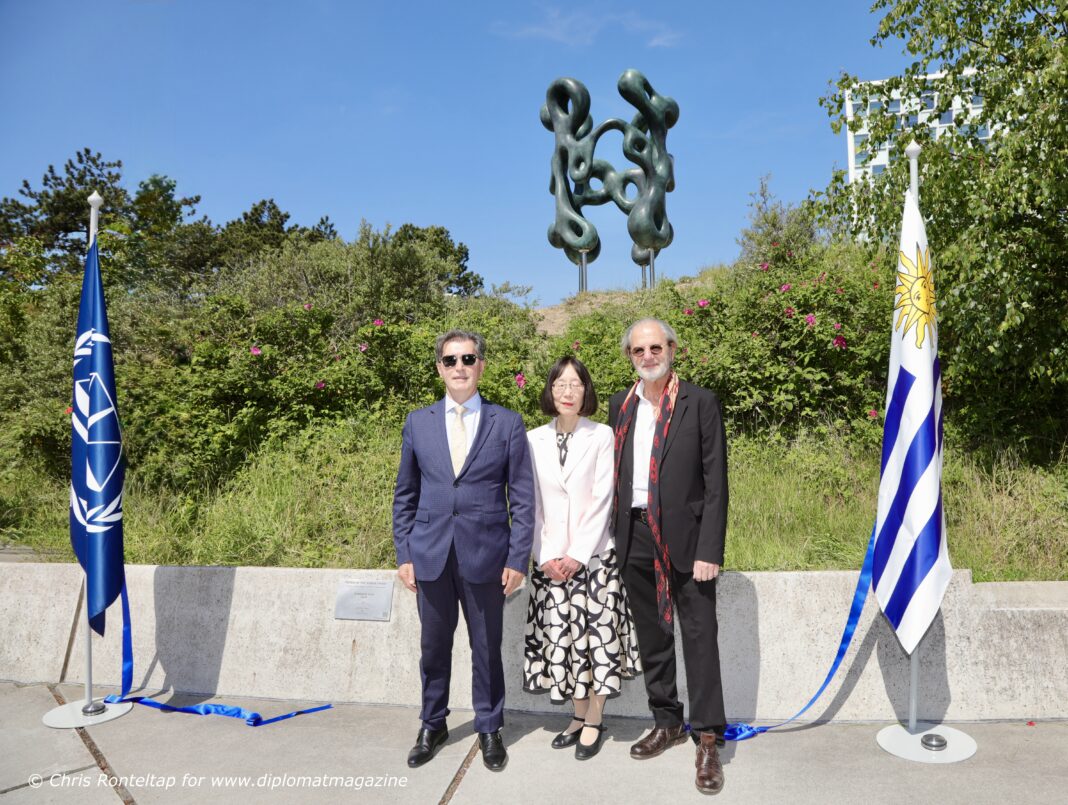

“The Totem of the Human Tribe” Unveiled at ICC Headquarters in The Hague
On 22 May 2026, H.E. Mr. Álvaro Enrique González Otero, Ambassador of Uruguay to the Netherlands, together with H.E. Ms. Tomoko Akane, President of the International Criminal Court (ICC), unveiled the sculpture “El Tótem de la Tribu Humana” (The Totem of the Human Tribe) at the ICC headquarters in The Hague, the Netherlands.
The monumental artwork, created by renowned Uruguayan artist Roberto Vivo and donated by the Government of Uruguay to the ICC, stands as a powerful symbol of fraternity, diversity, and international justice. Previously exhibited at the Venice International Art Biennale, the sculpture invites reflection on humanity’s shared pursuit of peace and coexistence.
The unveiling ceremony was attended by Roberto Vivo, who travelled to The Hague to personally present his magnificent oeuvre, alongside a distinguished gathering of ambassadors, heads of mission, judges, art collectors, and distinguish friends of Uruguay.

Among the notable guests were H.E. Sahar Ghanem, Dean of the Diplomatic Corps; H.E. Graciela Gatti Santana, President of United Nations International Residual Mechanism for Criminal Tribunals; Luis Moreno Ocampo, first Prosecutor of the ICC; and Silvia Fernández de Gurmendi, former President of the ICC.
A special message from Yamandú Orsi, President of Uruguay, was read in person by ambassador González Otero during the ceremony.
In his message, President Orsi declared “The sculpture evokes the idea of a diverse humanity and embodies universal values such as dignity, peaceful coexistence, and respect among peoples. This donation is a source of national pride, and its installation within the premises of the Court amplifies a message of peace that is especially necessary at this delicate moment, when wars are multiplying and threatening the very foundations of the international order.”
Ambassador González Otero underscored the symbolic importance of installing the sculpture at the Court.
“If there is one place where this idea acquires concrete meaning, it is precisely here, at the International Criminal Court,” he said. “An institution that represents the collective effort of States to affirm that, beyond geographical, cultural, political and religious differences, there exist fundamental values that must be safeguarded through law and justice.”

Reflecting on current global challenges, the Ambassador noted that the ICC remains a tangible expression of international commitment to justice and accountability. He recalled that the entry into force of the Rome Statute in 2002 marked a milestone in the development of international law, establishing a unique forum where States agree to uphold common legal principles in the belief that justice strengthens peace, stability, and international coexistence.
He further reaffirmed Uruguay’s longstanding commitment to international criminal law and to the fight against impunity, noting the country’s early support for the Rome Statute and its incorporation into Uruguay’s domestic legal framework through comprehensive legislation.
Ambassador expressed “Uruguay has historicaly demonstrated its vocation and commitment to international law, and the current Government continues to promote the strengthening of multilateralism. Uruguay’s role as a contributor to international and global public goods – such as the maintenance to international peace and security, the consolidation and development of international law through participation in norm-setting fora and international courts, support for disarmament, food, security, global health, and commitment to addressing climate change – has distinguished our country as a cooperative actor in advancing solutions to global challenges.”
“The presence of this work at the seat of the Court carries profound symbolic value. Its vary title – Human tribe Totem – evokes the idea of a shared humanity, diverse yet interconnected, united by common principles and by the conviction that human dignity must be universally protected”.

Roberto Vivo an internationally renowned sculptor, writer, and painter with a remarkable artistic trajectory developed primarily in the United States, Italy, and Uruguay; and author of the book War: A Crime Against Humanity, reflecting on the message conveyed through his work, stated: “Today we are unveiling this sculpture, which I call ‘The Totem of the Human Tribe.’”
“Those who enter the Totem of the Human Tribe connect with the earth and are able to gaze out in the four cardinal directions — a celebration of the diversity that the four points of the compass provide. And when they enter, I hear getting inside the sculpture and feel the connection with Mother Earth.”

“It encompasses discovering the positive value of variety. It embraces a preference for diversity over unanimity. This sculpture invites the public to become part of a novel global concept: Humanity.”
Vivo expressed: “Consensually creating global laws to protect the Human Tribe, and to put an end to wars — like the unspeakable human tragedies unfolding right now in Ukraine, Iraq, Syria, Israel, and the Gaza Strip, as well as in so many other places around the world.”
“In a nuclear age, war as a mechanism to manage conflict is obsolete. Worse still, nuclear war threatens to make the Human Tribe itself obsolete, rendering it subject to self-inflicted extinction. War begets revenge. Justice puts a stop to it. Justice is civilization. War is nihilist barbarism.”

Addressing the audience during the ceremony, Judge Akane highlighted the profound relevance of the artwork to the Court’s mission.
“The Human Tribe Totem is particularly fitting for the International Criminal Court because it speaks to our shared humanity,” she stated. “Its symbolism reminds us that the ICC was created not for the interests of any single nation or region, but for humanity as a whole.”
She continued by emphasizing the contemporary significance of the sculpture: “At a time when conflicts and human suffering continue to make headlines, this artwork serves as a powerful reminder of the importance of solidarity, accountability, and the rule of law. It reminds us that justice is not an abstract principle, but a responsibility shared by all nations and peoples.”
Since relocating to its permanent premises in December 2015, the ICC has received artistic donations from Australia, Belgium, Canada, Cyprus, Denmark, Japan, the Republic of Korea, Ireland, Liechtenstein, Mexico, the Netherlands, Portugal, Romania, Senegal, Slovenia, Tunisia, and now Uruguay.
The installation of The Totem of the Human Tribe adds another meaningful cultural landmark to the ICC headquarters, reinforcing the enduring connection between art, diplomacy, and the universal pursuit of justice.