
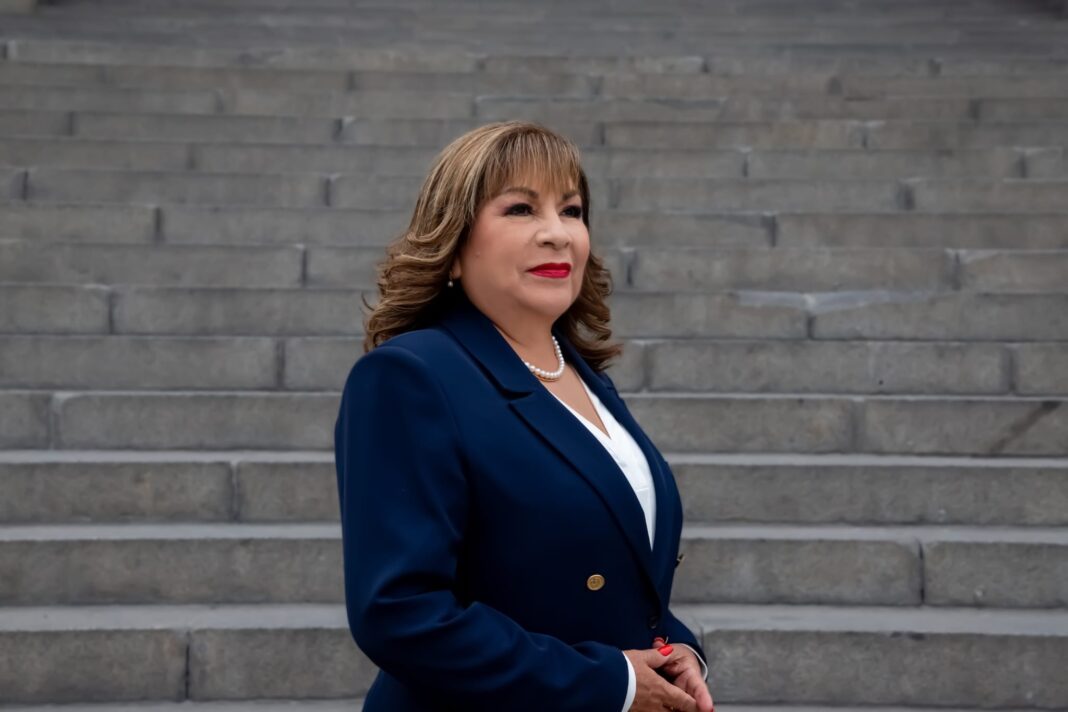

Candidacy for the International Court of Justice
INDEPENDENCE · EXPERIENCE · REPRESENTATION
| INDEPENDENCE 01 A RECORD OF JUDICIAL INDEPENDENCE – Judge Ibáñez’s judicial record bears witness to her independence of judgment. In complex and sensitive cases, she has applied the law and assessed the facts free from external influence or pressure, including where her view has differed from that of the majority. Her separate opinions are a testament to that independence: carefully reasoned, principled and firmly grounded in the law. Her independence is thus a quality demonstrated consistently through her judicial service. 02 A CLEAR COMMITMENT TO IMPARTIALITY – Judge Ibáñez’s impartiality is demonstrated through a judicial record spanning cases involving diverse parties, interests and highly sensitive circumstances. She has consistently approached those cases without favor, bias or prejudice, applying the law even-handedly and giving full consideration to the rights and interests of all those before the Court. Her separate opinions, including in particularly sensitive proceedings, bear witness to an impartiality grounded in law rather than in the identity or position of any party. 03 INDEPENDENCE IN THE FACE OF EXTERNAL PRESSURE – Judicial independence is most consequential when it is exercised in the face of external pressure. From her years as a prosecutor in Peru to her service as an international judge, Judge Ibáñez has exercised judicial and prosecutorial responsibilities in environments where powerful interests and external pressures could bear upon the administration of justice. During her tenure at the ICC, she has continued to discharge her judicial responsibilities independently, throughout a period in which international courts and their judges have faced unprecedented political and other forms of pressure. Her record demonstrates an independence of judgment, grounded in law and principle, and a steadfast commitment to safeguarding the judicial function. | EXPERIENCE 04 A RECORD OF INTERNATIONAL JUDICIAL EXPERIENCE – Nine years of service on the Appeals Chamber of the International Criminal Court have given Judge Ibáñez extensive experience in the demands of international adjudication at the highest level: rigorous examination of jurisdiction, procedure and legal argument, translated into clear and reasoned conclusions. That experience has also given her a firsthand understanding of the institutional responsibility entrusted to an international court and of the significance its judgments hold for the broader international legal order. 05 FOUR DECADES OF PUBLIC SERVICE – Judge Ibáñez brings more than four decades of legal and public service: over three decades as a prosecutor in Peru, alongside sustained engagement with legal academia, and, the past nine years, as an international judge. Her experience, spanning prosecution, scholarship and international adjudication, extending across national and international institutions, has given her a distinctive and deeply grounded understanding of the law, legal institutions and the responsibilities of public office. 06 LEADERSHIP AT THE HIGHEST INSTITUTIONAL LEVEL – As First Vice-President of the ICC (2021–2024), Judge Ibáñez Judge Ibáñez served the highest level of the Court’s institutional leadership, engaging extensively with States, international organizations and judicial institutions. Her tenure afforded her a broad perspective on the legal and geopolitical realities shaping international relations, and on the importance of dialogue and consensus in multilateral affairs. This experience deepened her understanding of multilateralism and the vital relationship between international law, justice, peace and security, a perspective of particular relevance to the judicial responsibilities and central role of the International Court. | REPRESENTATION 07 A LONGSTANDING GAP IN REPRESENTATION – In nearly eight decades of the Court’s history, 109 men have served as Judges of the International Court of Justice, compared with only six women. No woman from Latin America and the Caribbean has yet been elected to the Court. Judge Ibáñez’s election would contribute to addressing this longstanding gap in the Court’s composition, and to advancing Sustainable Development Goal 5 — women’s full and effective participation and equal opportunities for leadership and decision-making in public life — as envisaged by the UN 2030 Agenda. 08 REPRESENTATION ALONGSIDE MERIT J- udge Ibáñez’s candidacy brings meaningful regional and professional representation alongside the highest standards of legal competence and judicial independence. Her four decades of service across prosecution, legal academia and international adjudication, together with her perspective as a woman jurist from the GRULAC, would contribute a distinctive legal and professional perspective to the Court. 09 AN ENRICHED LEGAL PERSPECTIVE – Judge Ibáñez developed her legal career in Peru, within a legal tradition enriched by the jurisprudence of the Inter-American human rights system and other regional and multilateral mechanisms, and has carried this perspective throughout her nine years as a Judge of the International Criminal Court. Her work has contributed to the development of ICC jurisprudence, drawing on diverse legal traditions and approaches to international law. Her election would bring to the International Court of Justice the distinctive perspective of a South American woman jurist, grounded in a different legal tradition and body of jurisprudence, contributing to the diversity of perspectives that strengthen international adjudication and enhance the Court’s work in the service of the international community. |
| 10 A CAREER IN THE SERVICE OF JUSTICE AND PEACE Judge Ibáñez’s four-decade career has been consistently dedicated to the pursuit of justice as a means of strengthening and securing lasting peace, both nationally and internationally. From prosecuting terrorism and grave human rights violations in Peru, to adjudicating the gravest international crimes at the ICC and contributing to the leadership of an international judicial institution, she has devoted her professional life to upholding the rule of law, protecting human dignity and advancing justice. Her candidacy brings together extensive judicial experience, deep expertise in international law, and a sustained commitment to multilateralism and international peace and security—a record of service that she now places at the service of the International Court of Justice. |