
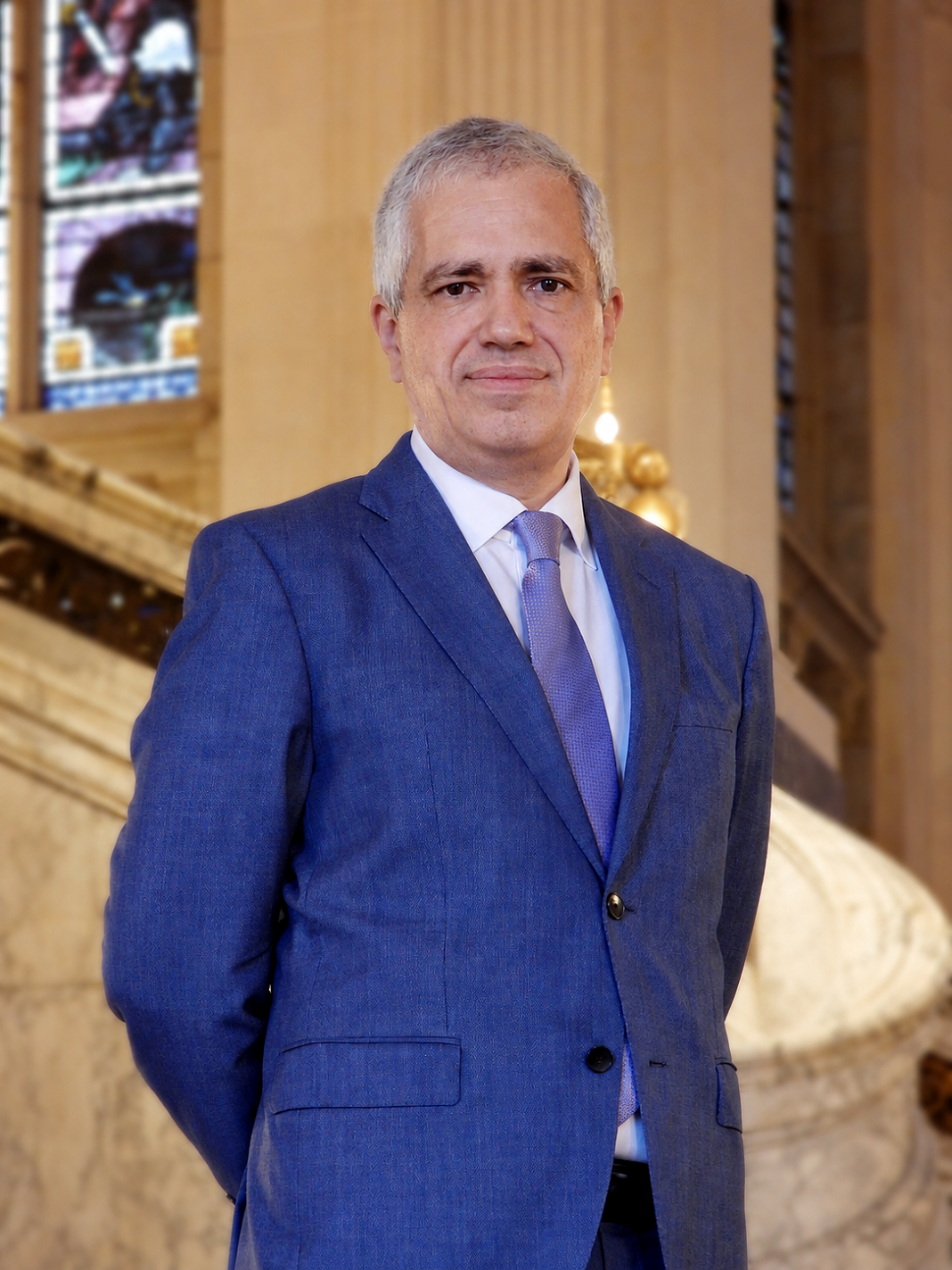

By H.E. Mr Santiago Villalpando, Registrar of the International Court of Justice
As the International Court of Justice (ICJ) marks the 80th anniversary of its inaugural sitting, its role in the international legal order has never been more relevant. The Court, the principal judicial organ of the United Nations, is experiencing an unprecedented level of activity, reflecting both the complexity of contemporary international relations and the trust that States continue to place in international law. H.E. Mr. Santiago Villalpando, who assumed office as Registrar earlier this year for a seven-year term, reflects on the Court’s growing workload, its enduring mandate, the responsibilities of the Registry and the importance of its relationship with the diplomatic community in The Hague.
An increasingly active Court
The Court has never been busier, and the figures speak for themselves. As of today, there are 24 pending cases on its docket. Between 2021 and 2025, an average of 4.6 new cases per year were brought to the Court, including both contentious cases and requests for advisory opinions, compared with an annual average of nearly half that number, or 2.4 cases, between 1946 and 2020.
The nature of proceedings has also evolved, as shown by the multiplication of incidental proceedings. For example, the parties to a case often request provisional measures, which reveals that they feel a sense of urgency. Indeed, provisional measures are indicated by the Court when it finds, among other things, that the rights of the States concerned are at an imminent risk of irreparable prejudice. Furthermore, a growing number of States that are not directly involved in a dispute decide to file requests for intervention. This bears testimony to the fact that disputes brought before the Court are of interest to the international community as a whole, for example, in matters concerning human rights and international humanitarian law.
The Court is therefore a beehive of activity. The general public may only be aware of a few weeks of hearings per year and the occasional formal sitting for the delivery of a judgment or advisory opinion, but internally the Court’s schedule is as busy as can be, with countless deliberations, drafting committees, first and second readings of judgments, and administrative and judicial meetings. Delivering three or four substantive decisions per year — which is the pace that the Court has imposed itself in recent times — means that there is never a down moment in the Court’s internal calendar. The Court has also adapted its working methods to the new environment, for example through the use of information technology.
All these developments speak of the continued relevance of the Court’s mandate and the trust placed in it by Member States. Thirty years ago, when the Court was turning fifty, a mentor of mine published an article entitled “The International Court of Justice: 50 years old and (for the time being) not a wrinkle!” As the Court commemorates its 80th anniversary this year, it seems to have taken a sip from the Fountain of Youth!
Eight decades of international justice
Indeed, one may wonder why an 80th anniversary is so significant. For me, it demonstrates the enduring vitality of one momentous idea contained in the Charter of the United Nations, which led to the adoption of the Court’s Statute and its first public sitting in 1946: the conviction that an international court fully integrated within the United Nations could play a central role in achieving the objectives of international peace and security, friendly relations, international cooperation and respect for human rights embedded in the Charter.
Consider, for a moment, what had happened in the 80 years that preceded the Court’s inaugural public sitting. Back in 1866, there were no multilateral institutions, and the idea of a World Court was but a distant utopia, although there was a growing confidence in international law. The 1863 Lieber Code and the first 1864 Geneva Convention had launched the regulation of the laws of war. The United States and Great Britain had agreed to settle their disputes regarding the American Civil War through arbitration, which eventually led to the famous 1872 Alabama arbitral award.
In the decades that followed, numerous attempts were made to systematise the peaceful settlement of disputes through the application of international law. Some of these attempts proved successful, such as the establishment of the Permanent Court of Arbitration in 1899 and that of the Permanent Court of International Justice in 1920, under the auspices of the League of Nations. Other attempts failed, such as the proposed creation of an International Prize Court in 1907 and the 1937 Convention aiming at establishing, for the first time, an international criminal court.
But most of all, the Judges who sat for the first time at the Peace Palace in 1946 were tragically conscious that, to paraphrase the Preamble of the Charter, “the scourge of war” had, twice in their lifetime, “brought untold sorrow to mankind”.
The trust placed in the Court by the international community, as it marks its 80th anniversary, demonstrates that the intuition of the negotiators at San Francisco was right. In its eight decades of existence, the Court has proved remarkably resilient, even in periods of profound international turmoil, in ensuring the peaceful settlement of disputes and the attainment of the principles of the Charter.
The foundations of the Court’s lasting role
The establishment of the Court embodies several core propositions.
First, the judicial function is an indispensable component of the United Nations. The novelty of the Court, compared with its predecessor, the Permanent Court of International Justice, is that it is fully integrated within the institutional structure of the United Nations as one of its principal organs, at the same level as the General Assembly, the Security Council or the Secretariat. This has ensured its stability, allowing it to give effect to the commitment undertaken by Member States, under Article 2, paragraph 3, of the Charter, to settle their international disputes through peaceful means.
Judicial means, however, are not intended to replace the other means of peaceful settlement of disputes listed in Article 33 of the Charter, such as good offices, mediation or even arbitration. The second feature of the Court’s Statute is therefore that it enriches the options available to States to solve their controversies based on international law. The cardinal principle remains that the Court’s jurisdiction is consensual, but the Statute offers several different ways of expressing such consent and opens the door to the judicial option.
Third, to succeed in its judicial mandate, the Court needs to reflect the diversity of the international community in which it operates. The composition of the Court has always strived to represent the major legal systems of the world. This has been made possible both by the procedure for the election of its Members, which involves the General Assembly and the Security Council, and by its configuration. It is interesting to note, in this regard, that since its inception the Court has had fifteen Members, contrary to the Security Council, which had only eleven members in 1945. When the Council’s composition was revised in 1963 to better represent the changes in the international community emerging from decolonisation, it was aligned with that of the Court!
Lastly, the Court’s Statute offers numerous advantages that may incentivise States to opt for this means of peaceful settlement. A permanent judicial institution, for example, has pre-established rules of procedure detailing the various phases of the judicial process, ready for States to use. These cover the number of pleadings, the organisation of hearings, the languages to be used, how to raise objections or obtain provisional measures, and the binding character of the final judgment, among other matters.
The Court also renders judgments that contain a detailed explanation of the reasons leading to the resolution of a dispute, based on a rich body of jurisprudence. Its proceedings are public, mirroring the old adage, already proclaimed in the first of Woodrow Wilson’s Fourteen Points in 1919, that “diplomacy shall proceed always frankly and in the public view”. Transparency and predictability are key features of the Court’s success.
The Registry: administrative, judicial and diplomatic responsibilities
As my predecessor, Philippe Gautier, pointed out in an article he wrote for Diplomat Magazine in 2022, the Registrar’s role includes a wide range of duties of an administrative, judicial and diplomatic nature.
On the administrative front, the Registrar manages the work of the Registry. The Registry works as a small international institution, which includes not only the lawyers who directly assist the Judges in the discharge of their judicial mandate, but also specialised personnel working on linguistic matters, protocol, public information, archives, library services, information technology, document processing, publication, human resources, budget, security, administrative support and so on.
The greatest challenge for the Registrar in this area will certainly be ensuring the sustainability of the support that the Registry provides to the Court. The General Assembly has provided some additional resources to the Court in recent years, but the exponential increase in the workload remains an enduring challenge. Fortunately, the Registry comprises an experienced team of international civil servants whose commitment to the mandate of the Court goes very far!
The Registrar must also offer his personal legal expertise to the Court in judicial proceedings. The Rules of Court spell out numerous distinct functions specifically assigned to the Registrar, from keeping a General List of all cases to transmitting pleadings and documents to the parties or ensuring the publication of the Court’s judgments, advisory opinions and orders.
But the Registrar also attends all public hearings, deliberations and drafting committee meetings. He is therefore expected not only to contribute to the resolution of procedural incidents, but also to contribute to the legal quality of the Court’s judgments and advisory opinions as they come into being. This is the reason why the Registrar is to be an experienced international lawyer, who may provide substantive assistance to the Court in shaping its decisions.
Lastly, the Rules of Court provide that the Registrar is also “the regular channel of communications to and from the Court”, which hints at his diplomatic role. Beyond the strictly procedural aspects of this function, the Registrar is to be an effective counterpart for the agents of the parties in proceedings, governments and the diplomatic community, as well as the United Nations system and the general public. There is a strong informal component in maintaining productive relations with stakeholders at all levels and in all circumstances, from formal hearings to various diplomatic functions.
The diversity and breadth of the Registrar’s responsibilities are among the most rewarding aspects of the position, while also making it demanding, especially at a time of budgetary constraints across the Organisation. Another challenge, but also an interesting aspect of the role, is to contribute to the modernisation of the Court’s practice while preserving its traditions and legal heritage.
A close relationship with the diplomatic community
It is not serendipitous that The Hague is often described as the international city of peace and justice. Compared with my prior position at UNESCO in Paris, where I sometimes felt quite lonely in my role as Legal Adviser, what strikes me about the diplomatic community in The Hague is that it is filled with lawyers!
The local diplomatic corps comprises very experienced individuals who have a thorough knowledge not only of bilateral and multilateral relations, but also of the intricacies of international law and, more particularly, of the Court’s judicial proceedings. I am impressed with the legal depth of the exchanges I am having with ambassadors and legal advisers, even in the most casual of conversations at a reception.
I would like the diplomatic community to see the Registry of the International Court of Justice as a partner that can support them in the performance of their duties with respect to the judicial settlement of their disputes. As I said, the Registrar is the formal channel of communication between the Court and Member States, but the relationship between the Court and the diplomatic community goes further than that.
For example, the Registry can be a resource for diplomats to obtain authoritative information about the Court, its jurisprudence, its practices and rules, so as to ensure the smooth conduct of proceedings. The Registry can also work closely with embassies to promote a better understanding of the principal judicial organ of the United Nations among their own governments, academia and the general public.
This is one of the Registry’s key objectives, to which we contribute frequently by receiving the highest dignitaries, as well as groups of civil servants, judges, students and professors, and even a younger audience eager to know more about what happens behind the impressive façade of the Peace Palace.
A life devoted to international law
For me, this is the accomplishment of an entire life devoted to the values of the United Nations and international law. Several years ago, I wrote my doctoral thesis on the intricate topic of the responsibility of States towards the international community as a whole: what were the legal consequences of the most serious violations of the international legal order, those that affect not only bilateral relations, but the very foundations of world society, such as peace, human rights or the protection of the environment?
In many respects, the exploration of those issues, which I carried out in the silence of libraries and the loneliness of sleepless nights, seemed thoroughly theoretical and, at times, almost utopic. Seeing those issues brought to the Court and being able to contribute to their resolution is more than a privilege; it is a reality I had never thought I would live. No matter where you stand on those matters, it is encouraging to see that they can be debated in the public and respectful setting of the Great Hall of Justice. I am proud to be a part of this.
Returning to The Hague
I have always kept very fond memories of The Hague. Coming back is like meeting again with a friend whom you have not seen in years — in fact, there are many old friends from those earlier times whom I am happy to see again!
But I am also discovering a new dimension of the city. There are rooms in the Peace Palace that I visited rarely in other times and where I now spend most of my days, just as there are places in The Hague that I am discovering for the first time.
What strikes me the most is how much the city has changed. It has become a hive of diplomatic activity at the multilateral level, with a very engaged diplomatic community and a rich expatriate community. The same is true of the local community itself. I feel there are more shops and cafés in the city, a more diversified social life, with lots of students and professionals, more cultural events and — which is vital for an Argentinian like me — more restaurants where one can enjoy a good steak!
As the International Court of Justice looks ahead after eight decades of existence, its continued activity and the confidence placed in it by States demonstrate the enduring relevance of the principles on which it was founded. For the Registry, supporting the Court’s judicial work, maintaining close relations with the diplomatic community and helping the wider public understand its role remain essential parts of that mission.