
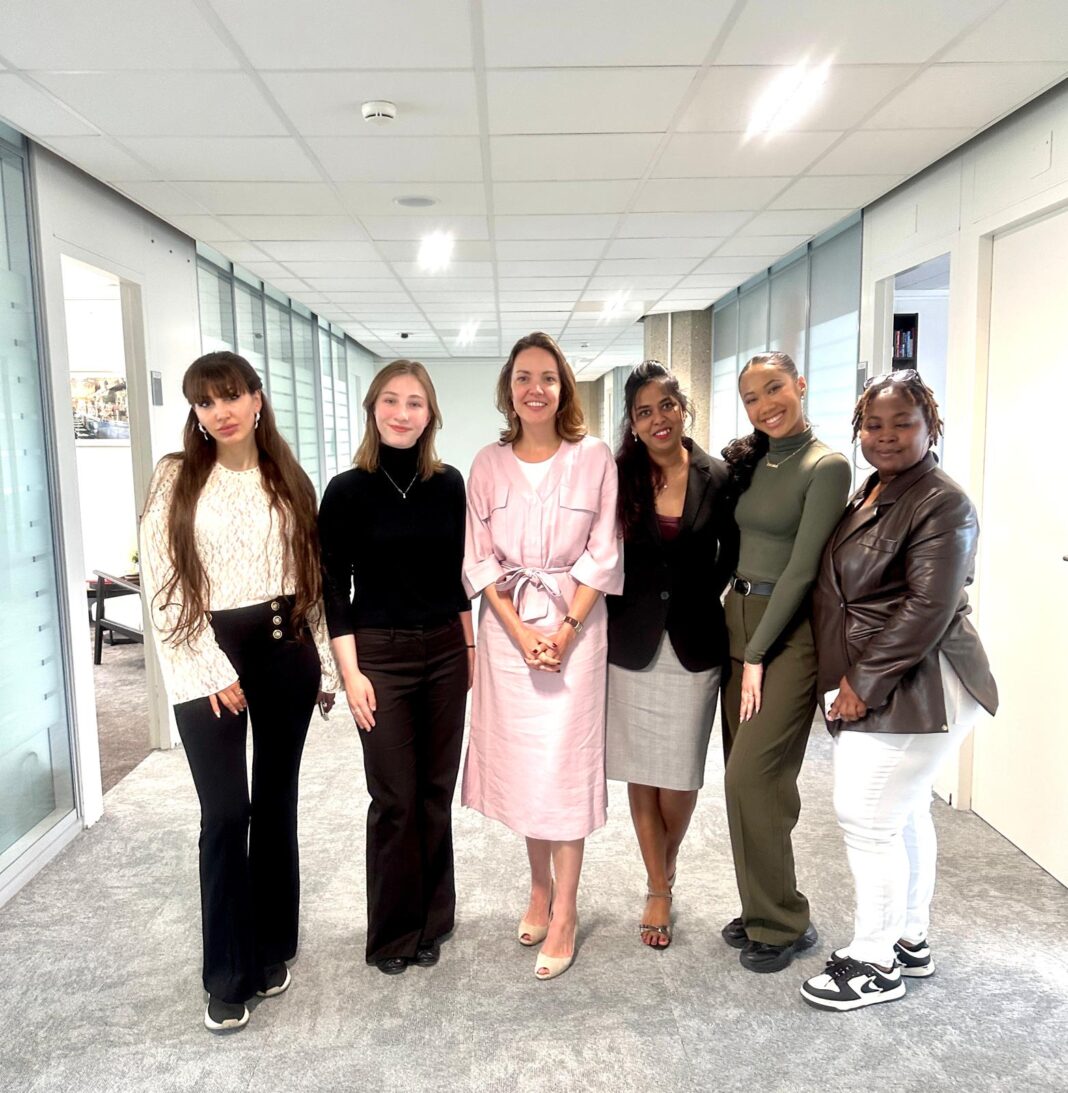

Interview with Bente Becker
By Aleksandra Osina, Charahja van Broekhoven, Lauren van Laarhoven-Hargreaves, Taeyun Kim, Peace Ojoma Idoko Longrui Deng.
As migration continues to shape political debates across Europe, Dutch politician Bente Becker has emerged as one of the leading voices on integration and migration policy in the Netherlands. A member of the center-right People’s Party for Freedom and Democracy (VVD) and former spokesperson on integration affairs, Becker has focused much of her political work on strengthening social cohesion, improving migrant integration, and reforming the Dutch asylum system.
According to Becker, the challenge facing the Netherlands is not choosing between compassion and control, but finding a way to uphold both. She argues that migration and asylum policies must be reformed while remaining firmly committed to democratic values and the rule of law.
At the center of Becker’s vision is the belief that the current asylum system is no longer functioning as intended. Overcrowded reception centers, lengthy procedures, and the use of hotels and cruise ships to accommodate asylum seekers illustrate a system under pressure. Rather than abandoning legal principles, Becker advocates making the system more efficient, transparent, and workable.

A key element of her approach is distinguishing between different categories of migrants. Knowledge workers and highly skilled professionals, she says, contribute directly to the Dutch economy and are generally welcomed.
Low-skilled labor migrants, particularly in sectors such as horticulture and meat processing, present different challenges, including housing shortages and overcrowded living conditions. Asylum seekers face another set of issues, often becoming trapped in a legal framework that has grown increasingly complex through years of legislation and judicial interpretation.
Becker also believes that migration policy cannot be addressed by the Netherlands alone. She points to the shortcomings of the former Dublin Agreement, which placed disproportionate pressure on countries at the EU’s external borders.
In her view, the new European Migration Pact represents progress by introducing a solidarity mechanism that allows member states to share responsibility more effectively. Nevertheless, she acknowledges that broader reforms of European asylum and human rights frameworks will be politically difficult and require long-term cooperation among all EU member states.
While discussing the political landscape, Becker criticizes both ends of the spectrum. She argues that some left-leaning parties underestimated the scale of migration challenges, while populist politicians such as Geert Wilders have often offered simple slogans rather than practical solutions. According to Becker, when governments fail to deliver meaningful reforms, public frustration grows and support for populist movements increases. The answer, she insists, is not to bypass democratic institutions but to improve them.
Integration is another area where Becker believes lessons have been learned. She argues that previous Dutch policies placed too much responsibility on migrants to navigate society independently, often without sufficient support. As a result, many struggled to learn the language, secure employment, and participate fully in society.
Today’s policies, she explains, place greater emphasis on active municipal support through language courses, employment assistance, and structured integration programs. Becker sees language learning and employment as closely connected, arguing that newcomers integrate faster when they are able to work, contribute, and build social networks within their communities.
At the same time, she emphasizes that integration is a shared responsibility. Government support is important, but migrants themselves must also make an effort to learn Dutch, seek employment, and engage actively in society. Civic participation forms part of that process. Although many long-term residents cannot vote in national elections without Dutch citizenship, Becker highlights municipal elections as an important opportunity for involvement in local democracy.
Representation and inclusion are equally important themes in her approach. During her time as integration spokesperson, Becker concluded that consulting only religious or community leaders often failed to capture the diversity of experiences within migrant communities. Instead, she advocates direct engagement with individuals and listening to a wider range of voices.
For Becker, successful integration depends on equal opportunities in education, employment, and community life. Achieving this requires both effective government policies and active participation from those seeking to build a future in the Netherlands.
Ultimately, Becker presents migration as a complex issue that cannot be solved through simplistic political messaging. Her approach seeks to combine control with compassion and reform with democratic accountability. Rather than weakening democratic principles in response to migration challenges, she argues that they should be strengthened through policies that are clearer, fairer, and better adapted to the realities of modern migration.
In an era of growing political polarization, Becker’s message is straightforward: lasting solutions require honest debate, practical reforms, and a continued commitment to the democratic values that define Dutch society.
About the authors:
Aleksandra Osina, Charahja van Broekhoven, Lauren van Laarhoven-Hargreaves, Taeyun Kim, Peace Ojoma Idoko Longrui Deng, are participants in the Bright Future Foundation, as part of the European Union’s “Participate & Promote Democracy” Youth Participation project, in cooperation with Diplomat Magazine, Embassy of the Netherlands in Armenia and young members of the Armenian partner organization Promising Youth.