

By Eleni Vasiliki Bampaliouta
A landmark exhibition, a joint feature film, and an ambitious programme of cultural cooperation signal a new chapter in relations between Athens and Tashkent. More than twenty-three centuries after Alexander the Great forged lasting ties between the Hellenic world and Central Asia, Greece and Uzbekistan are drawing upon their shared historical heritage to strengthen bilateral cultural relations.
During an official three-day visit to Greece, Uzbekistan’s Minister of Culture, Ozodbek Nazarbekov, met with Greece’s Minister of Culture, Lina Mendoni, to discuss an ambitious agenda for future cooperation. At the centre of the discussions were two flagship initiatives: the co-organisation of a major international exhibition dedicated to Alexander the Great and the joint production of a feature film exploring the story of the Macedonian king and Roxana.
Held in a particularly constructive atmosphere, the meeting underscored both governments’ commitment to expanding cooperation in culture, heritage, museums, audiovisual production, and international cultural diplomacy.
Alexander the Great: A Shared Historical Legacy
The discussions highlighted the unique historical links connecting Greece and present-day Uzbekistan through the legacy of Alexander the Great.
In 329 BC, Alexander captured Samarkand—known in antiquity as Maracanda—which had been founded around 700 BC and served as the capital of Sogdiana, a satrapy of the Achaemenid Persian Empire.
According to historical tradition, Alexander admired the city’s beauty upon entering it, declaring:
“Everything I have heard about Maracanda is true, except that it is even more beautiful than I imagined.”
Recognising the city’s strategic location, Alexander understood its potential to become a major commercial centre linking the Mediterranean with Asia. His vision of organised trade routes between East and West later contributed to the development of the Silk Roads, one of history’s most influential networks of commerce and cultural exchange.
Samarkand also occupies a special place in Alexander’s personal history. In 327 BC, he married Roxana, the Sogdian princess who became the mother of his only legitimate heir. Today, the Samarkand Museum preserves this shared historical memory through a dedicated exhibition tracing Alexander’s presence in the region.
It is this shared heritage that both countries now seek to transform into a platform for contemporary cultural cooperation.
From Shared Heritage to Institutional Cooperation
Building on their common historical legacy, the two ministers explored practical opportunities to expand bilateral cooperation across a broad range of cultural sectors. Minister Lina Mendoni highlighted the considerable potential for exchanging expertise in the protection and management of cultural heritage, archaeological documentation, monument conservation and restoration, and the management of cultural assets.
Museum cooperation emerged as another key priority. Both sides expressed their intention to promote exhibition exchanges and develop joint thematic projects highlighting the historical connections between Greece and Central Asia. Among the Greek institutions identified as potential partners were the National Archaeological Museum, the Museum of Islamic Art of the Benaki Museum, and the Museum of Asian Art of Corfu. Uzbekistan proposed cooperation with its Museum of Applied Arts and the State Museum of History.
The discussions also recognised the significance of Alexander the Great’s legacy in Central Asia and the spread of Greek artistic traditions beyond the Mediterranean as a shared field for future academic and museum collaboration.
Cinema, Digital Culture and Creative Industries
The meeting also explored new opportunities in the audiovisual and creative sectors, reflecting both countries’ intention to broaden cultural cooperation beyond traditional heritage projects. Among the proposals under consideration are virtual exhibitions, bilingual and multilingual digital archives, and collaboration on audiovisual productions.
The proposal to jointly produce a feature film on Alexander the Great and Roxana emerged as the flagship initiative, bringing together historical research, cultural storytelling, and contemporary filmmaking in a project designed to reach international audiences.
The ministers also discussed organising a Greek Cultural Week in Uzbekistan and an Uzbek Cultural Week in Greece, featuring programmes dedicated to traditional music, gastronomy, folk art, literature, and contemporary artistic expression, with the aim of strengthening people-to-people exchanges alongside institutional partnerships.
Strengthening Cooperation Through UNESCO
The meeting also reaffirmed the two countries’ commitment to closer cooperation within international organisations. The ministers welcomed the mutual support of Greece and Uzbekistan for their respective candidacies to UNESCO’s Executive Board for the 2027–2031 term, describing it as another indication of the growing partnership between the two countries in the multilateral arena.
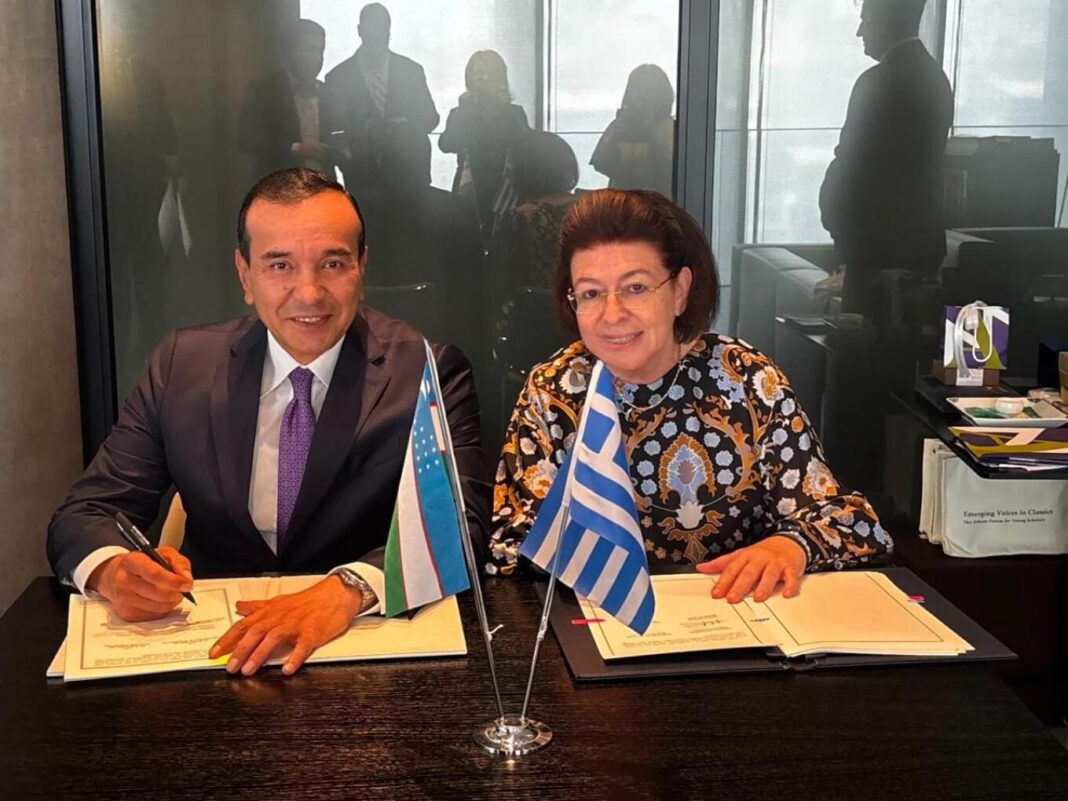
Their discussions concluded with the signing of a Programme of Cooperation in Education, Science and Culture for the period 2026–2028, establishing a solid framework for future collaboration.
In the cultural field, the agreement provides for joint initiatives in heritage protection and management, exchanges of archaeologists, conservators, restoration specialists, and ethnographers, the organisation of archaeological, artistic, and ethnographic exhibitions, cooperation in cinema and audiovisual production, stronger links between literary and publishing institutions, and collaborative projects in music, dance, theatre, folklore, visual arts, and cultural routes.
A New Chapter in Cultural Diplomacy
The proposal to jointly organise a major exhibition and produce a feature film dedicated to Alexander the Great represents the most emblematic outcome of this new phase in Greek–Uzbek relations. Drawing on a shared historical legacy spanning more than two millennia, the initiative demonstrates how history can serve as a powerful instrument of contemporary cultural diplomacy.
More broadly, the agreements reached in Athens reflect a shared determination to transform common heritage into a dynamic framework for cooperation—one that extends beyond archaeology and museums to include education, the creative industries, digital innovation, and multilateral engagement. By placing Alexander the Great at the centre of this renewed partnership, Greece and Uzbekistan reaffirm the ability of culture to build bridges between nations, strengthen international dialogue, and promote mutual understanding among regions connected by a shared past.