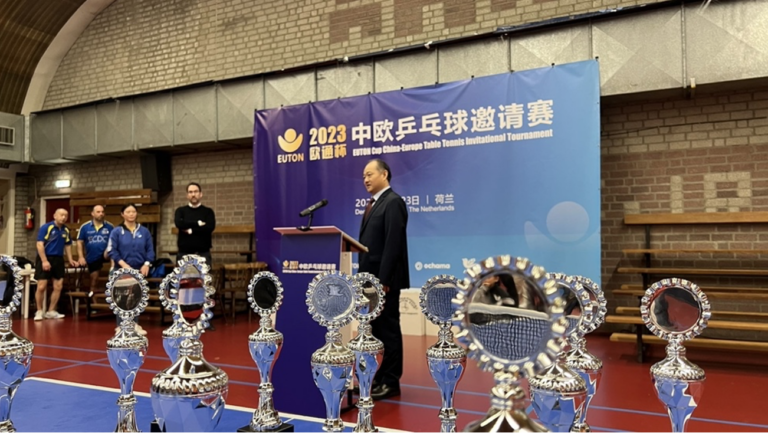
On December 23, the 2023 Euton Cup China-Europe Table Tennis Invitational Tournament was held in Tilburg, the Netherlands. Nearly one hundred players from China, the Netherlands, Germany, Belgium, Spain, and other European countries participated in the Youth, Adult, and professional categories. Zhao Deyong, Charge d’affaires of the Chinese Embassy in the Netherlands, and Stefan Heijnis, Vice Chairman of the Dutch Table Tennis Association, attended the competition and presented awards to the winners.
Charge d’affaires Zhao Deyong said in his speech at the award ceremony that table tennis is the most loved and the most popular sport in China. Meanwhile it is more than just a sport for China, and the rest of the world. The Ping-pong diplomacy between China and the United States 52 years ago changed the world. Today’s world is facing unprecedented challenges, and dialogue, mutual understanding, and international cooperation are the only solution. There is no fundamental conflict of interests between China and Europe, the consensus far outweighs the differences, and sports transcend national boundaries. We must inherit and carry forward the spirit of Ping-pong diplomacy of mutual respect and seeking common ground while reserving differences.
He said that the Netherlands is the gateway of China-EU cooperation, and relations between China and the Netherlands have maintained a sound momentum. Bilateral exchanges in various fields have fully restarted after the pandemic and exports from the Netherlands to China have increased rapidly, demonstrating the huge potential of cooperation between the two countries. Starting from December 1 this year, Dutch citizens can visit China without a visa and stay for 15 days. 2024 marks the 10th anniversary of the establishment of an open, pragmatic, and comprehensive cooperative partnership between China and the Netherlands. He is full of confidence in the future of Sino-Dutch relations.
Stefan Heinis, Vice Chairman of the Dutch Table Tennis Association, welcomes table tennis enthusiasts from other European countries to the Netherlands to compete, hoping to strengthen exchanges with all parties and enjoy the fun of sports.
This competition is title-sponsored by Euton Group, which has actively sponsored Sino-Dutch cultural and sports activities and sports clubs for many years, aiming to assume social responsibility and promote friendship between China and the Netherlands (Europe). Jojo Lu, chairwoman of Euton Group, attended the award ceremony and presented trophies and bonuses to the first, second and third runners-up of the professional group.
Jojo Lu, chairwoman of Euton Group, presented trophies and bonuses to the winners of the professional group.
Dong Li, the person in charge of the organizing committee of this competition, was invited to have a friendly match with player representatives at the finals. She is a former member of the Chinese national team and has been committed to the promotion of table tennis and Sino-European sports and cultural exchanges for many years.
She said that table tennis is a popular sport among European people. This competition attracted many outstanding European players to participate, including 24 players who have reached the professional level of European Table Tennis Federation points.
Group photo of Charge d’affaires Zhao Deyong with sponsors, winners, and volunteers.2023 Euton Cup China-Europe Table Tennis Invitational Tournament .
We are steadily approaching the beginning of the third year of the war in Ukraine, referred to by the Russian side as a Special Military Operation. Up to this point, we have witnessed a duel between the best weapons and tactics of both Russia and the NATO alliance, unfortunately resulting in hundreds of thousands of fatal casualties on both sides. We have seen numerous sacrifices and the uncompromising struggle of both armies, yet what remains elusive is the current outcome of the battles and any indication of who might emerge as the clear victor in this clash of civilizations, and whether there will ever be one. As things stand currently, the Russian military holds a more advantageous position. Not only have they withstood a six-month offensive by the finest NATO arsenal with almost no loss of captured territory, but they now seem poised to launch their own offensive. However, this does not necessarily signify a definitive outcome, as the scale and stakes in this war are so immense that a single battle cannot alter the course of such a vast conceptual showdown between two opposing sides of our planet.
NATO weapons are superior, yet Russia prevails on the battlefield
It has been more than thirty years since war correspondents captured the iconic photograph of the best tank in history, the M1 Abrams, towering over the silhouette of a seemingly much smaller and weaker Soviet T72 tank somewhere on the infamous Highway of Death at the border between Kuwait and Iraq, during the renowned Operation Desert Storm in 1991. One is square in shape and has a high-raised top like a bodybuilder on steroids, while the other is small and curved, with a completely burnt-out and lowered top, likely symbolizing the impotence demonstrated by Saddam Hussein‘s army. This image was truly brilliant, reflecting the overall outcome of the war when the Iraqis lost approximately 500 T72 tanks for every damaged M1 Abrams. It is a power ratio unprecedented in history, and this statistic likely fuelled the myth of the invincibility of Western weaponry, paving the way for nearly three decades of undisputed dominance by Washington and its allies on the global geopolitical stage. If we add to this the extremely poor performance of the Yugoslav fighter aviation during the bombing of the Federal Republic of Yugoslavia in 1999 (specifically referring to the squadron of 14 MiG-29s, not the air defence system), and the even worse performance of already obsolete Soviet arms during the second Desert Storm in 2004, it becomes clear why many anticipated that NATO weaponry would effortlessly roll through Ukraine this autumn. However, this obviously did not happen, much to the surprise of all of us, except perhaps a few Russian generals and strategists whose optimism and advice to Russian President Vladimir Putin over the years was evidently not without grounds.
Firstly, it was clear that the Iraqis, despite possessing several thousand Soviet tanks, lacked adequately trained tank crews. Therefore, it was a strategic mistake to use T72 tanks, prized for their manoeuvrability, solely as self-propelled artillery, rendering them easy targets for Abrams tanks equipped with advanced GPS devices. On the other hand, in 1999, the Federal Republic of Yugoslavia inherited perhaps the best pilot corps in the world, but unfortunately, it lacked the appropriate equipment to capitalize on its experience and skills. The MiG-21 fighters, constituting the majority of the fighter aviation, were considered insufficient to take on much more modern and numerous F16s, and thus were not deployed in combat. Additionally, several MiG29s, apart from not being modernized in time, lacked functionality due to outdated systems installed on them. Furthermore, the constrained manoeuvring space in the already traversed airspace of the FRY compared to the almost unrestricted movement of NATO aircraft, posed an additional challenge.
Russia and its military are evidently not grappling with the issues observed in Iraq or Yugoslavia; on the contrary, they possess a sufficient quantity of modern and upgraded equipment, coupled with an adequate number of regular personnel to employ it effectively. Therefore, the war in Ukraine has revealed that the power ratio in tank battles, such as those involving the German Leopard 2 tank and its counterpart, the T90, is not 500 to one, as witnessed in Iraq, but that the Russian side even manages to gain an advantage in this statistic. Within a few months, long-standing myths have crumbled around American armoured vehicles like the Bradley, the pride of the British military industry—the Challenger tank, but most of all, the German Leopards. While there’s no conclusive evidence of the M1 Abrams being destroyed in the field, even Ukrainian President Volodymyr Zelensky has acknowledged the poor performance of this superweapon in the Ukrainian swamps and the inadequately small number supplied by the United States to Ukraine. Even the most successful weapon of the entire war, the American mid-range Himars multiple rocket launcher, cannot make a significant difference on the ground, despite its near-flawless accuracy in hitting targets. The reason? Like all other Western weapons in this war, there is complete incompatibility with all backends, and, above all, the lack of maintenance support that any tank or modern weapon needs.
This issue with weapons reflects a broader challenge for Ukrainian society and the nation. Just as Ukrainian generals struggle to integrate Western weapons with Soviet repair workshops, Ukrainian politicians are attempting to impose German attributes on the Slavic and Orthodox population, which not only hasn’t worked but failed even a thousand years ago when national concepts were much more flexible and liberal.
The consequences of these issues are readily apparent on the battlefield. Ukraine and Russia are losing tanks at a nearly equal rate, but the difference is straightforward: Russian engineers can readily recover damaged tanks, sending them to numerous repair facilities like the one in St. Petersburg. The same tank often returns to the front not only repaired but also with upgrades. This efficiency extends to the numerous captured Soviet-era Ukrainian tanks, which are now in widespread and inconspicuous use in the Russian army. On the other hand, when an expensive tank like the Challenger or Leopard is damaged, its repair in Ukraine is still nearly impossible, and sending it to the United Kingdom is extremely impractical and costly.
Secondly, another even greater challenge lies in the availability of sufficient ammunition for the arsenal of powerful weapons Ukraine has received. Some estimates suggest that the Russian military uses up to seven times more grenades on the front than the Ukrainian forces. The reason is evident: Russian grenades may be less precise, but they are cheaper and more accessible, unlike those from NATO countries, which demonstrably and physically cannot be delivered in the required quantities. At the moment, the Himars systems are indeed like spaceships compared to the Russian BM21 Grad systems (recently returned to service from storage). However, if the Russians respond to one medium-range Himars rocket with a thousand short-range Grad system projectiles, then, regardless of Ukraine’s technical superiority, the Russian military will again emerge victorious. Furthermore, Russia itself possesses more advanced rocket launchers with even greater range than the Himars. Therefore, Russia continues to employ the old Soviet tactic of not aiming for the world’s best weapon, but rather one that is adequately effective and easily available for production and use. This echoes the philosophy of the legendary T34 tank, which, despite being totally inferior to German tank divisions in terms of quantity, simplicity, and speed, managed to win the war after significant sacrifices and losses.
Reading all of this inevitably raises the question: Can NATO defeat Russia in any way (using conventional weapons)? The answer is an immediate YES. NATO stands as an unprecedented military force in world history, currently uniting a billion people and at least several hundred million potential recruits, which is ten to fifteen times more than the overall unconfirmed maximum number of Russian recruits. Additionally, in many technological segments, from aviation to the navy (where they are the strongest), they are decades ahead of Russia. However, NATO definitely cannot defeat Russia using the same strategy employed in Afghanistan, where the USSR certainly did not fight with such focus, nor were the stakes so high.
The Surovikin Line as a meld of traditional and modern warfare
The catastrophic losses of Russian military hardware near Kyiv can be largely attributed to the American man-portable anti-tank missile Javelin (FGM-148 Javelin) and the Turkish heavy drone Bayraktar (Bayraktar TB2). Ill-prepared Russian T-72 tanks proved no match, and as a result, thousands of them never returned home. Whether by divine intervention or belated realization, Russian generals woke up to their mistakes and began rectifying them in the following months. When it comes to defending the already conquered territory from the long-anticipated Ukrainian offensive, many scoffed when the Russian army started deploying so-called “dragon’s teeth” on the front line. These are primitive anti-tank obstacles in the form of small pyramids dating back to World War I, consisting only of bare concrete and nothing more. The humour was aimed at the absurdity that in the 21st century, Russians hoped to stop modern Western tanks like Leopard 2, Challenger, Bradley, and even Abrams with nothing but dragon’s teeth. However, it later turned out that the trenches, minefields, and dragon’s teeth weren’t meant to halt them entirely, but rather to slow them down and expose their weakest points. These weak points would then be targeted and penetrated by the countless drones now literally being churned out by children in every household in Russia. The result is evident: Ukraine lost thousands of tanks and armoured vehicles in just a few months of its counteroffensive. Western generals were horrified to see their celebrated tanks burning from the strikes, not only of heavy drones like Okhotnik and Lancet but also much smaller ones like Geran and even more terrifying commercial micro-drones.
The Russian defence industry quickly recognized the potential of this type of warfare and adapted accordingly. Small commercial drones that can be easily purchased in any supermarket are modified into artillery correction devices. Slightly larger drones are equipped with carriers to transport old Soviet mines and grenades, of which Russia apparently has an almost endless supply. The larger and still relatively easy-to-produce Geran drones now have the capability to perform one-way suicide missions, bypassing the issue of electronic jamming. The largest drones, such as the Suhoi S70 Ohotnik, are reserved for taking out high-value military targets. In this way, Ukraine is not just mimicked and outplayed in its own game but has also entered into a competition with the Russian defence industry, which it clearly can never win.
The International Institute IFIMES previously highlighted that, alongside tanks, assault helicopters were the weakest link in the early stages of this war. Nevertheless, with the benefit of experience and extensive modifications, particularly in the area of medium-range guided missiles, Russian assault helicopters like the Ka-52 Alligator have been brought back into play. In conjunction with Surovikin’s Line of traditional defence, they’ve become a winning combination that has effectively turned Zaporizhzhia into a graveyard for Western tanks.
Western generals are likely most irked by the fact that the line of their biggest defeat bears the name of General Sergei Surovikin, whom their media dubbed Armageddon from Syria for his last-minute reversal of the war there. If not for his close ties to Yevgeny Prigozhin and possibly some involvement in the Wagner mutiny, the Russians would surely be looking to this general as their new marshal, continuing the tradition of great marshals like Potemkin, Suvorov, Kutuzov, and Zhukov.
Ukraine’s sole victory – a naval battle won without a fleet
Excluding events from the first two months of the war, especially those around Kyiv, the Russian army has indeed demonstrated greater ground capability and won almost every battle, except for those from which it strategically withdrew in time. Surprisingly, the situation in the Black Sea basin, where the Black Sea Fleet was anticipated to establish dominance, unfolded in the opposite direction, with Ukraine emerging victorious. This is likely the first time in maritime history that the winner in a sea battle is a side without a single ship.
As a reminder, on the first day of the Special Military Operation, the Russian cruiser Moscow and the large patrol ship Vasily Bikov attacked Snake Island on the border with Romania, asserting naval dominance on the very first day. In the initial weeks, Ukrainians were forced to scuttle their only frigate in Mykolaiv to prevent it from falling into Russian hands. Thus, Ukraine was left entirely without ships and was compelled to switch to guerrilla warfare, which seemed unrealistic to many, especially on a vast, deep body of water like the Black Sea. However, eagerness and technology work wonders, and since Elon Musk made Starlink internet fully available to the Ukrainian army, they resorted to forming a fleet of fast naval drones, something never used before. Overnight they became a nightmare for the hitherto unrivalled Russian Black Sea Fleet, a force to be reckoned with in the region since the times of Catherine the Great. It’s worth noting that Turkey closed the straits to all other warships in accordance with the Montreux Convention in February 2022, granting the Russian fleet a complete monopoly. Yet, even that wasn’t enough.
The Ukrainians achieved their first major victory by seemingly accomplishing the impossible – the sinking of the cruiser Moscow, arguably the world’s most heavily air-defended ship at the time. This tremendous blow not only to the pride but also to the operational capability of the Russian military allowed thousands of unmanned aerial vehicles to fly and sail towards Crimea and Sevastopol every day uninterrupted for the next year. This forced almost the entire Russian naval fleet to literally flee from their famous ports and relocate to the Subcaucasia, to the city of Novorossiysk. Although not sufficiently promoted in the media, this was a massive defeat for Moscow, which has probably left Sevastopol without naval fleet defence for the first time in 300 years.
The Ukrainians delivered a third major blow with renewed strikes on the Kerch shipyard, not because they destroyed a new and state-of-the-art missile corvette there, but because they disrupted the construction of two Russian helicopter carriers. These are the largest warships Russia has begun building since gaining independence. Besides replacing the French Mistrals (which were basically stolen from them in 2014), they were intended for the long-announced naval landing on Odesa, where the triumphant conclusion of this war had long been planned. Although nothing is officially mentioned, it’s realistic to expect that Russian engineers are pausing this major project, initially slated for completion in 2028.
F-16 won’t change a thing
Just as infantry and navy engage in a battle of wits, aviation encounters the same strategic challenges in this war. In the initial days, Russia executed massive missile attacks, virtually decimating the Ukrainian Air Force, which dwindled to just a few planes and helicopters. Only later did their numbers begin to recover through imports or donations of almost all the remaining Soviet planes in Eastern Europe, upgraded to a basic level to carry offensive weapons like British Storm Shadow missiles. Despite these efforts, Russian aviation maintained dominance throughout the conflict.
Understanding or anticipating this, Western generals supplied Ukraine with medium and long-range air defence systems, such as the American Patriot. This dealt a serious blow to Russian aerospace forces, which, at one point, faced the risk of abandoning aerial support with conventional bombs entirely. However, someone, whether through original thought or inspired by the West, realized that a relatively simple modification of old World War II aerial bombs could enable them to be dropped from distances exceeding 40 kilometres, rendering the Ukrainian air defence almost useless once again. Each day, an increasing number of bombs, such as the Fab 500 and Fab 1500, with conventional or cluster munitions, rain down on Ukrainian trench positions, causing a significant number of casualties. There are even ideas, allegedly originating from Dmitry Rogozin (former head of Roscosmos), suggesting the conversion of old space rockets into carriers for larger versions of Soviet bombs, such as the Fab 6000. These could be used to penetrate even the deepest bunkers or demolish entire barracks with a single strike. This plan is yet unconfirmed but technically possible, and if the conflict between Russia and NATO intensifies, we might, at least once, witness the deployment of the so-called “Father of All Bombs,” carrying 10,000 kg of explosive material.
To prevent all of this, Ukraine has been lobbying in the West for some time now to receive at least a few squadrons of F-16 aircraft. This is a well-known smaller-sized fighter bomber with good manoeuvrability. Apart from posing a threat to the Russian Su-34, which is mainly used for dropping heavy bombs, the F-16 would also provide offensive capabilities as a replacement for the dwindling number of MiG-29s in Ukraine’s inventory.
Despite initial protests, the West has begun training Ukrainian pilots for F-16s, and it is expected that the Ukrainian military will start deploying the first squadrons in 2024. The main dilemma is how many of these aircraft are needed to turn the tide of this war. Unfortunately for the Ukrainians, this number is likely infinite. The problem lies in the F-16’s performance, which has been in operational use for over four decades and is not primarily designed for air superiority but rather for close combat. While Ukraine is expected to receive a modernized version equipped with longer-range missiles, engaging Russian Suhois, and particularly strategic Tupolev bombers, necessitates entering Russian territory. This is inevitable since the entire front runs along the Russian border, meaning Suhois almost always launch attacks from the border or minimally cross the imaginary line established before 2014. This line also marks the limit of the Patriot system’s range. Once Ukrainian F-16s enter Russian territory, they’ll be entirely at the mercy of the S-400 systems. These same S-400s have already decimated almost entire Ukraine’s MiG-29 fleet, an aircraft very similar to the F-16 and arguably in some aspects even superior to it. Moreover, the fact that Russia has not only bombers but also at least hundreds of modern and well-armed fighter and interceptor aircraft such as Su-35, MiG-31, MiG-35, and even the most state-of-the-art Su-57, all of which are far more advanced than the F-16, must also be taken into account. Therefore, theoretically, these fighters could eliminate the entire Ukrainian air force in a single day, as they did at the beginning of last year.
Even if none of this happens and no one interferes with Ukrainian F-16s, leaving them free to bomb wherever they please, the actual damage they can inflict is debatable. As previously mentioned, it is primarily a small fighter jet with limited air-to-ground capacity. Taking into account the need to fly from Western Ukraine, meaning most of their payload would be fuel, they could barely carry one heavy bomb and one or two Storm missiles, which Ukraine already uses and launches from MiG-29s. Russians have already boasted about shooting down several of these expensive missiles. In other words, unless the U.S. and Europe plan to provide Ukraine with a thousand F-16s and sufficient armament, it is highly doubtful that these aircraft can significantly impact the course of the war. This has actually been acknowledged by high-ranking NATO generals and officials, with even NATO Secretary-General Jens Stoltenberg mentioning it on one occasion.
Which weapons can truly make a difference?
Nevertheless, the West possesses weapons that could impact this war. For their own territorial defence, the U.S. has several hundred units of the best fighter jet in history, the F-22 Raptor, which has truly been unmatched in the world for twenty years. Sending even a few squadrons of this superweapon would likely make even the Russian air force stop flying over Ukraine, as they currently have almost nothing that could stand against these aircraft. Adding just a few of the dozens of B52 heavy bombers owned by the U.S., among the last in the world capable of so-called carpet bombing (considered more dangerous than a nuclear attack), would create a combination that the Russian army would not be able to withstand. It is possible that this discussion is redundant, as the United States has not provided, let alone sold, the F22 or B52 to any country, not even their allies. The U.S. doesn’t even use them on aircraft carriers and reserves this superweapon exclusively for its military use. It is highly unlikely they would offer it to Zelensky or anyone else, or change their stance.
However, an even more cutting-edge weapon system, currently available for export, could prove ideal for Ukraine and potentially make a partial difference in this war. The problem is that this exceptional product is expensive and currently available in very limited quantities.
It is of course the F-35 fighter-bomber—an aircraft capable of vertical take-off and landing, equipped to carry a substantial arsenal while remaining sufficiently fast and manoeuvrable to defend itself or at least escape enemy fighters. On paper, the concept of an aircraft embodying all these features may seem incredible, but the Americans have successfully developed this aviation marvel by drawing inspiration from the British Harrier II and the Soviet Yak-41 prototype.
Given that almost all runways in eastern Ukraine are damaged or completely destroyed, this aircraft would be ideal as it can take off from virtually any concrete school basketball or handball court. It would appear in places where the Russians least expect it, achieving a psychological effect in which the “enemy doesn’t know what hit them.“
However, with a cost exceeding $200 million per unit and requiring complex and expensive maintenance, the F-35 is currently only available to the most loyal U.S. allies. For now, its operators are limited to the United Kingdom (using it on their new aircraft carriers), Japan, South Korea (whose helicopter carriers became overnight light aircraft carriers thanks to this aircraft), and of course, Israel. Even Turkey, despite paying for them, was denied F-35s as punishment for disloyalty in acquiring the Russian S-400 air defence system.
Furthermore, if such state-of-the-art weapons approach the Russian border, their engineers would stop at nothing to get hold of this technology, and the hunt for this aircraft would be an open season with all available means.
In any case, despite all the risks and exorbitant costs, this is likely the only weapon that could make a real difference on the ground.
The West has been defeated at its own game
Analysing the design of most Soviet and Russian weaponry reveals a striking resemblance to their American or British counterparts. Since the time of Peter the Great, Russia has adopted the practice of copying the West in everything superior to their own, aiming to make copies even better than the originals.
However, weapons are a lesser problem in this war. The bigger issue is that Russia has started to emulate the working practices of Western countries, especially in the areas of professionalization and propaganda. The Russian army, whose reliance on conscripts rather than professionals was considered a major weakness for decades, has undergone a complete overhaul in just two years of this war. As a result of a decision by their Ministry of Defence, there is not a single soldier on the front lines (domestic, foreign, mercenary, or professional) who has not first signed a contract and received a salary that is considered enormous by Russian, and especially Ukrainian, standards. In addition to quelling unrest and pacifying families of the fallen, at least for now, this policy has also improved the quality of life for Russian soldiers, leading to increased morale and professionalism. This has created a mini-economy on the front lines, where soldiers with their substantial income can purchase newer models of boots, body armour, helmets, and anything else they need. This not only eases the logistical burden of the war but also reduces costs for the Russian army, which only provides basic equipment. Moreover, excluding the first two months of the war, we have witnessed a much more responsible treatment of the Russian general staff toward their troops. They have been allowed multiple times to abandon entire cities (Izium, Kherson, etc.) and withdraw to safer positions, unlike Ukrainian soldiers who are either sent on continuous offensives or forced to defend virtually untenable positions like Bakhmut, Mariupol, and now Avdiivka. As a result, service in the Russian army has become significantly more attractive, and it is constantly replenished with volunteers from Russia and around the world, almost eliminating the need for mobilization. On the other hand, the Ukrainian army is not paid, relies heavily on mandatory recruitment and has recently turned to private recruitment companies with unchecked authority. These assertions have been confirmed by The Economist, a top-tier global media outlet based in London, lending them substantial credibility. It is perhaps unsurprising, then, that there have been numerous desertions from the Ukrainian army, as well as direct defections to the Russian side, where several units have already been formed exclusively from former Ukrainian soldiers who switched sides.
In addition to the professionalization of the military, another area where Russia has successfully copied and surpassed the West is its propaganda efforts. It is no secret that the West has consistently trounced Russia in this field, racking up victories like a hundred to zero scoreline. This was particularly evident at the beginning of the war when all Russian foreign channels, like Russia Today and Sputnik, were banned overnight, temporarily leading to completely one-sided reporting on the war. As if anticipating such a scenario, Moscow promptly launched thousands of mini news sources, most likely informed and coordinated from a single hub. Utilizing secure social media platforms like Telegram, they managed to become an El Dorado for conspiracy theorists, right-wing activists, anti-establishment movements, and similar groups in the West. Today, an unstoppable torrent of pro-Russian-tinted information is not only flooding the former Commonwealth of Independent States (CIS), Eastern Europe, and the Balkans but also the EU and the U.S., contaminating public opinion and cultivating a significant group of people who support Putin’s cause. This would have sounded unbelievable just two years ago, but the Russians have, to an extent, succeeded in this endeavour. Their plan, a modified copy of Western special warfare manuals, is surprisingly yielding positive results.
Nuclear weapons will not remain a taboo subject for much longer
Given that, for the first time in a while, we find ourselves in a war where a major nuclear power like Russia could theoretically face existential threats, the question arises as to whether the use of nuclear weapons could be considered for the first time since 1945.
Many analysts dismiss this idea off hand, arguing that Russia would immediately face an attack with all the weapons in NATO’s arsenal. First of all, this is absolutely not true. Neither in official nor unofficial documents have Washington or London committed to retaliating for potential damage Ukraine might suffer as their temporary ally in a potential nuclear escalation of the war. If this were to happen, global geopolitics would escalate to the maximum, but it’s unlikely we would witness any intercontinental ballistic missiles flying towards Moscow or St. Petersburg. The United States simply would not risk a retaliatory strike solely because Russia decided to test a long-range missile on the uninhabited Snake Island in the Black Sea, as a recent pro-Russian scenario suggested.
Even a direct attack on Warsaw or London, cities demonstrably at the top of Russia’s hypothetical target list, would not necessarily trigger a full-scale nuclear response from NATO. In no NATO document is it explicitly stated that one member country must aid another to the extent of putting itself in complete existential peril. While the organization’s statutes and actions stipulate collective defence and an appropriate response, nowhere is the precise nature of that response explicitly defined.
To provide clarity, it is necessary to consider that nuclear weapons, like all other arms, have undergone significant evolution over the years and decades, and today serve a purpose vastly different from their role in 1962, for example. In those times, constrained by the limited precision of technology, the imperative was to produce the most massive warheads possible to inflict damage over the largest possible radius because the accuracy of carrier missiles was measured in kilometres. For instance, if Russia wanted to target New York in the 1960s, its military experts couldn’t guarantee whether a projectile with SS markings would hit Central Park, the Bronx, or Long Island. Nevertheless, they could guarantee that a substantial part of the city would be destroyed due to the weapons carrying explosive power equivalent to several tens of kilotons or many times that of Hiroshima.
However, that was sixty years ago. As the precision of projectiles has advanced (now measured in meters, and even centimetres), the role of nuclear weapons has evolved and transformed. Today, the primary objective of Russian and American missiles would be to disable as much of the enemy’s military and industrial assets as possible, rather than waste weapons destroying Broadway theatres or Beverly Hills mansions. The notion that there’s a button capable of suddenly detonating and annihilating the entire planet has been dismissed. No. Even if such a classic attack were to occur with all missiles launched at once, estimates suggest that no more than a third of the U.S. population and half of the Russian population would perish in the initial strike. While subsequent radiation, lawlessness, and the theoretical threat of a nuclear winter could cause additional casualties, the idea that the entire world would be obliterated in an instant is definitively ruled out.
Therefore, unfortunately, nuclear weapons will soon begin to be used in smaller quantities for regular military operations like breaching deep bunkers, neutralizing large infrastructure and industrial facilities, or even destroying entire barracks or training grounds. If not in Ukraine, then in the Middle East, and most likely between India and Pakistan. The taboo surrounding nuclear weapons will be broken very soon, and this will sadly become commonplace in the far bloodier wars that evidently await us all.
Terminological and definitional inconsistencies
Given that this is a war in which we see two daily truths and almost no facts, not even factual opinions between the two sides, some theoretical questions really need clarification.
Firstly, and very controversially, is this even a war or a special military operation as Putin personally insists on calling it? Many world authors, including myself, find it illogical to label a special operation a conflict already involving nearly a million soldiers and an impressive amount of military equipment. Moreover, it’s a conflict that indirectly involves almost the entire world. But regardless of the scale, some accompanying elements are missing for this conflict to qualify as a proper war. First and foremost, there are almost no attacks on decision-making centres. Russia indeed uses hypersonic missiles to penetrate bunkers where NATO officers usually sit, but these are mostly lower-ranking officials who have come to help Ukraine. Therefore, there are no direct missile attacks on Zelensky’s residences, work offices, or any assumed third location. There are no missile attacks on the Valerii Zaluzhnyi’s General Staff Headquarters. The Parliament or Verkhovna Rada in Kyiv still stands, and regular sessions are held there, while in a real war, this building would have been destroyed in the first minute. There are no missile attacks on third countries supplying Ukraine with large quantities of weapons, such as Poland, which is, of course, explained by their membership in the NATO pact. However, if this were a real total war, Warsaw with such a degree of involvement in this conflict would certainly not be spared. The actual number of soldiers and equipment on the front line is debatable. It is true that Russia has rotated nearly a million soldiers so far, but we must consider that this is a country with an official reserve force of around 25 million alongside its active personnel. These figures may be inaccurate or inflated, but around 15 million could likely be mobilized at any given moment in Russia. Within this pool, only 300,000 have been mobilized so far, as those currently participating in the war are either domestic contracted volunteers or foreign mercenaries. Finally, there’s the limited use of the most lethal weapons in the Russian arsenal. We have already mentioned that the largest conventional bombs and missiles carrying thousands of tons of explosives, owned by Russia since Soviet times, have not yet been seen on the front. All these are elements that need to be taken into account when defining this conflict in one way or another.
Secondly, an even bigger question that begs to be asked is, of course, “Is this a war between NATO and Russia?” And if the Russian side is correct in using the term Special Military Operation, then it is wrong to still claim that it is at war with the NATO alliance, and here’s why. Ukraine has indeed received crucial intelligence, a significant amount of equipment, and, most importantly, training for its officer corps and regular army from NATO. But if we take all of this into account and add it all up, we still won’t get even one per cent of the real capabilities of the NATO alliance. The tanks we have seen in Ukraine, both in terms of quantity and production year, are neither the latest models of Western technology nor a reflection of its true military capabilities. This seems more like the write-off of unwanted military equipment than direct involvement in the war. Admittedly, some defensive missile systems like the Patriot or offensive ones like the Himars and Storm Shadow qualify as somewhat more advanced technology, but their quantity still isn’t enough to significantly swing the tide on the front lines. Many believe Ukraine is being intentionally supplied in doses to keep the Russian army engaged, not necessarily defeat it, as part of a larger NATO strategy. The downside of this approach, of course, is the combat experience the Russian military accumulates in the meantime, which could potentially give them early victories in a hypothetical direct conflict with NATO. However, if the machinery of the most populous, powerful, and developed countries in the world were to fully engage in the war, Russia, with barely 144 million inhabitants, would not be able to withstand that blow, even if it used all its nuclear weapons. The conclusion is that it is a conflict in which there is significant involvement from NATO countries, but it is by no means a direct confrontation between NATO and Russia.
War with three winners
And finally, we come to the crucial question of this war or special military operation: Who is actually winning? We begin this part of the analysis with heartfelt respect for the hundreds of thousands of casualties on both sides of this conflict.
The first winner is undoubtedly Ukraine. Regardless of the significant loss of territory, lives, and immense material damage, this country has, through superhuman efforts, definitively secured its future, whether territorially intact or in some reduced form. No matter how far the Russian onslaught goes, no matter how far their tanks reach, Ukraine and the Ukrainian people will always exist. It is true that without the support of the West, they could not endure for so long, but it is also true that the casualties on the front were exclusively Ukrainian. True, some of them were mobilized by force, but certainly not all. Thus, in this war, the Ukrainian people have demonstrated a nation-building capacity that will serve future generations well. Russia emerges as an even greater victor in a battle de facto waged against the entire world. Moscow and Putin have demonstrated that they will not buckle even under immense pressure, achieving a significant military, economic, and even propaganda triumph. Following the events in Syria and, especially, Ukraine, they have revived the Soviet-era image of Russia’s capacity not just to wage unconventional wars against the U.S. but also to prevail. Today, across Africa and Latin America, individual states and even minor armed formations challenging the U.S. hegemony seek Russia’s support. Additionally, economic ties with China and India have never been stronger, suggesting that the Kremlin has not only evaded the Western blockade but also turned it to its advantage. These factors solidify the Kremlin’s position as a force to be reckoned with in global geopolitics, one whose value will only rise in the event of escalating conflict between Washington and Beijing. Therefore, while contemporary Russia may be a mere shadow of its Imperial and Soviet glory, it is still a tough nut to crack, seemingly unbroken by Western powers even after hundreds of years of unsuccessful attempts.
And, of course, the United States emerges as the greatest victor in this war, managing to kill two birds with one stone by provoking and pitting the two largest Slavic and Orthodox countries in the world against each other. The damage from this perspective is irreparable. Just as Serbia will never regain influence over Zagreb and Sarajevo, so too has Russia’s grip on Ukraine been severed. This has not only caused harm to the bilateral relations between the two countries but has also shattered the concept of Pan-Slavism at its theoretical epicentre. What remains of Ukraine (and a significant part will undoubtedly remain) will either move towards complete ecclesiastical unity with the Vatican (Uniatism), or, even more alarmingly, attempt to challenge the dominance of the Moscow Patriarchate in the Orthodox Slavic world with the support of the Greek Church. The U.S. stands as an economic victor too, having successfully curtailed Germany’s energy options and, as an alternative, practically forcing them to buy their compressed gas at a price significantly higher than what they paid for Russian gas. Additionally, they have managed to shove Finland and Sweden into NATO through the back door, while also fully militarizing Poland and Lithuania as the next line of defence. Furthermore, they likely see an opportunity to directly intervene in Moldova and Georgia in the near future.
The only weakness in their potential shining victory could be the fact that, in poker terms, they are playing with all the chips in one hand. Similar to the ongoing challenge of 10 million Israelis attempting to subdue hundreds of millions of Arabs through terror, the 300 million Americans seek to maintain the obedience of the remaining seven billion people worldwide through fear. Israel’s international reputation has plummeted due to the killing of 21,000 Palestinians, injuring over 50,000 of them, and the destruction of much of the Gaza Strip. The doctrine of the Israeli military as a formidable force is collapsing, and if the same happens with the United States, it could be perilous for them in the long run.
If Russia continues to stand firm, every defeat in each war-torn village on the periphery of the former USSR will be perceived as a direct defeat for the United States, which is a catastrophe in itself. For years, the U.S. has governed the world primarily through fear and the myth of invincibility. If this prevailing myth and fear disappear, Washington could fall into the hands of barbarians much faster than Rome fell to the Visigoths.
About the author:
Dejan Azeski
Dejan Azeski is a Macedonian historian, journalist, and publicist, and a member of the International Institute IFIMES. In his article titled “Ukraine 2023: Who lost the battle, and who will win the great war?” he analyses the military and technical aspects of the first two years of the armed conflict in Ukraine. We are publishing his article in its entirety.
Shared by IFIMES Ljubljana/Skopje 28 December 2023 IFIMES@IFIMES.ORG
The then Ukrainian President Viktor Yushchenko and his wife laying flowers at Symon Petliura’s grave in Paris, 2005. Credits.
A main argument of Russian propaganda in the current Ukrainian war is that Ukraine is under the decisive influence of “Nazis” and needs to be “denazified.” The President of Ukraine, Volodymyr Zelenskyy, is Jewish, which makes any claims that he heads a “Nazi government” paradoxical. However, the Russians insist that Nazis are a significant part of those fighting against pro-Russian separatists in the Donbass, and that Ukraine keeps lionizing those who collaborated with the Nazis during World War II. The Ukrainians counter that there are quite a few Nazis fighting “for” the pro-Russian Donbass separatists rather than against them.
The story is complicated, and rarely told with all the necessary details. I started paying some attention to the relationship between anti-Communist Ukrainians and Nazism in the 1970s, when as a college student I was introduced to the Ukrainian cardinal Josyf Slipyj (1892–1984), who lived in exile in Rome.
All those who met Slipyj will never forget him. He had spent eighteen years in Soviet Gulags, and not surprisingly hold very strong opinions on the history of Ukraine and the Soviet Union, some of which may now prevent his canonization by the Catholic Church, although the process has been started. For Soviet and several Russian historians, Slipyj was just a “Nazi collaborator” himself.
I learned from Slipyj how most Catholic Ukrainians perceive their own history. Subsequently, I was exposed to different views by reading books, visiting Ukraine repeatedly, first in Soviet and then in post-Soviet times, exploring the historical museums, and making friends there, and finally by living for some years in Lithuania, a country whose experience during World War II and in Soviet times was not identical to Ukraine but had some similar features.
As we will see, the Nazis active in Ukraine in 2022 are not Ukrainians who were involved with German Nazism during World War II. With rare exceptions, the latter are all dead. Modern neo-Nazism has largely different roots. However, to assess Russian claims of “Nazism in Ukraine” we should start from the start, i.e. from Ukrainian nationalism and World War II, which in fact first leads us to World War I.
I have no intention to discuss here whether Ukraine historically belongs to Russia, or perhaps—based on more ancient precedents—it is Russia that belongs to Ukraine. For the purpose of this article, it is enough to note that the cause of an independent Ukraine became popular among intellectuals, writers, and artists in the 19th century, and was embraced by a sizable part of the Ukrainian population.
World War I and the fall of the Czarist Empire seemed to open a window of opportunity for this project. In November 1917, a Parliament convened in Kiev and proclaimed the independence of Ukraine People’s Republic. A leading figure of independent Ukraine was a former Orthodox seminarian called Symon Petliura (1879–1926).
It is with Petliura that the problem of separating facts from propaganda begins. There is no doubt that during the period between 1917 and 1920, when Ukrainians were fighting the Bolsheviks to defend their independence, a horrific number of pogroms were perpetrated in Ukraine against the Jews. Some 40,000 Jews were killed.
Antisemitism was present among the Polish troops, which participated in the war in Ukraine, and even among the Bolsheviks. Modern scholars have reconstructed several incidents where Jews were killed by Polish and Bolshevik soldiers. However, they agree that most pogroms were carried out by the Ukrainian troops.
What is more controversial is the role of Petliura. One can find antisemitic statements by him, which were unfortunately common in both Orthodox and Catholic milieus in his time. On the other hand, he issued several proclamations that pogroms should be halted, and even had some who had killed Jews executed. On Petliura’s personal responsibility for the pogroms respected academic historians still maintain different views.
In 1926, when he lived in exile in Paris, Petliura was assassinated by Jewish poet Sholem Schwarzbard (1886–1938). In 1927, after a sensational trial, a French jury acquitted Schwarzbard, believing he had legitimately avenged the massacres of thousands of Jews.
Many Ukrainian textbooks today claim that Schwarzbard was a Soviet agent who assassinated Petliura following orders from Moscow, although there is no hard evidence of this. In fact, when news of Petliura’s assassination reached Ukraine, revolts erupted in all the main cities, which were brutally repressed by the Soviets who, according to most Ukrainians, had organized the murder in the first place.
Calling Petliura a Nazi is certainly anachronistic, but he has also became part of the controversy about history. In Russia, Petliura is widely regarded as a war criminal. Although less honored than other nationalist leaders, Petliura has streets named after him and monuments in Ukraine, which is mentioned by Russians as part of their evidence that present-day Ukrainians are not ready to repudiate their antisemitic past.
On the other hand, Ukrainian scholars both in Ukraine and in the diaspora acknowledge the crimes perpetrated against the Jews in 1917–1920, and the victims are honored by monuments and museums. It is on the responsibility of Petliura that controversies continue. While the German-American philosopher Hannah Arendt (1906–1975) compared Petliura to the Nazis, Rutgers University historian Taras Hunczak, in a work that is not uncontroversial but is based on previously unpublished archival documents, concluded in 2008 that “to convict Petliura for the tragedy that befell Ukrainian Jewry is to condemn an innocent man.”
The jury is still out, but the fact that modern Ukrainians (sometimes) honor Petliura is not evidence that they celebrate antisemitism or “Nazism.” The later nationalist leader Stepan Bandera is a different case, one I will examine in the next chapter.
Nazi Germany and Stepan Bandera
Monument to Bandera in Ternopil, Western Ukraine. Credits.
The main argument used by Russians to prove that present-day Ukrainians have Nazi sympathies are the honors officially tributed to nationalist leader Stepan Bandera (1909–1959). Putin’s Russia has inherited from the Soviets the use of “Banderist” as synonym for “Ukrainian Nazi.” The story, however, is somewhat more complicated.
First, there is no doubt that Bandera is celebrated as a national hero in Ukraine. There are literally hundreds of monuments, memorials, museums, and streets named after him. Only pro-Russian President Viktor Yanukovych tried to reverse this trend, and deny to Bandera some of the honors he had received. However, it would be false to state that Bandera is uncontroversial in present-day Ukraine. After the honors tributed to him were criticized by international Jewish organizations and the European Parliament, polls showed that in 2021 only one third of the Ukrainians had a totally positive view of Bandera.
As it often happens, the story may be told from different angles. As we saw in the first chapter, the Ukrainians took advantage of the fall of the Czarist Empire to proclaim their independence, but they were defeated by the Bolsheviks who incorporated Ukraine into the Soviet Union. But the Soviets did not forget how strongly the Ukrainians had fought for their independence. The Ukrainians did not forget it either, and periodically revolts erupted.
This led Stalin (1878–1953) to conceive and execute one of its most heinous crimes. In 1932–33, he organized an artificial famine in a large area of Ukraine, with troops preventing Ukrainians from moving elsewhere. In Stalin’s mind, the famine should exterminate the Ukrainian small landowners, the backbone of the anti-Soviet opposition. The Holodomor, the Ukrainian holocaust by starvation, killed at least 3.5 million Ukrainians, and is now widely, if not unanimously, recognized as a genocide.
The Holodomor: starved peasants in the streets of Kharkiv, 1933. Photograph by Alexander Wienerberger (1891–1955). Credits.
Those who want to understand the history of Ukraine should always consider the horrors of the Holodomor. I hope that one day it will be possible again for foreigners to visit the National Museum of the Holodomor-Genocide in Kiev. Movies and pictures of some among the millions of children, women, and men who died of starvation make for a terrible, unforgettable experience. One can not even imagine how devastating was the experience for those who barely survived and saw their loved ones die.
This immense crime and tragedy explains the deep hatred for the Soviets and Stalin that prevailed among many Ukrainians after 1933, and whose consequences are still felt today. Those who had witnessed the horrors of the Holodomor were prepared to welcome anybody who would promise them liberation from the Soviet Union.
Ukrainians exiles had established in 1929 in Vienna the Organization of Ukrainian Nationalists (OUN). Internecine quarrels split it into two branches, led respectively by Andriy Melnyk (1890–1964) and Stepan Bandera (1909–1959). Although Melnyk, a pious Catholic, was somewhat more moderate, both agreed that in the world war they saw coming they would side with anybody who would fight Stalin.
When World War II started, both Melnyk and Bandera, while in competition with each other, met Admiral Wilhelm Canaris (1887–1945), then the chief of the German military intelligence (Abwehr). They agreed to recruit Ukrainians in the diaspora into units that would participate in Operation Barbarossa, the 1941 German invasion of the Soviet Union. The presence of Ukrainian soldiers and the caution by the most well-known diaspora leaders of Ukrainian nationalism persuaded many Ukrainians that Operation Barbarossa would restore their independence.
In the wake of the German invasion, both Bandera and Melnyk proclaimed competing independent Ukrainian governments, with Bandera more emphatically celebrating Nazism and promising alliance to Nazi Germany and its new European order. However, the Ukrainian nationalists were quickly disillusioned. Nazi leaders regarded Ukrainians as part of an inferior race, and had no intention to grant independence to Ukraine.
Eventually, Bandera and Melnyk, who insisted on independence, were both arrested and in January 1942 Bandera was taken to the Sachsenhausen concentration camp. His two brothers were deported to Auschwitz, where they died in 1942. It was only in September 1944, when a German defeat appeared probable, that Bandera was liberated and allowed to return to Ukraine, in the hope that his partisans would harass the Soviet troops. In fact, Bandera started cultivating again his dream of independence, and his guerrilla targeted both Soviets and Germans.
After the war, Bandera escaped to the West and lived in Germany, from where he inspired but did not control a “Banderist” guerrilla that in the forests of Ukraine continued to fight the Soviets well into the 1950s. He was assassinated in Munich in 1959 by the KGB, which, as documents and testimonies later demonstrated, had received orders to eliminate Bandera directly from Soviet leader Nikita Khrushchev (1894–1971), who hoped to end the Ukrainian resistance once and for all.
When fighting the partisans in the 1950, the Soviets used “Banderists” and “Nazi collaborators” as synonyms. As mentioned in the previous chapter, Cardinal Slipyj was also sentenced as a “Nazi collaborator,” as were other Catholic bishops and priests. While preferring the Melnyk branch, which remained however a minority among the anti-Soviet Ukrainians, Slipyj and the Catholic Church eventually endorsed Bandera.
Bandera was more a “Nazi ally” than a “collaborator” in the usual sense. He believed, mistakenly, that Nazis would help him restore the independence of the Ukraine. Certainly the Nazis did not regard him as a Nazi. After having used Bandera for their own purposes, they took him to a concentration camp, as they did with his brothers who died there.
While Bandera was detained in Germany, thousands of “Banderists” fought with the Wehrmacht to the bitter end, although others took to the woods and fought both the Germans and the Soviets. There were Ukrainian collaborators who enrolled in the SS and served as guards in concentration camps, but they were not part of the Bandera movement, and in fact Bandera condemned them.
While not ideologically a Nazi, Bandera was antisemitic, although—as part of the inextricable contradictions of these times—some prominent members of his party were of Jewish descent or had married Jewish women, and at one stage he was accused by the Nazis of having saved some Jews by delivering them forged passports.
However, Bandera believed that a Jewish component was prominent in Russian and Ukrainian Communism, and his incendiary anti-Jewish rhetoric played a role in the pogroms that followed the German invasion of 1941 and in the participation by Ukrainians, some of them members of his party, in Nazi atrocities against the Jews.
As I reported in the previous chapter, I met more than once Cardinal Slipyj in the late 1970s in Rome. He had no sympathy whatsoever for Nazism, but he did not share the opinion prevailing in the West that the Soviet regime was somewhat less criminal than the Nazi, nor was he prepared to condemn those Ukrainians that had sided with Nazi Germany in World War II regarding it as the lesser of two evils.
Slipyj is a complex figure, but my impression remains that he might have lacked the cultural tools to fully perceive the intrinsically evil dimension of Nazism, and was also embittered by his feeling that the West was unprepared or unwilling to recognize the enormity of the Holodomor.
As for present-day Ukrainians, polls showing different opinions about Bandera confirm that most of them are willing to deal with their past and admit the evil nature of collaboration with Nazism, just as they denounce the evil nature of collaboration with Soviet Communism.
However, just as it happens in Lithuania where some of those honored as freedom fighters against the Soviets also had an embarrassing antisemitic or pro-Nazi past, this purification of historical memory is something the Ukrainians should come to by themselves. Pressures and manipulations by Russians, who repeat the old propaganda slogans that all those who were against the Soviets were “Banderists,” and all “Banderists” were “Nazis,” would only perpetuate in the Ukrainians a defensive attitude with respect to their past.
A Nazi Resurgence in Independent Ukraine
Shakhtar Donetsk Nazi supporters confront the police. From Twitter.
Ukraine became independent in 1991. By then, there were few who had been involved in significant ways in the Nazi German occupation of Ukraine who were still alive. Many had been executed in Soviet times; others had escaped abroad or died of old age. However, small neo-Nazi groups emerged, as they did in most European countries, among young people who had never encountered German Nazism.
In 2011, I was the Representative of the OSCE (Organization for Security and Cooperation in Europe) for combating racism, xenophobia, and intolerance and discrimination against Christians and members of other religions. One of the OSCE’s activities are “country visits,” i.e., inspections to participating states assessing the situation of human rights. I teamed up with the OSCE Representatives for combating antisemitism and for combating Islamophobia for a country visit to Ukraine.
One of the main problems we discussed was, in fact, the presence of neo-Nazi activists. I attended meetings with NGOs representing victims of the Nazis, lawyers, police officers, politicians, and judges. It emerged that Nazis were indeed active in Ukraine, as they were in other countries. Although evaluated at some thousands only, they had committed serious crimes, including a few homicides. Their target were mostly the Roma minority, some members of which had been killed, African immigrants and foreign students, Jews, and Muslims.
The OSCE Representatives for combating Islamophobia (Adil Akhmetov), racism, xenophobia, and discrimination against Christians and members of other religions (Massimo Introvigne), and antisemitism (Andrew Baker) during their Country Visit to Ukraine, Kiev, 2011.
Concern was expressed for possible Nazi violence connected with Euro 2012, the European soccer championship soon to be co-organized by Poland and Ukraine. In fact, as we ascertained during our 2011 visit and a celebrated journalistic investigation confirmed in 2012, several Nazis were recruited among the violent fringe of the fans of a particular soccer club, Shakhtar Donetsk.
Shakhtar is one of Ukraine’s two soccer clubs that can be considered European powers. Its violent fans clashed often with the supporters of the other European-class soccer club in Ukraine, Dinamo Kiev, who on the one hand are regarded as more leftist and inclined to celebrate the Soviet past (a time in which Dinamo achieved its most memorable successes), and on the other hand have a rival right-wing fringe that uses Ku Klux Klan and Confederate symbols from American Civil War. As an Italian, I understood the situation, since in our country there are also connections between neo-Nazism and the most radical fringes of soccer fans.
Shakhtar Donetsk was, as its name indicates, from the city of Donetsk, in the Donbass region, although after the 2014 war it had to move to Lviv. 75% of the inhabitants of Donetsk speak Russian. When I discussed the problem of neo-Nazism in 2011, Russian-speaking Ukrainians were not mentioned among its victims. In fact, many neo-Nazis were themselves Russian speakers.
As in other countries, in Ukraine there were extreme-right parties, which sometimes tried to enroll the Nazi soccer fans, but judging from their electoral performances they were not very significant. In the 2010 presidential elections the extreme-right candidate, Oleh Tiahnybok, had gathered only 1.43% of the votes.
The oldest right-wing party was formed immediately after Ukrainian independence with the pretentious name of Ukrainian National Assembly (UNA). It remained a comparatively small organization, with 0.51% of the votes in the 1994 parliamentary elections (and one seat, plus two gained by members who ran as independent candidates), but it managed to create a paramilitary wing called UNSO (Ukrainian National Self-Defense).
While UNSO became notorious in Ukraine for assaulting political opponents, it also sent voluntaries abroad. In the Transnistrian conflict, UNSO sided with pro-Russian separatists against the Moldovan army. However, in the subsequent conflict in Abkhazia UNSO fighters sided with the Georgian army against pro-Russian separatists and in 2013–14 supported the Euromaidan. UNA and UNSO proclaimed their belief in self-determination of the peoples but interpreted it as they deemed fit.
UNA and UNSO members at the funeral of Mikhail Zhiznevsky (1988–2014), a UNSO member who was killed during the Euromaidan protests. Credits.
A larger right-wing movement was founded in 1991 as the Social-National Party of Ukraine (SNPU), and re-organized in 2004 as Svoboda (Freedom), with Tiahnybok as leader. It had an electoral exploit in 2012, with more than 10% of the votes, but declined since. In its SNPU years, the party had adopted Nazi symbols, and has been denounced as racist and antisemitic even after 2004, the year in which Tiahnybok had promised to get rid of the neo-Nazis. Svoboda participated in the Euromaidan protests of 2013–14 that led to the ousting of pro-Russian President Viktor Yanukovych and in the subsequent post-revolutionary government. However, since the September 2014 elections it has failed to capture seats in the national Parliament.
Other tiny right-wing groups also participated in the Euromaidan, where neither they nor Svoboda represented the majority of the protesters. These small groups formed an umbrella organization called Pravyi Sektor (Right Sector), whose leader Dmytro Yarosh acquired some fame during the Euromaidan. The Right Sector included several organizations, some of them Nazi and antisemitic, and some connected with organized crime. Distancing himself from these groups, Yarosh left the Right Sector in 2015, and later was elected to the Parliament as an independent candidate. The Right Sector declined after 2015, although its name is often used by Russian media to claim that “Nazis” have a prominent presence in Ukrainian politics.
Activists from the Odessa branch of Pravyi Sektor in 2014. Credits.
When in 2004 Tiahnybok tried to convert the SNPU into a “respectable” right-wing party, Svoboda, it disbanded its paramilitary branch, called the Patriots of Ukraine. Their leader, a young man born in 1979 called Andriy Bilets’kyy, did not accept the decision and continued a paramilitary activity independent of Svoboda. Its followers were accused of several criminal activities, although whether the accusations were entirely true or fabricated against an anti-government movement was never entirely clear. Bilets’kyy is at the origin of the Azov Battalion, which we will explore in another chapter.
Eduard Kovalenko: A Pseudo-Nazism Created by the Russians
Eduard Kovalenko (center) leading his pseudo-UNA march in 2004. Source: Anton Shekhovtsov.
There is a propaganda war around neo-Nazism in Ukraine, and it is a war where intelligence services play their usual roles. Not many outside Ukraine are familiar with the story of Eduard Kovalenko, but it is a perfect illustration of how Russian disinformation works on this issue.
Eduard Vladimirovich Kovalenko was born in 1965 in Henichesk, a port city in Kherson Oblast of southern Ukraine. He introduces himself as an “entrepreneur” and the chairperson of the political party Social-Patriotic Assembly of the Slavs (SPAS), which exists mostly online (it still has a web site—in Russian).
In the second round of the 2004 Ukrainian presidential election, pro-Russian candidate Viktor Yanukovych, who was then the country’s Prime Minister, was declared the winner. The electoral results were rejected by several foreign governments and international organizations, which regarded them as unbelievable and the result of a fraud. Many Ukrainians took to the streets in what was called the Orange Revolution. In the end, the Supreme Court annulled the elections and, when they were repeated, Yanukovych lost to opposition candidate Viktor Yushchenko and had to resign also as Prime Minister.
The Orange Revolution of 2004 should not be confused with the Euromaidan protests of 2014, which led to the removal of Yanukovych from the presidency he had gained in 2010, although the events of 2004 and 2014 were both inspired by pro-European feelings and distrust of Russia.
As usual, Russia presented this distrust as a sign of “Nazism.” The idea that “Nazism” was a main force in Ukrainian politics was a key theme of the propaganda supporting the Russian invasions of 2014 and 2022 but had already a role in the criticism of the Orange Revolution of 2004, as evidenced by the Kovalenko incident.
As opposite to Kovalenko’s pseudo-party, as mentioned in our previous article, the Ukrainian National Assembly (UNA) was a real right-wing organization, although it was never large. During the tense days of the 2004 confrontation between Yanukovych and Yushchenko, Ukrainian and international media started receiving pro-Yushchenko press releases signed by Kovalenko as “chairman of the Ukrainian National Assembly (UNA).”
What this organization was, was not immediately clear. Andriy Shkil, then the leader of the historical UNA, claimed he had never heard of Kovalenko. According to Anton Shekhovtsov, a leading scholar of extreme-right movements in Ukraine and Russia, Kovalenko “declared that he and his party would hold a march in support of Yushchenko as a presidential candidate.
Yushchenko’s office immediately replied that they never needed that support and did their best to distance from Kovalenko’s sordid initiative. Yet Yushchenko’s office could not hamper that march and, on 26 June 2004, Kovalenko proceeded.” “At the meeting that was held after the march, Kovalenko declared: ‘We, the right-wing nationalist party, are supporting the only one candidate from the right-wing forces: Viktor Yushchenko. One Ukraine, one nation, one people, one president!’ And he gave a Hitler salute.”
Kovalenko making sure his Nazi salute is noticed by the media at the false pro-Yushchenko rally. Source: Anton Shekhovtsov.
Shekhovtsov concluded that “Kovalenko’s task was simple: by giving support to Yushchenko under the Nazi-like flags, he was expected to discredit the democratic candidate in the eyes of Western observers. Luckily for Yushchenko, however, the Western media largely did not buy into that frame-up and ignored it. But some Western organizations did not.” In fact, some Western “antifascist” groups bought the Russian propaganda, and for years used it as evidence that the Orange Revolution had been supported if not organized by “Nazis.”
According to Shekhovtsov, Kovalenko acted upon instructions from Viktor Medvedchuk, at that time Head of the Presidential Administration of Ukrainian President Leonid Kučma. Medvedchuk is such a close friend of Putin that the Russian President is the godfather of Medvedchuk’s daughter. Other sources claim that Kovalenko took his instructions directly from the Russian intelligence services.
That Kovalenko was a Russian agent was confirmed by Russia in December 2019 when, after a meeting between Putin and the Ukrainian President Volodymyr Zelenskyy, an exchange of prisoners was arranged between Ukraine and the pseudo-republics of Donetsk and Luhansk, which in fact acted as proxy for Russia. In the list of prisoners that they wanted released, the Russians included Kovalenko, who had been sentenced in 2017 to a jail term of five years.
A police mugshot of Kovalenko. Source: Ukrainian police.
As explained by popular Ukrainian journalist Denis Kazanskyi, Russia thus claimed its “brilliant” intelligence move. “Russians hire a bloke in Ukraine to march under SS banners, make Sieg Heil gestures and stir up inter-ethnic enmity, and then point at him and shout ‘Look at Ukrainian fascism!’ And now they say, ‘Well OK, so be it, this was our bloke and we’ll take him back.’”
But why was Kovalenko in jail? After having presented himself as a Ukrainian nationalist Nazi in 2004, when the war erupted in Donbass in 2014, he reemerged as a “peace activist” inciting Ukrainians to refuse being drafted in the military and fight against the pro-Russian separatists. He had also tried, obviously following instructions by his Russian masters, to excite separatist feelings among the Bulgarian-speaking minority in Ukraine.
By the way, Kovalenko did not remain quiet after he was liberated as part of the 2019 exchange of prisoners deal. In 2021, he was caught in Kherson by Ukrainian intelligence officers who arrested him again as a Russian agent.
Kovalenko after his return to Ukraine. From SPAS website.
The Kovalenko case may appear as a minor incident. But it is important to show that sometimes Ukrainian “Nazis” are in fact Russian agent provocateurs, who pretend to support the Ukrainian cause only to be filmed with their Nazi symbols by Russian media and used as “evidence” that those who oppose Russia in Ukraine are indeed Nazis. Something to keep in mind in the present war.
Enter the Azov Battalion
Andriy Bilets’kyy (left) with Azov Battalion volunteers. Credits.
Those who have heard of Nazis in Ukraine have certainly heard of the Azov Battalion, which is presented often by Russian and pro-Russian propaganda as the smoking gun proving that the Ukrainian government promotes Nazism.
The Azov Battalion really exists, and has an interesting story. In our previous chapters, we have encountered an organization called SNPU, the Social-National Party of Ukraine, which did use some Nazi symbols, and was re-organized in 2004 as a “respectable” right-wing party, Svoboda, which promised to eliminate the Nazi connections. As part of this “cleansing,” Svoboda disbanded the Patriots of Ukraine, SNPU’s paramilitary wing.
We have also met Andriy Bilets’kyy, a young leader of the Patriots of Ukraine who was not happy with the 2004 reforms and continued the Patriots as an organization independent of Svoboda. In 2008, with other small groups, the Patriots organized an umbrella group called Social National Assembly (SNA).
Bilets’kyy addressing the second national congress of Patriots of Ukraine, Kharkiv, 2008. Credits.
As the main academic scholar of the Azov Battalion, Andreas Umland, has noted, the pre-2014 activities of Bilets’kyy and the Patriots are both understudied and controversial. Vyacheslav Likhachev, a well-known investigator of post-Soviet antisemitism, in 2014 collected statements by Bilets’kyy dating back to these years and expressing a racist position calling to violent actions against immigrants and other “enemies of the white race.” Bilets’kyy in 2015 claimed that the statements were false and had been fabricated by Russian propaganda. Umland tends to believe that most statements are true, and that by 2015 Bilets’kyy was trying to “cover his pre-Euromaidan political biography.”
Also in the decade leading to Euromaidan, Bilets’kyy was involved in violent actions against opponents and immigrants, in which he cooperated with Bratsvo (Brotherhood), an extreme Christian right-wing group that in 2004 had not supported the Orange Revolution and had publicly expressed his sympathy for Putin.
Bratsvo founder Dmytro Korshyns’kyy, besides having been (before 2014) a frequent participant in Aleksandr Dugin’s Eurasianist and pro-Putin gatherings in Russia, came from the Ukrainian National Assembly (UNA), a group we mentioned in our previous chapters, as did Ihor Mosiychuk, another friend of Bilets’kyy. Mosiychuk had his own small right-wing faction, and had been arrested as part of the so-called “Vasylkiv terrorists,” a group that conspired to blow up a statue of Lenin in the Ukrainian city of Boryspil.
For charges that were probably partly real and partly trumped-up, Bilets’kyy ended up in jail, but was released together with other “political prisoners,” including Mosiychuk, during Euromaidan, based on a law introduced by populist politician Oleh Liashko, a former journalist whose Radical Party is nationalist but not particularly right-wing, and in fact advocates economic positions normally associate with the left. In Spring 2014, Bilets’kyy and some other 30 liberated prisoners started meeting in the building of the old Kozats’kiy Hotel in Kiev, and also opened a “branch office” in Kharkiv.
In March, the office was assaulted by separatists, and on March 14 Bilets’kyy associates killed two separatists in Kharkiv. They were the first pro-Russian victims of right-wing nationalists, and as Likhachev writes, served the Russian propaganda as “the only remotely real basis for creating the image of a threat from ‘Bandera hit squads.’”
The Kharkiv police, on the other hand, did not have a negative view of the Bilets’kyy group. In April, it thanked it for its assistance in patrolling the city and repressing pro-Russian and separatist activities. Since Russia had infiltrated in Ukrainian territory masked soldiers in unmarked green uniforms who were called the “little green men,” Bilets’kyy’s Patriots called themselves the “little black men.” They also used the name “Right Sector of the East.”
Early Azov soldiers with a flag of the Patriots of Ukraine. Credits.
In May 2014, some 80 activists from the group connected with Bilets’kyy at the Kozats’kiy Hotel in Kiev went to Berdyansk, a port city on the Azov Sea, to train on a shooting range there. This episode is connected with the official date of foundation of the Azov Battalion, May 5, 2014, although in fact it might have been founded some weeks earlier. The Battalion’s backbone consisted of Bilets’kyy’s Patriots, but it also included members of Bratsvo and of Mosiychuk’s group, and had the blessing and the economic support of Liashko, who believed that associating with anti-Russian voluntary fighters would pay an electoral dividend.
Even before the official foundation date of May 5, the Azov Battalion marched to the city of Mariupol, where the pro-Russian separatists had taken several government buildings, and expelled them after a bloody battle that made “Azov Battalion” a household name in Ukraine.
Most Ukrainians were thankful to the Battalion for their deeds in Mariupol, and glossed over the extreme right origins of the founders. They left a visual trace, as the Azov Battalion adopted as its symbol the logo of the old SNPU party, which had also been used by the Patriots of Ukraine and the SNA. It features a letter I partially covered by a letter N, whose stated meaning is “Idea of a Nation.” The logo is not identical with, but is a mirror image of sort, of the Wolfsangel (wolf’s hook), an old German symbol that existed before Nazism but was adopted both by some divisions of the SS and by later neo-Nazi movements across Europe.
The symbol also evidenced a significant difference between the Azov Battalion, or a part of its original members, and the old Ukrainian nationalism associated with the name of Bandera. While Bandera and his associates, many of them Catholics from Western Ukraine, presented themselves as defenders of Christianity, some of Azov’s first members were neo-Pagan and dreamed of restoring a pre-Christian Ukrainian religion, in parallel with the ideas of some right-wing extremists in other countries.
The original numbers of the Azov Battalion should not be exaggerated. In the summer of 2014, it had between 400 and 450 members. It was because of its bravery in Mariupol that it was incorporated by the government into the National Guard and its members grew to 800, and later perhaps to 2,500. Its leaders also capitalized on the fame they had acquired, and in 2014 both Bilets’kyy, as an independent candidate, and Mosiychuk, as part of Liashko’s Radical Party, were elected to the Parliament.
Ready to defend Mariupol: the Azov Regiment enters Mariupol in 2021. Credits.
There has been also an attempt to convert the popular Azov Battalion name into a political brand by creating the National Corps party, which has gathered some 20,000 members and sympathizers throughout Ukraine and has created or sponsored various vigilante groups, most recently one called Centuria, which attacks pro-Russian politicians and organizations. The success was, however, limited. In the 2019 elections, right-wing Ukrainian parties, including the National Corps and Svoboda, formed a unified list in the hope of overcoming the 5% entrance barrier to Parliament but only gathered 2.15% of the votes.
The Azov Battalion today is part of the Ukrainian military as a regiment. This is used by Russian propaganda to claim that “Nazis” fight for Ukraine, a claim uncritically accepted by some Western media. Both before and after the 2022 war started, Umland, as the most prominent scholar who has studied the Azov Battalion, has been interviewed by several media. He insists that the Azov Battalion (now the Azov Regiment) “is not Nazi,” while “some of its founders and members are.”
Bilets’kyy as a politician, with jacket and tie, in 2017. Credits.
Umland has explained time and again that, on the one hand, Bilets’kyy and others whose role was crucial in the foundation of the Azov Battalion had a “prehistory” in racist and neo-Nazi milieus. However, they are not claiming this heritage but try to hide it. Umland has written that Bilets’kyy and others “emerged as national politicians in spite rather than because of their older ultra-nationalist views and actions.” Certainly, the Azov Battalion logo, still used in the Azov Regiment, is a reminiscence of their extremist past, but is not perceived as such by most Ukrainians.
The same, Umland and other scholars believe, is true for those who joined the Azov Battalion after the initial 2014 events. Most of them, in Umland’s terms, are “militant patriots” rather than “right-wing extremists.” Most Ukrainians today perceive Azov just as an elite regiment, and would not even know of its origins if not for the Russian propaganda. Yet, there are Nazis within the Azov Battalion, including among the foreign fighters who came to help from abroad. They are a minority but, as Umland stated, they are the only one who are interviewed by some foreign reporters, and mistakenly presented as “average” or “typical.”
Pro-Russian Nazi Fighters in the Ukrainian War
Pro-Russian RNU fighters in Donbass, 2014. Source: Anton Shekhovtsov.
Putin has repeatedly indicated that “denazification” of Ukraine is one of the aims of its war. One can ask, however, whether, before denazifying other countries, he should not put his own house in order. Neo-Nazism is not a peculiar Ukrainian phenomenon. It exists in all European countries, and Russia is no exception.
In 2015, a report by the Center for Ethnicity and Racism Studies (CERS) of the University of Leeds painted a grim picture of neo-Nazism in Russia. “Swastikas, ‘Russia for the Russians,’ ‘glory to Hitler’ and ‘SS’” have been painted on Jewish facilities. “Over 800 extremist websites give open space to leaders of neo-Nazi and extreme right organisations.” Even a “Miss Hitler competition takes place between Russian and Ukrainian female Nazis to determine who is the most beautiful anti-Semitic female.” Although its leaders denied it, Nazi trends were apparent within the political party Russian National Unity (RNU), which was banned in Moscow in 1999 but continued as the Russian National Socialist Party and even with the name RNU outside of Moscow.
As we noted for Ukraine, in Russia too neo-Nazis recruit among football (soccer) fans. CERS reported that “the neo-Nazi threat has not vanished from Russia and it is evident that many have joined with violent football fan groups,” particularly among supporters of FC Spartak Moscow, whose violent fans “join with neo-Nazis in a display of racial violence against those they ideologically oppose.” “It is evident, the report concluded, that Russia faces a severe issue involving neo-Nazism.”
It would be false to state that the Russian authorities did not act against neo-Nazis. Those who committed crimes, including homicides of non-White or non-Slavic citizens and immigrants, were arrested and prosecuted. For example, in 2011, five members of the particularly vicious National Socialist Society North were convicted of several homicides and received life sentences.
RNU’s original flag (now replaced by one without swastika). Credits.
At the same time, reputable scholars regard as credible that FSB, Russia’s main intelligence agency and the heir of Soviet KGB, has infiltrated and uses neo-Nazis for its own purposes. I have mentioned in the previous chapter the studies of Vyacheslav Likhachev. In 2016, he published a study of extreme right and neo-Nazi activities in Ukraine. He suggested that in 2014 in Donbass neo-Nazi groups “were cooperating closely with the Russian secret services and were used from the very beginning to spark off the conflict.” The founder and leader of the RNU party Alexander Barkashov visited Donbass in February-March 2014 and created a RNU branch there.
The first “People’s Governor” of the pseudo-“People’s Republic of Donetsk,” Pabel Gubarev, was among the members of the RNU in Donetsk. When pictures of Gubarev with the RNU emblem, featuring a swastika were published by Russian dissidents, he was first defended by Russia but then sidelined.
Likhachev also notes the role of the RNU in orchestrating the “referendum” on the “independence” of Donetsk in 2014. “In May 2014, he writes, A. Barkashov also instructed the local activists … about how and when they should carry out a ‘referendum on independence’ (the RNU’s leader’s instructions were followed to the letter).”
While, after the problems with Gubarev, the RNU swastika symbol was replaced by one without swastika among Donbass RNU-connected militias, which included both Ukrainian citizens and Russian volunteers, other emblems remained. Likhachev writes that, “The round eight-pronged swastika—’kolovrat’ (a neo-pagan swastika) appeared on the badges of the neo-Nazi ‘Rusich’ and ‘Ratibor’ sabotage-reconnaissance units within the ‘Batman’ Rapid Response Group, and the ‘Svarozhichi’ battalion within the ‘Oplot’ brigade.”
In the other pro-Russian pseudo-state in Donbass, Luhansk People’s Republic, certificates were given to volunteers with the number-slogan 1488. As Likhachev explains, “1488” is used by neo-Nazis internationally. “‘14’ stands for ‘14 words,’ a white supremacist slogan invented by [American white supremacist] David Lane [1938–2007] and ‘88’ stands for ‘Heil Hitler’ because ‘h’ is the eighth letter in the Latin alphabet.”
As mentioned in a previous article, Likhachev played a key role in unearthing the neo-Nazi past of the founders of the anti-Russian Azov Battalion, and had a very public conflict with its main leader Andriy Bilets’kyy, who even accused the scholar of relying on false documents. However, when studying the presence of neo-Nazis both in the anti-Russian and pro-Russian camps in Ukraine, Likhachev concluded that, “On the whole, members of far-right groups played a much greater role on the Russian side of the conflict than on the Ukrainian side.”
Likhachev published his study in 2016, and referred to the war started in 2014, but most of the neo-Nazi groups fighting on the Russian side he mentioned are still active in 2022. The scholar also found that pro-Russian neo-Nazi “activities on Ukrainian territory were coordinated with the Russian secret services.”
Russian propaganda sometimes emphasizes the fact that well-known Russian neo-Nazis moved to Ukraine and settled there. This is not false, and indeed some Russian neo-Nazis who had become Ukrainian citizens fought with the Azov Battalion in its early days. On the other hand, both Likhachev and Taras Tarasiuk and Andreas Umland (a scholar I have also mentioned in a previous article) report that some Russian neo-Nazis who had moved to Ukraine, particularly those connected with the RNU party, eventually fought in Donbass with the pro-Russian separatists. One of them, Anton Raevsky, tried to organize a pro-Russian insurrection in Odessa. One can ask whether they “escaped” to Ukraine or were infiltrated there by Russian intelligence.
The jury is still out in some cases, including Sergey Arkadyevich Korotkykh, who was born in Tolyatti, Russia (a city named after Italian Communist leader Palmiro Togliatti, 1893–1964) in 1974 but after the fall of the Soviet Union became a citizen of Belarus. He also became notorious as a leading Belarusian neo-Nazi, participated in several Nazi activities in Russia, and in Spring 2014 moved to Ukraine, just on time to join the then newly formed anti-Russian Azov Battalion, where he eventually became a commander and was granted Ukrainian citizenship.
In 2020, the Ukrainian NGO Institute of National Politics published a very detailed report, based according to Tarasiuk and Umland on “considerable research,” whose conclusion was that Korotkykh was, and had always been, working for the Russian and Belarusian intelligence services. Yet, no action was taken against Korotkykh. On March 4, 2022, Korotkykh gave an interview to an Italian journalist in a Kiev hotel, waving an Azov flag and surrounded by Russian, Belarusian, and Ukrainian volunteers, whom he claimed were waiting for the Russians to fight them.
It is also true that Western neo-Nazi and other extreme right-wing volunteers fought in the early Donbass war and are fighting in the 2022 war, but on both sides of the fence. Italians are a case in point. As reported by the leading Italian newspaper “Corriere della Sera,” the Italian security services are aware that some sixty volunteers, most of them right-wing extremists (although some come from the extreme left), are fighting in the current Ukrainian war. On both sides, although the oldest and more organized presence of Italian right-wing and neo-Nazi extremists is in the camp of pro-Russian separatists.
I have a personal memory of this curious underworld. When I criticized Russia for the “liquidation” of the Jehovah’s Witnesses in 2017, I was violently attacked on social media by Andrea Palmeri, a fugitive from Italian justice who was (and is currently) fighting with the Russians in Luhansk. Palmeri is a textbook example of a militant soccer fan (of the Tuscan third-division team Lucchese) accused of violence and of being a neo-Nazi who lionizes Putin, spreads his propaganda (on February 24, 2022, he reported that the Ukrainian Army was “surrendering without fighting” and suggested that Russia might win the war in 24 hours) and fights with and for the Russians.
Andrea Palmeri. From Facebook.
Are there neo-Nazis in the Ukrainian war? Yes: on both sides, possibly with a larger presence on the pro-Russian side. As for Putin’s “denazification,” an important scholar of European neo-Nazism I have already mentioned in this series, Anton Shekhovtsov, explained in 2017 what it means: “In a Russian rhetoric that dates back to the Soviet Union, ‘fascist’ simply means ‘enemy of Russia.’ If a fascist becomes a friend of Russia, then by definition s/he is no longer a fascist.”
It is now time to draw some conclusions from the six chapters I have devoted to the question of Nazism in Ukraine. They show, I believe, that Russian propaganda is just propaganda, and war propaganda is rarely informative.
The Ukrainian nationalism and the 19th-century movement for an independent Ukraine had an antisemitic component, but antisemitism was unfortunately common almost everywhere at that time. In a previous Bitter Winter series on the blood libel, the false accusation that Jews killed Christian children to use their blood in esoteric rituals, I discussed the Beilis trial of 1913. It was one of the worst cases of blood libel, and it happened in Kiev. But it was also true that a jury of common citizens of Kiev eventually found the Jewish defendant, Menahem Mendel Beilis (1874–1934), not guilty.
There were horrific pogroms in Ukraine, including in the short-lived independent Ukrainian republic of 1917–1920, but there were pogroms in Russia too. I am personally a Roman Catholic, and I am ashamed of the role Catholic bishops and priests, including in Western Ukraine, played in spreading antisemitism. However, this again was not a distinctive character of Ukraine, as Christians spread antisemitism in several countries. Russian Orthodox antisemitic activists fabricated the infamous “Protocols of the Elders of Zion” and produced other antisemitic material that circulated internationally.
The post-independence history of Ukraine is dominated by the tragedy of the Holodomor, the artificial famine created by Stalin to exterminate Ukrainian small landowners. He suspected they would otherwise continue to support separatism and independentism. While covered by some media when it happened, the Holodomor, which killed three and a half million Ukrainians, was ignored for decades in the West, except by a few scholars. Many Ukrainians who were lucky enough to survive did so by keeping in their eyes for all their lives the terrible images of their elders and children slowly and painfully dying of hunger, while Soviet soldiers prevented them from moving to nearby areas where food was available.
The Holodomor: it was unfortunately so common for starved Ukrainians to collapse and die in the streets that passers-by almost ignored them. Credits.
This horrible genocide, which most in the West ignore, explains even if it does not justifies why a sizable number of Ukrainians, including political leaders such as Stepan Bandera and Catholic bishops and priests, sided with Nazi Germany when it invaded the Soviet Union. They naively believed that by fighting with Germany and proclaiming their loyalty to Nazism they would recover Ukrainian independence. The Nazis had no such intention, regarded Ukrainians as part of an inferior race, and once they had conquered Ukraine they arrested Bandera and sent him to the Sachsenhausen concentration camp (his two brothers were sent to Auschwitz, and died there).
Yet, most “Banderists” continued to fight with the Germans, regarded as the lesser of two evils, against the Russians. Shamefully, the old antisemitic impulse of Ukrainian nationalists reared its ugly head again, and some “Banderists” became accomplice in the Nazi extermination of the Ukrainian Jews. After the war, groups of “Banderists” took to the forests and continued to fight the Russians, until Bandera who lived in exile in Germany was killed by a KGB agent in 1959.
Ukrainian stamp commemorating the 100th anniversary of the birth of Bandera, 2009. Credits.
When Ukrainians today commemorate Bandera and the “Banderists,” they honor their fight for the independence and against the Soviets rather than their collaboration with the Nazis. As Ukraine becomes more integrated with European Union countries, a majority of its population according to polls is in favor of reassessing the role of Bandera and his followers, and of eliminating monuments and other tributes to those who acted as Nazi collaborators. Friends of Ukraine should encourage it in this necessary endeavor. However, pressures by Russia, which brands as “Nazis” all those who fought against the Soviets, makes the purification of historical memory not easier, but more difficult.
In independent Ukraine, as in all other European countries, including Russia, small extreme-right movements were established, some of them neo-Nazis. Rather than veteran collaborators of the Nazis in World War II, their leaders were young men who had never known the historical Nazism, and a significant number of their militants were recruited, as happened in other countries, among the violent fringes of soccer fans, primarily the mostly Russian-speaking supporters of Shakhtar Donetsk but also the right-wing fringe of the fans of Dinamo Kiev, who used American white supremacist symbols. These new Nazis did not target the Russian-speaking Ukrainians (since most of them were themselves Russian-speaking) but foreign immigrants and students, Jews, and the Roma minority. While reduced in numbers, they were surely dangerous, and committed various homicides.
Neo-Nazis threatening a Roma settlement in Ukraine. From Facebook.
Electoral results demonstrate that right-wing extremists never represented more than a small minority of the Ukrainians. When they managed to obtain some better results, and elected members to the Parliament, right-wing parties and candidates did so not because but notwithstanding Nazi and extremist connections, which they tried to hide, or repudiated. Real extremist movements should not be confused with false Nazi organizations created, when tension with Russia mounted, by agent provocateurs infiltrated in the right-wing milieus by Russian intelligence services, as the case of Eduard Kovalenko demonstrates.
The small neo-Nazi movements did not play any important role in the Orange Revolution of 2004, but had an unexpected opportunity when the pro-Russian attitudes of President Viktor Yanukovych led to the Euromaidan revolution of 2013–2014 and his ousting from power. Inter alia, Yanukovych tried to silence the commemorations of the Holodomor and claimed it was part of a famine affecting various countries and that “blaming one of our neighbors [Russia] for it is unjust.” As some scholars have noted, once again many non-Ukrainians failed to understand the enormity of Yanukovych’s claim for Ukraine. It was as if a president of Israel would join the camp of Holocaust denial.
Right-wing extremists, including some neo-Nazis, did participate in the Euromaidan, but did not represent the majority, nor even a significant minority, of the protesters. However, when Russia invaded Crimea in 2014 and created the secessionist pseudo-republics of Donetsk and Luhansk, which started the Donbass war, some neo-Nazis, who had a paramilitary training and were ready to fight, participated in the creation of volunteer units, including the Azov Battalion that distinguished itself for its bravery during the recapture of Mariupol. The Azov Battalion had 400–450 members at that time. It was then incorporated into Ukraine’s National Guard, became a regiment, and grew to include some 2,500 soldiers.
On the one hand, some of the Battalion’s main founders had at least a Nazi “prehistory,” which they tried unsuccessfully to hide and which influenced the choice of the Azov’s logo, which has both neo-Pagan and Nazi associations. On the other hand, not all the original fighters of 2014, perhaps not the majority, were neo-Nazis. When the Battalion was incorporated into the National Guard and expanded, neo-Nazis came to represent a small minority of its soldiers, although they were not absent and its symbolism remained a liability. However, the leading Western academic scholar of the Azov Battalion, Andreas Umland, has insisted that calling the Azov Battalion “Nazi” or “neo-Nazi” is wrong.
As Umland writes, the new relevance of anti-Russian neo-Nazis “would not have occurred without the increasingly destructive Russian interference in Ukrainian internal affairs throughout 2014. The rising social demand for militant patriotism provided previously marginal far right activists with new political space.”
In an ideal world, the Azov Battalion, which many Ukrainians admire not for its neo-Nazi roots but for its bravery at war, may drop its insignia and perhaps its name, and take an argument away from Russian propaganda. However, this is unlikely to occur in the middle of a war.
Unbeknownst to many Western media, not all Ukrainian neo-Nazis, not all the Russian neo-Nazis who had moved to Ukraine, and not all the right-wing foreign fighters who came to Ukraine to fight in the Donbass war sided with the Ukrainians. Some sided with Russia, Putin, and the pro-Russian Donbass separatists. Although precise statistics are obviously difficult, the more so for the 2022 war, a leading scholar of Russian and Ukrainian neo-Nazism, Vyacheslav Likhachev, believes that in the Donbass war that started in 2014 “members of far-right groups played a much greater role on the Russian side of the conflict than on the Ukrainian side.”
Pro-Russian RNU fighters in Donbass in 2014, with Pyotr Barkashov (center), the son of RNU leader Aleksander Barkashov. Source: Anton Shekhovtsov.
All this is not to deny that Ukraine, as do many other countries, including Putin’s Russia, has a problem with a tiny neo-Nazi minority whose members have spread unacceptable racist and antisemitic ideas and committed serious crimes. It is, however, false that the government of Ukraine, whose President is a Jew, promotes or tolerates Nazi ideologies. It is absolutely false that Ukraine is dominated by Nazis, that Nazis are a significant percentage of those who fight against the Russians, and that Ukraine needs a forced “denazification.”
By the same standards Russia, who also has its percentage of Nazis among those who fought on its side in Ukraine both in 2014 and 2022, also needs “denazification.” While the question of neo-Nazism in both Russia and Ukraine deserves further academic study, using it as a pretext to justify a war of aggression against another country is just part of a propaganda that is both dishonest and dishonorable.
The Appointing Authority, Ambassador Lars-Gunnar Wigemark, after having received the recommendations of the independent Selection Panel, appointed six new Judges to the Roster of International Judges (Roster) in accordance with Article 28(4) of the Law on Specialist Chambers and Specialist Prosecutor’s Office (Law).
The Judges, Mr Gilbert Bitti (France), Mr Daniel Fransen (Belgium), Mr Fergal M. Gaynor (Ireland), Ms Romina Incutti (Italy), Ms Nina H.B. Jørgensen (Norway), and Mr Roumen H. Nenkov (Bulgaria) join the 17 Judges currently on the Roster.
The Appointing Authority further appointed Judge Antonio Balsamo and Judge Nenkov specifically to serve as Judges on the Specialist Chambers of the Constitutional Court (SCCC) and appointed Ms Incutti to serve as reserve Judge of the SCCC. Per his request, Judge Roland Dekkers is no longer a Judge of the SCCC, but remains on the Roster, allowing him to be assigned to any other Chamber other than the SCCC.
President Trendafilova warmly welcomed the new Judges and stated that she looks forward to working together with them and the other Judges on the Roster toward the efficient and effective fulfilment of the mandate of the KSC.
The 5th World Media Summit (WMS) convened in Guangzhou, Guangdong Province, China from December 1st to 7th, 2023
The World Media Summit is a premium global media exchange and coordination platform. It was jointly launched in 2009 by a group of globally renowned media organisations, including Xinhua News Agency, the Associated Press and Reuters.
This year’s Summit focuses on “Boosting Global Confidence, Promoting Media Development.”
Representatives from 197 mainstream media outlets, government agencies, think tanks, diplomatic missions to China, and international organisations participated in the summit, along with government officials and heads of media outlets worldwide. The editor of Diplomat Magazine in The Hague, the Netherlands, also participated in this August gathering of top-level media outlets. In 2023, Diplomat Magazine proudly celebrates its 10th anniversary and culminates the year with outstanding participation in the 5th World Media Summit event.
This photo, taken on Dec. 3, 2023, shows Guangzhou’s 5th World Media Summit (WMS) opening ceremony.
Xinhua News Agency President Mr Fu Hua Delivers Key-note Speech at 5th World Media Summit.
During the World Media Summit (WMS) opening ceremony, Mr Fu Hua, the president of Xinhua News Agency, delivered the keynote speech. Fu Hua emphasised the value of confidence, stating that it is more valuable than gold when facing difficulties. He believes that confidence is a keyword for global media leaders, as historical development, civilisation prosperity, and human progress require the media to foster unity and boost confidence.
The summit’s theme was “Boosting Global Confidence, Promoting Media Development.” Attendees discussed extensively how to contribute media power to construct a brighter future. Fu Hua noted that the WMS is essential for media communication and cooperation between countries. Therefore, efforts should be made to improve this multilateral mechanism and utilise it fully. This can be achieved by tapping into the potential for cooperation, innovating collaboration models, and expanding cooperation channels.
Mr Fu Hua also stated that Xinhua News Agency will enhance communication and consultation processes with media organisations from various countries. They will work together to construct and utilise the summit mechanism to promote media development and boost global confidence. In his discourse, he hopes that this initiative will help to build consensus and strengthen development trust, uphold objectivity and truth to enhance media’s credibility and deepen exchanges and collaboration to contribute to building an open, inclusive, clean and beautiful world that enjoys lasting peace, universal security and shared prosperity.
Mr Fu Hua said confidence is a crucial word for global media leaders in his keynote speech at the 5th World Media Summit opening ceremony.
During the World Media Summit (WMS), Mr Hu Heping, the Executive Deputy Head of the CPC Central Committee Publicity Department, delivered a speech at the opening ceremony. He emphasised that the summit is an essential occasion for media professionals across the globe and the world media community.
Mr Hu Heping hopes that media outlets worldwide will uphold fairness and justice, fulfil their responsibilities, strengthen cultural exchanges, promote mutual learning among civilisations, deepen practical cooperation, and strive for mutual benefit and win-win results. He believes these efforts will contribute wisdom and strength to community building, leading to a shared future for all humanity. Mr Hu Heping remarked that the 5th WMS is a grand event for the global media circle and calls on media outlets to stay unbiased, promote mutual learning between civilisations, and deepen pragmatic cooperation to contribute their wisdom and strength to building a community with a shared future for humanity and building a better world.
Guangdong Governor Mr Wang Weizhong said in a speech that the World Media Summit is an essential platform for understanding China. Media outlets are welcome to visit Guangdong and the Guangdong-Hong Kong-Macao Greater Bay Area to witness and tell stories about China’s development.
Delegates attend the opening ceremony of the 5th World Media Summit in Guangzhou.
UN Undersecretary-General Melissa Fleming and other guests also delivered speeches at the ceremony. They agreed that as humanity faces many global challenges, we can only boost confidence and build a shared future by deepening communication and strengthening cooperation. A document titled “Joint Statement for the 5th World Media Summit“ was released at the opening ceremony and plenary session. During the summit, attendees discussed human development and security, new technological opportunities and challenges, media and market in the new era and other topics of common concern. They also visited several places in the provinces of Guangdong and Yunnan and holded exchanges.
The 5th World Media Summit, co-hosted by Xinhua News Agency and the Guangdong- and Yunnan provincial governments – December 2 to 8 2023 in Guangzhou and Kunming
Delegates talk during Guangzhou’s 5th World Media Summit (WMS) opening ceremony.
Delegates talk during the opening ceremony of the 5th World Media Summit.
Addenda
An overview of participating media outlets in the 5th World Media Summit
Associated Press
AFP
Teheran Times
Jordan’s state-run Petra news agency.
Prensa Latina News Agency
News Ghana
TASS
Egypt State Information Service
Philippine News Agency (PNA). PNA and Xinhua signed a news cooperation agreement in 1978, indicating a longstanding healthy relationship between the two sides.
Iraqi Media Network
ALJAZEERA MEDIA NETWORK
Lebanon
Reuters(Sue Brooks) values friendly relations with Xinhua News Agency and is willing to deepen exchanges with Xinhua in areas such as media application of new technologies and strengthen cooperation under the framework of the World Media Summit. The two organizations are both initiators of the World Media Summit and members of the summit’s preasidium.
Barbados
Telam, Argentina’s official news agency
Qatar News Agency (QNA)
TV BRICS, among others.
On December 2, Fu Hua, Executive Chairman of the World Media Summit and President of Xinhua News Agency, met in Nansha, Guangzhou, with Ahmed Said, President of Qatar News Agency, who was in China to attend the 5th World Media Summit.
Testimonials and observations from attendees at the Xinhua Summit
The summit aims to stimulate refashioning the international media order in the 21st century. Xinhua News Agency suggests the current “international media order” is unfair, and we must “get all media from different countries and regions involved in news reporting in an equal way.” We need “comprehensive, objective and accurate news reporting,” but one goal of such coverage should be “eradicating the chasms, splits and gaps between different civilisations.”
“Media is very important, even more than we maybe can realise now. So, it is very important to spread the right and proper information, not misinformation,” said Igor Mekina, Director and editor in Chief Insajder.com, Slovenia.
When media discuss media and, news becomes the news
At the 5th World Media Summit, media professionals discussed various challenges and opportunities the industry faces. The veteran Indian journalist Mr Narasimhan Ram, Director of The Hindu Publishing Group (1878) made several noteworthy contributions to the WMS. “Professional journalism he says, which is based on fact-checking, accuracy, and integrity, will triumph over the rubbish information we see all around”. The industry faces many challenges, including the ongoing conflict between the Russian Federation and the Ukrainian Republic, as well as the Gaza conflict between the State of Israel and Hamas, which has created a deep divide across the globe.
Additionally, the current border dispute between the Bolivarian Republic of Venezuela and the Cooperative Republic of Guyana, particularly over the oil-rich Essequibo region, is another topic of concern. During the proceedings, various opinions were shared, including:
“To tweet or not to tweet has become the modern Shakespearean dilemma for individuals.”
“The main role of media in the new coming age is to verify information.”
“It’s amazing what technology can do and scary at the same time.”
This photo, taken on Dec. 3, 2023, shows the opening ceremony of the 5th World Media Summit.
World Insights
Chinese modernisation is inspiring for the world, say participants at the World Media Summit. Participants at the fifth World Media Summit in the Chinese cities of Guangzhou and Kunming shared their insights about Chinese modernisation, saying it is inspiring for the world.
Participants noted that the summit allows them to personally experience China’s approach to modernisation, its people-centred philosophy and its emphasis on innovation.
To see is to believe
The participants from various regions, including the Middle East, Latin America, Africa, the Caribbean and Europe, agree that the best way to know China’s development is to “see with your own eyes.”
Mohamad Malli, press centre manager of the Lebanese Ministry of Information, said he used to know China from reading as a poor country with poverty-stricken people.” But when I come and see with my own eyes, I find you have clean and good nature, polite and educated people,” he said.
General manager of Grupo Multimedios (Mexico) Guillermo Franco Gallegos has a similar view, saying that people will know whether the China they watched on TV, read about in the newspaper, or heard about from others is true after seeing it by themselves.
“If I didn’t come here, I wouldn’t know that it is a great civilisation,” said Peter Tata Mabu, deputy managing editor of Cameroon News and Publishing Corporation.
Janna Tolstikova, CEO of TV BRICS, said, “This kind of event (the fifth World Media Summit) brings opportunities for participants to see with their own eyes what’s happening here.”
People Centred
A key hallmark of Chinese modernisation is its commitment to people-centred development, prioritising its citizens’ well-being, empowerment and quality of life.
“The key element of that modernisation in China is what can be referred to as a people-centred modernisation, people-centred development,” said Mark Levine, an American professor at the Minzu University of China.
The economy and societal development are essential, but it all starts with improving Chinese people’s lives and living conditions, Levine said.
This photo, taken on Dec. 3, 2023, shows the opening ceremony of the 5th World Media Summit.
Martin Jacques, a renowned British scholar, said that China’s modernisation, which is people-oriented, “seeks to humanise modernity, to put people’s needs and interests before narrow material gain, to prioritise people’s spiritual needs above those of narrow consumerism.”
“The prosperity of a society is inseparable from the well-being of its people, which is the most crucial issue,” said Zafar Uddin Mahmood, president of the Understanding China Forum, a Pakistan-based think tank.
The fact that China has nearly lifted 800 million rural individuals out of poverty is the best proof of the people-centred philosophy of Chinese modernisation. And now, China is embarking on a new journey towards constructing a modern socialist country.
Innovation Driven
Citing the development of trains, construction, and autonomous vehicles, Chun Wai Wong, the Malaysian National News Agency chairman, said Chinese modernisation is advancing tremendously. “Every time I come to China, it’s an eye-opener for me,” he said.
China can modernise at such a fast pace because the country sticks to an innovation-driven strategy. The tour to Huawei village and Tencent headquarters on the sidelines of the summit organised by Xinhua News Agency left a profound impression on the participants.
Delegates talk during Guangzhou’s 5th World Media Summit (WMS) opening ceremony.
Jose Juan Sanchez, chief of Brazil’s financial and agricultural information provider CMA Group, said that he was deeply impressed by the rapid pace of China’s technological development and its substantial support for talent.
Echoing Sanchez, Khalid Mubarak SH S Al-Shafi, editor-in-chief of The Peninsula Newspaper, said, “This is my second visit to China. I am amazed by the technological advancement and significant development.”
“The world needs to know a real Africa and a real China and how they cooperated to benefit people on both sides. The China-Africa cooperation in various aspects has set a good example for the whole world, so as African media, we do have a story to tell,”
The WMS serves as an essential platform for African media outlets to interact with their counterparts across the globe.
It is of great importance that media outlets in China and the Arab world introduce each other objectively and impartially, while the Western media “mostly adopt biased and non-positive views on the Arab countries and China,” said Ahmed Sallam, former undersecretary of Egypt’s State Information Service.
Highlighting media’s increasingly significant role in building relationships between countries and fostering dialogue between states, the CEO of TV BRICS said, “It is the work of the media that allows us to ‘build bridges’ between countries and entire civilisations, to introduce them to each other, to unite and bring them together.”
Journalists work during Guangzhou’s 5th World Media Summit (WMS) opening ceremony.
A Malaysian observer has said that designed to harm China’s position on the global stage, the anti-China narrative peddled by the West to international audiences exposes the ignorance of those seeking to undermine the country’s peaceful rise. Unable to understand or accept China’s economic and social achievements in recent decades, the West, through its extensive media dominance, has turned to attacking China and its peaceful developments, Chandran Nair, founder and CEO of the Global Institute for Tomorrow, told Xinhua in an interview.
The idea that Western media are run by independent, impartial people who speak only truth to power is an illusion. We need more non-Western sources and readers who are more informed about global issues so they don’t fall prey to the current propaganda war,” Nair said.
Roy Lie-Atjam is a seasoned editor at Diplomat Magazine who has observed numerous technological advancements during his visit. Originally from the Netherlands, Lie-Atjam is confident that his readers’ opinions about China were flawed. He aims to give his readers a more precise portrayal of China by dispelling their previous misconceptions. (Shenzhen News Group)
The historic Italian statue of Our Lady of Mount Carmel, which holds great religious importance, has been returned to Italy from the Netherlands with judicial support from Eurojust. The religious artefact was stolen in 2014 from a church in Pastena on the Amalfi Coast and later bought by a Dutch collector. The Agency assisted the Italian authorities with the rapid execution of a European Investigation Order (EIO) to arrange for its return to the Pastena parish.
The historic Italian statue of Our Lady of Mount Carmel, which holds great religious importance, has been returned to Italy from the Netherlands with judicial support from Eurojust. The religious artefact was stolen in 2014 from a church in Pastena on the Amalfi Coast and later bought by a Dutch collector. The Agency assisted the Italian authorities with the rapid execution of a European Investigation Order (EIO) to arrange for its return to the Pastena parish.
Monday, 4 December 2023, Bonn, NRW, Germany: The Franco-German Parliamentary Assembly held a session in the city of Bonn presided jointly by the Speaker of the German Federal Parliament (Bundestag), Bärbel Bas as well as the Speaker of the French National Assembly, Yaël Braun Pivet.
The session’s focus on educational issues brought the incumbent Plenipotentiary for German-French Educational and Cultural Cooperation Anke Rehlinger (Premier of the Saarland) to the podium as well as the French Minister of National Education and Youth Affairs, Gabriel Attal. The French Ambassador in Germany François Delattre was likewise in attendance. Other topics discussed included the European approach to Middle Eastern diplomacy, in particularly the engagements undertaken by the German and French diplomacies. The implementation of EU directives into German and French national legal frameworks were likewise raised.
The Franco-German Parliamentary Assembly consists of 100 members, including 50 members of the German Bundestag and 50 members of the French National Assembly, who are supposed to meet alternately in Germany and France at least twice a year. The inaugural session took place on Monday, March 25, 2019, under the leadership of Bundestag President Dr. Wolfgang Schäuble and President of the National Assembly, Richard Ferrand, in Paris. The basis for this institutionalized parliamentary cooperation is the Franco-German Parliamentary Agreement, which was adopted by the National Assembly on March 11, 2019, and by the German Bundestag on March 20, 2019. The parliamentary agreement is the result of intensive discussions by the Franco-German working group, established for this purpose on January 22, 2018, on the occasion of the 55th anniversary of the signing of the Treaty of Franco-German Cooperation (Élysée Treaty).
Tuesday, 12 December 2023, Berlin-Tiergarten, Germany: The Embassy of Azerbaijan in Germany organized a grand event at the Azerbaijan Cultural Center in Berlin, dedicated to the memory of National Leader Heydar Aliyev. The event was attended by representatives of German state institutions, foreign ambassadors, members of the diplomatic corps, cultural and art figures, as well as members of the Azerbaijani, Turkish, and other communities living in Germany, with nearly 300 guests in total.
At the beginning of the event, a one-minute silence was observed in memory of National Leader Heydar Aliyev.
100 years Heydar Aliyev – Picture by Embassy of Azerbaijan in Germany
Speaking at the event, the Ambassador of Azerbaijan to Germany, Nasimi Aghayev, highlighted the significant and invaluable services of National Leader Heydar Aliyev in laying the foundation for modern Azerbaijani statehood. He noted that thanks to his efforts, civil conflict in Azerbaijan was prevented, stability was restored, and the country gradually embarked on the path of development. The Ambassador emphasized that the establishment of Azerbaijan’s independent statehood and the formation of a balanced foreign policy are associated with the name of National Leader Heydar Aliyev, and this policy is successfully continued by President Ilham Aliyev, resulting in the restoration of Azerbaijan’s territorial integrity and sovereignty throughout the entire country.
As part of the event, a portrait of Heydar Aliyev, painted by the young Azerbaijani artist Günay Shams, who resides and works in Germany, was presented. The artist provided information about the factors that inspired her to create this artwork.
Following the speeches, a concert was held featuring performances by the “Rain Virtuosos,” a chamber orchestra led by Anar Ibrahimov, a renowned Azerbaijani conductor, violinist, and composer based in Germany. The orchestra performed compositions by well-known Azerbaijani and European composers.
This event in Berlin paid tribute to the memory of National Leader Heydar Aliyev and celebrated his contributions to Azerbaijan’s modern history and its relations with Germany.
Two days ago, on 16 December 2023, three young Ukrainians could be sent back home from Russia, through the mediation of Qatar. This happened within the framework of the action plan of the President of Ukraine “Bring Kids Back UA”. Two Ukrainian teenagers, a 15-year-old boy and a 12-year-old girl, could be taken out of the territories occupied by Russia and reunited with their mother. Another one was taken out of Russia through Georgia. This was reported on Telegram by Dmytro Lubinets, the Verkhovna Rada Commissioner for Human Rights, who at the same time recalled that any information related to the deportation of children could be shared with him through various channels: hotline 0 800 50 17 20 – within Ukraine, 044 299 74 08 – for calls from abroad, e-mail: hotline@ombudsman.gov.ua.
On 16 October 2023, Qatar announced that four children from the age of two to the age of 17 years had been reunited with their families in Ukraine. The two-year old child had been deported from the region of Zhytomyr at the age of six months. Qatar’s Ministry of Foreign Affairs facilitated the accommodation of the children and their families in their embassy in Moscow during the operation. Their staff accompanied them to their destination, ensuring their safety, comfort and well-being. The trip was organized with several modes of transport, including a diplomatic convoy, a train, and a private charter plane through Qatar.
It is during a visit to Ukraine in July 2023 by Qatari Prime Minister Sheikh Mohammed bin Abdulrahman al-Thani that Qatar agreed to a Ukrainian request to mediate with Russia on the return of children to their immediate families.
About the magnitude of the deportation of Ukrainian children
Since the beginning of the full-scale military invasion of the Ukraine, the Russian Federation has been carrying out forced mass displacement and deportation of Ukrainian children who, under various circumstances, were separated from both parents, other relatives or legal representatives, without providing the opportunity to return to the territory of permanent residence or reunite with family members.
The exact number of deported children cannot be established due to the ongoing full-scale aggression, difficult access to the temporarily exact number of deported children, it is impossible to establish the occupied territories, and the failure of the Russian side to provide reliable information.
According to the Russian Federation Commissioner for Children’s Rights Maria Lvova-Belova, Russia has “accepted” about 4.8 million Ukrainian residents on its territory since the start of the “Special Military Operation” (full-scale invasion war on Ukraine) and more than 700,000 are children. The Commissioner of the President of Ukraine for the Rights of the Child Daria Herasymchuk said that this figure is purposefully overstated by Russia which describes the operation as “evacuation and rescue of children” behind which the reality is the illegal forceful displacement of hundreds of thousands of children from the occupied territories.
So far, Ukraine has collected personal data on only 19,546 deported children. These are only children whose data – names, circumstances of deportation – have been established, so this figure does not fully reflect the real scale of deportation. Their number continues to grow.
These children have become hostages of the war as they are under the rule of the enemy, who is constantly trying to Russify them.
On 1 September 2023, the Commissioner for Human Rights of the Verkhovna Rada of Ukraine, Dmytro Lubinets, said that there is currently confirmation of the adoption of 386 Ukrainian children who were deported by the Russian Federation to its territories.
On 17 March 2023, the Pre-Trial Chamber of the International Criminal Court in The Hague issued arrest warrants for Russian President Vladimir Putin and Russian Commissioner for Children’s Rights Maria Lvova-Belova for the war crime of unlawful deportation of population and unlawful transfer of population from occupied areas of Ukraine to the Russian Federation, in prejudice of Ukrainian children.
The last three children repatriated on 16 December 2023. (Source: Instagram).
Qatar was the first international partner to return Ukrainian children
At the beginning of autumn 2023, Ukraine launched the implementation of the Project «Bring Kids Back UA», which is a comprehensive action plan that unites the efforts of all Ukrainian authorities, other states, international and non-governmental organizations for the return to their homeland of all Ukrainian children who were illegally deported by Russia.
As noted by Ukrainian Ombudsman Dmytro Lubinets, during the full-scale war, Ukraine received many proposals from our international partners regarding the repatriation of Ukrainian children but the first country to be successful was Qatar.
According to him, this issue was debated at the forum in Jeedah (Saudi Arabia) in early August 2023. The Qatari authorities managed to persuade the Kremlin to return Ukrainian children, without putting forward any conditions that would relate to the national interests of Ukraine.
Commenting on the cooperation with Ukraine about the return of Ukrainian children abducted by Russia, Prime Minister and Minister of Foreign Affairs of Qatar Sheikh Mohammed bin Abdulrahman bin Jassim al-Thani said: “Qatar mediates in various conflicts that are taking place not only in this region, but even beyond that. This is the basis of our country’s foreign policy and that’s the main element we’re concentrating on. We see this as the contribution of a small country to international peace and security.”
On December 4th, the Ambassador of Panama to the Kingdom of the Netherlands, H.E. Elizabeth Ward Neiman, presided over the celebration of the National Day of Panama in The Hague. The event brought together members of the diplomatic corps, international organizations, academics, friends of Panama, and Panamanians, marking the 120th anniversary of the birth of the Republic with a reception characterized by solemnity, solidarity, and patriotism.
In her address, Ambassador Neiman commemorated the courage, determination, and indomitable spirit of the Panamanian people, recognizing the historic events that shaped the nation’s identity and paved the way for independence and sovereignty. She highlighted key moments in Panama’s history, such as its proclamation of independence from Spain on November 28th, 1821, and the significant chapter on November 3rd, 1903, when the country separated from Colombian rule to assert absolute independence.
National Day of Panama 2023
Reflecting on these historical milestones, the Ambassador emphasized the Panamanian people’s ability to unite for a better future grounded in hard work, cultural diversity, and a shared commitment to achieving great goals. “Today, Panama stands out as a friendly, safe, vibrant, and continuously growing country with a thriving economy based on innovation and openness to the world.”
The Ambassador acknowledged the importance of international collaboration, particularly with the host country, the Kingdom of The Netherlands. “Over the past three years, bilateral agreements between national agencies, universities, and medical research centers have strengthened ties. The import of Panamanian products and Dutch investments continues to grow, exemplified by the repatriation of 343 pieces of pre-Hispanic cultural heritage, a historic return for both the Netherlands and Central America.”
Milciades Castillo Gonzalez, Head of Commercial Section, Jorge Corrales Hidalgo, Attache, Ambassador Ward Neiman and Renato Famiglietti Moreno, Second Secretary.
The Ambassador expressed gratitude for the contributions of Panamanians residing abroad, emphasizing their power, commitment, and love for Panama as crucial elements in strengthening cultural ties and contributing to the country’s development.
“On this special day, Panama reaffirms its allegiance to the principles of freedom, democracy, peace, and justice that have guided its history. The Ambassador extended National Day greetings to all Panamanians and friends, celebrating the rich history, diversity, and greatness of the country.”
Before the short award ceremony, Ambassador Neiman thanked sponsors, including Air Europa, Leonardo Hotel, and Diplomat Magazine, for their support. She then proceeded to recognize two special individuals from Panama and the Netherlands who have made significant contributions to Panama’s development or left a positive imprint on the country in the past year.
“Chef Roberto Torres, who provided the evening’s food, received recognition for his culinary contributions, promoting Latin gastronomy creatively at the renowned restaurant SELVA in Amsterdam. Vincent Westmass, a dedicated promoter of Panama and a friend of the Embassy, was acknowledged for his efforts in collecting rare Panamanian literature and cultural artifacts, as well as organizing tours to remote areas, promoting tourism among the Dutch.”
Panama Embassy’s team, first row Jorge, Johanna, Milciades, Sheila, Renato. Second row, Roberto Torres, Vincent Westmass and Ambassador Ward.
The Ambassador concluded the ceremony with a heartfelt appreciation for her Embassy team, recognizing Milciades, Renato, Jorge, Sheyla, and Johanna as the committed backbone behind the Embassy’s achievements. The evening closed with a round of applause for all those involved.