

By Ayesha Asim
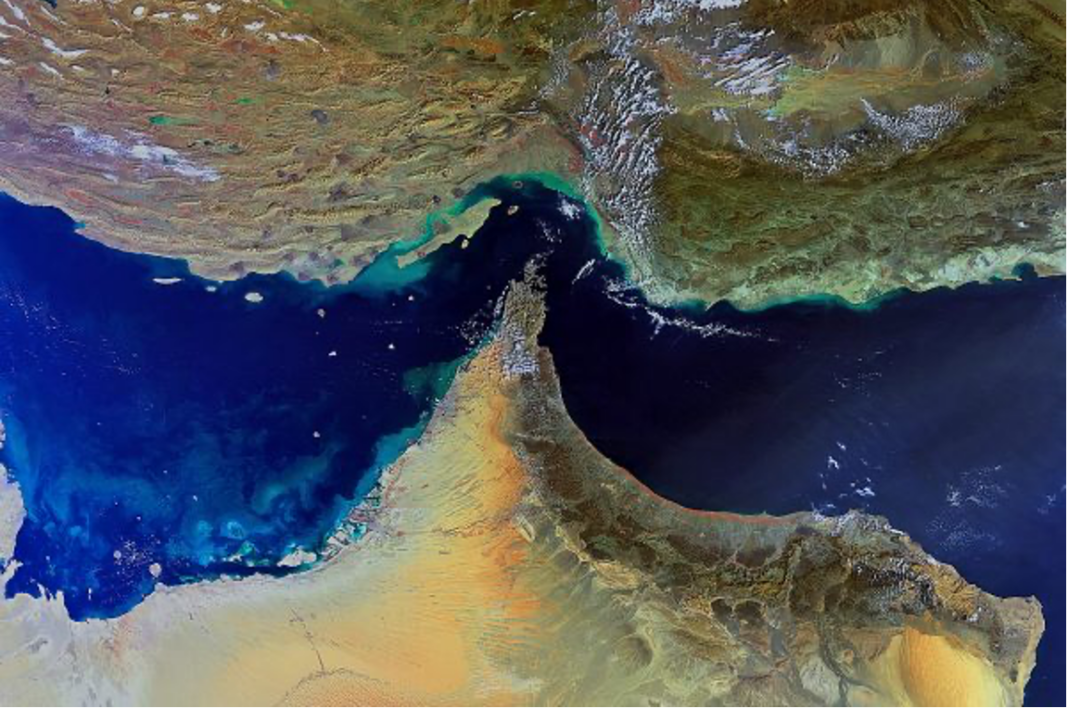
The Strait of Hormuz has once again become the subject of international attention. As tensions in the Middle East continue to rise, concerns over the security and accessibility of this narrow waterway have also increased. The Strait is not simply a geographical feature. It is one of the world’s most important maritime routes, connecting the Persian Gulf with the Gulf of Oman and the wider Indian Ocean. Any serious disruption to navigation through it can have consequences far beyond the region. This raises an important legal question. Can Iran, as one of the states bordering the Strait, restrict passage or require vessels to pay a charge for using it?
The answer under international law is not entirely straightforward. It requires a careful balance between two competing principles. On one side is the sovereignty and security of a coastal state. On the other is the international community’s interest in freedom of navigation.
The legal starting point is the United Nations Convention on the Law of the Sea, commonly known as UNCLOS. The Convention establishes a special regime for straits used for international navigation. Under Articles 37 and 38, ships and aircraft enjoy the right of transit passage through such straits. This right is particularly important because it allows international navigation to continue between one part of the high seas or exclusive economic zone and another. Transit passage is not supposed to be suspended or unnecessarily impeded by the states bordering the strait.
The Strait of Hormuz is widely regarded as falling within this category. Its international importance and the volume of shipping that passes through it make it difficult to view it simply as ordinary territorial waters subject to unrestricted coastal control. However, one important legal complication must be acknowledged. Iran signed UNCLOS in 1982 but has not ratified it. Therefore, Iran is not bound by the Convention as a state party in the same manner as states that have ratified it. This does not, however, mean that UNCLOS is irrelevant to the legal debate. Some of its provisions reflect customary international law, while others remain matters of treaty obligation between states parties. The precise customary status of individual provisions therefore matters.
Iran has also historically expressed reservations about aspects of the Convention’s regime concerning international straits. Its position reflects a broader concern that the rights of coastal states should not be overlooked in favour of the interests of powerful maritime states.
This is an important perspective to consider. The Strait of Hormuz lies immediately adjacent to Iranian territory. Iran has legitimate security concerns in a region where foreign military forces have maintained a significant presence for decades. From Iran’s perspective, the Strait is not merely a commercial route. It is also part of a sensitive security environment. International law cannot simply disregard these realities. At the same time, sovereignty over territorial waters does not give a coastal state unlimited authority to control international navigation. The law of the sea has always attempted to strike a balance between coastal sovereignty and the wider interests of the international community.
The question of charging vessels illustrates this balance particularly well. There is a significant legal difference between imposing a mandatory toll simply for the right to pass through a maritime strait and charging for a specific service provided to a vessel. The latter may be legally defensible in certain circumstances. The former is much more difficult to justify.
Article 26 of UNCLOS, although formally part of the regime governing innocent passage, reflects an important principle: a coastal state should not impose a charge on a foreign ship merely because it passes through its territorial sea. Charges may instead be connected to specific services provided to the ship. While the direct application of this provision to the transit passage regime and to Iran’s legal position requires careful consideration, the underlying distinction remains relevant.
In practical terms, there is a difference between saying, “You must pay because you are passing through these waters,” and saying, “You must pay for a specific maritime service that we provide.” International law is much more comfortable with the second situation than the first. Therefore, if Iran were to impose a general compulsory toll on every vessel simply for using the Strait of Hormuz, it would face serious legal difficulties. Such a measure could be seen as interfering with the broader principle of international navigation. If, however, a charge was genuinely connected to a specific service, such as navigational assistance or another identifiable maritime facility, the legal analysis would be different.
The purpose and practical effect of the charge would therefore be critical. The same distinction applies to restrictions on passage. Iran may have legitimate authority to regulate navigation for reasons such as maritime safety, environmental protection or the prevention of unlawful activities. International law does not require coastal states to abandon all regulatory powers simply because a waterway is internationally important.
The difficulty arises when regulation becomes an effective restriction on navigation. A measure that genuinely improves maritime safety is legally different from one designed to prevent particular states or categories of vessels from exercising their navigation rights. International law therefore requires a close examination of the actual purpose and effect of any restriction.
The present circumstances make the issue even more complicated because the region is experiencing heightened military tensions. If an international armed conflict exists, the legal analysis may extend beyond the ordinary law of the sea to the law of naval warfare and international humanitarian law.
In an armed conflict, states may have greater legal authority to take measures against enemy vessels in certain circumstances. But this does not mean that every commercial vessel becomes a legitimate target or that a state can simply close an international strait without regard to international law.
The status of the vessel becomes important. A military vessel belonging to a party to an armed conflict is legally different from a neutral commercial tanker carrying civilian cargo. Any military action against shipping must be assessed under the applicable rules governing armed conflict, including the principles of distinction and proportionality. This is why the present debate should not be reduced to a simple question of whether Iran can “close Hormuz”. The legal position depends on the circumstances, the nature of the measure, the status of the vessel and the existence of an armed conflict. There is also a broader point that deserves attention. Freedom of navigation should not be used selectively.
If Iran’s actions are assessed under international law, the actions of other states operating in or around the Strait should also be assessed by the same legal standards. The principle of freedom of navigation does not give any state an automatic licence to use military force. Any military operation must comply with the United Nations Charter and other applicable rules of international law.
This is where a balanced approach becomes essential. Iran cannot simply rely on its geographical position to claim an unlimited right to control international navigation. At the same time, other states cannot ignore Iran’s legitimate security concerns or assume that every disagreement over maritime access can be resolved through military pressure. The law seeks a middle ground.
In my assessment, Iran may face significant legal difficulties in claiming a general right to impose a mandatory toll simply for passage through the Strait of Hormuz. The stronger interpretation of international maritime law is that international navigation through a strait used for international navigation should not be made conditional upon such a payment. However, this does not necessarily rule out every form of maritime charge or regulation. Genuine service fees and reasonable safety-related measures raise different legal questions.
The issue of restrictions is similarly context-dependent. In peacetime, broad restrictions that effectively prevent international navigation would be difficult to reconcile with the principles governing international straits. During armed conflict, however, the law of naval warfare may permit certain measures in relation to enemy shipping, subject to strict legal limitations. The Strait of Hormuz therefore represents a delicate balance between national sovereignty and international interests. Iran has legitimate interests in protecting its security and regulating activities near its territory. Other states have legitimate interests in ensuring that international maritime routes remain open and secure.
International law recognises both interests.
The real challenge is ensuring that neither principle is treated as absolute. Iran’s sovereignty does not automatically give it an unrestricted right to turn an international maritime chokepoint into a pay-for-passage route. Equally, the importance of freedom of navigation does not erase the rights and security concerns of the coastal state. The legal question surrounding Hormuz is therefore not simply whether Iran can control the Strait. It is about the limits of that control under international law. For now, the strongest legal position appears to be that Iran cannot lawfully impose a general mandatory toll merely as the price of international passage. But any specific measure must be examined on its own terms. Its purpose, legal basis and practical effect all matter.
The Strait of Hormuz remains a powerful reminder that international law often operates in the space between competing interests. Its purpose is not to give one side everything it wants. It is to establish rules that allow sovereignty, security and international navigation to coexist. That balance will be tested again as tensions in the region develop. How the international community responds will have implications not only for Iran and its neighbours, but also for the future interpretation of freedom of navigation in strategically important maritime straits around the world.
About the Author:
Ayesha Asim is a legal academic, legal analyst, and PhD scholar in law. She holds an LLM in International Law (Gold Medal) and has experience in legal research, teaching, and advisory work. Her interests include international law, humanitarian issues, and other contemporary legal challenges. You can reach her at ayeshamalyc09@gmail.com